
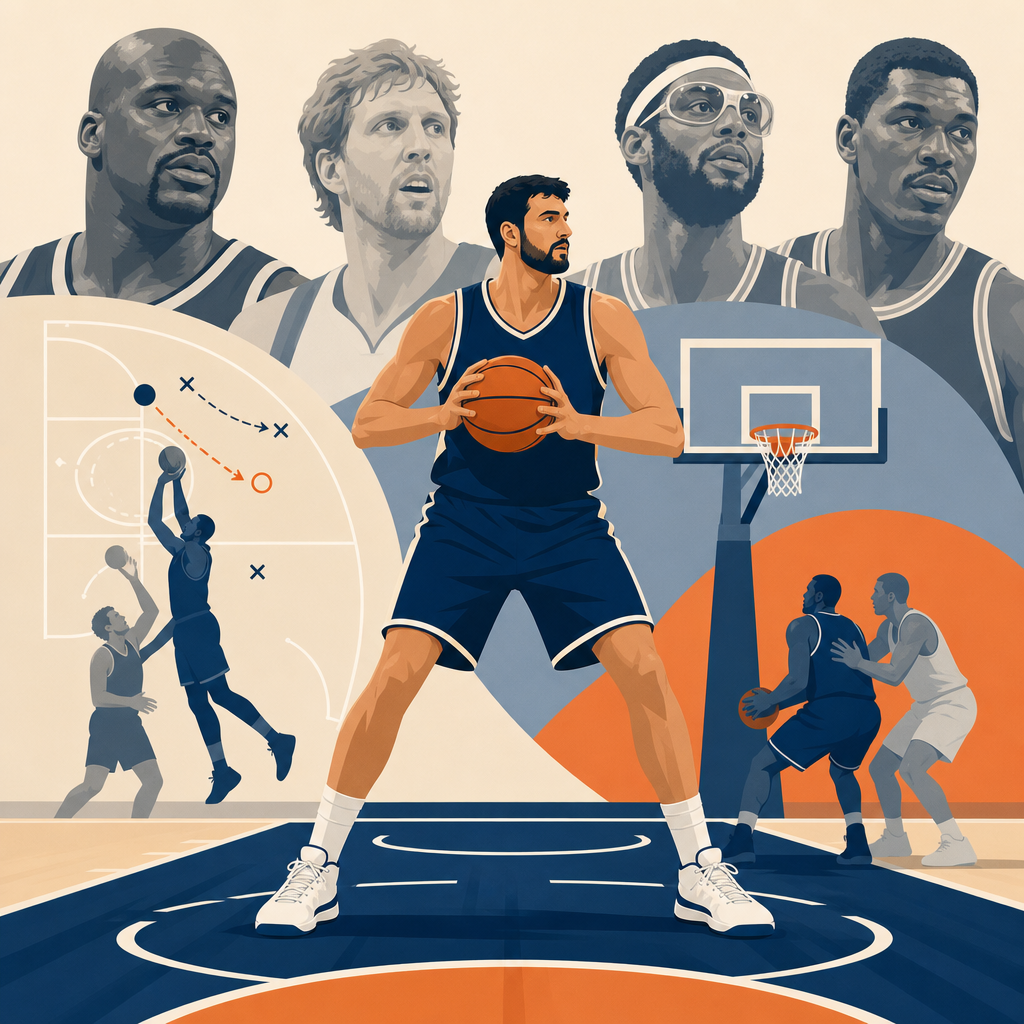
The center position in basketball sits at the physical and tactical heart of the game. Traditionally, the center is the tallest player on the floor, stationed near the rim on both ends, responsible for rebounding, interior scoring, rim protection, and setting the tone for physical play. In modern basketball, that job description has expanded. Today’s centers may still anchor the paint, but many also initiate offense from the elbow, switch onto guards, space the floor with three-point shooting, and act as defensive quarterbacks who organize coverages in real time.
Within the broader NBA Basics conversation, understanding the center is essential because every other position is shaped by what the big man can or cannot do. Guards attack differently depending on whether they have a lob threat behind the defense. Forwards defend differently depending on whether their center can contain dribble penetration. Coaches build systems around the strengths of their centers, whether that means post-heavy offense, spread pick-and-roll, five-out spacing, or a drop-coverage defense designed to protect the rim.
When I explain positions and roles to new fans, I start with a simple principle: the center influences the highest-value areas on the court. Basketball analytics have made this clearer than ever. Shots at the rim are usually the most efficient attempts, and centers affect both sides of that equation. Offensively, they create layups, dunks, put-backs, and free throws. Defensively, they contest those same attempts and end possessions with rebounds. That is why elite centers have remained valuable across every era, even as style, pace, and spacing have changed dramatically.
This hub article covers the center position comprehensively as part of the positions and roles subtopic. It explains core duties, offensive and defensive responsibilities, how the position has evolved, what skills separate average centers from great ones, and which players define the standard historically. If you want to understand how basketball functions structurally, start here: the center position is where size, timing, discipline, and decision-making meet.
What a center does on offense
The most basic offensive duty of a center is to create pressure near the basket. That can happen through post-ups, rolls to the rim, offensive rebounds, duck-ins, cuts, and screen assists. A classic low-post center establishes deep position with leverage, catches the ball close to the block, and scores with jump hooks, drop steps, up-and-unders, or power finishes. Think of Hakeem Olajuwon on the left block, using footwork and counters, or Shaquille O’Neal sealing defenders under the rim and finishing through contact.
In today’s NBA, the center’s offensive role often begins with screening. Ball screens are central to modern offense, and a center who sets wide, legal, well-angled picks can unlock an entire playbook. After contact, the center may roll hard for a dunk, short roll into open space to make a pass, or pop to the perimeter if he can shoot. Nikola Jokic is the clearest modern example of how a center can function as an offensive hub. He screens, reads help defenders instantly, finds cutters, punishes single coverage in the post, and turns the high elbow into a playmaking station.
Rim gravity is another essential concept. Even without touching the ball, a center who is a constant lob threat forces weak-side defenders to tag the roll man, which opens corner threes and driving lanes. Clint Capela has made a career from this kind of vertical spacing. By sprinting into screens and diving hard, he bends defenses enough to create opportunities for ball handlers and shooters.
Good centers also generate extra possessions. Offensive rebounds are not only about raw size; they are about anticipation, hand strength, and timing. Moses Malone built Hall of Fame value from relentless work on the glass, often turning missed shots into immediate put-backs or reset possessions. For younger fans learning positions and roles, this is important: a center does not need twenty post touches to impact offense. Screening, rolling, sealing, passing, and rebounding can be just as valuable.
What a center does on defense
Defense is where the center’s influence is most direct. The center protects the rim, controls the defensive glass, and organizes the back line. In practical terms, that means meeting drivers at the basket without fouling, contesting shots vertically, calling out screens, directing teammates into the correct help positions, and ending possessions with secure rebounds. If the point guard is the offense’s primary organizer, the center is often the defense’s final decision-maker.
Rim protection is not simply blocking shots. Many of the best defensive centers change attempts before the ball leaves the shooter’s hand. They show chest position early, maintain legal verticality, and force players into floaters, off-balance finishes, or kick-out passes. Rudy Gobert exemplifies this impact. Even when he does not record a block, his length and positioning discourage drives and lower shot quality near the rim.
Pick-and-roll defense is the most demanding recurring task for modern centers. Coaches ask centers to play different coverages depending on personnel and scheme: drop, hedge, blitz, show, switch, or play at the level. Brook Lopez has been elite in drop coverage, staying deep enough to protect the rim while still contesting pull-up lanes with size. Bam Adebayo, though undersized for a traditional center, is exceptional because he can switch onto guards and survive in space while still providing interior help.
Defensive rebounding completes the job. A strong contest means little if the offense gets a second chance. Great centers box out first, pursue second, and understand where shots are likely to come off the rim. Tim Duncan, often listed as a power forward but functionally a center for large parts of his career, mastered this. He controlled space, secured rebounds with two hands, and triggered transition by making clean outlet passes.
Core center skills and how teams evaluate them
NBA teams evaluate centers through a mix of measurable traits and functional skills. Height and wingspan matter, but they are not enough. The most useful framework is to ask whether a center can finish, defend, rebound, process quickly, and stay playable across matchups. A seven-footer who cannot defend pick-and-roll or catch in traffic becomes difficult to trust late in games.
Hands are a major separator. Coaches notice immediately whether a center can catch pocket passes, corral rebounds in traffic, and finish through contact. Screening is another undervalued skill. A center who slips too early or never makes real contact will not create advantages. Footwork matters on both ends, especially for post defense, drop steps, pivots, and recovery angles.
Passing has become a premium skill. Teams now value centers who can make reads from the short roll, hit weak-side shooters, or deliver dribble handoffs. Domantas Sabonis is a strong example. His scoring and rebounding matter, but his ability to trigger offense through handoff actions and interior passing gives Sacramento structure. Shooting also changes lineup flexibility. A center who can space to the arc pulls a rim protector away from the basket, opening lanes for slashers.
| Center skill | Why it matters | Player example |
|---|---|---|
| Rim protection | Prevents efficient shots at the basket and anchors team defense | Rudy Gobert |
| Post scoring | Punishes switches and single coverage in half-court offense | Hakeem Olajuwon |
| Screen setting | Creates separation for guards and opens roll or pop actions | Steven Adams |
| Playmaking | Turns the center into an offensive hub, especially from the elbow | Nikola Jokic |
| Floor spacing | Pulls defenders out of the paint and improves driving lanes | Brook Lopez |
| Rebounding | Ends defensive possessions and creates second chances on offense | Moses Malone |
Scouting also considers stamina, foul discipline, and role acceptance. Some centers produce in short bursts but cannot stay on the floor because of conditioning or repeated foul trouble. Others are individually talented yet undermine spacing or defensive structure by chasing the wrong actions. The best centers combine size with repeatable habits, and coaches trust them because their decisions hold up under playoff pressure.
How the center position has changed across eras
The center was once the default franchise position. In earlier NBA eras, offenses were often built through the post because size was scarce and rules, spacing, and roster construction favored interior play. George Mikan established the idea of a dominant big man as a championship centerpiece. Bill Russell redefined defense and winning through rim protection, rebounding, and leadership. Wilt Chamberlain expanded the limits of volume scoring and statistical dominance. Kareem Abdul-Jabbar then perfected the most reliable post weapon in league history, the skyhook.
By the 1990s, the league still revolved around elite big men. Olajuwon, David Robinson, Patrick Ewing, and O’Neal were foundational stars, and teams needed size simply to survive playoff basketball. But the 2000s and 2010s brought major shifts. Hand-checking changes, increased three-point volume, pace-and-space systems, and more sophisticated pick-and-roll attacks forced centers to cover more ground and fit into more open offensive environments.
This did not make centers obsolete. It changed the requirements. Traditional back-to-the-basket specialists who could not defend in space became harder to build around. At the same time, versatile centers gained value. Marc Gasol offered passing, positioning, and defensive intelligence. Draymond Green, though not a conventional center physically, showed how a smaller player could anchor elite defenses with communication, switching, and anticipation. Jokic has pushed the position further by becoming a primary offensive engine, while Joel Embiid represents a different modern path: a dominant interior scorer who also faces up, draws fouls, and shoots from range.
The position now includes multiple archetypes rather than one template. Some teams want a vertical spacer and shot blocker. Others want a stretch five. Others want a playmaking hub. Understanding positions and roles means recognizing that “center” describes where the player affects the game most, not a single rigid style.
The all-time greatest centers and why they rank so highly
Any serious list of the greatest centers begins with Kareem Abdul-Jabbar, Bill Russell, Wilt Chamberlain, Shaquille O’Neal, and Hakeem Olajuwon. Kareem combined unmatched longevity, six MVP awards, six championships, elite scoring efficiency for his era, and a signature move that remained nearly unguardable. Russell’s case rests on defense, rebounding, leadership, and team success; his eleven championships are inseparable from his genius as a rim protector and organizer. Chamberlain remains one of the sport’s great outliers, pairing enormous scoring with historic rebounding and durability.
O’Neal is the most overwhelming interior force many coaches and players have ever faced. At his peak, he collapsed entire defenses, generated fouls at huge volume, and controlled playoff series with raw power. Olajuwon, meanwhile, may be the most complete two-way center ever. He offered elite post scoring, exceptional footwork, advanced passing reads, and high-level rim protection. His 1994 and 1995 title runs remain a masterclass in center-led basketball.
The next tier is also crowded with greatness. Moses Malone dominated the glass and punished defenses through effort and strength. David Robinson blended athleticism, defense, and efficient scoring. Patrick Ewing gave teams elite rim protection and reliable offense for years. Robinson and Ewing are sometimes overshadowed by their era’s depth at the position, but both were franchise anchors by any historical standard.
Modern rankings now require a serious Jokic discussion. He has already altered how analysts think about the center position because his playmaking is not merely good for a big man; it is historically elite by any positional standard. If his production and postseason résumé continue to grow, he will move into the highest tier. That is the central truth about great centers across eras: their methods differ, but they all control the game where it matters most, at the rim, on the glass, and in the decisions that shape every possession.
The center position remains one of basketball’s clearest windows into how the sport works. It combines visible tasks such as rebounding, shot blocking, and post scoring with less obvious responsibilities like screen angles, help timing, paint communication, and spacing pressure. For anyone learning NBA positions and roles, the center is the ideal study because the position touches offense, defense, lineup construction, and game strategy all at once.
The all-time greatest centers earned that status in different ways, but the pattern is consistent. They dominated efficient scoring areas, protected the rim, controlled possessions through rebounding, and gave coaches a dependable structure on both ends. Russell and Chamberlain shaped the early league. Kareem sustained excellence longer than almost anyone. Olajuwon and O’Neal defined different forms of peak dominance. Jokic shows that the position still evolves.
If you are building your understanding of NBA Basics, use this article as your hub for the positions and roles subtopic. Watch how centers screen, rotate, seal, box out, and direct teammates, not just how many points they score. The more closely you follow the center position, the faster the rest of basketball starts to make sense.
Frequently Asked Questions
What does the center position do in basketball?
The center is traditionally the backbone of a basketball team. On offense, centers often operate near the basket, where their size, strength, and touch make them valuable scorers in the post, on put-backs, and as finishers in pick-and-roll actions. They also set screens to free up guards and wings, creating driving lanes and open jump shots. In many systems, the center’s ability to seal defenders, draw help in the paint, and convert high-percentage chances can shape the entire offense.
Defensively, the center usually serves as the last line of protection around the rim. That means contesting shots, blocking attempts, altering drives, and controlling the defensive glass to end possessions. A great center also communicates constantly, calling out screens, directing teammates into the right spots, and organizing the defense from behind the play. Even when they do not record a block, elite centers influence opponents simply by being in the paint and forcing tougher shots.
In today’s game, the job goes well beyond size and interior play. Modern centers may facilitate from the high post, dribble into handoff actions, switch onto smaller players, and even stretch defenses with three-point shooting. The position has evolved from a mostly paint-bound role into one that blends physical presence, basketball IQ, mobility, and versatility. At every level, though, the core duties remain the same: protect the rim, rebound, set solid screens, and provide stability on both ends.
How has the role of the center changed in modern basketball?
The biggest change is that centers are no longer expected to play only with their back to the basket. In earlier eras, many teams built their offense around traditional low-post scoring, with centers catching the ball on the block and powering through defenders. That skill still matters, but the modern game places much more emphasis on spacing, pace, and defensive versatility. As a result, today’s centers often need to be comfortable operating in multiple areas of the floor rather than living exclusively in the paint.
Offensively, many modern centers are asked to pass from the elbow, run dribble handoffs, and make quick reads when defenses collapse. Some can also shoot from mid-range or beyond the arc, which pulls opposing big men away from the basket and opens the floor for teammates. This kind of floor spacing has become a major asset, especially in systems built around drive-and-kick offense. A center who can both screen and shoot creates difficult choices for defenses.
Defensively, the change is just as dramatic. Instead of simply dropping back near the rim on every possession, many centers now have to hedge screens, recover quickly, and sometimes switch onto guards in space. That demands more lateral mobility and stronger conditioning than the position required in many previous decades. The best modern centers combine classic strengths like rebounding and rim protection with contemporary skills such as playmaking, perimeter awareness, and positional flexibility. In short, the center has gone from a narrowly defined interior role to one of the most strategically complex positions in basketball.
What skills make a great center at any level of basketball?
Rebounding is one of the most essential skills for any center. A great center does not just rely on height; they understand positioning, timing, leverage, and how to box out consistently. Securing rebounds on both ends can completely change a game by creating second-chance opportunities for one team and denying them for the other. Strong hands, good anticipation, and a willingness to be physical are all crucial here.
Rim protection is another defining trait. Great centers know when to challenge a shot, when to stay vertical, and how to avoid unnecessary fouls. They also understand angles and help defense, arriving in the right place before the play fully develops. This requires more than raw athleticism. It takes discipline, timing, and the awareness to read ball handlers, cutters, and weak-side action. The best shot blockers are often the best paint defenders because they alter decisions as much as they block attempts.
On offense, touch around the basket, screening, and decision-making are vital. A center who sets strong, legal screens helps create the framework for the entire offense. Finishing through contact, making quick passes out of double teams, and understanding spacing all separate effective centers from limited ones. Increasingly, footwork, passing, and even shooting range matter too. At higher levels, communication and leadership are also major skills. Because centers are often positioned near the action defensively and involved in screening actions offensively, they play a key role in keeping teammates organized and connected throughout the game.
Who are considered the greatest centers in basketball history?
Any serious conversation about the greatest centers of all time usually starts with a handful of legendary names: Kareem Abdul-Jabbar, Bill Russell, Wilt Chamberlain, Shaquille O’Neal, and Hakeem Olajuwon. Kareem combined longevity, skill, winning, and unstoppable scoring with his signature skyhook, making him one of the most accomplished players in basketball history. Russell redefined defense, rebounding, and leadership, anchoring a dynasty and setting the standard for team-first excellence at the position. Chamberlain brought overwhelming physical dominance and statistical production that still seems almost unbelievable decades later.
Shaquille O’Neal is often cited as the most physically dominant center ever, especially at his peak, when he controlled games through power, touch, and sheer force around the rim. Hakeem Olajuwon added a different kind of greatness, blending elite footwork, defensive brilliance, shot blocking, and offensive skill into one of the most complete center profiles the sport has seen. Moses Malone also deserves mention for his relentless rebounding and scoring, while David Robinson brought elite athleticism, defense, and two-way consistency.
In more recent eras, players like Tim Duncan are sometimes included in center discussions depending on how positions are classified, while Nikola Jokić has transformed expectations for the role with historic playmaking, efficiency, and offensive orchestration. Patrick Ewing, George Mikan, Willis Reed, and Dwight Howard also have strong historical cases depending on whether the focus is peak dominance, championship impact, or all-around influence. Ultimately, the answer depends on the criteria being used—titles, individual awards, longevity, peak performance, or stylistic innovation—but the all-time great centers are united by one thing: they did not just fill the position, they defined eras of basketball through it.
Why is the center position still so important even in a guard-driven era?
Even though perimeter scoring and three-point shooting dominate much of the modern game, the center remains critical because basketball still revolves around controlling the most valuable areas of the floor. The basket, the paint, and the defensive glass are as important as ever. A center who can protect the rim changes how opponents attack. Teams may take more outside shots today, but nearly every defense still depends on having someone who can anchor the middle, clean up mistakes, and secure rebounds after contests.
Centers also influence offense in ways that do not always show up fully in box scores. Screening creates separation for ball handlers, rolls to the basket collapse defenses, and offensive rebounding extends possessions. If a center can pass, shoot, or handle the ball, their value increases even more by making the offense less predictable. Many of the best teams in the world rely on centers to connect actions rather than simply finish them. That connective role can be just as important as scoring itself.
The position is especially valuable in the postseason, when games slow down and teams hunt weaknesses. A center who cannot defend in space or punish smaller lineups can become a target, but a complete center can swing an entire series. That is why elite big men are still so prized. No matter how much the game evolves, teams still need size, rebounding, interior defense, and reliable structure. The modern center may look different from the traditional version, but the importance of the role has not disappeared. It has simply become broader, more demanding, and in many ways more influential than ever.