
NBA player fashion has evolved from a tightly policed workplace uniform into one of the league’s most visible cultural stages, and that shift tells a larger story about labor, celebrity, branding, race, masculinity, and media. In the broadest sense, NBA player fashion means the clothing, accessories, grooming, footwear, and styling choices players use in team settings, travel, public appearances, and especially the arena tunnel. “Tunnel fits” refers to the outfit a player wears while arriving at the arena, now photographed, filmed, dissected, and monetized like a red carpet look. As someone who has covered league style cycles for years, I have watched this category move from a side note in game broadcasts to a standalone content machine that influences shopping behavior, endorsement strategy, and even how fans understand player identity.
The topic matters because NBA style is no longer superficial decoration around basketball. It is part of the business of the league and part of the cultural vocabulary of modern sports. Apparel brands build campaigns around players before they ever step onto the floor. Teams hire photographers to capture arrivals. Media outlets rank weekly fits. Players launch clothing lines, become ambassadors for luxury houses, and use fashion to communicate hometown pride, political values, gender expression, or simple competitive swagger. What used to be framed as a distraction is now recognized as image management, entrepreneurship, and creative authorship. To understand current NBA culture, you have to understand how fashion became one of its most public languages.
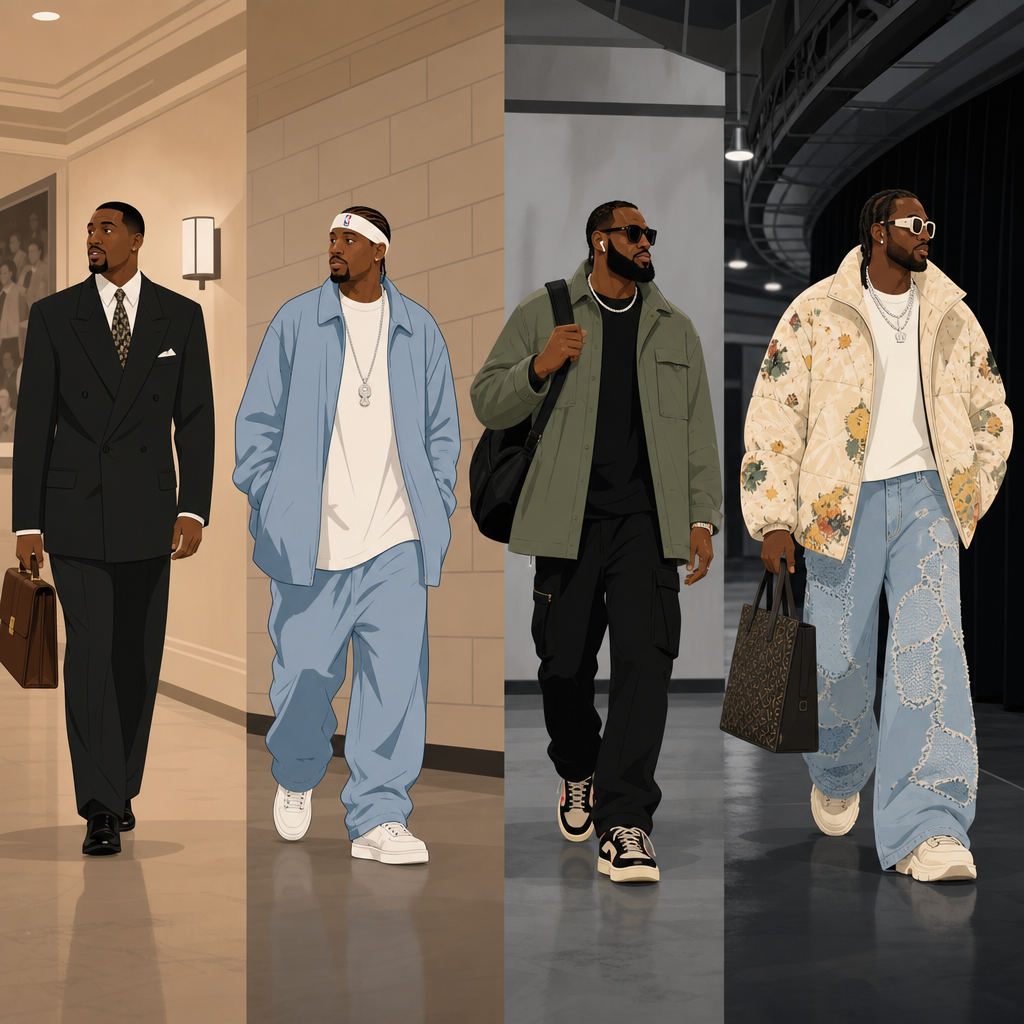
Three terms help define the arc. The “dress code era” usually refers to the period after the NBA instituted a business-casual policy in 2005 under commissioner David Stern, requiring players to wear sport coats, dress shoes, sweaters, dress shirts, or conservative attire while on team or league business. “League fits” describes the broader style ecosystem around players, including postgame outfits, travel wardrobes, and brand partnerships. “Tunnel fits” is the social-media-era expression of that ecosystem, where arrival clothing is treated as editorial content. This hub article covers gear and style across that whole spectrum, from the Allen Iverson flashpoint to the tailored experimentation of Russell Westbrook, the luxury minimalism of LeBron James, the designer-athlete partnerships of Shai Gilgeous-Alexander, and the stylist-driven image strategies that define today’s league.
The Dress Code Era and Why It Changed the Conversation
When the NBA announced its dress code in 2005, the official rationale centered on professionalism and league image. The rules banned chains worn outside clothing, sleeveless shirts, T-shirts, jerseys, Timberland-style boots, sunglasses indoors, headphones while walking to the bench, and headwear such as caps or do-rags on team business. Jackets, collared shirts, turtlenecks, loafers, and dress slacks were encouraged. On paper, this looked like standard corporate presentation policy. In practice, it became a cultural flashpoint because many fans and players understood the code as a response to a specific aesthetic associated with hip-hop, Black streetwear, and the post-1990s NBA generation.
Allen Iverson became the symbolic center of the debate, even though the policy affected the whole league. Iverson had already transformed athlete style through tattoos, cornrows, oversized denim, throwback jerseys, diamond chains, and unapologetic alignment with rap culture. Stern’s policy was not written with Iverson’s name on it, but the public conversation often treated him as the reason it existed. That framing mattered. It turned clothing into a referendum on respectability and sent a message that self-presentation linked to Black urban style was incompatible with the league’s preferred commercial image. Players complied, but many did so while openly criticizing the assumptions behind the rules.
The dress code still changed fashion history in a less obvious way: it forced players to engage with tailoring, suiting, luxury retail, and personal styling at a new level. Some leaned into the policy reluctantly. Others turned constraint into competition. Instead of simply suppressing expression, the code redirected it. Players began distinguishing themselves through lapel width, shoe choice, fit, fabric, watch selection, eyewear, and made-to-measure details. The league office wanted order; the players eventually found a new arena for individuality within that order. That tension laid the groundwork for the modern NBA fashion economy.
How Players Turned Compliance Into Personal Style
By the late 2000s and early 2010s, the most style-aware NBA players had moved beyond basic compliance. They were not just wearing suits because they had to. They were using menswear as self-branding. LeBron James embraced clean tailoring, slim trousers, pocket squares, luxury luggage, and coordinated team travel wardrobes that projected executive authority. Dwyane Wade became a fashion week regular, partnering with brands and wearing cropped trousers, bold frames, patterned jackets, and experimental color palettes that pushed traditional athlete dress into editorial territory. Amar’e Stoudemire explored bespoke suiting and eventually worked within fashion businesses himself. Chris Paul refined the polished point guard aesthetic: structured, conservative, expensive, and camera-ready.
What changed was the rise of intention. Stylists, custom clothiers, and showroom relationships entered the process. Players learned the difference between off-the-rack and made-to-measure, between a fused jacket and a canvassed one, between trend chasing and silhouette control. In coverage I have edited over the years, the clearest inflection point was when pregame entrances started being discussed with the same seriousness as postgame stat lines. A navy suit was no longer just a navy suit if the trousers had a cropped break, the knit tie softened the formality, and the sneakers signaled a bridge between luxury and sport.
This phase also made NBA fashion more legible to sponsors. A player with a consistent visual identity could attract watch brands, luggage companies, retailers, eyewear labels, or fashion houses beyond the traditional sneaker ecosystem. Style became marketable because it became repeatable. That repeatability is central to how the league’s gear-and-style culture now operates.
The Social Media Shift That Created Tunnel Fits
Today’s tunnel fit culture would not exist at its current scale without Instagram, X, TikTok, Getty Images distribution, and team-owned content operations. Once every arrival became photographable, searchable, shareable, and rankable, the tunnel turned into a runway with built-in audiences. The geometry is simple: players walk a predictable route, photographers know where to stand, brands know what can be seen, and fans are conditioned to treat the image as part of the game-day package. A fit worn for three minutes can generate millions of impressions.
Russell Westbrook was one of the decisive bridge figures in this era. He treated arrivals as conceptual styling opportunities, wearing oversized proportions, kilt-inspired layers, workers’ uniforms, distressed denim, lens-heavy eyewear, and gender-challenging garments long before that became common athlete behavior. He did not just wear clothes; he used fashion to provoke reaction. That mattered because it widened the boundaries of acceptable athlete presentation. Soon after, players like Kyle Kuzma, P.J. Tucker, Jordan Clarkson, Kelly Oubre Jr., and Shai Gilgeous-Alexander each carved out distinct lanes, from avant-garde layering to luxury streetwear to archival sneakers and high-fashion minimalism.
Tunnel fits also changed fashion journalism around basketball. Coverage became episodic and visual. Instead of broad seasonal trend pieces alone, outlets now publish nightly galleries, power rankings, and close reads of accessories, bags, and jewelry. The image itself does analytical work. A fan can instantly understand whether a player is channeling classic tailoring, Japanese streetwear, workwear, Paris luxury, Y2K revival, or post-gender fashion. The tunnel became a compressed storytelling format.
The Core Style Archetypes in Modern NBA Fashion
Although individual expression drives the scene, most NBA player fashion falls into a handful of recognizable archetypes. Understanding them helps explain how this subculture works and why certain players resonate more strongly with certain audiences, brands, and media formats.
| Archetype | Key Features | Representative Players | Why It Works |
|---|---|---|---|
| Executive Tailoring | Sharp suiting, luxury basics, restrained color, premium leather goods | LeBron James, Chris Paul | Signals authority, longevity, and sponsor-friendly polish |
| Fashion Experimentalist | Oversized shapes, unexpected fabrics, skirts or kilts, directional accessories | Russell Westbrook | Creates conversation and positions the player as a tastemaker |
| Luxury Streetwear | Designer hoodies, varsity jackets, cargo pants, statement sneakers, logos | Kyle Kuzma, Jordan Clarkson | Connects directly to younger consumers and hype-driven markets |
| Minimalist Luxury | Monochrome palettes, precise fit, quiet labels, strong outerwear | Shai Gilgeous-Alexander | Photographs cleanly and aligns with current high-fashion tastes |
| Sneaker Archivist | Rare shoes, player exclusives, deep cut retros, outfit built around footwear | P.J. Tucker | Earns credibility with collectors and sneaker media |
These categories overlap, and many players move between them. The point is not to force a label but to recognize that NBA style has matured into a set of readable visual strategies. Each strategy supports a different kind of personal brand.
Gear Beyond Clothes: Sneakers, Jewelry, Grooming, and Bags
Fashion in the NBA is inseparable from gear. Sneakers remain the foundation because basketball culture still revolves around footwear more than any other product category. Player exclusives, pregame lifestyle pairs, and vintage grails all carry meaning. P.J. Tucker’s reputation, for example, was built partly on wearing ultra-rare Kobes, Yeezys, and deadstock heat before games, making him a bridge between NBA style and sneaker collecting culture. Even players without signature shoes can sharpen their fashion reputation through disciplined sneaker selection that complements silhouette and color story rather than overpowering it.
Jewelry has become more refined than the oversized chain era that dress code critics often fixated on. Today’s players rotate watches from Rolex, Audemars Piguet, Cartier, and Patek Philippe; layered necklaces; diamond studs; and rings that function less as spectacle than as finishing elements. Bags matter too. Goyard totes, Louis Vuitton keepalls, Rimowa luggage, Bottega Veneta carryalls, and Prada nylon pieces all communicate status and aesthetic literacy. In many arrival photos, the bag is as intentional as the jacket.
Grooming is another underrated layer. Braids, twists, fades, beards, nail art, and skin-care presentation now read as integrated styling choices, not separate categories. When a player’s outfit is minimal, grooming often carries the visual texture. That integration is why comprehensive NBA gear and style coverage cannot stop at clothing racks alone.
Stylists, Brands, and the Business of NBA Image Making
Behind many of the league’s strongest looks is a professional ecosystem of stylists, tailors, publicists, brand reps, showroom managers, jewelers, and photographers. Some players style themselves, but even the most independent dressers usually work within networks that source samples, coordinate loans, manage returns, and negotiate campaign opportunities. A tunnel fit can serve multiple business goals at once: support a brand relationship, seed future press, test audience reaction, and reinforce the player’s personal narrative.
This business structure explains why NBA fashion now matters to companies far outside athletic apparel. Luxury houses want athlete ambassadors because players deliver global reach, cultural credibility, and repeat exposure over an 82-game season plus playoffs. Unlike actors during awards season, NBA stars generate frequent, scheduled red carpet moments. Shai Gilgeous-Alexander’s rise as a fashion figure illustrates the point. His combination of elite performance, distinctive proportions, and calm luxury styling made him attractive to brands looking for modern menswear relevance.
There are tradeoffs. Heavy brand integration can flatten individuality if every outfit starts looking like a campaign. The best-dressed players avoid that trap by preserving authorship. They wear the clothes instead of letting the clothes wear them.
Style, Identity, and the Broader Cultural Impact
NBA fashion now influences mainstream menswear more directly than any other North American team sport. The league’s demographics, global reach, music connections, and visual intimacy make it especially powerful. Fans borrow outfit formulas from players even when they cannot afford the exact pieces: wider trousers with a cropped hem, monochrome layering, varsity jackets with luxury bags, vintage tees under tailored overcoats, or loafers paired with relaxed suiting. Retailers notice. Social feeds accelerate imitation. Brands build product assortments around the silhouettes players normalize.
The impact is also social. Fashion gives players a public method for expressing nationality, religion, politics, sexuality-adjacent boundary pushing, and community ties without speaking in a press conference. During recent years, arrivals have included pieces from Black-owned brands, tributes to Kobe Bryant, garments referencing African tailoring traditions, and looks that challenge rigid expectations of masculinity. That does not mean every outfit carries a grand message. Sometimes a fit is simply playful. The important point is that the platform exists.
For a sub-pillar hub on NBA culture, the main takeaway is clear: gear and style is not a side category. It connects to sneakers, endorsements, media, social identity, merchandising, celebrity, and fan behavior. If you are building out deeper coverage, the most useful supporting topics include signature shoe histories, stylist profiles, best tunnel fits by season, the economics of player-brand partnerships, the role of team photographers, the influence of hip-hop and luxury fashion on league aesthetics, and how women in player styling and content production have shaped the modern look of NBA presentation.
From the dress code era to today’s tunnel fits, NBA player fashion has moved from regulation to authorship. The 2005 policy tried to standardize image, but it also pushed players into a more deliberate relationship with clothing. Over time, that discipline merged with social media, luxury branding, sneaker culture, and personal storytelling to create one of the richest style ecosystems in sports. The result is a league where arrivals matter, visual identity has commercial value, and fashion operates as both creative expression and strategic business tool.
The biggest lesson is that NBA style works best when it is specific. The players who define an era are not just wearing expensive items. They build recognizable aesthetics, understand proportion, choose gear with intent, and connect clothing to a broader sense of self. LeBron James projects executive control. Russell Westbrook uses experimentation to challenge convention. Shai Gilgeous-Alexander turns restraint into modern luxury. P.J. Tucker makes footwear expertise part of his brand. Different paths, same principle: style becomes influential when it is coherent and consistent.
For readers exploring NBA culture, this hub should be the starting point for everything in gear and style. Use it to trace the history, understand the archetypes, and identify the people and forces shaping what players wear now. Then go deeper into sneakers, stylists, brand deals, and season-by-season fit analysis. Watch the tunnel before tipoff, pay attention to the details, and you will see something important: in today’s NBA, fashion is not adjacent to the game. It is part of how the game is presented, marketed, and remembered.
Frequently Asked Questions
1. What changed NBA player fashion from a team-enforced dress standard into today’s tunnel fit culture?
The biggest change was that NBA style stopped being treated as a side issue and became part of how players are seen, marketed, and understood. In the mid-2000s, the league’s dress code pushed players toward a narrow version of business attire during official team activities, especially after concerns about image, professionalism, and league marketability. That policy reflected more than clothing preferences. It sat at the intersection of workplace control, race, public relations, and respectability politics, because many of the styles being discouraged were closely associated with Black youth culture and hip-hop fashion.
Over time, the media environment transformed. Social platforms, celebrity culture, athlete branding, and 24-hour visual coverage turned player arrivals into content. The arena tunnel effectively became a runway, and what had once been a regulated point of entry became one of the most photographed spaces in basketball. Players recognized that fashion could communicate personality, confidence, taste, cultural affiliation, and business ambition before they ever stepped on the floor. Instead of simply complying with a uniform idea of professionalism, they began using style to tell stories about themselves.
At the same time, the definition of professionalism expanded. Luxury fashion houses embraced athletes, stylists became more common, sneaker culture grew into a global economic force, and NBA stars gained more power as individual brands. In that environment, fashion evolved from a league image-management concern into a player-driven platform. Today’s tunnel fit culture exists because athletes now operate not only as employees of a team, but also as public figures, entrepreneurs, trendsetters, and media properties in their own right.
2. Why is the NBA dress code era still such an important part of the conversation about player style?
The dress code era matters because it provides the clearest example of how clothing in sports is never just about clothes. When the NBA introduced stricter business-casual requirements for players during team-related appearances, the move was framed as a professionalism measure. But many observers and players understood it as a cultural intervention aimed at reshaping the league’s public image by discouraging styles linked to hip-hop, streetwear, and Black self-expression. That is why the policy remains central to any serious discussion of NBA fashion history.
Looking back, the dress code highlights a tension that still exists in modern athlete style: who gets to define what looks appropriate, respectable, or marketable? The league wanted visual consistency and broader commercial appeal, while many players felt that personal style was being unfairly targeted and culturally coded. Even for people who supported the policy at the time, it is now easier to see that it reflected broader social anxieties about race, masculinity, class signaling, and media perception.
Its legacy also helps explain why tunnel fits now carry so much symbolic weight. Every bold look, designer collaboration, gender-fluid silhouette, or streetwear-luxury mix can be read as part of a larger shift away from imposed conformity and toward player autonomy. In other words, the dress code era is important not just because of what players were told to wear, but because it sharpened the meaning of fashion as a site of control, resistance, adaptation, and identity within the NBA.
3. What do tunnel fits say about labor, celebrity, and personal branding in the modern NBA?
Tunnel fits say that NBA players are no longer viewed only as athletes performing during the game; they are also public-facing brands whose visibility begins the moment they arrive at the arena. The tunnel has become a pregame media stage where clothing can generate headlines, social engagement, sponsor attention, and fashion-world credibility. That makes style part of the job in a modern sense, even if it is not officially listed in a contract. A memorable outfit can shape perception, reinforce a player’s image, and create value far beyond basketball performance.
From a labor perspective, this is significant because it shows how the work of being an NBA player now includes forms of image production. Players are expected to be camera-ready, socially legible, and commercially distinctive. Some lean into minimal tailoring, others into avant-garde fashion, vintage sportswear, luxury labels, or experimental accessories. Those choices are not random. They can signal seriousness, creativity, cultural fluency, aspirational status, or affiliation with certain designers and audiences. In many cases, the outfit is part of a larger ecosystem that includes endorsements, agency strategy, social media, and long-term post-career positioning.
Celebrity is the force that turns these looks into public events. A tunnel fit can circulate globally in minutes, be dissected by sports media and fashion media alike, and help place a player in conversations that go beyond points and rebounds. That crossover power is why tunnel fashion matters so much today. It sits at the meeting point of labor and lifestyle, where athletes are not just workers in a league structure but also authors of image, taste, and market identity.
4. How has NBA fashion reflected broader conversations about race, masculinity, and self-expression?
NBA fashion has long been tied to how Black masculinity is interpreted, policed, celebrated, and monetized in American culture. Because the league is made up largely of Black athletes, debates over what counts as acceptable style have often carried deeper assumptions about respectability, visibility, and threat. During the dress code era, certain looks were framed as unprofessional or undesirable in ways that many people saw as coded judgments about race and culture rather than neutral standards of appearance. That is one reason the topic remains so emotionally and politically charged.
As player fashion expanded, it also broadened public ideas about masculinity. Modern tunnel fits can include sharp tailoring, oversized silhouettes, jewelry, handbags, knitwear, unconventional color palettes, or pieces historically coded as feminine or nontraditional for male athletes. Not every player dresses in a boundary-pushing way, but the range itself matters. It shows that masculinity in the NBA is no longer expressed only through toughness, uniformity, or conservative dress. Players increasingly use fashion to present nuance, vulnerability, irony, artistry, and individuality alongside physical dominance and competitive intensity.
That evolution is culturally important because it gives players more room to define themselves on their own terms. Fashion becomes a language for resisting stereotypes, engaging with heritage, honoring community influences, or simply enjoying creativity in public. It also reveals a paradox: the same culture that once criticized athlete self-expression now often profits from it. Brands, broadcasters, and leagues all benefit from the visual energy players bring. So NBA fashion is not just a trend story. It is a window into who gets to be visible, who gets to be complex, and how style can challenge older assumptions about race and masculinity in sports.
5. Why do tunnel fits matter to fans, media, and the business of the NBA beyond simple style commentary?
Tunnel fits matter because they create an additional layer of engagement around the league. For fans, they offer another way to connect with players beyond statistics and highlights. A player’s fashion choices can make them feel more relatable, more aspirational, or more culturally relevant depending on the audience. Some fans follow tunnel fits as seriously as they follow sneaker drops or injury reports, because style has become part of the league’s week-to-week storytelling. It helps turn arrivals, road trips, and off-court moments into meaningful content.
For the media, tunnel fashion expands the NBA’s narrative ecosystem. It gives broadcasters, digital publishers, photographers, and social accounts a stream of visually compelling material that keeps the league in conversation all day, not just during games. This is especially valuable in an attention economy where every image can become a debate, a meme, a ranking, or a trend piece. The tunnel offers recurring moments that are easy to package and easy for audiences to share, which increases visibility for both players and the league.
From a business standpoint, the stakes are even larger. Fashion connects the NBA to luxury brands, sneaker companies, stylists, magazines, and new sponsorship opportunities. It helps players build independent commercial identities and gives the league access to audiences who may be interested in style, music, or celebrity culture as much as basketball itself. In that sense, tunnel fits are not superficial extras. They are part of the NBA’s modern entertainment infrastructure, where image, influence, and commerce are deeply intertwined with the sport.