
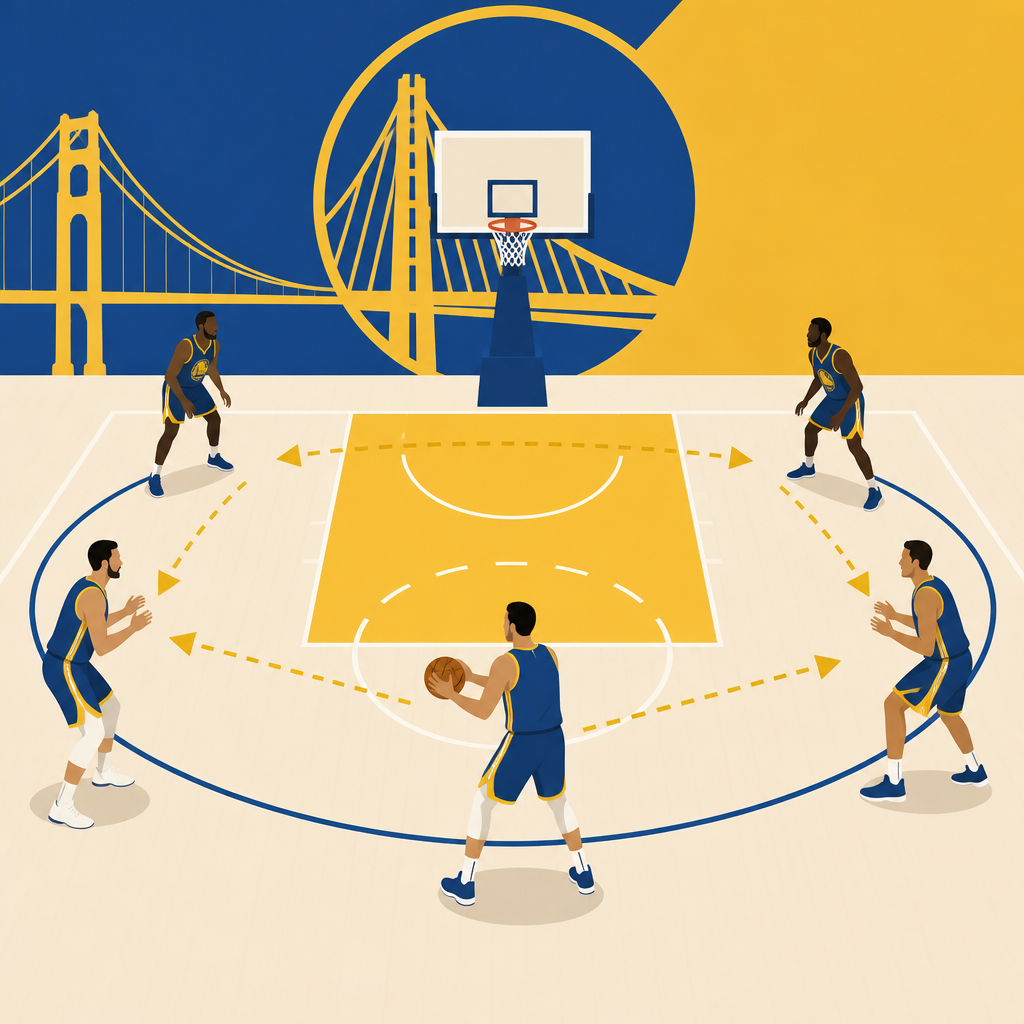
The Golden State Warriors changed NBA offense by proving that spacing and ball movement could be a complete team identity rather than a supporting tactic. In practical basketball terms, spacing means placing players far enough apart to stretch help defenders and open driving, passing, and shooting lanes. Ball movement means moving the ball quickly from side to side, through the paint, and from one advantage to the next until a high-value shot appears. Together, those ideas sound simple, but the Warriors turned them into the defining offensive model of modern pro basketball. As a result, their rise belongs in any serious discussion of NBA team histories.
This subject matters because the Warriors did not merely win championships; they changed what front offices draft for, what coaches teach, and what defenses fear. Before their peak, many teams still built around deliberate post play, isolation scoring, and rigid positional roles. After their ascent, nearly every organization began valuing shooting at every position, quicker decisions, and lineups designed to create space. I have studied these shifts through seasons of game film, coaching clinics, and playbook concepts, and the Warriors remain the clearest case of an offensive philosophy reshaping an entire league.
For readers exploring team histories, this article serves as a hub because it connects strategy to personnel, coaching, and legacy. The Warriors’ story is not only about Stephen Curry making impossible threes. It is also about how Klay Thompson’s gravity, Draymond Green’s decision-making, Andrew Bogut’s screening, Andre Iguodala’s connective passing, Kevin Durant’s shot creation, and Steve Kerr’s system fit together. Understanding that mix explains why their offense was so hard to guard and why opponents spent the last decade trying to imitate parts of it.
The core lesson is direct: elite offense is not only about having great scorers. It is about generating repeated advantages through spacing, timing, screening angles, player movement, and immediate reads. The Warriors mastered all of those details, then executed them at championship speed. To understand how NBA offense evolved, you have to understand what Golden State built, how it worked, and why its influence still shapes the league today.
From Franchise History to Offensive Revolution
The Warriors were not always the model franchise people remember now. Their history stretches from the Philadelphia Warriors of Joe Fulks and Wilt Chamberlain to the West Coast teams led later by Rick Barry, Run TMC, and the “We Believe” era. Each period mattered, but none transformed league-wide offense the way the Curry era did. That distinction is important for a team histories hub: organizational change rarely comes from one star alone. It usually emerges when talent, coaching, front-office vision, and timing meet at the right moment.
Golden State drafted Curry in 2009, Thompson in 2011, and Green in 2012. Those moves formed the strategic center of the eventual dynasty. Curry became the greatest off-the-dribble shooter in league history, Thompson became one of the best movement shooters ever, and Green became the playmaking big who connected every action. Just as important, the Warriors developed these players together. Their chemistry was not theoretical. It came from thousands of possessions learning where cuts would appear, when help would rotate, and how quickly the next pass had to arrive.
Mark Jackson helped establish defensive competitiveness and belief, but Steve Kerr’s arrival in 2014 unlocked the offense. Kerr imported motion principles influenced by Phil Jackson’s triangle concepts, Gregg Popovich’s passing culture in San Antonio, and his own experience playing in high-IQ systems. The result was not a copy of any one model. It was a modern hybrid built around split cuts, read-and-react passing, weak-side exchanges, dribble handoffs, and constant off-ball relocation by elite shooters.
What separated Golden State from earlier perimeter-oriented teams was scale and commitment. They did not just run a few clever sets for shooters. They organized entire possessions around creating impossible choices for defenders. Trap Curry too high, and Green would play four-on-three. Stay home on shooters, and Curry would pull from 28 feet. Switch too casually, and the Warriors would punish the mismatch through slips, cuts, or quick-hitting post split actions. Their attack made standard defensive rules feel outdated.
How Spacing Created New Geometry on the Floor
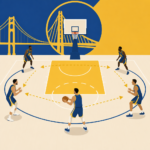
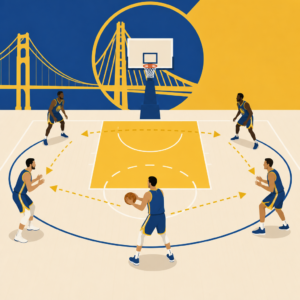
Spacing is often discussed vaguely, but the Warriors turned it into measurable floor geometry. Curry’s range forced defenders to pick him up several feet beyond the three-point line, sometimes near the logo. That extended the shell of the defense in a way older scouting reports rarely required. The farther a defense stretches, the larger the gaps between defenders become. Those gaps create driving lanes, back-cut windows, cleaner skip passes, and easier offensive rebounding paths because rotations start from compromised positions.
Thompson amplified this effect because defenses could not help off him either. Many teams have one player who bends coverage. Golden State had two, and both could shoot off the catch, off screens, and in transition. Add a passer like Green at the top of the floor and a screener like Bogut setting bruising picks, and the Warriors could create space without dribbling the air out of the ball. The spacing was active, not static. Players were not just standing in corners; they were moving defenders into difficult decisions.
A signature example was the high pick-and-roll with Curry and Green. If the on-ball defender went under the screen, Curry took the three. If both defenders trapped Curry, Green received the short roll around the foul line. From there, Green could hit a corner shooter, find a cutter, or attack the rim. Coaches around the league began teaching the short roll more aggressively because Golden State showed how devastating it was when a big could make quick reads. That is a direct tactical legacy.
The Warriors also embraced lineups with Green at center, often called the “Death Lineup” or “Hamptons Five” in later variants. By removing a traditional center and adding another wing creator, they made every defender guard in space. Opponents had fewer places to hide slow-footed bigs. This mattered in playoff basketball, where weak links are targeted possession after possession. Golden State’s spacing was therefore not just about open shots; it was about forcing roster-level stress on opponents.
Why Ball Movement Made the System Unstoppable
Ball movement was the second half of the equation, and it worked because it was paired with immediate decision-making. The Warriors did not pass for appearance’s sake. They passed to shift the defense, trigger help, and move from one advantage to the next before a recovery could happen. In film sessions, this is the difference between a harmless extra pass and a possession that collapses the defensive shell. Golden State understood that distinction better than any team of its era.
One of their staple actions was the post split. The ball would enter to Green or Bogut near the elbow or low post, then Curry and Thompson would screen for each other on the perimeter. Defenders had to choose whether to switch, trail, top-lock, or deny. Every answer carried risk. Switch lazily, and a shooter popped free. Overplay the perimeter, and a cutter slipped to the rim. Send extra help to the post hub, and the next pass found a wide-open three. The beauty of the action was that no dribble was needed to create danger.
Another feature was relocation. Curry often gave up the ball, cut through, then sprinted to a new spot behind the arc while the defense relaxed for a split second. That habit turned ordinary passes into high-value looks. It also punished defenders trained to ball-watch. Young players around the world now practice relocation threes because Curry normalized the skill at the highest level. In that sense, ball movement was inseparable from player movement; Golden State’s offense required both.
| Warriors offensive element | How it worked | League-wide impact |
|---|---|---|
| Deep shooting gravity | Defenders picked up Curry and Thompson far beyond the arc | Expanded acceptable shooting range for guards |
| Short-roll playmaking | Green attacked four-on-three situations after traps | Increased demand for passing bigs |
| Post split action | Entry pass triggered screens and cuts around the ball | Revived motion concepts for modern spacing |
| Small-ball lineups | Green at center opened five-out spacing and switching | Pushed teams to prioritize versatility over size |
| Relocation shooting | Curry moved after passing to create return passing lanes | Made off-ball movement a premium guard skill |
The statistical profile matched the eye test. During their championship years, the Warriors routinely ranked near the top of the league in assists, passes leading to shots, effective field goal percentage, and three-point volume without becoming predictable. Synergy Sports tracking regularly showed them as elite in spot-up efficiency, cuts, and transition threes. Their offense was not built on one play. It was built on a network of connected actions that magnified each player’s strengths.
The Players and Coaching Choices That Made It Work
No offensive revolution succeeds without the right personalities. Curry’s unselfishness was essential because a superstar willing to move without the ball makes the entire system credible. Thompson accepted a lower-dribble role and turned efficiency into a weapon. Green embraced the dirty work of screening, defending, talking, and making split-second reads. Bogut set legal but punishing screens and protected the logic of the structure as a high-post passer. Iguodala added experience, defense, and another decision-maker who kept the ball flowing.
When Durant joined in 2016, the system changed but did not break. In fact, the Warriors showed that a movement offense could absorb an isolation scorer of historic caliber. Durant gave them a late-clock bailout option when motion stalled, while spacing around Curry and Thompson reduced the help he faced. The tension was real: too much isolation could slow the machine, while too much motion could ignore Durant’s one-on-one excellence. Kerr balanced those forces better than most coaches could.
Coaching details mattered everywhere. Kerr and his staff emphasized the 0.5 concept before many teams popularized the label: decide quickly whether to shoot, pass, or drive. Assistant coaches refined timing, footwork, and screen angles so actions looked spontaneous but were carefully taught. Ron Adams anchored the defensive side, which mattered because stops fueled early offense and transition threes. The Warriors’ attack was devastating in the half court, but it became overwhelming when live-ball turnovers let their shooters sprint into space before defenses were set.
The broader organizational culture supported patience and intelligence. General manager Bob Myers and the front office prioritized players who could think the game, not just score. Development staff reinforced habits instead of chasing empty numbers. Veterans accepted role clarity. That is why the Warriors matter in team histories beyond highlights. They built a coherent basketball ecosystem, and the offense was the clearest expression of that coherence.
How the Warriors Reshaped the Rest of the NBA
The league’s response was visible within a few seasons. Teams increased three-point attempts dramatically, but the deeper change was qualitative rather than numerical. More organizations sought multi-positional defenders, centers who could pass on the move, and guards who threatened defenses without monopolizing the ball. Coaches borrowed split actions, Spain pick-and-roll counters, pistol entries, and five-out spacing ideas that fit the new environment. Not every copy worked, because the original depended on rare talent, yet the blueprint changed roster construction everywhere.
Defenses adapted too. Switch-heavy schemes became more common because chasing through multiple screens against elite shooting was exhausting and often futile. Big men were asked to defend farther from the basket. Top-locking shooters, showing early help on cuts, and pre-switching weak defenders became standard counters. Even those adjustments confirm the Warriors’ impact. When one team forces the rest of the league to rewrite coverage rules, it has changed the sport.
The legacy also extends below the NBA. College programs now recruit for spacing and quick decision-making with even greater urgency. Youth players train pull-up threes off movement, not just set shots. International clubs continue to value read-and-react systems that look more adaptable in a spaced floor era. The Warriors did not invent passing, shooting, or cutting. What they did was combine them so effectively, with so much star power and so many wins, that the style became the modern reference point.
For anyone building knowledge around NBA team histories, the Warriors are the central case study in how a franchise can alter basketball ideology. Their championships from 2015, 2017, 2018, and 2022 were different in roster composition and competitive context, yet each carried the same offensive DNA: stretch the floor, move the ball, trust the next read, and let skill plus spacing pressure every inch of the defense. That is why their influence has lasted longer than any single season’s numbers.
The Golden State Warriors changed NBA offense by turning spacing and ball movement into a repeatable championship formula. They showed that deep shooting could expand the court, that passing bigs could punish traps, that off-ball movement could be as valuable as isolation scoring, and that small-ball versatility could decide playoff series. Their system was not gimmicky or temporary. It was structurally sound, rooted in player fit, coaching precision, and relentless execution.
As a hub for team histories, this story offers more than nostalgia. It explains how franchises evolve, how tactical ideas spread, and why the best teams influence the league long after banners are raised. If you want to understand modern basketball, start with Golden State’s offensive revolution, then follow how other NBA teams adapted, resisted, or copied pieces of it across the decade.
The main takeaway is simple: the Warriors won because they created better shots more consistently than their opponents, and they did it through spacing, passing, screening, and trust. Study their history, revisit their film, and use this article as your starting point for exploring how team identities shape the NBA.
Frequently Asked Questions
What does “spacing” mean in basketball, and why did the Warriors make it so important?
Spacing in basketball refers to how players position themselves on the floor to maximize room for driving, passing, cutting, and shooting. The Golden State Warriors turned spacing into a central offensive principle by showing that proper floor balance could dictate defensive behavior on nearly every possession. Instead of crowding the paint or placing multiple non-shooters in areas where defenders could ignore them, the Warriors kept players spread wide and purposeful. That forced defenders to cover more ground, made help defense riskier, and opened lanes that did not exist when offenses were packed tightly together.
What made the Warriors especially influential was that their spacing was not static. It was not just about standing in the corners and waiting for a kick-out three. Their players constantly relocated, screened, cut, and exchanged positions, which meant the defense had to react to movement within a spaced floor. That combination stretched defenders both horizontally and mentally. A help defender could not simply sit near the lane because one pass could lead to a clean shot, a backdoor cut, or another quick swing that shifted the defense out of alignment. In effect, spacing became more than a formation choice. It became a system that made every defensive decision more difficult.
How did ball movement define the Warriors’ offense differently from traditional star-driven attacks?
Ball movement in the Warriors’ system was about moving the defense before attacking the basket, rather than relying on one player to beat his man in isolation over and over. Traditional star-centered offenses often begin and end with a single creator controlling the possession, waiting for a screen, reading the coverage, and trying to generate a shot or pass from that one action. The Warriors certainly had elite individual talent, but they used that talent within a framework built on quick decisions, extra passes, reversals, and continuous pressure on defensive positioning.
Their offense often flowed from one action into the next without pause. A defender might chase Stephen Curry off a screen, only for the ball to swing to another side of the floor, where a dribble handoff or split cut immediately created a second problem. That sequence forced defenders to process multiple threats in a short period of time. The key was not just passing for the sake of passing, but passing with purpose. Every touch aimed to create or increase an advantage. If the first pass bent the defense, the second pass often broke it. This style reduced predictability, rewarded smart team play, and made it far harder for defenses to load up on one star.
Why were Stephen Curry and Klay Thompson so essential to this offensive revolution?
Stephen Curry and Klay Thompson were essential because their shooting range and movement expanded what spacing could accomplish. Many teams had good shooters before the Warriors’ rise, but Curry and Thompson changed the geometry of the court. Defenders had to guard them farther from the basket than was previously normal, which stretched defensive coverage into uncomfortable areas. That wider defensive attention created larger gaps near the elbows, wings, and driving lanes. Once defenders extended that far, the Warriors could punish even small breakdowns with cuts, slips, and quick ball reversals.
Curry in particular transformed offensive spacing because he was dangerous both with and without the ball. He could pull up from deep, run defenders through multiple screens, relocate after passing, and draw two defenders simply by moving into open space. Thompson added another layer because he punished any hesitation with instant catch-and-shoot efficiency. Together, they forced defenses to remain in constant alert mode. Their shooting gravity did not just create three-point attempts for themselves. It generated easier finishes for teammates, cleaner passing windows, and more opportunities for the offense to keep flowing without stalling. In that sense, they were not just great scorers within the system. They were the main reason the system reached historic levels of effectiveness.
How did the Warriors’ offense influence the rest of the NBA?
The Warriors’ impact on the league was massive because they demonstrated that spacing and ball movement could be the foundation of a championship offense, not just a stylistic preference. After their success, more teams prioritized versatile shooters, playmaking big men, quick decision-makers, and lineups with fewer spacing liabilities. Front offices began valuing players who could pass, shoot, and defend multiple positions because those skill sets fit a more fluid offensive structure. Coaches also expanded the use of actions such as dribble handoffs, split cuts, five-out spacing concepts, and off-ball screening packages designed to keep the defense rotating.
Just as importantly, the Warriors changed how teams thought about shot quality and offensive rhythm. The modern NBA became even more focused on creating efficient shots at the rim, open threes, and free throws while reducing low-value, contested mid-range attempts. But the Warriors’ lesson was not simply “shoot more threes.” It was that the best threes usually come from forcing the defense into multiple choices through pace, movement, and spacing. Teams across the league borrowed elements of that philosophy, even if they did not have shooters as devastating as Curry and Thompson. The result was a broader league-wide shift toward more dynamic, read-based offenses built on creating advantages collectively rather than individually.
Was the Warriors’ style only possible because they had unique talent, or can other teams realistically copy it?
The honest answer is both. The Warriors’ exact version of the offense depended on rare talent, especially the unprecedented shooting and movement of Stephen Curry and the elite complementary shooting of Klay Thompson. Very few teams in league history have had that level of off-ball gravity, decision-making speed, and shooting accuracy all at once. That means simply telling a roster to “play like the Warriors” rarely works if the personnel cannot shoot, pass, screen, and process the game quickly enough to sustain that style.
However, the broader principles absolutely can be adapted. Teams do not need two all-time shooters to benefit from better spacing, faster ball movement, and smarter off-ball activity. Any offense improves when players maintain useful distance, make quick reads, avoid over-dribbling, and move from one action into another with purpose. The Warriors proved that these ideas are scalable. A youth team, college team, or NBA roster can apply the same core concepts by emphasizing spacing discipline, unselfish passing, strong screening, and constant movement after the first action. The specific form may change depending on personnel, but the strategic lesson remains universal: when the floor is spaced properly and the ball moves faster than the defense, the offense gains control of the possession.