
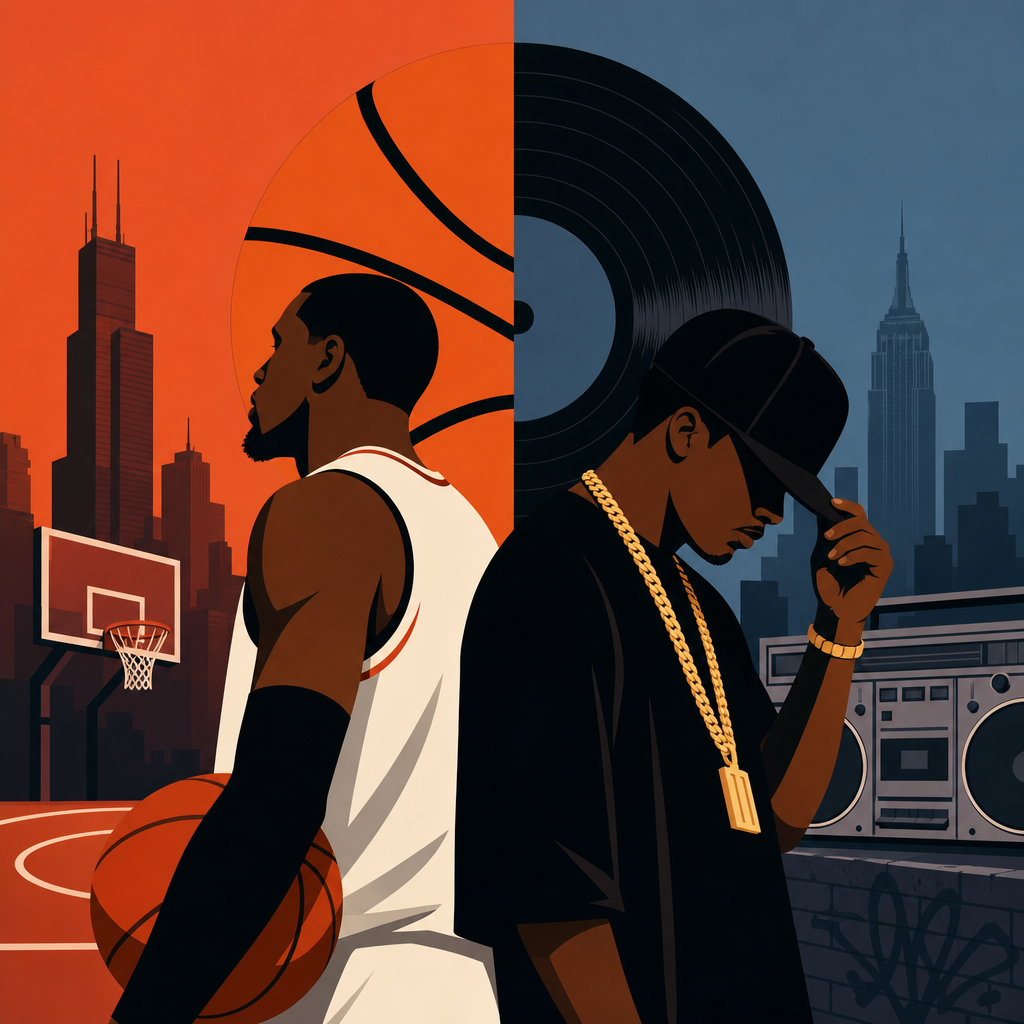
The relationship between the NBA and hip-hop is no longer a trend, marketing angle, or passing overlap between sports and music. It is a permanent cultural alliance shaped by shared geography, style, language, ambition, and business power. When people talk about player culture in today’s league, they are usually describing habits and values that hip-hop helped popularize: personal branding, fashion as identity, public storytelling, community credibility, entrepreneurial thinking, and an unapologetic sense of self. To understand modern NBA culture, you have to understand why hip-hop became one of its foundational languages.
Hip-hop, born in the Bronx in the 1970s, grew from DJing, MCing, breakdancing, and graffiti into a global cultural force. The NBA, founded decades earlier, transformed during the television era from a domestic sports league into an international entertainment brand. Their paths converged because both were driven by young Black creators turning local talent into mass influence. In arenas, barbershops, playgrounds, and recording studios, the same audiences followed both. I have worked on basketball content and brand strategy long enough to see the pattern repeat across generations: the artists change, the players change, but the exchange between the two worlds only gets deeper.
This matters because player culture now shapes how fans choose favorites, how sponsors spend, how teams communicate, and how media covers the league. A tunnel walk can move product. A courtside lyric can revive a rivalry. A signature shoe campaign can sound like an album rollout. For readers exploring NBA culture, this hub on player culture explains the core connections: where the relationship began, how dress, music, language, and business merged, and why the bond remains durable even as both industries evolve. If you want to understand the NBA beyond the box score, start here.
Shared origins: urban identity, visibility, and self-expression
The NBA and hip-hop became inseparable because they developed in overlapping social spaces. Both drew energy from Black urban communities, especially New York, Los Angeles, Chicago, Philadelphia, Detroit, Houston, and Atlanta. In the 1980s and 1990s, basketball courts and hip-hop scenes often shared neighborhoods, schools, and youth centers. The same teenager might spend afternoons at the park, evenings listening to mixtapes, and weekends imitating both crossover moves and rap cadences. That overlap created more than a fan crossover; it created a shared identity system.
By the late 1980s, players were no longer viewed only as athletes. They were symbols of aspiration, style, and local pride, much like rappers. Hip-hop celebrated authenticity, confidence, and resilience, values that also fit elite basketball culture. Allen Iverson later embodied this connection more visibly than any previous star. Cornrows, tattoos, arm sleeves, oversized fits, and direct language made him a lightning rod, but he reflected a generation more than he invented one. His influence was so broad that league officials responded with the 2005 dress code, a policy widely understood as a reaction to hip-hop aesthetics entering the NBA mainstream.
That tension proved the relationship had real power. If fashion choices, jewelry, and grooming styles could trigger league-wide rules, then hip-hop was not external to basketball culture; it was shaping it from within. Players were claiming the right to define professionalism on their own terms. That argument still matters across every topic within player culture, from fashion and music tastes to social media voice and off-court business identity.
How music became part of the NBA player identity
Music is the most obvious connector because it influences routine, emotion, and image. Players train to it, enter arenas to it, celebrate wins with it, and build public personas through it. Locker-room playlists are not trivial details. They help set energy, reinforce team hierarchies, and reveal generational tastes. In my experience around basketball media environments, pregame music choices often tell you as much about a roster’s personality as a press conference does.
Hip-hop became the dominant soundtrack because it matched the emotional tempo of the sport. Basketball demands rhythm, improvisation, one-on-one creativity, and controlled aggression. Hip-hop rewards cadence, timing, wordplay, and charisma. The fit feels natural. That is why player warmups, arena DJ sets, highlight edits, and video game soundtracks consistently lean rap-heavy. It is also why rappers reference players constantly, using names like Jordan, Kobe, Curry, Durant, and LeBron as shorthand for excellence, swagger, scoring, or longevity.
The exchange goes both ways. Players appear in music videos, attend album releases, and form friendships with artists that become part of public narrative. LeBron James discussing lyrics, Damian Lillard releasing albums as Dame D.O.L.L.A., Shaquille O’Neal recording platinum-selling rap, and Jay-Z’s long association with the Nets each show different levels of involvement. Some connections are promotional, but many are organic. The important point is that hip-hop does not simply entertain NBA players. It helps them communicate who they are.
Fashion, tunnel culture, and the politics of image
Player culture cannot be explained without fashion, and hip-hop gave NBA fashion its modern vocabulary. Before social media elevated tunnel arrivals into publishable content, players still used clothing to signal taste, confidence, and affiliation. Hip-hop accelerated the idea that every public appearance is a statement. That mindset turned the arena tunnel into one of the most influential style runways in men’s fashion.
Russell Westbrook, Dwyane Wade, Carmelo Anthony, P.J. Tucker, Shai Gilgeous-Alexander, and Jordan Clarkson each helped move player style beyond team-issued sameness. The influence runs from luxury houses to streetwear labels such as Supreme, BAPE, Fear of God, Off-White, Denim Tears, and Gallery Dept. Sneakers remain central because footwear links performance, scarcity, and identity in a way almost nothing else can. Signature lines from Nike, adidas, and Under Armour function like cultural texts: they tell fans what kind of star a player wants to be.
The Iverson era and the dress code dispute are still essential case studies. The league framed the policy as professionalism, but many players and observers saw cultural policing. Over time, the NBA shifted. Instead of resisting player expression, it learned to package it. Team social channels now post fits before tipoff. Brand partners seed clothing. Media outlets rate tunnel looks. What was once treated as controversial has become a monetized pillar of NBA culture.
Business power: shoes, brands, and entrepreneurial ambition
One reason the NBA and hip-hop stay connected is that both reward individual brand building. In each field, top performers can convert audience attention into endorsements, ownership stakes, media ventures, and lifestyle labels. Michael Jordan created the template. Air Jordan was not just a sneaker endorsement; it became a cultural institution spanning basketball, music, and fashion. Rappers wore Jordans to signal status and taste, while players chased the same symbolic power in their own deals.
Today’s players think like founders as much as endorsers. LeBron James built SpringHill, invested in Blaze Pizza, and positioned himself as a media executive. Kevin Durant’s Thirty Five Ventures expanded into production and investment. Stephen Curry helped elevate Under Armour’s basketball business while building a family-friendly yet elite personal brand. These moves mirror hip-hop’s long shift from record sales to diversified enterprise, a path associated with figures like Jay-Z, Dr. Dre, and 50 Cent.
| Player | Hip-hop related cultural lane | Business impact |
|---|---|---|
| Michael Jordan | Referenced constantly in rap lyrics | Air Jordan became a multibillion-dollar brand |
| Allen Iverson | Embodied rap-era style and attitude | Reebok identity expanded beyond performance shoes |
| LeBron James | Public ties to artists and lyrics culture | Built media, retail, and equity-driven ventures |
| Damian Lillard | Active recording artist as player | Merged athletic and music audiences directly |
| Shai Gilgeous-Alexander | Fashion leadership rooted in hip-hop aesthetics | Strengthened luxury and style partnerships |
The broader lesson for player culture is clear: hip-hop normalized the idea that fame should be leveraged, not merely enjoyed. NBA players increasingly control production companies, podcasts, agencies, and investment portfolios because the cultural script now values ownership, narrative control, and long-term wealth.
Language, confidence, and the public persona of players
Hip-hop changed how NBA players speak in public and how the public interprets that speech. Slang, cadence, competitiveness, and direct self-mythology all became more visible as media spaces loosened. Earlier eras often expected athletes to sound sanitized, deferential, and generic. Hip-hop made confidence legible in a different way. Saying you are great, calling out disrespect, or framing your journey in personal terms no longer automatically reads as arrogance. Often, it reads as cultural fluency.
This is one reason younger fans connect strongly with players who feel unfiltered. Anthony Edwards’ blunt humor, Kevin Durant’s online directness, and Jimmy Butler’s self-crafted intensity each fit a media environment influenced by rap’s emphasis on voice and authenticity. That does not mean every outspoken player is performing hip-hop identity. It means the wider cultural acceptance of strong personal voice owes a debt to hip-hop norms around authorship and self-definition.
There are tradeoffs. What some fans hear as authenticity, others hear as immaturity or brand risk. Sponsors still prefer controlled messaging. Teams still manage reputational exposure. Yet the center of gravity has shifted. Players are now expected to have a point of view, not just a stat line. That expectation is central to any serious discussion of NBA player culture.
Media, social platforms, and the always-on culture machine
The bond between the NBA and hip-hop intensified in the social media era because both industries thrive on clips, quotes, symbolism, and personality-driven conversation. A crossover highlight and a freestyle snippet travel similarly online: short, repeatable, emotionally immediate, and easy to debate. Platforms such as Instagram, X, TikTok, YouTube, and podcasts turned players and artists into constant presences rather than event-based celebrities.
This changed the scale of influence. A rapper sitting courtside can become a headline. A player rapping along to a new release on Instagram Live can boost discovery. Collaborations now happen through playlist placements, documentary cameos, branded capsule drops, and athlete-hosted interview shows. Even NBA 2K has become part of this ecosystem by curating soundtracks that reinforce the link between basketball identity and hip-hop listening habits.
The result is a feedback loop. Fans consume games through culture and consume music through sports. Journalists covering player culture now track fit photos, lyric references, sneaker rotations, and friendship networks because these details help explain audience attachment. This hub matters for internal exploration of NBA culture because every adjacent topic, from rivalries to endorsements to fan communities, is touched by this media loop.
Why the connection endures across generations
The NBA and hip-hop remain inseparable because the relationship keeps renewing itself. Magic Johnson and early rap shared an era of expanding visibility. Michael Jordan and 1990s hip-hop globalized aspiration. Iverson and the mixtape generation made style battles unavoidable. LeBron’s era fused athlete empowerment with digital media. Today, players like Ja Morant, Jayson Tatum, Devin Booker, and Shai Gilgeous-Alexander operate in a landscape where cultural fluency is assumed, not exceptional.
The connection also endures because it solves a basic need for both sides. The NBA benefits from emotional relevance beyond wins and losses. Hip-hop benefits from association with elite competition, physical excellence, and global reach. Both speak to reinvention, status, struggle, and spectacle. Both are youth-driven but multigenerational in impact. And both remain disproportionately shaped by Black creativity while circulating through worldwide commercial systems.
For anyone building a deeper understanding of NBA player culture, the key takeaway is simple: hip-hop did not just influence the league’s soundtrack or wardrobe. It helped define how modern players present themselves, protect their image, build wealth, and connect with fans. Explore the rest of the NBA Culture hub with that lens in mind, and the league’s fashion choices, business moves, media habits, and identity debates will make far more sense.
Frequently Asked Questions
Why are the NBA and hip-hop so closely connected compared to other sports and music genres?
The bond between the NBA and hip-hop feels unusually natural because both grew from many of the same urban environments, especially in cities where basketball courts and local music scenes were central to daily life. They developed side by side as forms of expression for young people who wanted visibility, respect, and a path to influence. Basketball rewarded creativity, confidence, rhythm, and improvisation on the court, while hip-hop rewarded originality, storytelling, style, and presence. Those values overlap in a way that made the connection more than promotional or accidental.
Another reason the relationship became permanent is that both cultures are driven by individuality within a public arena. A basketball player can stand out through fashion, mannerisms, interviews, celebrations, and the way he carries himself, just as a rapper builds identity through lyrics, image, attitude, and authenticity. The NBA, more than many other leagues, gave fans a clear view of its players as personalities rather than just athletes. Hip-hop amplified that visibility by providing a language for ambition, confidence, and self-definition that players could adopt and reshape for themselves.
Over time, this connection moved beyond influence into infrastructure. Rappers sat courtside, referenced players in lyrics, formed friendships with stars, and invested in sports businesses. Players appeared in music videos, launched labels, collaborated with artists, and used hip-hop aesthetics in everything from tunnel fits to personal branding. What started as shared cultural energy evolved into a full ecosystem of media, fashion, entrepreneurship, endorsement power, and mutual validation. That is why the NBA-hip-hop relationship is not a phase. It is a long-term alliance rooted in common origins and reinforced by real economic and cultural power.
How did hip-hop change the image and identity of NBA players?
Hip-hop helped redefine what it meant to be an NBA player in public. Earlier eras often emphasized athletes primarily as team representatives, but hip-hop encouraged a stronger focus on personal identity. Players increasingly became brands, storytellers, tastemakers, and cultural figures whose relevance extended well beyond the game itself. The influence showed up in fashion choices, interview style, social media voice, music preferences, business ventures, and the confidence to present themselves on their own terms.
One of the biggest shifts was in the acceptance of visibility as power. Hip-hop normalized the idea that image is not superficial when it reflects taste, credibility, and control over one’s narrative. In the NBA, that translated into players treating clothing, jewelry, tattoos, hairstyles, and public appearances as meaningful parts of identity rather than distractions from performance. The modern tunnel walk is a perfect example. It is not just about style for style’s sake. It is a stage where players communicate affiliation, aspiration, creativity, and status, much like artists do before stepping into the spotlight.
Hip-hop also influenced how players think about ownership and long-term leverage. Many athletes now approach their careers with an entrepreneurial mindset, building media companies, fashion labels, investment portfolios, and community initiatives while they are still active. That mirrors hip-hop’s evolution from music genre to business framework. Rappers showed that cultural relevance could become commercial power if managed strategically, and NBA players absorbed that lesson. As a result, today’s player identity is not confined to points, rebounds, or championships. It includes voice, influence, business vision, and the ability to shape public culture in real time.
What role did fashion play in making the NBA and hip-hop inseparable?
Fashion became one of the clearest visible bridges between the NBA and hip-hop because both cultures treat style as a serious form of communication. In each world, clothing is not just decorative. It signals taste, confidence, regional identity, class mobility, rebellion, and creative control. As hip-hop expanded from music into a broader lifestyle force, it brought with it a fashion vocabulary that naturally resonated with NBA players, many of whom were already part of the same cultural conversations.
The influence worked in both directions. Hip-hop helped popularize certain brands, silhouettes, and styling choices that NBA players embraced publicly, while NBA stars gave those looks even greater mainstream reach through televised arrivals, postgame press conferences, endorsement deals, and social media. Sneakers became especially important because they sat at the intersection of performance, status, and storytelling. Signature shoes, player exclusives, and artist collaborations turned footwear into a shared language between the court and the recording booth. Few cultural products show the merger of basketball and hip-hop more clearly than sneaker culture.
Fashion also mattered because it gave players a way to assert personality within a highly structured professional environment. Even when league policies attempted to regulate appearance, the desire for self-expression did not disappear. It evolved. Over time, the NBA came to understand that player style was not a threat to the brand but one of its greatest marketing assets. Today, pregame fits, luxury partnerships, streetwear collaborations, and designer visibility are standard parts of NBA coverage. That level of style attention would be difficult to imagine without hip-hop’s long-standing influence on how masculinity, success, and cultural authority are visually presented.
Did the relationship between the NBA and hip-hop affect business and marketing as much as culture?
Yes, and that may be one of the strongest reasons the relationship became permanent. The NBA-hip-hop alliance did not stay at the level of aesthetics or celebrity friendship. It reshaped how brands market athletes, how leagues package personality, and how players think about monetizing influence. Hip-hop showed that audience connection grows when people feel they are buying into a story, a lifestyle, and a point of view rather than a product alone. The NBA adapted exceptionally well to that reality.
Brands quickly recognized that players influenced not only sports fans but also broader youth culture, especially when their image aligned with hip-hop’s language of confidence, authenticity, hustle, and aspiration. That made NBA stars ideal ambassadors for sneakers, apparel, headphones, drinks, luxury goods, and later tech and investment platforms. Meanwhile, musicians benefited from association with the league because basketball carried global reach, elite status, and nonstop visual exposure. The result was a feedback loop: artists validated players as cultural leaders, and players validated artists as mainstream power brokers.
This crossover also changed the business behavior of athletes themselves. Rather than waiting until retirement to expand beyond the court, many players began building brands during their prime years. They launched podcasts, production companies, fashion collaborations, restaurants, venture funds, and community-driven enterprises. That strategy closely reflects hip-hop’s business model, where the goal is often to convert cultural momentum into durable ownership. In practical terms, the alliance between the NBA and hip-hop helped create a generation of athletes who are not just endorsers but operators, investors, and media architects.
Why is the connection between the NBA and hip-hop considered permanent now instead of just a trend?
It is considered permanent because the relationship no longer depends on novelty. A trend can fade when attention moves elsewhere, but the NBA and hip-hop are now integrated at nearly every level of culture, commerce, and identity. The connection exists in player behavior, fan expectations, brand strategy, music references, fashion systems, media coverage, and even the way young athletes imagine success before they reach the league. In other words, hip-hop is not something the NBA occasionally borrows from. It is part of the league’s modern cultural DNA.
Another reason the relationship feels permanent is generational continuity. Younger players grew up in a world where hip-hop was already the dominant soundtrack of sports culture, and younger fans expect athletes to have distinct personalities, style, and an active voice in public life. That means the relationship keeps renewing itself naturally. It does not require a special campaign or crossover event to stay visible. It is already embedded in how players dress, speak, market themselves, and engage with audiences.
Most importantly, both the NBA and hip-hop now function as global platforms for influence. They shape conversations about identity, success, race, creativity, wealth, community, and self-determination. Their partnership endures because it serves real purposes for everyone involved: players gain expressive language and business models, artists gain access to a powerful athletic stage, brands gain cultural credibility, and fans gain a richer experience that connects sports to lifestyle and storytelling. That combination of emotional meaning and commercial utility is what turns a crossover into a lasting cultural institution.