

The power forward has always lived in basketball’s middle ground, part bruiser, part scorer, and often the position that reveals where the NBA is headed next. In the simplest terms, the power forward is traditionally the bigger frontcourt player who operates near the basket, rebounds, defends larger opponents, and supplies interior scoring alongside a center. Yet that traditional definition no longer captures the full job description. In the modern NBA, power forwards may initiate offense, space the floor from three, switch onto guards, or function as small-ball centers depending on lineup needs and coaching philosophy.
That evolution matters because positions and roles shape how teams are built, how prospects are evaluated, and how fans understand the game. When I break down film or build scouting reports, power forward is often the hardest spot to label cleanly. A player might defend centers, screen like a big, handle the ball like a wing, and still be listed as a four. Understanding the position means understanding larger NBA basics: offensive spacing, defensive versatility, rebounding responsibilities, lineup construction, and why rigid labels matter less than functional roles. This article serves as a hub for positions and roles, so it explains what a power forward does, how the position changed, what skills now define success, and where the four fits next to centers, wings, and guards in today’s NBA.
What a power forward traditionally did
For decades, the classic power forward played close to the rim and won with strength, timing, and physicality. The role sat next to a center in two-big lineups, which meant handling much of the dirty work that box scores only partly captured. A traditional power forward set hard screens, established deep post position, attacked the offensive glass, protected teammates with physical presence, and guarded opposing fours who lived on mid-post touches and putbacks. On offense, many scored through short jumpers, drop-step post moves, duck-ins, and baseline cuts rather than perimeter creation.
Think of Karl Malone, Charles Oakley, Buck Williams, or Antonio McDyess at different points in NBA history. Malone paired elite transition running with bruising post play and deadly elbows. Oakley carved out value through rebounding, screens, defense, and intimidation. Tim Duncan, though capable of playing center, spent years functioning as a power forward beside a true five, blending bank shots, rim protection, and textbook positioning. Kevin Garnett expanded the role with face-up skill and passing, but he still anchored core big-man duties: rebounding, help defense, and interior coverage. In that era, the power forward’s identity centered on size, toughness, and production inside the arc.
The traditional job also reflected older NBA geometry. Teams attempted far fewer threes, played at tighter spacing, and fed the post more often. With more bodies near the paint, power forwards needed balance and touch in crowded areas rather than wide-open floor speed. Defensive assignments were more static too. Coaches generally expected the four to guard another four, fight for rebounding position, and rotate from the weak side without switching onto point guards for entire possessions. If you are learning NBA positions and roles, this older template is the baseline from which every modern change makes sense.
Why the position changed so dramatically
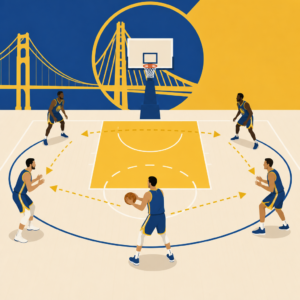
The power forward changed because the league changed around it. Three-point volume increased, illegal defense rules had long since loosened into modern help principles, analytics highlighted the value of shots at the rim and from beyond the arc, and pace-and-space offenses stretched traditional frontcourts. If a power forward could not defend in space or offer value away from the basket, he became easier to target. Coaches began asking one direct question: can this player help create efficient offense without clogging the paint?
Rule interpretation mattered as much as strategy. Freedom-of-movement emphasis made perimeter skill more valuable, while defensive three seconds discouraged planting a giant near the rim every possession. As a result, frontcourt players had to cover more ground laterally and recover faster on closeouts. The rise of spread pick-and-roll also put power forwards in repeated decision-making situations. They had to hedge, switch, show, recover, tag rollers, and contest shooters. Being simply strong was no longer enough. Being mobile, anticipatory, and technically sound became essential.
Personnel accelerated the shift. Dirk Nowitzki proved a seven-footer could bend defenses from the perimeter. Chris Bosh evolved from interior scorer to floor-spacing big in Miami’s smaller lineups. LeBron James-led teams weaponized four-out spacing. Draymond Green redefined the spot by defending every position, facilitating offense, and playing center in closing groups. Giannis Antetokounmpo, Jayson Tatum, Kevin Durant, and Anthony Davis further blurred categories by bringing star-level handle, length, and defensive range to frontcourt roles. Once teams saw that versatility created matchup problems, the old power forward mold stopped being the default and became just one option among many.
The modern power forward skill set
Today’s power forward must usually do at least three things well: defend multiple actions, maintain offensive spacing, and finish possessions through rebounding. The exact blend changes by team, but the modern four is defined less by height and more by functional versatility. A 6-foot-7 forward may play the position if he can switch, rebound, and make quick decisions. A 7-footer may also be a power forward if he shoots, moves, and complements a rim-protecting center.
Shooting is the clearest shift. Not every power forward must be a high-volume three-point shooter, but defenses now test any non-shooter by helping off him. That affects driving lanes, post touches, and pick-and-roll spacing. Players like Lauri Markkanen, Kristaps Porzingis when paired with another big, and Jaren Jackson Jr. illustrate how frontcourt shooting changes the map of the floor. Even respectable corner-three accuracy can keep weak-side defenders honest. In practice, coaches value fast decision-making as much as raw percentage: catch, shoot, drive, or swing without stalling the possession.
Ball skills matter more than they once did. Many teams use the four as a short-roll passer, dribble handoff hub, or transition grab-and-go threat. Julius Randle, Paolo Banchero, and Zion Williamson have all operated as offense initiators from frontcourt alignments. Others, such as Aaron Gordon, thrive as connective players who screen, cut, finish, and attack tilted defenses. The key is processing speed. Modern offenses punish hesitation, so the best power forwards read tags, recognize help, and move the ball before the defense resets.
Defensively, versatility is nonnegotiable. A modern power forward may need to switch onto a guard one possession, front the post the next, then rotate as a low man to contest at the rim. Film study consistently shows that poor footwork gets exposed faster at the four than casual viewers realize. Open the hips too early on a closeout and a wing drives middle. Miss the tag on a rolling center and the rim is unprotected. Fail to box out after a switch and the defense still loses. That is why coaches trust fours who communicate early, stunt without overhelping, and finish the play with a rebound.
How teams use power forwards in different systems
There is no single modern power forward archetype. Team context determines the role. Some fours are stretch partners for a traditional center. Others are defensive specialists next to an offensive five. Some become small-ball centers in closing lineups. The best way to understand positions and roles is to see how different responsibilities align with roster construction.
| Archetype | Primary Offensive Role | Primary Defensive Role | NBA Example |
|---|---|---|---|
| Stretch four | Space to corners and above the break, attack closeouts | Rebound, provide help, survive switches | Lauri Markkanen |
| Playmaking four | Initiate from elbow, short roll, or in transition | Rotate, switch selectively, finish possessions | Draymond Green |
| Finishing four | Screen, cut, dive, offensive rebound | Guard bigger wings or bigs, bring physicality | Aaron Gordon |
| Rim-protecting four | Secondary scoring, spacing if possible | Weak-side shot blocking, length, versatility | Jaren Jackson Jr. |
In five-out systems, the power forward may be interchangeable with a center, especially if the offense values constant spacing and handoffs. In more traditional systems, the four can serve as the mobile complement to a paint-bound rim protector. Denver’s use of Gordon beside Nikola Jokic is a strong example. Gordon does not need high-volume jump shooting because Jokic creates from the elbows and post, while Gordon adds screening, cutting, dunker-spot pressure, and defensive flexibility. The role works because it is tailored to star strengths rather than forced into a generic template.
Boston offers a different model. With Jayson Tatum often functioning as a forward creator and lineups filled with shooting, the nominal power forward role can shift based on matchup. Sometimes it belongs to a bigger wing, sometimes to a spacing big, sometimes to a switchable defender. That fluidity reflects a league-wide truth: coaches now build role ecosystems, not static positional boxes. The power forward remains important, but the label only matters if it tells you what the player actually does within the system.
Relationship to other NBA positions and roles
As a hub for positions and roles, this topic only makes sense when compared with adjacent spots on the floor. The power forward overlaps most with the center and small forward. Against a center, the four is usually more mobile, more perimeter-oriented, and less exclusively responsible for rim protection. Against a small forward, the four is generally stronger, more involved in screening and rebounding, and more likely to defend interior actions. But those differences are increasingly situational rather than absolute.
On offense, the power forward often connects guards to the center. The point guard initiates, the center screens or facilitates, and the four becomes the release valve who keeps spacing intact or punishes rotations. On defense, the power forward frequently acts as the second line of resistance. He may not be the primary rim protector, but he tags rollers, bumps cutters, scrams mismatches, and cleans the glass. In film sessions, coaches spend plenty of time on these hidden tasks because one missed rotation from the four can unravel the entire possession.
This is why fans learning NBA basics should avoid treating positions as five isolated jobs. Modern basketball is role-based. A team may start a player listed as a small forward at power forward because his rebounding and switch defense fit the matchup. Another team may list a center at power forward to maximize size. The useful question is not “What is his listed position?” but “What responsibilities does he handle on both ends?” For the modern NBA, that question produces better analysis than any roster label.
What to watch for when evaluating a power forward
If you want to identify whether a power forward is helping a team win, start with possessions, not points per game. Watch where he stands when a guard drives. Does he space correctly, cut at the right moment, or clog the lane? On defense, notice whether he communicates switches early and whether he arrives on time as a helper. Rebounding is also a major tell. Secure defensive rebounds end possessions; contested offensive rebounds create extra ones. Both swing games even when they do not lead highlight packages.
Next, look at role efficiency. Shooting percentage alone can mislead, so consider shot quality and volume. A power forward who hits 35 percent from three on meaningful attempts may be more valuable than one who shoots 40 percent on very low volume that defenses ignore. Passing reads matter too. Can he make the simple kickout from the short roll? Can he hit a cutter from the elbow? Turnover avoidance is part of the evaluation because frontcourt decision-makers often attack rotating defenses where timing is tight.
Finally, measure scalability. This is a term front offices use constantly: does the player’s game hold up next to stars, in the playoffs, and against multiple lineup styles? A scalable power forward can defend up or down a position, contribute without monopolizing the ball, and avoid becoming a target in postseason matchups. That is why players such as Gordon, Green, and prime Serge Ibaka have been so valuable. Their skills translate across systems and stakes. When evaluating the four, portability is often more important than raw counting stats.
The future of the power forward position
The future of the power forward is continued hybridization. Young players are trained earlier in ball handling and shooting, while pro defenses demand more switching and recovery speed than ever. That means tomorrow’s fours will likely look even more interchangeable with oversized wings and mobile centers. Prospects entering the league are already expected to defend in space, process actions quickly, and contribute as passers. A one-dimensional power forward can still survive, but only in carefully built contexts.
Even so, size and physicality are not disappearing. The playoffs repeatedly remind teams that someone must rebound through contact, hold position in the post, and absorb the wear of frontcourt defense. The modern NBA did not eliminate the old power forward responsibilities; it layered perimeter demands on top of them. The best players at the position now combine old-school force with new-school skill. That combination is why the role remains central to understanding basketball strategy, roster balance, and how positions and roles continue to evolve.
If you are building your NBA basics foundation, start here: a power forward is no longer just the player next to the center. The position is a strategic connector between size and speed, interior play and spacing, structure and adaptability. Learn what the four is asked to do in a given system, and the rest of the lineup will make more sense. Use this hub as your reference point for positions and roles, then keep watching games with those responsibilities in mind. The modern power forward explains the modern NBA.
Frequently Asked Questions
What does a power forward do in basketball?
A power forward traditionally plays as one of the two frontcourt spots, usually alongside a center. Historically, the role has been built around physical play near the basket: setting hard screens, battling for rebounds, defending strong interior scorers, and providing reliable scoring in the paint or from short range. Power forwards were often expected to do a little of everything that did not always show up in highlight reels, including boxing out, rotating on defense, contesting shots, and creating second-chance opportunities through hustle and positioning.
In today’s NBA, that job description is much broader. A modern power forward may still rebound and defend bigger players, but many are now also asked to handle the ball, make quick passing decisions, and stretch the floor with perimeter shooting. Some function as secondary playmakers who can start fast breaks after a rebound or attack slower defenders off the dribble. Others serve as versatile defensive pieces who switch across multiple positions instead of staying anchored near the rim. That evolution is what makes the power forward position so important to understanding modern basketball: it sits at the crossroads between size, skill, strength, and adaptability.
How has the power forward position changed in the modern NBA?
The biggest change is that the position has shifted from being defined mainly by physical interior play to being defined by versatility. For decades, many power forwards operated primarily inside the arc, scoring on post-ups, offensive rebounds, putbacks, and mid-range jumpers. They were usually paired with a traditional center, and the division of labor was fairly clear. The center protected the rim and controlled the paint, while the power forward cleaned the glass, defended opposing forwards, and offered toughness and scoring from close to medium range.
Modern NBA spacing has changed those expectations. As three-point shooting became more central to offense, teams began valuing power forwards who could pull defenders away from the basket. That gave rise to the “stretch four,” a power forward with enough shooting ability to create room for guards to drive and for centers to roll to the rim. At the same time, defensive schemes became more switch-heavy, which increased the demand for mobile forwards who could guard wings on one possession and battle inside on the next.
The result is a much more fluid role. Today’s power forward might be a floor spacer, a short-roll passer, a transition initiator, or even a small-ball center in certain lineups. Instead of fitting one mold, the position now reflects broader league trends: pace, space, skill development, and lineup flexibility. That is why the modern power forward often tells you a lot about how a team wants to play on both ends of the floor.
What is the difference between a power forward and a center today?
The line between the two positions is much less rigid than it used to be. Traditionally, centers were the biggest players on the floor and handled most rim protection, low-post scoring, and interior defense against opposing big men. Power forwards were slightly smaller, quicker, and more mobile, often acting as the physical complement next to the center. They did much of the rebounding and interior defending too, but usually with more freedom to face up, attack from the elbows, or rotate into help situations.
In the modern NBA, those distinctions often blur because many teams prioritize skill sets over old positional labels. A power forward may be the team’s better shooter and perimeter defender, while the center remains the primary screener and rim protector. But in other systems, the power forward may be strong enough to defend centers in small-ball lineups, or skilled enough to initiate offense from the top of the key. Some teams even use a power forward as a playmaking hub, asking that player to create opportunities through handoffs, passes, and dribble actions.
The clearest practical difference usually comes down to matchup and role within a team’s scheme. Centers are still more likely to anchor the paint consistently, protect the rim, and finish plays near the basket. Power forwards are generally expected to offer more lateral mobility and more versatility offensively, especially as shooters or secondary creators. Still, because the NBA has become more positionless, many players move between both roles depending on the lineup, opponent, and game situation.
Why is shooting so important for modern power forwards?
Shooting matters because it changes the geometry of the court. When a power forward can consistently make outside shots, especially from three-point range, defenders can no longer simply crowd the paint. That extra spacing opens driving lanes for guards, creates more room for pick-and-roll actions, and makes it harder for defenses to help off the weak side. In simple terms, a power forward who can shoot forces the defense to make more difficult choices, and that has enormous value in an offense built around pace and spacing.
This is one of the main reasons the stretch four became such an influential archetype. A traditional interior-focused power forward might be effective in specific matchups, but if defenders are comfortable ignoring that player outside the lane, it can clog the offense. By contrast, a shooting power forward can pull a larger defender away from the rim and punish slow closeouts. That does not just improve that one player’s scoring chances; it often improves the efficiency of the entire team.
That said, shooting is not the only requirement. The best modern power forwards combine floor spacing with rebounding, defensive versatility, and smart decision-making. Simply standing behind the arc is not enough. Teams want players who can shoot, move the ball quickly, attack off the catch, and remain strong enough to handle physical frontcourt responsibilities. Shooting is important because it expands the role, but the position still demands a complete game.
What skills make a great power forward in the modern NBA?
A great modern power forward usually blends traditional frontcourt toughness with perimeter-friendly skill. Rebounding remains essential, because possessions still end with a box out or a defensive board, and offensive rebounds can still swing games. Defensive reliability is also critical. A top power forward must be able to guard bigger players in the post, rotate into help, and often switch onto wings or guards without completely breaking the defense. That combination of strength and mobility is one of the hardest things to find, which is why elite power forwards are so valuable.
Offensively, the modern standard is much higher than it once was. Strong finishing around the rim still matters, but so does shooting range, passing ability, and comfort making decisions in space. Great power forwards can set effective screens, roll hard, pop for jumpers, move the ball without holding it too long, and punish mismatches in different ways. Many also bring transition value by grabbing rebounds and pushing the ball themselves, allowing their teams to play faster and create early offense before the defense gets set.
Just as important is basketball intelligence. Because the role is so fluid now, power forwards need to read the game quickly. They must recognize when to space out, when to cut, when to switch defensively, and when to help or recover. The best players at the position understand how to connect a lineup rather than just fill a stat sheet. In the modern NBA, that connective value, being able to defend, rebound, pass, shoot, and adapt, is what separates a good power forward from a truly great one.