
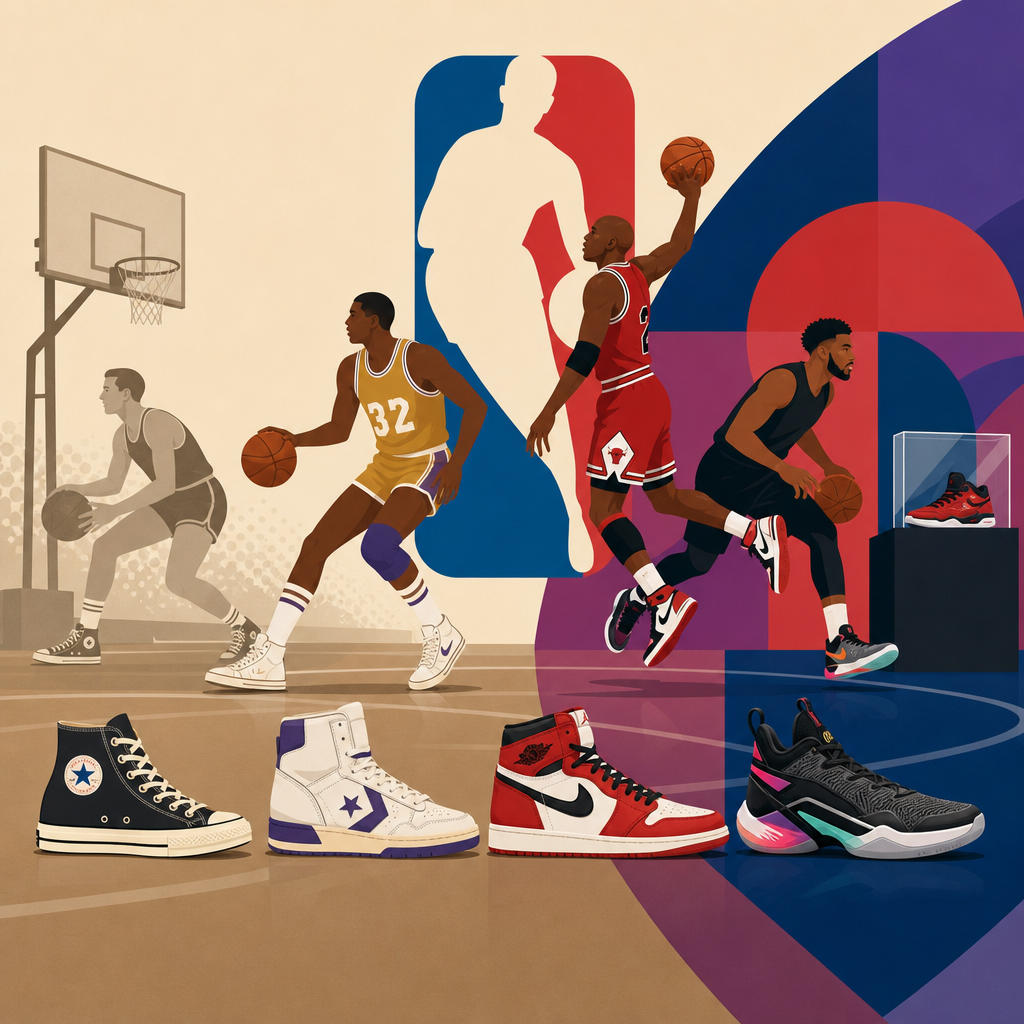
NBA sneaker culture history traces the evolution of basketball shoes from simple canvas performance gear to status symbols, collector assets, and identity markers woven into the league’s image. In the NBA, sneakers are not just equipment. They shape player branding, influence fashion trends, drive resale markets, and create some of the strongest links between sports, music, and streetwear. When people talk about gear and style in professional basketball, shoes sit at the center because they combine function, visibility, and storytelling better than any other item a player wears.
To understand modern NBA sneaker culture, it helps to define the core terms. Performance basketball shoes are built for court movement, traction, cushioning, support, and fit. Signature shoes are models designed around one player’s name, style, and marketing identity. Player exclusives, often shortened to PEs, are special editions made for a specific athlete and not always sold to the public. Limited releases are retail drops produced in restricted quantities, usually with unique colorways, collaborations, or event-driven themes. Together, these categories explain how the NBA moved from uniform utility to a complex ecosystem of design, endorsement, collecting, and cultural influence.
This matters because the NBA has become the most style-conscious major sports league in North America. Tunnel walks are covered like fashion week. Draft-night fits are analyzed as carefully as scouting reports. Sneaker contracts can shape an athlete’s off-court profile almost as much as points per game. I have worked on basketball content and product analysis long enough to see one consistent truth: if you want to understand NBA culture, you have to understand what players wear on their feet, why brands fight for those placements, and how fans use shoes to connect with the league. This hub covers that full story, from Converse and canvas uppers to modern exclusives and drop culture.
The Converse Era and the Birth of Basketball Footwear
Before sneaker culture became a business category, basketball shoes were mainly functional tools. Converse dominated the early landscape through the Chuck Taylor All Star, first introduced in the 1910s and promoted heavily in the 1920s and 1930s. For decades, the silhouette became the standard basketball shoe in the United States. Its canvas upper, rubber outsole, and high-top profile provided a simple answer to the needs of the game at the time. NBA players in the league’s early decades wore shoes that today would look minimal, flat, and underbuilt, but in context they represented the accepted performance standard.
Converse built credibility by aligning with top players and teams long before athlete marketing became sophisticated. By the 1960s and 1970s, stars such as Wilt Chamberlain and Julius Erving wore Converse models, helping cement the brand’s basketball legitimacy. The key point is that early NBA footwear culture centered on reliability and league-wide uniformity, not individual expression. Shoes mattered, but they did not yet function as personal billboards. Players had limited color choices, and technology changed slowly. Still, this period established the basic template: the best players could influence what kids wanted to wear, and brands that won the NBA floor could build long-term authority.
Leather, Technology, and Brand Competition in the 1970s and 1980s
The 1970s and early 1980s brought major change. Basketball shoes shifted from canvas to leather, added padding, improved ankle structure, and became more visibly technical. Adidas, Puma, and Nike pushed innovation and competed for player visibility. The rise of television coverage mattered here. As more fans watched games nationally, shoes became easier to notice, and that visibility increased their commercial value. NBA footwear was no longer only about surviving the season. It became part of the entertainment package.
Adidas made a major impact through leather construction and endorsement strategy, while Puma remained relevant through star associations, including Walt Frazier, whose Puma Clyde became one of the first NBA shoes to feel genuinely stylish off the court. That distinction changed everything. A basketball sneaker could now be a lifestyle product as well as sports equipment. Nike, founded in 1964 as Blue Ribbon Sports and renamed in 1971, entered basketball later than Converse or Adidas but understood that athlete storytelling could accelerate market share. By the early 1980s, the ground was set for the endorsement model that would redefine the entire category.
Air Jordan and the Modern Blueprint for NBA Sneaker Culture
No discussion of NBA sneaker culture history is complete without Michael Jordan. When Nike signed him in 1984 and launched the Air Jordan line in 1985, the business model changed permanently. The Air Jordan 1 did not invent basketball shoes, but it created the modern relationship between player, product, narrative, and demand. Nike used color, attitude, and scarcity to make the shoe feel bigger than sport. The often-repeated banned narrative, tied to league uniform rules and Nike’s rebellious marketing, gave the line instant mythology whether consumers understood the regulatory nuance or not.
What made Air Jordan different was the combination of elite performance and emotional branding. Each release connected to Jordan’s competitive identity, on-court achievements, and design innovation, especially through Tinker Hatfield’s work on later models like the Air Jordan III and XI. Visible Air cushioning, elephant print, patent leather, and numbered annual releases gave fans a reason to follow the line like a continuing series. Kids did not simply buy basketball shoes. They bought into Jordan’s story, and that story expanded globally.
Jordan Brand also normalized the idea that one player’s sneaker line could become a self-sustaining cultural universe. That principle still governs the industry. Every major signature model now tries to capture some version of that formula: clear athlete identity, memorable design language, compelling launch story, and collectible afterlife.
The Signature Shoe Boom of the 1990s and 2000s
After Jordan proved the ceiling, brands expanded aggressively. The 1990s and early 2000s became the golden age of signature diversification. Nike built lines around Penny Hardaway, Charles Barkley, Scottie Pippen, Jason Kidd, Kevin Garnett, and later LeBron James and Kobe Bryant. Adidas found traction with Kobe before he moved to Nike, then with Tracy McGrady and later Derrick Rose. Reebok created one of the most influential campaigns of the era with Allen Iverson’s Question and Answer series, pairing sharp design with a player whose style, swagger, and cultural resonance reached beyond box scores.
What changed during this period was segmentation. Big men, slashers, guards, and all-around stars were sold different footwear identities. Midsole technologies such as Nike Air, Zoom Air, Adidas Feet You Wear, DMX, and later lightweight foam systems became selling points. The NBA calendar also became a release calendar. All-Star Weekend, playoffs, Christmas games, and draft season turned into launch opportunities. In practical terms, sneaker culture became a year-round content machine, driven by games, commercials, magazines, and later online forums such as NikeTalk and Sole Collector.
| Era | Defining Brands | Key Player | Main Culture Shift |
|---|---|---|---|
| 1950s to 1970s | Converse | Julius Erving | Shoes as standard performance gear |
| 1980s | Nike, Adidas | Michael Jordan | Signature storytelling and mass demand |
| 1990s to 2000s | Nike, Reebok, Adidas | Allen Iverson | Player identity and lifestyle crossover |
| 2010s to today | Nike, Jordan Brand, Adidas, Under Armour, Puma, New Balance | LeBron James | Limited releases, resale, fashion integration |
How NBA Players Turned Sneakers into Personal Style Statements
As dress codes, television exposure, and social media evolved, players gained more control over image. On-court color restrictions loosened over time, especially after the NBA adjusted footwear rules in the 2010s. That change encouraged more player-specific colors, tribute designs, and storytelling details. A modern NBA shoe might reference a hometown, family member, school, charitable cause, or nickname. These details matter because they transform a product from generic equipment into visible autobiography.
Allen Iverson was a turning point because his shoes were inseparable from his broader style influence. He brought hip-hop aesthetics, unapologetic individuality, and authenticity to the league’s fashion conversation. Later, tunnel-walk culture amplified that model. Russell Westbrook, P.J. Tucker, Kyle Kuzma, Shai Gilgeous-Alexander, and Devin Booker helped make pregame arrival imagery part of the media cycle. Tucker in particular became famous for wearing ultra-rare pairs on court, proving that NBA players themselves could function as top-tier collectors and curators.
From direct observation of how fans discuss gear, one thing stands out: they respond most strongly when a player’s shoe choice feels consistent with personality. A minimalist star in loud footwear can feel forced. A player with a clear aesthetic point of view can make even a simple colorway memorable.
Player Exclusives, Limited Releases, and the Resale Economy
Exclusive limited releases are the clearest sign that NBA sneaker culture now operates like both sports merchandising and luxury retail. A player exclusive differs from a standard general release because it is usually produced for team use, athlete wear, or highly restricted distribution. Some PEs become legends precisely because fans cannot buy them easily. Think of special Kobe Bryant team colorways made for colleges, rare LeBron samples, or P.J. Tucker’s one-of-one game pairs. Scarcity creates social value, and social value drives demand.
Limited releases expanded dramatically in the 2010s with the growth of SNKRS, Confirmed, boutique raffles, StockX, GOAT, and stadium consignment stores. The mechanics are simple. A brand releases fewer pairs than market demand. Buyers compete at launch. Missed buyers move to resale, often at a premium. High-profile collaborations, holiday launches, playoff storylines, and retro anniversaries increase urgency. The result is an aftermarket where some basketball shoes trade like collectibles. Price depends on condition, rarity, historical importance, and cultural relevance rather than only performance quality.
This system has benefits and drawbacks. Limited releases create excitement, preserve prestige, and reward strong storytelling. They also frustrate regular consumers, attract bots, and shift attention from hooping to speculation. Serious coverage of NBA gear and style has to acknowledge both sides. Not every important shoe is impossible to get, and not every expensive pair matters culturally.
Retro Culture, Collaborations, and the Fashion Industry Connection
Retro basketball sneakers became powerful because nostalgia is a reliable market force. Jordan retros proved that fans would buy old models repeatedly if brands managed colorways, quality, and timing well. Soon, other labels revived classic basketball silhouettes from Penny, Iverson, Grant Hill, and Kobe eras. These retros appeal to older fans who watched the original moments and younger consumers who discover them through highlights, music videos, and social media archives.
Collaborations pushed the category even further into fashion. When designers, boutiques, musicians, or streetwear labels reinterpret basketball shoes, they add new audiences without erasing the NBA connection. Virgil Abloh’s work on Nike silhouettes, Ronnie Fieg’s retail collaborations, and high-end presentations from brands like Fear of God Athletics show how far the category has moved beyond the hardwood. Yet the most successful projects still preserve basketball credibility. A shoe with no authentic link to the game rarely carries the same weight in NBA culture as one rooted in league history or player use.
The same pattern applies to apparel and accessories around sneakers. Compression gear, socks, warmups, travel fits, and even sneaker cases now support the broader gear-and-style ecosystem. The shoe remains the anchor, but it pulls an entire visual language with it.
The Current NBA Sneaker Landscape and What Comes Next
Today’s NBA sneaker market is more fragmented and more creative than ever. Nike and Jordan Brand still dominate league-wide visibility, but Adidas, Under Armour, Puma, New Balance, Anta, Li-Ning, and Skechers all compete for relevance through signatures, team deals, and player-specific narratives. Stephen Curry built Under Armour into a basketball force. Kawhi Leonard gave New Balance credibility in the performance conversation. Puma returned aggressively with LaMelo Ball, whose MB line proved that younger players can still generate major signature energy if the design feels fresh and the marketing feels native to digital audiences.
Performance design is also changing. Modern shoes balance containment, lightweight materials, energy return, and low-to-the-ground court feel. Brands now speak in terms of cushioning setups, shank plates, traction patterns, and upper containment systems because players are more informed buyers. At the same time, consumers care about sustainability, manufacturing scale, and durability. Those concerns will shape the next phase of NBA sneaker culture just as much as celebrity endorsement.
NBA sneaker culture history shows a clear pattern: the shoes that last are the ones that connect performance, personality, and story. From Converse basics to Air Jordan mythology to exclusive limited releases, every major shift has reflected a bigger change in how the league presents itself. For fans exploring NBA gear and style, sneakers are the best entry point because they reveal the intersection of sport, commerce, design, and self-expression in one object. Start with the eras, learn the signature lines, watch what players wear now, and follow how each release connects to the culture around the game.
Frequently Asked Questions
1. How did NBA sneaker culture begin, and why were early basketball shoes so different from today’s models?
NBA sneaker culture began with function, not fashion. In the early decades of professional basketball, players wore simple canvas high-tops such as Converse Chuck Taylors because the market for basketball-specific footwear was still undeveloped. Shoes were designed primarily to provide basic grip, ankle coverage, and durability on hardwood courts, not to express individuality or build an athlete’s public image. At that stage, sneakers were viewed as equipment in the same way as a jersey or a pair of socks. They were practical tools for a growing sport, and most players had limited choice in what they wore.
What makes that era so important is that it established sneakers as part of the visual identity of basketball, even before brands understood their cultural potential. As the NBA became more visible through television and media coverage, fans started noticing what players wore on their feet. Over time, companies realized that performance innovation could be paired with marketing. Materials improved, cushioning systems developed, and design moved beyond plain canvas into leather uppers, stronger support structures, and more distinct silhouettes. That transition laid the foundation for modern sneaker culture, where shoes are expected to deliver elite performance while also representing personality, status, and style.
In other words, early basketball shoes were different because the game, the business, and the audience were different. The league had not yet become a global entertainment force, and sneakers had not yet become cultural symbols. Once basketball grew into a media-driven sport and athletes became marketable stars, shoes evolved from standard issue gear into one of the most powerful products in sports culture.
2. What role did signature shoes play in transforming NBA sneakers into cultural icons?
Signature shoes changed everything because they connected a product directly to a player’s identity. Instead of selling a generic basketball shoe, brands began selling the story, style, and aura of a specific athlete. This was a major shift in both sports marketing and consumer behavior. A signature shoe allowed fans to feel connected to their favorite player, not just through admiration, but through ownership. Buying the shoe meant buying into a persona: excellence, confidence, rebellion, flash, work ethic, or cool.
The biggest turning point came when brands recognized that a player could become larger than the game itself from a marketing standpoint. Signature sneakers made stars into global brands, and no discussion of NBA sneaker history is complete without recognizing how transformative that idea became. Once a shoe carried an athlete’s name, number, logo, or personal design language, it became more than performance footwear. It became storytelling in product form. The colorways, ad campaigns, and limited editions built emotional value around the shoe, and that emotional value often mattered just as much as the technical specs.
Signature lines also helped shape the hierarchy of the sneaker industry. They elevated certain players into commercial powerhouses and gave brands a reason to invest heavily in innovation and image. Over time, signature models became milestones in sneaker culture because they reflected what the league valued in each era. Some represented dominance and championship pedigree, others represented style and swagger, and others symbolized youth appeal or crossover influence into music and streetwear. That is why signature shoes remain central to NBA sneaker culture: they turned footwear into legacy.
3. How did NBA sneakers become connected to fashion, hip-hop, and streetwear?
The connection developed naturally because the NBA sits at the crossroads of sport, celebrity, and visual culture. Basketball players are uniquely visible athletes. Their footwear is on display throughout games, warmups, tunnel walks, commercials, and social media. As the league’s popularity expanded, especially from the 1980s onward, sneakers began moving beyond the court into everyday style. Fans were no longer wearing basketball shoes because they played basketball. They were wearing them because the shoes looked good, signaled taste, and carried cultural meaning.
Hip-hop played a huge role in accelerating that shift. Rappers embraced basketball sneakers as part of their personal style, and that endorsement gave sneakers relevance far beyond sports. At the same time, urban fashion and streetwear scenes adopted NBA footwear because it represented authenticity, aspiration, and access to a broader cultural conversation. A basketball shoe could communicate familiarity with the league, appreciation for design, and connection to the style of influential artists and athletes. That made sneakers powerful symbols across multiple communities at once.
The NBA also helped normalize fashion as part of an athlete’s identity. As player entrances, media appearances, and off-court style became more visible, sneakers took on an even larger role. Shoes began to complement outfits, support personal branding, and anchor entire fashion trends. Limited collaborations between athletes, designers, musicians, and brands pushed that relationship even further. Today, the line between basketball footwear and streetwear is extremely thin because NBA sneaker culture helped erase the boundary. What started on the hardwood now shapes how people dress in cities around the world.
4. Why are limited releases and resale markets such a major part of modern NBA sneaker culture?
Limited releases matter because scarcity creates desire. In modern sneaker culture, exclusivity is often just as influential as performance or design quality. When a brand ties a shoe to a major NBA star, a memorable game, a playoff moment, or a special collaboration, the product gains narrative value. If that shoe is released in small quantities, demand rises quickly. Fans, collectors, and resellers all compete for access, which turns the release into an event rather than a standard retail launch.
The resale market grew out of that dynamic. Once people realized certain NBA-connected sneakers could sell for well above retail price, shoes began functioning as collectible assets in addition to wearable products. This changed how consumers approached sneaker buying. Some wanted pairs to wear, some wanted them to display, and others wanted them as investments. In each case, the shoe’s association with a player, a moment, or a cultural trend helped determine its value. A limited release tied to a superstar or a historically important design could become highly sought after almost instantly.
This system also reflects how deeply sneakers are tied to identity and status. Owning a rare pair can signal dedication, knowledge, and access within sneaker communities. At the same time, it has made the culture more competitive and, in some cases, more frustrating for everyday buyers. Still, there is no question that limited drops and resale platforms have become central to the modern NBA sneaker ecosystem. They amplify hype, extend the life of a release, and reinforce the idea that basketball shoes now exist at the intersection of sports, fashion, collecting, and commerce.
5. Why do sneakers remain so important to NBA player branding and the league’s overall image today?
Sneakers remain essential because they give players one of the clearest ways to express individuality within a team sport. Uniforms are standardized, but shoes offer room for personal storytelling through colorways, custom editions, causes, tributes, and brand partnerships. For fans, that makes footwear one of the most immediate and memorable parts of a player’s image. A signature silhouette, a player-exclusive colorway, or a notable game-worn pair can become inseparable from an athlete’s reputation and era.
From a branding perspective, sneakers create long-term value that extends well beyond box scores. A great player may be remembered for championships and highlights, but sneakers help translate that legacy into a product line, a visual language, and a broader cultural footprint. That is why brands invest so heavily in athlete partnerships. The right shoe can strengthen a player’s marketability, connect them to new audiences, and keep their influence alive even after retirement. In many cases, a legendary sneaker line becomes part of the athlete’s permanent legacy.
For the league, sneakers enhance the NBA’s image as a style-driven, personality-rich global brand. They contribute to storylines, drive fan engagement, and help the NBA stand out from other sports. Sneaker conversations link game performance to fashion coverage, social media buzz, endorsement news, and collector culture. That broad appeal is one reason basketball has such a powerful presence in global youth culture. Sneakers are not a side detail in the NBA story. They are one of the main ways the league connects competition, commerce, creativity, and cultural influence.