
Finger tape is one of the most visible details in NBA gear and style, yet most fans only notice it after a close-up of a shooter at the free-throw line or a ball handler adjusting his hand during a timeout. In professional basketball, players tape their fingers for two primary reasons: injury prevention and functional support. The tape can limit painful motion after a sprain, stabilize a jammed joint, protect skin from splits and abrasions, and help an athlete finish a game or practice without worsening minor damage. It also fits squarely within the broader culture of NBA gear, where every visible accessory, from compression sleeves to ankle braces, reflects a blend of performance needs, medical advice, routine, and personal preference.
When people ask why NBA players tape their fingers, they are usually asking a bigger question about how hand health affects performance. Basketball is a hand-dominant sport. Players catch hard passes, absorb contact at the rim, swipe for steals, fight through screens, and release hundreds of shots every week. The fingers and thumbs take constant microtrauma. A point guard with a sore proximal interphalangeal joint may still dribble, but his handle can feel less secure. A wing with a sprained thumb metacarpophalangeal joint may still shoot, but ball control on the gather becomes less natural. Small injuries matter because elite skill depends on fine motor control, touch, and confidence.
In team settings, I have seen finger taping treated less like a fashion statement and more like routine maintenance. Athletic trainers evaluate swelling, range of motion, tenderness, and joint laxity, then decide whether a player needs buddy taping, a figure-eight wrap, thumb spica support, or simple protective strips over vulnerable skin. The goal is not to create a rigid cast. The goal is to preserve as much normal function as possible while reducing painful or excessive movement. That balance explains why finger tape looks light and minimal compared with braces worn on larger joints.
This matters for anyone trying to understand NBA gear and style because finger tape sits at the intersection of sports medicine and on-court identity. Some players wear it only after injury. Others make it part of a consistent game-day setup because routine improves comfort and focus. In this hub for gear and style, finger tape is a useful starting point: it shows how even the smallest equipment choice can affect health, feel, and performance in measurable ways.
What finger tape does on an NBA court
Finger tape works by adding external support to small joints that absorb repeated force. In practical terms, that means the tape can reduce end-range motion, provide compression to manage mild swelling, and create a tactile reminder that discourages risky movement. For an NBA player, this can be the difference between a manageable annoyance and a problem that disrupts dribbling, passing, rebounding, or shooting. Tape does not heal tissue by itself, but it can protect healing tissue while the athlete continues to compete.
The most common basketball issues involve jammed fingers, collateral ligament sprains, thumb sprains, and skin damage. A jammed finger usually occurs when the ball strikes the fingertip and drives the joint backward, often affecting the PIP joint in the middle of the finger. Collateral ligament sprains happen when the finger is forced sideways. Thumb sprains are especially significant because the thumb is essential for grip, ball pickup, and control through contact. In all of these situations, athletic tape helps by reducing stress on the injured structure.
There is also a performance component that casual viewers underestimate. A taped finger can improve confidence. That matters because hesitant hand use changes mechanics. Shooters may avoid full follow-through, rebounders may stop attacking the ball with both hands, and defenders may pull back from disruptive swipes. The tape itself is not enhancing athletic ability in the way a stronger tendon or faster reaction time would. Instead, it preserves usable function by making pain and instability less intrusive.
Rules and practicality shape how tape is applied. NBA players cannot wear gear that presents a safety risk or gives an unfair advantage, so taping must remain functional, streamlined, and nonhazardous. Trainers usually keep applications low profile so the player can still feel the seams of the ball. Too much tape can become counterproductive by reducing tactile feedback and making release mechanics feel unnatural.
Common injuries that lead players to tape fingers
The NBA schedule creates ideal conditions for hand injuries. Players handle the ball daily, travel constantly, and have limited recovery windows between games, practices, film sessions, and strength work. Finger injuries are common because the hands are exposed in almost every basketball action. Even minor trauma can linger when there is no true opportunity for complete rest.
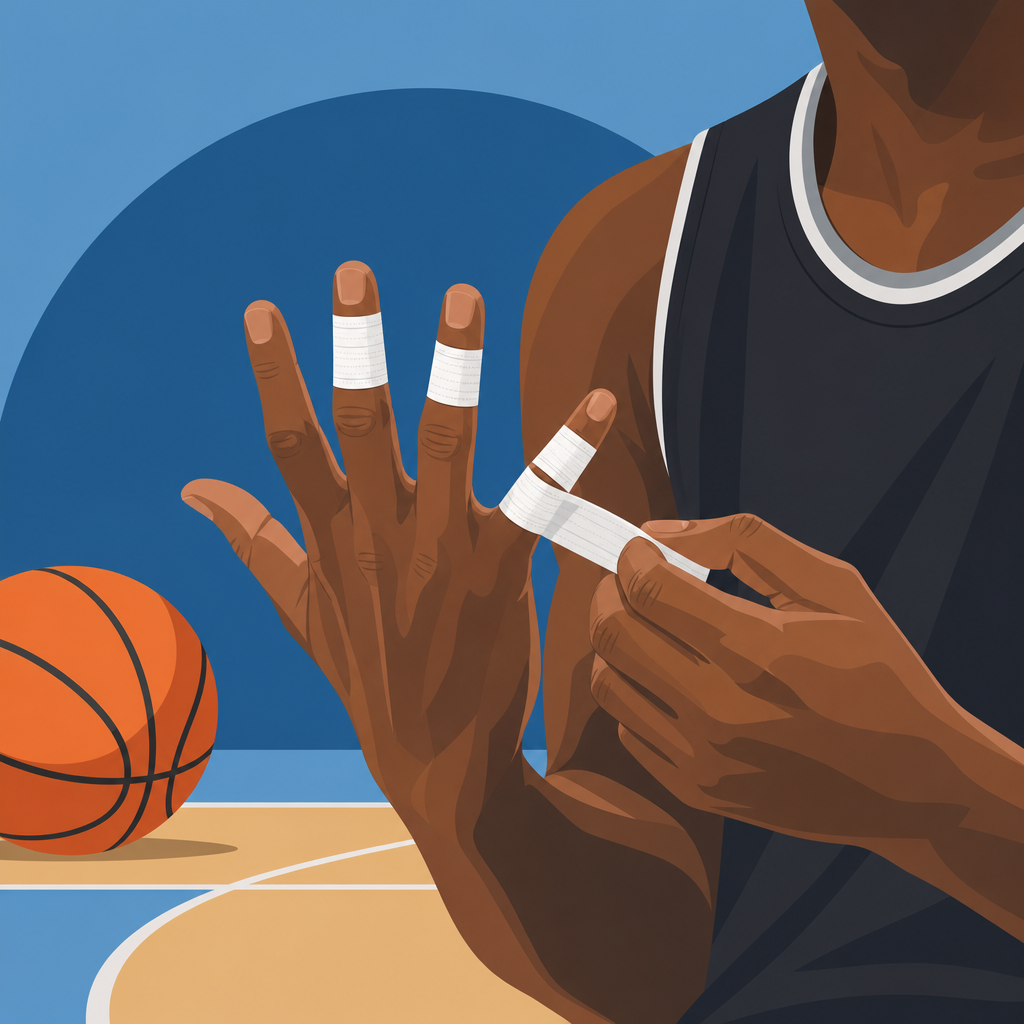
Jammed fingers are the classic example. A player reaches for a deflection, the ball catches the tip of the finger, and the joint swells almost immediately. If the ligaments remain mostly intact, the medical staff may tape the finger to a neighboring finger for support, a method commonly called buddy taping. This allows continued participation while limiting side-to-side stress. Many guards and wings have played through this kind of issue because full immobilization would be more disruptive than the injury itself.
Thumb injuries are often more consequential. The thumb contributes heavily to grip strength and ball security. A player with a sprained thumb may struggle to palm the ball, absorb passes, or control a dribble in traffic. Trainers may use a thumb spica style wrap to support the base joint while leaving enough freedom for shooting and passing. Big men dealing with heavy contact in the paint often need thumb protection because rebounds and strips place high stress on the joint.
Dislocations and ligament injuries can require more than standard taping, but tape still plays a role during return to play. After a reduction, splint period, or rehabilitation block, a player may re-enter competition with protective taping to reduce reinjury risk. Skin injuries are another overlooked reason. Repeated friction, dry conditions, and contact with jerseys or defenders can split skin around the fingertips or knuckles. In those cases, tape functions as a barrier rather than a stabilizer.
| Issue | Typical cause | How tape helps | Performance concern |
|---|---|---|---|
| Jammed finger | Ball hits fingertip and forces joint backward | Limits painful motion and adds light support | Catching passes and shooting touch |
| Collateral ligament sprain | Finger bent sideways during contact | Buddy taping reduces lateral stress | Secure dribble and hand fighting on defense |
| Thumb sprain | Ball stripped, awkward fall, or rebound contact | Thumb wrap supports grip-related structures | Ball control, palming, and passing |
| Skin split or abrasion | Friction, dryness, repeated contact | Creates protective barrier over vulnerable area | Comfort, grip consistency, and pain tolerance |
How athletic trainers decide when and how to tape
Finger taping in the NBA is usually guided by the training staff, not by improvisation. A certified athletic trainer or team medical professional examines the injury, asks about mechanism and symptoms, and checks whether the problem is stable enough for continued participation. Swelling pattern, bruising, loss of grip strength, and point tenderness all matter. If there is concern for fracture, tendon injury, or significant instability, imaging and a more protective plan may be necessary.
Once a player is cleared to practice or play, the taping method depends on the exact structure involved. Buddy taping is common for lesser finger sprains because the adjacent finger acts as a splint while preserving general hand use. Figure-eight configurations can support interphalangeal joints while allowing some flexion. Thumb applications are more specialized because the trainer must protect the joint without removing the athlete’s ability to handle the ball naturally.
Material choice matters too. Standard zinc oxide athletic tape offers firm support and stays secure with sweat, while cohesive wraps can add comfort in layered applications. Some trainers place pre-wrap or padding under the tape if skin irritation is a concern, though too much bulk can reduce feel. Application tension is critical. Tape that is too loose provides little benefit. Tape that is too tight can impair circulation, increase discomfort, or make the hand feel clumsy.
Good taping is also dynamic, not static. Staff members often retape at halftime, after warmups, or when sweat loosens the original application. Players give immediate feedback: Does the joint feel supported? Can you still snap a pass? Does the release feel normal? In my experience, the best game-day taping jobs are the ones the player stops thinking about after the first few possessions.
Does finger tape help or hurt shooting and ball handling?
The short answer is that properly applied finger tape usually helps more than it hurts when an injury is present, but the margin is narrow. Basketball skill depends on sensory feedback. Players feel the seams, adjust pressure with each finger, and rely on subtle hand positioning throughout the shot pocket and release. Heavy or poorly placed tape can interfere with that process. That is why NBA finger tape tends to be minimal and targeted.
For shooters, the greatest risk is changing the release pattern. Tape across a knuckle can alter flexion timing, and bulky wrapping on the index or middle finger may affect the final contact point on the ball. Players and trainers counter this by leaving the fingertip free, avoiding unnecessary layers, and testing the wrap during pregame shooting. If the player reports that the ball is sticking or rolling differently, the application gets modified.
Ball handlers care most about grip and confidence under pressure. A stable finger or thumb can make crossovers, gathers, and pocket passes feel safe again after injury. Tape may slightly reduce raw feel, but instability is usually more harmful than a small loss of sensation. This is especially true for players returning from sprains who need to trust the hand when absorbing contact from defenders.
There are limits. Tape cannot compensate for a serious structural problem, and some injuries simply make elite touch impossible until healing progresses. That tradeoff is common across NBA gear and style. Accessories are useful because they solve specific problems, not because they remove the body’s physical constraints.
Finger tape as part of NBA gear and style culture
Within the larger world of NBA gear and style, finger tape occupies a distinctive place because it is both practical and personal. A shooting sleeve or signature shoe can be brand-forward and immediately recognizable, but finger tape often signals something more intimate: maintenance, resilience, and ritual. Fans may associate taped fingers with toughness because the visual cue suggests a player is managing pain while still competing.
That visibility has cultural value. Television close-ups turn small details into recognizable signatures, and players often develop consistent taping patterns that become part of their on-court look. Yet unlike purely aesthetic accessories, finger tape usually starts with a medical reason. Over time, the look can persist because athletes are creatures of habit. If a player had success while wearing a certain configuration, he may keep using it even after the acute injury settles, much like a golfer who refuses to change a grip or a pitcher who repeats a precise pre-pitch routine.
This is why a gear and style hub should treat finger tape as foundational rather than incidental. It connects to other subtopics naturally: shoes and traction, sleeves and compression, ankle support, knee pads, shooting accessories, and even uniform-era aesthetics. Every category raises the same underlying questions. What problem is this item solving? What tradeoff does it create? Why does one player swear by it while another avoids it completely?
For readers exploring NBA Culture through gear and style, finger tape offers the clearest lesson: equipment choices in basketball are rarely random. They are responses to biomechanics, injury history, comfort, confidence, and routine. The look matters, but the function comes first.
What fans, players, and coaches should understand
Fans should read finger tape as information, not decoration. It often indicates recent trauma, ongoing management of a chronic irritation, or a player-specific preference shaped by repetition. Players at every level should understand that copying an NBA taping style without knowing the underlying issue is not automatically useful. The same wrap that helps a sprained ring finger could hinder a healthy shooter’s touch. Coaches should treat recurring finger problems seriously because small hand injuries can quietly erode passing accuracy, finishing confidence, and defensive aggression over time.
The biggest takeaway is simple. NBA players tape their fingers because hands are central to every basketball skill, and even minor instability or pain can have outsized effects on performance. Proper taping supports vulnerable joints, protects skin, and allows athletes to keep functioning at a high level while healing progresses. It is one of the clearest examples of how sports medicine shows up in visible gear.
As a hub topic within NBA gear and style, finger tape also points readers toward the broader logic behind basketball accessories. The best equipment choices are individualized, tested in real movement, and adjusted to balance protection with feel. That principle applies whether the subject is finger tape, ankle braces, compression gear, or footwear setup.
If you are building a deeper understanding of NBA Culture, start with the details players trust most. Watch the hands during warmups, notice who gets retaped during breaks, and compare how different athletes use support. Those small choices explain a lot about durability, performance, and style on an NBA court.
Frequently Asked Questions
Why do NBA players tape their fingers during games and practices?
NBA players tape their fingers mainly for injury prevention and functional support. Basketball places constant stress on the hands through dribbling, passing, catching, rebounding, and absorbing contact, so finger joints are regularly exposed to bending, jamming, twisting, and hyperextension. Tape helps limit painful or excessive motion after a minor sprain, supports a finger that has already been jammed, and adds stability to vulnerable joints without completely taking away movement. It can also protect the skin from splits, friction burns, and abrasions that happen when players repeatedly handle the ball or make contact with opponents.
In many cases, finger tape is not about making a player stronger or more stylish, even though it has become a recognizable part of NBA gear. It is often a practical tool that allows an athlete to keep training or finish a game while reducing discomfort. For elite players, even a small amount of added support can make a difference because hand function affects ball control, shooting touch, passing accuracy, and confidence. That is why finger tape remains so common at the professional level: it offers a simple, fast, and effective way to protect one of the most heavily used parts of a basketball player’s body.
Does finger tape actually help prevent injuries, or is it mostly for comfort?
Finger tape can genuinely help prevent certain minor injuries and reduce the risk of aggravating existing ones, although it is not a guarantee against damage. Its biggest benefit is mechanical support. By reinforcing a finger joint, tape can limit awkward movement that might otherwise worsen a mild sprain or create more pain after a jammed finger. It also serves as a reminder to the athlete to be careful with that hand, which can influence how forcefully they catch passes, fight through contact, or brace during falls.
That said, finger tape works best as one part of a broader injury-management strategy. NBA players also rely on athletic trainers, strengthening work, recovery protocols, and proper diagnosis when a hand injury occurs. Tape is especially useful for smaller issues like mild instability, tenderness, skin protection, or post-injury support, but it cannot fully protect against the force of a hard pass, a collision at the rim, or an opponent striking the hand. So the honest answer is that it helps both with prevention and comfort. It offers meaningful support in many real basketball situations, but it is most effective when used correctly and paired with professional medical guidance.
Does taping fingers affect shooting, dribbling, or ball handling performance?
It can, but usually in a controlled and often beneficial way when applied properly. Basketball performance depends heavily on fingertip feel, grip, flexibility, and fine motor control, so anything placed on the fingers has the potential to change touch. If tape is too thick, wrapped too tightly, or placed across important contact areas, it may interfere with a player’s feel for the ball. Shooters may notice a slight change in release, and ball handlers may initially feel less natural control when dribbling or palming.
However, when tape is applied by experienced athletic trainers, the goal is to protect the finger while preserving as much normal function as possible. In many cases, players perform better with tape because the added stability reduces pain and gives them more confidence using the injured or vulnerable finger. A player who is worried about a sore joint may hesitate on catches, avoid certain passes, or alter shooting mechanics. Tape can reduce that hesitation. For this reason, the tradeoff is often worthwhile: a small reduction in unrestricted feel may be far less important than the benefit of being able to handle the ball comfortably and play through minor hand issues at a high level.
What kinds of finger problems are NBA players trying to manage with tape?
Finger tape is commonly used to manage jammed fingers, minor sprains, joint instability, swelling, skin splits, cuts, and abrasions. In basketball, one of the most frequent hand issues occurs when a finger gets struck by the ball at an awkward angle or caught against another player. That can lead to pain, swelling, and limited mobility in the small joints of the finger. Tape helps support the affected area and can reduce stress during continued play. Players may also tape adjacent fingers together, a method often called buddy taping, to create extra stability while still allowing hand use.
Beyond joint support, tape is also valuable for skin protection. Repeated contact with the ball, hardwood floor, jerseys, and other players can create raw spots or cause skin to split, especially around knuckles or fingertips. Even a small crack in the skin can be surprisingly painful for someone who needs constant hand contact. In that situation, tape acts like a protective barrier. For NBA players, these issues may look minor from the outside, but because hand precision is so essential, even small finger problems can affect shooting rhythm, passing sharpness, and overall comfort on the court.
Why do some NBA players wear tape all the time, even when they do not seem injured?
Some players tape their fingers regularly because they have a history of recurring hand injuries, chronic joint looseness, or areas that are easily irritated during play. Once a finger has been sprained or jammed multiple times, an athlete and training staff may decide that preventive taping is worthwhile before every game and practice. In that sense, the tape becomes routine maintenance rather than a sign of a brand-new injury. It can provide consistency, reassurance, and a familiar level of support that helps the player feel ready from the opening tip.
There is also an element of habit and individual preference. Professional athletes are extremely sensitive to small details in their equipment and body preparation. If a player believes taped fingers improve comfort, reduce postgame soreness, or help protect problem areas, that routine may stay in place long term. While fans may sometimes interpret finger tape as a fashion statement, its continued use is usually rooted in function. At the NBA level, players and medical staffs make these decisions carefully because hand health directly affects performance. What looks like a minor strip of tape often reflects an ongoing effort to preserve durability, manage wear and tear, and keep a player effective over the course of a long season.