
NBA fashion has never been just about uniforms; it has been a visible record of how basketball, music, race, commerce, and celebrity have evolved together in American culture. When people talk about player style, they usually mean two connected arenas: on-court gear, such as jerseys, sneakers, sleeves, and fit changes that affect performance and league identity, and off-court fashion, including tunnel outfits, tailoring, streetwear, jewelry, and brand collaborations that shape public image. As someone who has covered basketball culture and tracked apparel trends season after season, I have seen how style choices often signal bigger changes before the standings or transaction wire do. A longer short, a slimmer jersey, a luxury sneaker partnership, or a pregame walk photographed like a runway can tell you where the league is headed.
This matters because NBA style now influences far more than fan merchandise. It drives sneaker markets, fuels social media engagement, creates endorsement categories, and helps players build businesses that outlast their careers. It also affects how teams, sponsors, and media package the sport. The NBA’s dress history reflects broader shifts in masculinity, Black cultural expression, globalization, and athlete empowerment. From Converse high-tops and short shorts to oversized suits, from the dress code era to today’s luxury-streetwear blend, every decade changed the visual language of basketball. For readers exploring NBA Culture, Gear and Style is a central lane because it connects performance technology, identity, marketing, and fandom in one story. Understanding that evolution makes it easier to understand why modern players arrive at arenas with stylists, why sneaker free agency matters, and why tunnel fashion can generate as much discussion as a box score.
The 1950s through the 1970s: Function First, Personality Emerging
In the early NBA, fashion was mostly functional, even if the look now feels iconic. Players wore short shorts, simple tank jerseys, high socks, and canvas or leather sneakers with little customization. Brands like Converse dominated, especially through the Chuck Taylor All Star, which served as a standard basketball shoe for decades. Uniform construction was basic by modern standards: heavier fabrics, fewer moisture-management features, and limited attention to individualized fit. Off the court, players often appeared in conservative suits because professional athletes were expected to project respectability rather than personal flair. League photography from the Bill Russell, Wilt Chamberlain, and Jerry West years shows a sport still tied to mid-century ideas of professionalism.
Yet style was emerging. Walt Frazier became the clearest early bridge between basketball and fashion celebrity. His fur coats, hats, tailored suits, and jewelry in the late 1960s and 1970s stood apart from the prevailing team-first image. Frazier did not simply dress well; he expanded what an NBA star could look like in public. At the same time, the ABA, though outside the NBA, pushed basketball aesthetics forward with bolder colors, flashier branding, and a freer cultural vibe that influenced the merged basketball landscape. On court, the short-shorts silhouette became part of the sport’s identity, later immortalized by players such as Julius Erving. By the end of the 1970s, basketball style was still restrained compared with later eras, but the groundwork had been laid: gear could carry attitude, and clothing could help define a player’s persona as clearly as a crossover dribble.
The 1980s: Television, Sneaker Marketing, and the Rise of Signature Style
The 1980s changed NBA fashion because the league itself changed. With Magic Johnson and Larry Bird reviving television interest and David Stern steering the NBA into a more polished entertainment product, players became easier to market visually. Uniforms remained relatively short and fitted compared with later decades, but materials improved, team branding sharpened, and color palettes became more memorable. The Los Angeles Lakers’ gold and purple, the Boston Celtics’ classic green, and the Chicago Bulls’ red-black palette were no longer just team identifiers; they became retail assets.
The biggest shift was sneakers. Nike’s partnership with Michael Jordan and the launch of the Air Jordan line in 1984 created a template still shaping player style today. Signature shoes turned on-court performance gear into cultural products with stories, scarcity, and aspirational value. The NBA’s initial resistance to Jordan’s nonconforming footwear only amplified the appeal. Soon, shoes were not merely equipment. They were identity, rebellion, and status. Converse still had major endorsers, including Magic Johnson and Larry Bird through the Weapon campaign, while Adidas and emerging brands competed for visibility, but Jordan changed the stakes permanently.
Off the court, the 1980s NBA player was becoming more camera-conscious. Tailoring was still common, but luxury and flash became more acceptable as player salaries rose and endorsement income grew. Players were no longer just athletes in postgame slacks; they were television personalities entering a more image-driven marketplace. This decade established two lasting truths: footwear could anchor a player’s brand, and visual presentation could expand a career beyond basketball itself.
The 1990s: Hip-Hop Influence, Longer Shorts, and Global Visibility
If the 1980s professionalized NBA style, the 1990s made it culturally dominant. This was the decade when basketball and hip-hop became inseparable in the public imagination. The Fab Five at Michigan, though a college phenomenon, helped normalize baggier shorts, black socks, and a tougher, more street-rooted aesthetic that soon flowed into the NBA. By the middle of the decade, shorts were longer, jerseys looser, and silhouettes noticeably bigger. Players like Michael Jordan also influenced fit; his preference for longer shorts became widely copied across the league and youth basketball. Uniform style no longer looked inherited from earlier generations. It looked contemporary.
At the same time, the NBA’s global expansion increased the value of recognizable style. The Dream Team in 1992 made NBA players worldwide celebrities, and their look, from warmups to sneakers, became exportable culture. Brands responded with more aggressive signature lines and team merchandise programs. Nike expanded beyond Jordan, Reebok built around Shaquille O’Neal and Allen Iverson, and Adidas tied itself to rising stars and street influence. Iverson in particular shifted both on-court and off-court style by bringing cornrows, tattoos, sleeves, and unapologetic hip-hop fashion into the league’s center. He represented a real cultural turn, not just an aesthetic one.
That turn also generated backlash. Critics often framed Black urban style as a professionalism problem rather than what it was: an authentic expression of the era’s dominant youth culture. By the late 1990s, NBA fashion had become a site of debate over image, class, and control. But from a style perspective, the impact was unmistakable. Bigger fits, visible accessories, and a stronger link between music and basketball had reset the visual code of the league.
The 2000s: The Dress Code Era and Fashion as Public Negotiation
No discussion of NBA gear and style is complete without the league dress code introduced in 2005. After years of concern from sponsors and executives about the league’s image, the NBA required players to wear business casual attire during team or league duties. In practice, this meant collared shirts, dress shoes, sweaters, sport coats, and a ban on many items associated with hip-hop fashion, including chains worn outside clothing, sleeveless shirts, headphones during interviews, and certain types of headwear. Commissioner David Stern framed the move as professional branding. Many players and observers saw it as coded cultural regulation.
From my perspective covering this period, the most important outcome was not that players stopped caring about style. It was that they became more strategic. The dress code forced experimentation with tailoring, luxury labels, and polished personal branding. Players such as LeBron James, Dwyane Wade, Chris Paul, and Russell Westbrook learned to use fitted suits, eyewear, knitwear, and designer accessories as forms of self-presentation. What looked restrictive at first eventually expanded the fashion vocabulary of the league.
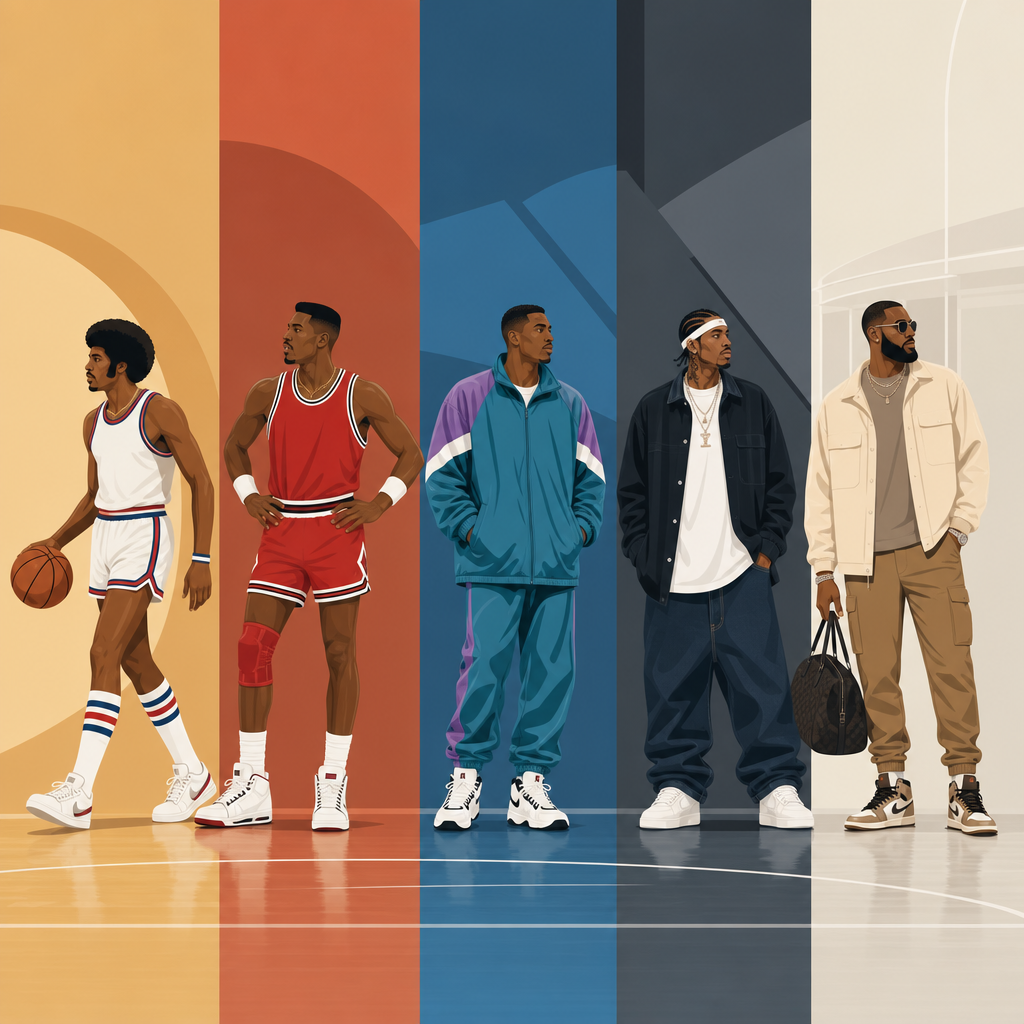
| Decade | On-Court Look | Off-Court Style Signal | Key Influence |
|---|---|---|---|
| 1970s | Short shorts, simple sneakers | Tailored suits, early flair | Walt Frazier |
| 1980s | Fitted uniforms, signature shoes | Polished celebrity image | Air Jordan era |
| 1990s | Longer shorts, looser jerseys | Hip-hop fashion, visible accessories | Fab Five, Iverson |
| 2000s | Sleeves, tech fabrics, branded footwear | Business casual and designer suiting | League dress code |
| 2010s-2020s | Compression wear, low-tops, PE sneakers | Tunnel fashion, luxury streetwear | Social media and athlete brands |
The 2000s also brought technical advances in gear. Moisture-wicking fabrics became standard, compression apparel gained acceptance, and shoe design increasingly relied on cushioning systems, lightweight uppers, and biomechanics testing. Nike Shox, Adidas T-Mac models, LeBron signatures, and Kobe’s eventual move toward lower-profile performance shoes all reflected a deeper merger of design, science, and marketing. By decade’s end, NBA fashion was no longer a side conversation. It was a negotiation between league standards, player individuality, and commercial opportunity.
The 2010s: Tunnel Fashion, Social Media, and the Stylist Era
The 2010s transformed player fashion from a background detail into a content category of its own. Two structural changes explain why. First, social media platforms such as Instagram and Twitter let players publish their own image without relying on team or media gatekeepers. Second, the pregame arena arrival, now widely called tunnel fashion, became a repeatable visual event. Outfits were photographed daily, distributed instantly, and discussed with the same intensity once reserved for sneakers or contract news.
Russell Westbrook was central to this shift. His willingness to wear bold prints, cropped silhouettes, designer layers, and unconventional color combinations made fashion part of his competitive identity. LeBron James refined the powerful-athlete-in-luxury template, while Dwyane Wade embraced tailoring and European fashion influence. James Harden used high-fashion labels and statement accessories to create a distinctive look. P.J. Tucker turned sneaker collecting into a serious subfield of NBA style, wearing rare pairs that connected game performance to collector culture. Serge Ibaka, Kyle Kuzma, Chris Paul, and Jordan Clarkson each helped expand the acceptable range of menswear expression in the league.
This decade also normalized the use of professional stylists. Players treated wardrobe as brand architecture, not impulse shopping. They built relationships with houses such as Thom Browne, Louis Vuitton, Gucci, Prada, and Rick Owens, while still mixing in Fear of God, Off-White, Palm Angels, and other labels linked to luxury streetwear. The point was not simply expense. It was curation. A player’s silhouette, tailoring choice, footwear rotation, and accessory strategy all communicated something about confidence, taste, and market positioning.
On court, style kept evolving too. Compression tights, shooting sleeves, leggings, and personalized player exclusive sneakers became standard visual markers. Kobe Bryant’s embrace of low-top basketball shoes changed performance style significantly; many players adopted lower cuts after seeing elite guards prioritize mobility over old assumptions about ankle support. The modern NBA look became cleaner, more customized, and more individual.
The 2020s: Personal Brands, Inclusivity, and Fashion as Business Infrastructure
In the current decade, NBA fashion functions as business infrastructure. Players are founders, investors, collaborators, and media properties, and clothing is part of that ecosystem. Tunnel fits now reach audiences through team accounts, league channels, fashion publications, and athlete-owned platforms. A strong style identity can support endorsement categories far beyond shoes, including watches, luggage, skincare, jewelry, and luxury travel. Shai Gilgeous-Alexander, for example, has become one of the league’s clearest fashion authorities by pairing high-end labels with a relaxed confidence that feels native rather than forced. His influence matters because it shows how style credibility can expand an athlete’s relevance internationally.
The 2020s also reflect a broader definition of masculinity and self-presentation. Pearls, handbags, cropped jackets, avant-garde tailoring, painted nails, and gender-fluid styling choices appear far more often than they would have a decade earlier. Not every player adopts those looks, but the range itself is significant. The league’s fashion culture now rewards originality more than conformity. At the same time, nostalgia is strong. Players routinely wear throwback jerseys, retro sneakers, and archival sportswear, turning past eras into current fashion currency.
There are practical limits. Team sponsorship obligations, league uniform regulations, and travel demands still shape what players can wear. Not every trend works outside a photo moment, and not every luxury partnership converts into long-term brand equity. But the central truth holds: NBA style is now a professional asset. For young fans, it can be the entry point into basketball culture. For veterans, it can become a second career path in design, retail, media, or investment.
Why Gear and Style Matter Across NBA Culture
Gear and style matter because they connect every layer of NBA Culture. They influence how games look on screen, how players are marketed, how fans buy products, and how athletes express identity under intense visibility. A sneaker launch can revive interest in a player’s archive. A tunnel outfit can introduce a fan to a designer. A uniform redesign can affect merchandise revenue and franchise branding. Even small details, such as leg sleeves, shooting shirts, or color-blocked warmups, shape memory. People remember the Bulls partly through red, the Showtime Lakers through gold, Iverson through braids and arm sleeves, and the Miami Heat’s Big Three through sharply tailored arrivals.
For a hub page, the most useful takeaway is that NBA fashion should be read in layers. First, there is performance gear: shoes, uniforms, compression wear, and fit technology. Second, there is personal branding: tunnel outfits, signature pieces, and collaborations. Third, there is cultural context: music, race, labor, commerce, and media. When those layers align, style becomes historically important, not superficial.
The evolution of NBA fashion shows how the league moved from uniform professionalism to expressive individual branding without losing the competitive edge that makes basketball compelling. Every era added something: the clean functionality of the early decades, the sneaker revolution of the 1980s, the hip-hop imprint of the 1990s, the tailored recalibration of the 2000s, and the digitally amplified fashion ecosystem of today. If you want to understand modern NBA Culture, follow the clothes as closely as the highlights. They reveal how players see themselves, how the league wants to be seen, and where basketball style is going next. Explore the related Gear and Style topics next, from signature sneakers to tunnel fashion icons, to see how each piece of the story fits together.
Frequently Asked Questions
How has NBA fashion changed from the early decades of the league to the modern era?
NBA fashion has evolved from relatively uniform, team-controlled presentation into one of the most visible style ecosystems in sports. In the league’s earlier decades, especially from the 1950s through the 1970s, on-court apparel was functional and limited by manufacturing technology. Short shorts, simple tank jerseys, high socks, and canvas or basic leather sneakers reflected the practical needs of the game more than individual expression. Off the court, players were not yet marketed as lifestyle icons in the way they are today, so personal style received far less media attention, even though many players still expressed identity through tailoring, grooming, and regional influences.
By the 1980s and 1990s, that began to change dramatically. Television growth, sneaker culture, hip-hop’s expanding influence, and the rise of superstars like Magic Johnson, Michael Jordan, Allen Iverson, and others helped turn players into cultural tastemakers. Uniforms became more visually distinctive, signature sneakers became central to player branding, and off-court style became part of how fans understood personality, confidence, and status. The 2000s brought another major shift as oversized fits, luxury labels, and streetwear became tied to athlete image, followed by the league’s dress code era, which pushed public conversation about race, professionalism, and self-presentation to the forefront.
Today, NBA fashion is both highly individualized and deeply commercial. Players use tunnel walks like runways, collaborate with global brands, launch their own labels, and move easily between performance wear, luxury tailoring, and streetwear. At the same time, advances in fabrics, compression gear, footwear engineering, and fit have transformed what players wear on the court. In other words, NBA fashion now operates as a blend of sport, technology, branding, and cultural storytelling, far beyond simple uniforms.
Why is the NBA considered more influential in fashion than many other sports leagues?
The NBA holds a unique place in fashion because its players are unusually visible as individuals. Basketball is played without helmets or face-obscuring gear, which makes players more recognizable and marketable than athletes in many other sports. The NBA calendar also creates frequent public style moments, from pregame arrivals and postgame interviews to All-Star Weekend, playoffs, and offseason events. That steady exposure allows players to build visual identities that fans, brands, and media can follow in real time.
Another major reason is the league’s deep relationship with music, especially hip-hop, which has shaped style language in the United States and globally for decades. NBA players and musicians often occupy overlapping cultural spaces, sharing designers, trends, social circles, and endorsement networks. Because of that, what players wear does not stay inside the sports world. It enters conversations about streetwear, luxury fashion, Black style, masculinity, and celebrity branding. Sneakers are a perfect example: a shoe worn by an NBA star can matter just as much in fashion and youth culture as it does in performance basketball.
The NBA has also benefited from timing and media evolution. The rise of cable sports, then the internet, then social media amplified the league’s style influence. Fans no longer only see players during games; they see arrivals, fits, collaborations, photoshoots, and personal posts. This makes fashion part of a player’s ongoing narrative. In that environment, the NBA became more than a sports league. It became a platform where athletic performance, image-making, and cultural influence reinforce one another.
What role did sneaker culture play in the evolution of NBA player style?
Sneaker culture is one of the most important forces in NBA fashion history because it connected performance innovation with personal identity and consumer desire. Early basketball shoes were built primarily for function, but as competition increased and branding matured, footwear became a way for players to stand out. Signature shoe lines transformed sneakers from equipment into symbols of status, style, and storytelling. Once fans began associating certain silhouettes with specific stars, shoes became a direct bridge between what happened on the court and what people wanted to wear in everyday life.
The Michael Jordan era fundamentally changed the scale of that influence. Air Jordans helped define the model for modern athlete branding, where a player’s image, performance, and lifestyle appeal could drive global retail demand. After that, signature lines were no longer just endorsements; they became extensions of personality. Later generations expanded the blueprint in different ways, whether through the bold attitude associated with Allen Iverson, the performance-driven innovation tied to Kobe Bryant, or the broad lifestyle crossover seen with LeBron James and others. Sneakers became a language of era, position, playing style, and cultural alignment.
Today, sneaker culture remains central because it sits at the intersection of technology, nostalgia, and fashion. Players wear performance models engineered for speed, cushioning, and support, but they also revive classics, debut exclusives, and influence resale markets. Fans pay attention not only to what players wear in games, but also to player-exclusive colorways, collaborations, and archival references. In many ways, the history of NBA fashion cannot be separated from the history of basketball sneakers, because shoes have been the most consistent medium through which player style reaches the public.
How did off-court fashion, especially tunnel style, become such a major part of NBA culture?
Off-court fashion became a major part of NBA culture as media expanded and the definition of athlete visibility changed. In earlier decades, fans mainly encountered players during games, official appearances, or magazine profiles. But as sports broadcasting, entertainment news, digital publishing, and social media grew, more attention shifted to what players wore before tipoff, after games, and during travel. The arena tunnel emerged as an ideal stage because it offered a repeatable, highly photographed moment where players could present themselves on their own terms.
Tunnel style matters because it lets players communicate identity beyond team uniforms. A pregame outfit can signal luxury, hometown pride, artistic taste, political awareness, gender experimentation, or alignment with specific designers and cultural scenes. For some players, a sharply tailored suit projects discipline and polish. For others, oversized streetwear, rare sneakers, jewelry, or archival pieces communicate confidence, trend fluency, and individuality. These choices help shape how players are understood by fans and sponsors, often influencing endorsement appeal as much as on-court performance does.
This rise also reflects a broader change in the role of athletes in public life. NBA players are no longer viewed only as competitors; they are entrepreneurs, tastemakers, activists, and media figures. Tunnel fashion fits naturally into that expanded role because it gives players a controlled form of self-expression in a league environment. What began as a practical walk into the arena has become a powerful cultural ritual, one that connects basketball to fashion week, social media virality, and the modern economics of personal brand building.
How have race, commerce, and celebrity shaped the way NBA fashion is discussed and understood?
NBA fashion cannot be fully understood without recognizing how race, commerce, and celebrity intersect within the league. Because the NBA has long been shaped by Black cultural influence, player style has often reflected broader conversations about respectability, expression, power, and public perception in America. Fashion choices that seem purely aesthetic on the surface can carry deeper meaning when placed in the context of how Black athletes have historically been judged, marketed, celebrated, or criticized. This is one reason debates over “professionalism” in the NBA have often been about more than clothes alone.
Commerce has intensified those conversations by turning style into a major business asset. What a player wears can affect sponsorships, luxury partnerships, sneaker sales, media coverage, and long-term brand value. Companies understand that NBA players do not just sell products; they help define taste. As a result, fashion has become part of the commercial machinery of the league, from signature collections and capsule drops to endorsement campaigns and designer collaborations. Players benefit from these opportunities, but they also operate within systems that package authenticity into marketable image.
Celebrity ties everything together. Modern NBA stars live in a media environment where every appearance can become content and every outfit can become a statement. Their fashion choices are discussed not only by sports fans, but also by style editors, music audiences, and mainstream entertainment media. That cross-industry attention gives NBA fashion unusual cultural weight. It also means that player style functions as a running record of larger social change, documenting how ideas about masculinity, Black identity, luxury, creativity, and influence have shifted over time both within basketball and far beyond it.