

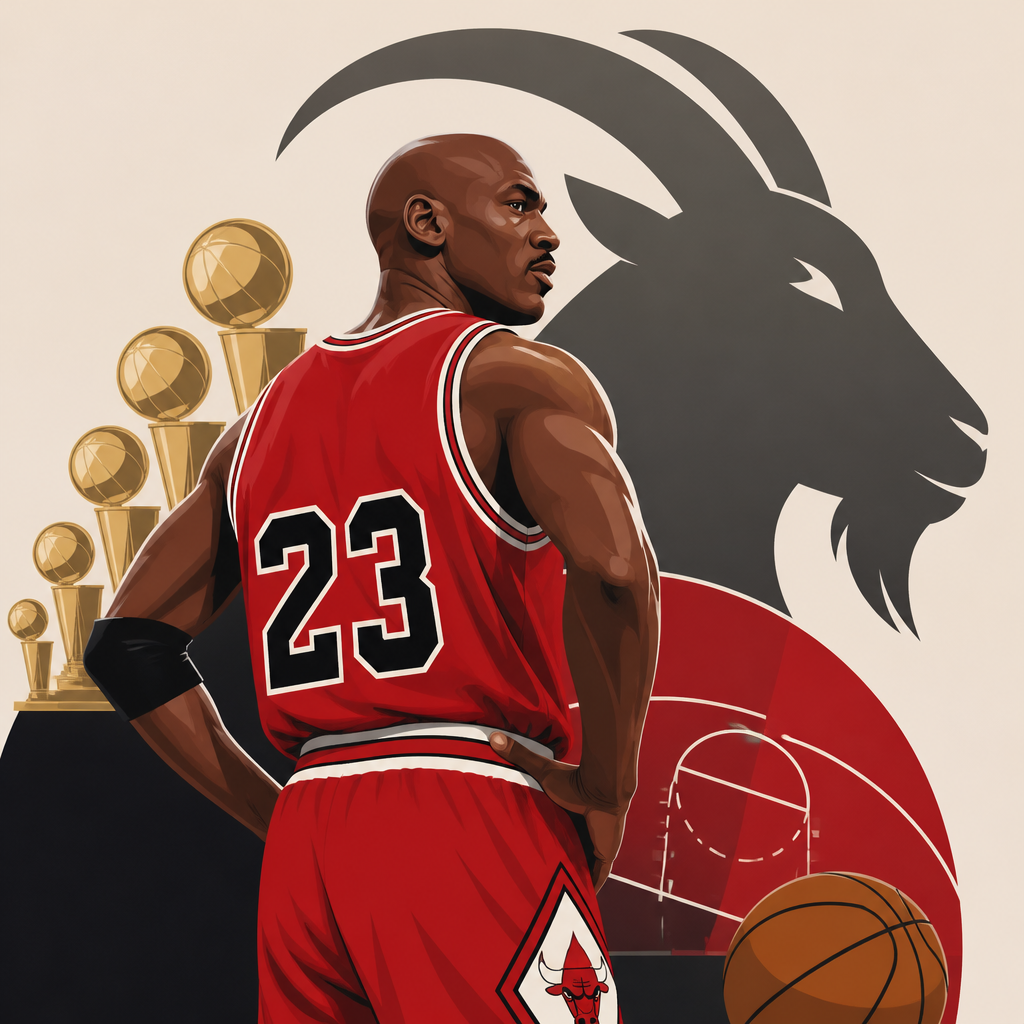
Michael Jordan is called the GOAT because his career combines unmatched peak performance, relentless winning, cultural force, and statistical dominance in ways no other NBA legend has fully matched. In basketball, GOAT means greatest of all time, a label that weighs individual production, team success, longevity, era context, playoff impact, and influence on how the sport is played and remembered. As someone who has spent years studying NBA history through game film, playoff series, team construction, and advanced metrics, I can say the Jordan case remains unusually complete. He was not simply the best scorer of his generation or the star of a dynasty. He was the defining player of the modern NBA, the benchmark for greatness in debates that now include Kareem Abdul-Jabbar, Magic Johnson, Larry Bird, LeBron James, Kobe Bryant, Tim Duncan, Shaquille O’Neal, Wilt Chamberlain, Bill Russell, and Stephen Curry. This hub for Legends and Eras explains why Jordan’s résumé still sets the standard, stat by stat, and how his case fits within the broader history of basketball greatness.
The Core GOAT Argument: Peak, Winning, and Complete Two-Way Play
The quickest answer to why Michael Jordan is called the GOAT is this: his peak was historically high, his teams won at the highest level, and he dominated both ends of the floor. Jordan won six NBA championships in six Finals appearances with the Chicago Bulls, earning Finals MVP every time. No other perimeter player has paired that perfect Finals record with such overwhelming individual control of the series. He also won five regular-season MVP awards, ten scoring titles, one Defensive Player of the Year award, and made nine All-Defensive First Teams. Those honors matter because they show sustained recognition from voters, coaches, media, and opponents over more than a decade.
Jordan’s complete game separates him from pure scorers. He led the league in points per game ten times, but he was also an elite defender, a strong passer from the triangle offense, and an exceptional rebounder for a guard. In film study, what stands out is not just the volume of his production but the flexibility of it. Early in his career, he attacked in transition and lived at the rim. During the first three-peat, he became deadly from the elbows and post. In the second three-peat, he leaned even more on footwork, fadeaways, and strength. Across eras, his game scaled to playoff basketball because it was built on balance, body control, and shot creation under pressure.
Regular-Season Statistics That Built the Foundation
Jordan’s career regular-season average of 30.1 points per game is the highest in NBA history. That number matters because it is not a single hot season or a short prime; it spans 1,072 regular-season games. He also averaged 6.2 rebounds, 5.3 assists, and 2.3 steals, numbers that show broad impact beyond scoring. His player efficiency rating of 27.9 remains among the best ever, and his box plus-minus, win shares per 48 minutes, and value over replacement all place him in the top tier of all-time players. Even before advanced metrics became common language, Jordan’s dominance was obvious in traditional box scores and standings.
Context strengthens the statistical case. The NBA of the late 1980s and 1990s was more physical on the perimeter, hand-checking was legal, spacing was tighter, and teams attempted far fewer three-pointers. Jordan scored at elite volume without the modern benefits of spread pick-and-roll systems and freedom-of-movement emphasis. In 1986-87, he averaged 37.1 points per game, one of the greatest scoring seasons ever, despite defenses built to pack the paint. In 1987-88, he won MVP, Defensive Player of the Year, and the scoring title in the same season, a combination that captures his all-court dominance better than almost any single statistic.
Another often missed point is efficiency relative to role. Jordan’s career true shooting percentage of 56.9 looks ordinary beside some modern stars, but era-adjusted evaluation shows he was consistently well above league average while carrying extraordinary usage. High-volume scorers usually lose efficiency under playoff attention and late-clock responsibility. Jordan largely did not. He absorbed difficult possessions that suppress percentages, then still finished seasons as one of the league’s most efficient primary creators. That blend of burden and productivity is central to the GOAT argument.
Playoff Performance and the Standard for Big Moments
If the regular season established Jordan’s greatness, the playoffs turned it into mythology. He averaged 33.4 points per game in the postseason, the highest in NBA history. That is not a narrow lead; it is a major historical marker considering the quality of competition and defensive preparation in playoff series. Jordan’s famous 63-point game against the 1986 Boston Celtics remains the playoff scoring record for a single game. Larry Bird’s response afterward, calling him “God disguised as Michael Jordan,” has lasted because it captured what opponents felt: even elite defenses could not keep him from reaching his spots.
His playoff résumé is packed with defining moments that also had championship consequences. “The Shot” over Craig Ehlo in 1989 announced him as a closer. The 1991 Finals against Magic Johnson’s Lakers established him as the league’s new center of power. The “Flu Game” in 1997 showed endurance under extreme physical distress. The 1998 steal from Karl Malone and title-winning jumper over Bryon Russell became the perfect closing image for a dynasty. These moments are famous, but they were not isolated miracles. They were extensions of a consistent pattern: Jordan regularly elevated under the highest stakes.
Advanced playoff metrics support the highlight reel. His postseason PER of 28.6 is one of the best ever. He produced elite scoring while maintaining defensive value and low turnover rates relative to usage. In late-game situations, he was trusted to create from isolation, the post, or mid-post actions, and he succeeded against set defenses that knew the ball was coming his way. Great players have signature games; Jordan built a signature postseason.
Championship Résumé and Finals Dominance
Jordan’s six championships from 1991 to 1998 came in two separate three-peats, interrupted only by his retirement and brief baseball career. That structure matters historically. Repeating is difficult; three-peating is rarer; doing it twice is almost unthinkable in the expansion-era NBA, with media pressure, roster wear, and every opponent designing a season around beating Chicago. The Bulls went 6-0 in the Finals during Jordan’s title years, and Jordan was the best player in every one of those series. He averaged 33.6 points per game in the Finals for his career, another all-time standard.
Critics sometimes argue that Finals record can oversimplify broader playoff success, and that is fair in isolation. But with Jordan, the point is not just 6-0. It is that once his supporting cast and system matured, he converted every Finals trip into a title and controlled those series decisively. Against the Lakers, Trail Blazers, Suns, SuperSonics, and Jazz, he solved different styles of defense and exploited different matchups. Portland tried length on the wings. Seattle used Gary Payton’s pressure. Utah played with discipline, size, and continuity. Jordan still won every time.
| Category | Michael Jordan | Why It Matters |
|---|---|---|
| Championships | 6 | Ultimate team result with Jordan as clear lead star |
| Finals MVPs | 6 | Best player in every championship series he won |
| Regular-Season MVPs | 5 | Dominance recognized across multiple seasons |
| Scoring Titles | 10 | Unmatched control of offensive production |
| Defensive Player of the Year | 1 | Rare proof of elite offense and elite defense together |
| Playoff Points Per Game | 33.4 | Highest postseason scoring average in league history |
The titles also changed the shape of NBA history. The Bulls became the defining team of the 1990s, and Jordan prevented several Hall of Fame stars from winning more rings in their primes, including Charles Barkley, Karl Malone, John Stockton, Clyde Drexler, Patrick Ewing, and Reggie Miller. In era analysis, this matters because greatness is partly measured by whose ambitions you stopped. Jordan’s championship run left a long trail of all-time players with fewer banners because they ran into him.
Defense, Competitiveness, and the Parts Stats Miss
Jordan’s GOAT case is often framed around scoring, but that undersells his defensive edge and competitive pressure on games. At his best, he was a devastating point-of-attack defender with elite hands, timing, and anticipation. He led the league in steals three times and made nine All-Defensive First Teams. On tape, he disrupted dribble entries, jumped passing lanes without losing structural discipline, and rotated quickly enough to erase mistakes. Unlike stars who conserve energy on defense, Jordan often treated defense as an extension of personal dominance.
Competitiveness is harder to quantify, but in Jordan’s case it repeatedly translated into outcomes. Teammates and opponents describe a player who attacked practices, regular-season road games, and playoff possessions with unusual intensity. That mindset did not make him flawless; it could be abrasive, and modern leadership standards might judge some of it harshly. But on the court, the effect was real. Chicago played with emotional sharpness because its best player demanded exact execution. Jordan’s late-game composure, willingness to take responsibility, and obsession with exploiting weaknesses created a psychological advantage before the opening tip.
For readers exploring the broader Legends and Eras conversation, this is where Jordan fits differently from many all-time greats. Bill Russell represents the highest defensive championship standard. Wilt Chamberlain symbolizes statistical extremes. Magic and Bird transformed the league’s popularity and style. Kareem brought historic longevity and unmatched scoring totals for decades. LeBron embodies all-around versatility and sustained excellence across eras. Jordan’s unique place is that he combines enough of each category without carrying a clear weakness in the historical debate.
Era Context, Competition, and Common Counterarguments
No GOAT case is complete without addressing era context and objections directly. The strongest argument against Jordan usually centers on longevity. LeBron James has compiled more total points, more All-NBA level seasons, and elite production deep into his late thirties. Kareem Abdul-Jabbar also built a longer prime-plus-longevity profile than Jordan. If a voter values total career accumulation above absolute peak, Jordan does not win automatically. That is a legitimate standard.
Another counterargument says Jordan benefited from Hall of Fame support, especially Scottie Pippen, Phil Jackson, and the triangle offense. He did. Great dynasties always require infrastructure. But that point cuts across NBA history. Magic had Kareem and Pat Riley. Bird had stacked Boston rosters. LeBron won with Dwyane Wade, Chris Bosh, Kyrie Irving, and Anthony Davis. Russell played on loaded Celtics teams. The real question is whether Jordan maximized his environment more completely than other superstars. The answer is yes. Once the Bulls reached title level, they did not lose on the biggest stage.
The weak-era claim also does not hold up well under scrutiny. The 1990s featured elite centers such as Hakeem Olajuwon, David Robinson, Patrick Ewing, and Shaquille O’Neal, plus high-level wings and guards across contenders. Expansion diluted some rosters, but every era has structural quirks, including today’s pace-and-space inflation and previous decades with fewer teams. Jordan cannot be penalized for mastering the conditions in front of him. Historical evaluation should ask who most decisively ruled his own time. Jordan’s answer remains compelling.
Legacy, Cultural Impact, and Why the GOAT Label Endures
Jordan’s case is not only statistical or even only competitive. He changed the commercial and cultural scale of basketball. The Air Jordan brand turned a superstar into a global business model. “Be Like Mike” made him a marketing icon beyond sports. Internationally, the 1992 Dream Team used Jordan as the face of basketball’s worldwide explosion, helping create the global fan culture that later stars inherited. When people picture NBA excellence, they still often picture Jordan’s silhouette, tongue out on drives, elevating for a fadeaway or a dunk.
This matters because the GOAT label is partly about who defines the sport in public memory. Jordan became the standard by which later greats were judged. Kobe Bryant borrowed elements of his footwork and competitive edge. LeBron’s entire career has unfolded alongside Jordan comparisons. Modern stars still chase “Jordan-like” scoring bursts, playoff heroics, and championship authority. In media, front offices, and barbershop debates, he remains the shorthand for basketball perfection.
The clearest takeaway is simple. Michael Jordan is called the GOAT because the full case holds from every serious angle: peak, stats, playoff production, championships, defense, era control, and influence. Other legends own pieces of the argument, and any honest NBA history hub should say so. But Jordan’s résumé is the most balanced, most forceful, and most iconic version of greatness the league has produced. If you are building your understanding of NBA History, start with Jordan as the standard, then compare every other legend and era against the bar he set.
Frequently Asked Questions
What does GOAT mean in basketball, and why is Michael Jordan so often the player attached to that label?
In basketball, GOAT stands for “Greatest of All Time,” and it is not a casual title. It is a standard built from several overlapping factors: individual dominance, team success, playoff performance, longevity, era difficulty, statistical profile, two-way impact, and cultural influence. Michael Jordan is so often attached to that label because his career checks all of those boxes at an elite level, and in several of them, he sets the benchmark rather than merely meeting it. He was not just a prolific scorer. He was a relentless competitor, a championship engine, an elite defender, and the defining basketball figure of his era.
Jordan’s case starts with peak value, which is where many historians believe his argument is strongest. At his best, he was the most overwhelming force in the sport: a player who could lead the league in scoring, make life miserable for opponents on defense, control late-game possessions, and elevate under playoff pressure. His six NBA championships and six Finals MVPs matter because they show that his individual brilliance consistently translated into the highest possible team outcome. He never reached the Finals and failed to be the best player in the series. That kind of clean championship résumé is rare, and it carries enormous weight in GOAT discussions.
His résumé is also supported by advanced and traditional numbers alike. Jordan owns the highest career points-per-game average in NBA history, won 10 scoring titles, claimed an MVP award five times, and earned Defensive Player of the Year while also being selected repeatedly to All-Defensive teams. That combination is a major separator. Many all-time greats dominate offensively, and many impact the game defensively, but Jordan did both at an MVP level. When people call him the GOAT, they are not relying on myth alone. They are reacting to a record that combines production, efficiency, defense, moments, rings, and historical impact in a way that is unusually complete.
Which statistics make the strongest case for Michael Jordan as the GOAT?
If you are building the case stat by stat, the strongest starting point is Jordan’s scoring profile. He has the highest career scoring average in NBA history at 30.1 points per game in the regular season, and he somehow increased that to 33.4 points per game in the playoffs. That matters because it shows his production did not shrink under postseason pressure; it expanded. He also won 10 scoring titles, including seven straight from 1987 through 1993. No perimeter player has matched that combination of volume, consistency, and playoff translation in quite the same way.
From there, his efficiency and all-around impact become just as important. Jordan was not a reckless high-volume scorer. For much of his prime, he produced elite offense while carrying massive usage against defenses designed entirely to stop him. His advanced metrics reinforce that reality. He ranks at or near the top historically in player efficiency measures, box plus-minus style impact models, and win shares per 48 minutes, depending on the database and methodology being used. Even when different eras make direct comparisons imperfect, Jordan remains one of the safest statistical bets ever: massive scoring, strong efficiency, low drop-off in the postseason, and elite possession-by-possession impact.
Then there is the two-way side of the argument. Jordan was a nine-time All-Defensive First Team selection and won Defensive Player of the Year in 1988. That is a crucial point in GOAT debates because it separates him from candidates whose greatness was more one-directional. Add in five MVPs, six Finals MVPs, six championships, and a career defined by elite postseason runs, and the statistical case becomes unusually complete. It is not just that Jordan posted great numbers. It is that he posted historic numbers while also winning at the highest level and maintaining major defensive value. Very few players in league history can claim that combination without compromise.
How important are Michael Jordan’s six championships and six Finals MVPs in the GOAT debate?
They are enormously important, though they should be understood in context rather than treated as a simple ring count. Championships are team accomplishments, so no serious GOAT argument should rely on rings alone. But Jordan’s six championships and six Finals MVPs are powerful because they show a direct connection between his individual greatness and team success on the biggest stage. Every time his team reached the Finals during the Bulls dynasty years, Chicago won the title, and every time Jordan was clearly the central reason why. That level of conversion from contention to championship is one of the strongest pieces of his case.
The six Finals MVPs deepen the argument even more. They confirm that Jordan was not merely present on title teams loaded with support. He was the defining force in each championship series. Whether it was scoring explosions, late-game shot-making, defensive pressure, or total control of the emotional tone of a series, he consistently performed like the best player on the floor. That matters because GOAT conversations are often really about who could impose greatness most reliably when the stakes were highest. Jordan’s Finals record is compelling not because 6-0 is a catchy phrase, but because those six trips ended with him unquestionably driving the result.
It is also worth noting that his title runs came in a compressed prime due to his retirement interruptions. That opens a fair what-if: had Jordan played continuously, his counting totals and possibly his championship total might have been even larger. Even without leaning too hard on hypothetical outcomes, the championships he did win came against strong competition and under intense scrutiny. So while rings alone should not decide the GOAT debate, Jordan’s championships are uniquely persuasive because they align perfectly with his individual dominance instead of existing separately from it.
Did Michael Jordan dominate both offensively and defensively, or is his GOAT case mostly about scoring?
His GOAT case is not mostly about scoring, even though scoring is the most visible part of it. Jordan absolutely dominated offensively, but one reason his résumé has held such long-term power is that he influenced games at an elite level on both ends of the floor. Offensively, he was the league’s most feared scorer, capable of beating defenders in isolation, destroying help coverage in the midrange, punishing transitions, and creating under heavy playoff pressure. But defensively, he was much more than a good athlete who played passing lanes. He was disciplined, competitive, physically disruptive, and capable of changing possessions with ball pressure, rotations, steals, and timely shot contests.
The awards support that view. Jordan made nine All-Defensive First Teams and won Defensive Player of the Year in 1988, something almost unheard of for a guard carrying his kind of offensive burden. That award is not a decorative detail in his résumé. It is evidence that he was one of the rare superstars who could be the focal point of an offense and still impose elite defensive standards. He had quick hands, sharp anticipation, and a level of competitiveness that turned routine possessions into confrontations. Opponents had to work for everything when he was fully locked in.
This two-way excellence matters a great deal in GOAT discussions because it raises his floor and his ceiling at the same time. On nights when the shot was not falling at its usual level, Jordan could still control the game through defense, rebounding from the guard spot, passing, and pressure. That made him less dependent on one style of domination than many other all-time great scorers. So yes, the scoring numbers are historic and they deserve attention, but reducing Jordan’s case to offense alone misses one of the biggest reasons many analysts still place him first: he was an all-time offensive weapon and an all-time competitive defender in the same career arc.
How much does Michael Jordan’s cultural impact and era context matter when evaluating his GOAT case?
It matters a lot, especially when the goal is to understand greatness in full rather than reducing the conversation to spreadsheets. Era context matters because Jordan played in a league that was highly physical, less spaced, and less tailored to perimeter efficiency than today’s NBA. Defenses could load up differently, hand-checking was part of the environment for much of his prime, and driving lanes were often more crowded because teams took fewer threes. None of that means one era is automatically harder than another in every respect, but it does mean Jordan’s production has to be read in the context of a game that often made life tougher on high-usage scoring guards. The fact that he still produced historic efficiency and playoff scoring under those conditions strengthens his argument.
Cultural impact also matters because GOAT status has always included more than box scores. Jordan did not simply become the best player in the league; he became the defining face of basketball around the world. He helped transform the NBA into a global entertainment force, expanded the commercial reach of the sport, and became a standard for excellence that influenced generations of players. His style, brand, competitiveness, signature moments, and visual iconography all fused into something bigger than a typical superstar résumé. That level of influence does not replace basketball value, but it does enhance the total historical case because it shows how thoroughly he shaped the sport’s identity.
When people call Jordan the GOAT, they are usually pointing to a complete package: elite peak, elite winning, elite playoff performance, strong longevity even with interrupted seasons, elite two-way play, and a cultural footprint few athletes in any sport