
NBA charter flights sit at the intersection of travel logistics, labor rights, luxury branding, and daily player culture, making them one of the clearest windows into how the modern league actually operates behind the arena lights. When fans picture team travel, they often imagine private jets, oversized seats, and stars walking straight from bus to runway, but the reality is more structured than glamorous. An NBA charter flight is a privately arranged team aircraft, typically operated by a commercial carrier under a charter agreement, built around league schedules, security needs, performance science, and collective bargaining rules. It matters because travel shapes recovery, punctuality, media routines, family life, and even competitive balance across an 82-game season. I have worked around team operations and sports travel planning long enough to know that what happens in the air affects what happens on the court the next night. A late departure, poor sleep setup, customs delay, or catering mistake sounds minor until it hits the second game of a back-to-back. For a topic filed under NBA Culture, charter flights belong near the center, because they reveal hierarchy, professionalism, and the daily habits that define player culture beyond highlights. They also connect to broader questions fans ask: who flies with the team, what perks players get, why the league uses charters instead of standard first class, and what rules keep the process controlled. Understanding NBA charter flights means understanding the workday of an NBA player, not just the image.
Player culture in the NBA is often discussed through fashion tunnels, shoe deals, and social media, yet travel is where status, routine, and team chemistry become tangible. A charter environment creates a mobile workplace with medical staff, coaches, executives, security personnel, and players all sharing the same compressed schedule. It allows teams to leave immediately after games, reduce airport exposure, protect playbooks and conversations, and manage athletes whose bodies absorb constant load. The shift is practical first and luxurious second. Compared with standard airline travel, charters give teams control over departure times, seating configurations, baggage handling, meal timing, and access to treatment gear. That control matters in a league spanning four time zones, altitude changes, customs crossings into Canada, and frequent stretches of four games in six nights. The result is a version of player culture built on efficiency: veterans know where they sit, rookies learn unwritten etiquette, trainers monitor hydration, and equipment staff make sure every trunk, shoe case, and recovery device lands where it should. At the same time, charter flights reinforce the league’s internal pecking order. Not everyone boards under the same conditions, not every guest can come along, and not every perk is unlimited. To explain the planes, the perks, and the rules clearly, it helps to break NBA charter travel into how teams source aircraft, what the cabin is really like, what benefits players actually receive, and which policies quietly shape behavior throughout the trip.
How NBA charter flights work from scheduling to wheels up
An NBA team usually does not own its own jet. Most clubs contract with established airlines or charter operators that supply aircraft, crews, maintenance, and dispatch support. In recent years, large carriers such as Delta have become closely associated with NBA team travel, while some franchises use other major operators depending on geography, budget, and availability. The team’s travel department coordinates months in advance around the official schedule, then adjusts in real time for television changes, weather, playoff uncertainty, and practice plans. After a game, players exit to a secure team bus area, go directly to a private terminal or controlled airport access point, and board quickly with minimal public interaction. Equipment trunks, training tables, medical kits, game film systems, and personal bags are loaded according to a strict sequence because quick unload times matter at the destination. I have seen operations staff treat baggage placement with the same seriousness as a scouting report, because one missing recovery case can disrupt the entire next morning.
Flight timing is designed around performance. If a team can get airborne within roughly ninety minutes of final buzzer, players gain valuable sleep time at the next city instead of spending it in a crowded terminal or hotel transfer. Medical and performance staff often prefer immediate departure after night games, especially before practice-light days. However, there are tradeoffs. Very late arrivals can worsen sleep quality, and some teams choose next-morning travel in specific situations. Every decision blends sports science, coach preference, airport curfews, and crew legality rules under Federal Aviation Administration standards. International trips to Toronto add customs coordination and additional security protocols. Team security also works closely with airport personnel because athlete visibility changes risk levels. The reason charter flights persist is simple: no commercial alternative offers the same combination of time control, privacy, and operational certainty.
Inside the planes: what cabins, seating, and onboard routines are really like
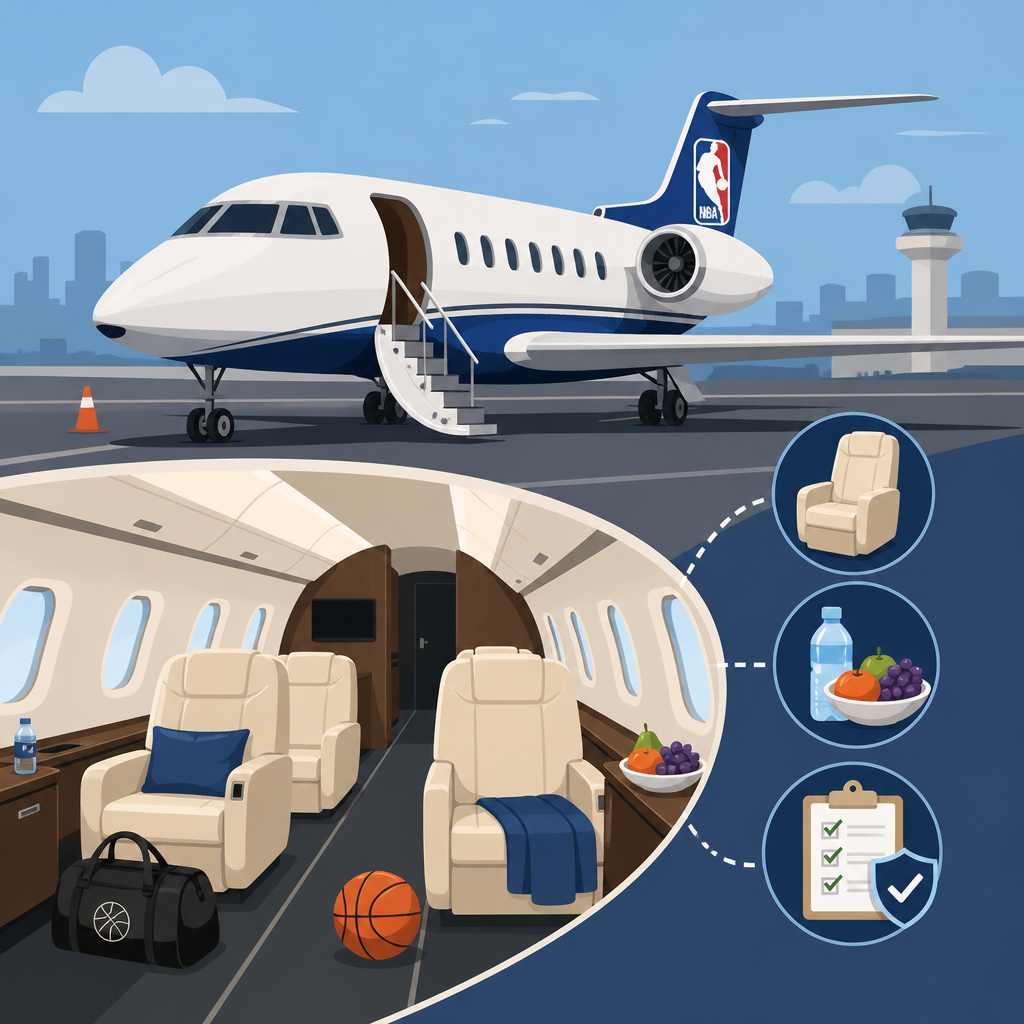
The typical NBA charter aircraft is not a tiny celebrity jet. Teams often use larger narrow-body or wide-body aircraft configured for far fewer passengers than a standard commercial flight. That means more legroom, wider seats, easier movement for very tall athletes, and cabin zones for players, coaches, front office staff, broadcasters, and support personnel. A roster full of players between 6-foot-4 and 7-foot means standard airline geometry simply does not work well. Seats may be arranged in first-class style rows, business-style pods, or mixed layouts depending on the operator. Some organizations assign seats by seniority or role; others maintain relatively fixed placements for consistency. Veterans often value routine, and routine matters on the road.
Onboard life is less party scene than recovery lab. Players usually change into comfortable travel gear, eat quickly, review tablets, watch film, play cards, or sleep. Trainers encourage hydration after games because air travel can compound dehydration. Team catering is planned around postgame nutrition, often emphasizing lean protein, carbohydrates, fruit, and options for players with individual dietary requirements. Sleep masks, compression gear, and portable recovery tools are common. Coaches may gather assistants for a short review, but long tactical meetings are rare right after games because bodies and minds are spent. Younger players sometimes assume the flight will feel glamorous every time; within weeks, it feels like an airborne extension of the locker room.
| Feature | NBA Charter Flight | Standard Commercial First Class |
|---|---|---|
| Departure timing | Built around game end and team schedule | Fixed public timetable |
| Privacy | Controlled passenger list and secure boarding | Shared airport and cabin environment |
| Seat suitability for very tall players | Customized spacing and lower passenger density | Limited by standard cabin layout |
| Equipment transport | Integrated for trunks, medical gear, and staff needs | Constrained by public airline procedures |
| Recovery support | Team meals, trainers, coordinated routines | Minimal sport-specific support |
The perks players get and the culture those perks create
The headline perks are real: privacy, comfort, speed, flexible baggage handling, premium food, and the ability to avoid crowded terminals. For NBA players, though, the biggest perk is control over recovery time. A charter can save hours in a week, and those hours can become treatment, sleep, or simply less stress. That is not trivial in a league where marginal gains decide availability. Teams also benefit from reduced distraction. A player can finish media duties, board, eat, get treatment notes from staff, and settle into a familiar seat within a tightly managed window. Families and approved guests may occasionally travel, but this is governed by team policy and not treated as an unlimited entitlement.
These perks shape player culture in distinct ways. First, they normalize professionalism at a very high standard. Rookies quickly learn that being late to the bus or the plane is not a small mistake; it disrupts dozens of people and can trigger fines or internal discipline. Second, the flight becomes a relationship space. Teammates decompress together, card games form, assistant coaches build rapport with reserves, and executives observe the room without forcing interaction. Third, charters reinforce the image of the NBA as a premium league where stars are both workers and assets. The comfort is part of a larger investment package that includes training staff, sleep science, and secure movement. Still, perks have boundaries. Players cannot simply treat the aircraft as personal property, and most veterans understand that the smoothest flights come from respecting the people who make them run: pilots, flight attendants, operations coordinators, security staff, and equipment managers.
The rules behind NBA team flights: league policy, security, and etiquette
The rules around NBA charter flights are a mix of federal aviation law, airline operating procedures, team policy, and collective bargaining realities. Crew hours, maintenance requirements, and dispatch rules follow the same aviation safety framework that governs other charter operations. Teams may control the passenger list, but they do not control aviation regulations. Security rules are strict because player safety, confidentiality, and schedule integrity matter. Access to manifests is limited. Boarding areas are usually separated from public traffic. Social media posting can be sensitive if it reveals travel plans in real time. In a betting-heavy sports environment, operational secrecy has become even more important.
Then there is the human side: etiquette. Every team has unwritten norms. Do not hold up departure. Do not create problems for crew members. Respect seating assignments. Keep noise down when players are sleeping. Handle guests carefully. On some teams, rookies take cues from veterans; on others, the player engagement staff makes expectations explicit. Alcohol policies vary by team culture, trip timing, and coach preference. Contrary to fan assumptions, not every flight is a champagne celebration. After losses, cabins can be quiet enough to feel like a library. After long road swings, the mood may be pure exhaustion. Rules exist to keep the environment functional, not to flatten personality.
Costs, criticism, and why charter travel remains the standard
Charter travel is expensive, and that is the most obvious criticism. The total annual cost can run into millions per team once aircraft time, repositioning, catering, ground transport, and staffing are included. Yet NBA franchises continue to absorb that cost because the alternative creates too much operational drag. Lost time, inconsistent recovery, public exposure, and complex baggage handling all undermine the central business of keeping elite players available and prepared. In practical terms, charter flying is now part of the league’s infrastructure, just like dedicated medical staff or advanced analytics departments.
There are still tradeoffs. Private-style travel carries a large environmental footprint, and that concern is legitimate. Teams can mitigate some impact through newer, more efficient aircraft, smarter routing, and operator sustainability programs, but no honest assessment should ignore emissions. There is also an optics question: luxurious travel can look excessive against broader economic realities. The counterargument is that these are not leisure trips. They are tightly scheduled work movements for organizations worth billions, with players whose health directly affects competitive and financial outcomes. From experience, the strongest case for charter flights is not image; it is reliability. When a road trip has to function, reliability wins.
Why charter flights matter to NBA Culture and the broader Player Culture hub
Within NBA Culture, charter flights connect almost every major part of Player Culture. They influence dress codes because travel fits are public-facing content. They shape recovery culture because sleep, nutrition, and treatment begin the moment a player leaves the arena. They reveal hierarchy through seating, guest access, and veteran privilege. They support team bonding through repeated shared hours in a closed environment. They even touch business culture, since agents, sponsors, and family logistics are all affected by how often players are in transit. If you want one hub topic that links fashion, wellness, discipline, status, and routine, team flights are it.
For fans, the useful takeaway is this: NBA charter flights are less about indulgence than about operational control. The planes are spacious, but space serves bodies that are unusually large and unusually taxed. The perks are substantial, but they exist to support performance and security. The rules can feel strict, but strict systems keep a team moving through a relentless calendar. If you are exploring Player Culture, this subject deserves attention because it shows how stars live between games, how organizations protect their investments, and how modern basketball work extends far beyond tipoff. Follow the rest of this Player Culture hub with that lens in mind, and many other NBA habits, privileges, and pressures will make more sense.
Frequently Asked Questions
What exactly is an NBA charter flight, and how is it different from a normal commercial flight?
An NBA charter flight is a privately arranged aircraft used exclusively for a team’s travel, usually operated by a commercial airline or charter company under a dedicated contract rather than as a public flight anyone can book. That distinction matters. Players, coaches, team executives, medical staff, equipment personnel, and select support staff travel together on a schedule built around the NBA calendar, not around public airline timetables. The plane itself may be a large commercial-style jet, but the experience is completely different from standard passenger travel because the team controls the passenger list, departure timing, baggage handling, onboard security, and many of the in-flight procedures.
In practical terms, charter travel exists because the NBA schedule is relentless. Teams often play late at night, fly immediately afterward, cross time zones, and need to be ready for practice, treatment, meetings, or another game within a day or two. A commercial setup would create too many variables: airport crowds, connecting flights, security delays, checked-bag issues, and limited flexibility if a game runs long or weather disrupts plans. A charter reduces those risks by turning air travel into a controlled extension of team operations. So while fans often focus on the luxury angle, the real point is efficiency, recovery, privacy, and schedule control.
Are NBA team planes as luxurious as people imagine?
They can be very comfortable, but the image of nonstop extravagance is usually exaggerated. Most NBA charter flights are designed first for function and second for prestige. Players are taller than the average traveler, many are well over six and a half feet, and teams need cabin layouts that provide more legroom, easier movement, and seating arrangements that reduce fatigue after games. That means roomier seats, more personal space, and fewer passengers than on a standard commercial flight. Some aircraft may include first-class-style sections, lounge areas, enhanced catering, and upgraded finishes, but the defining feature is not pure luxury for luxury’s sake. It is operational suitability for elite athletes who need to arrive ready to perform.
There is also a branding component. Team travel is part of the professional image of a franchise, and organizations understand that players notice how they are treated. Comfortable charters, customized meals, strong Wi-Fi, medical supplies, and a quiet environment all support player satisfaction and performance. But the cabin is not just a floating VIP club. It is often a workspace and recovery space. Coaches review game film, players sleep, trainers coordinate treatment, and staff manage logistics for arrival. In other words, NBA charters may look glamorous from the outside, but inside they are usually a blend of premium travel, strict routine, and practical demands tied directly to winning games.
Who gets to fly on an NBA charter, and are there rules about guests or family members?
Access to an NBA charter is tightly controlled. The core group typically includes players, coaches, front-office decision-makers, team security, medical and performance staff, communications staff, equipment managers, and selected operations personnel whose work directly supports the trip. Because these flights are part of a private team travel system, the passenger list is managed carefully for security, privacy, and liability reasons. Teams need to know exactly who is onboard, where equipment is stored, and how arrival procedures will work once the plane lands. That level of control is one reason charters are so valuable in the first place.
As for guests and family members, policies vary by team and by situation, but this is not usually a free-for-all. Some organizations may permit occasional family travel or special guest access under specific circumstances, especially for milestone games or limited approved trips, while others keep the manifest restricted almost entirely to official personnel. Even when guests are allowed, they are usually subject to internal rules, available seating, and security review. The broader point is that NBA charter flights are governed by team policy and league realities, not by celebrity culture. The system is built around protecting the team’s schedule, privacy, and performance environment, so any non-essential access is generally the exception rather than the rule.
Why are NBA charter flights tied to labor rights and player working conditions?
Team travel may look like a perk from the outside, but inside professional sports it is also a workplace issue. NBA players are employees performing physically demanding work under an intense schedule that often includes back-to-backs, late-night exits, cross-country flights, and limited recovery windows. In that context, the conditions of travel affect sleep, injury risk, preparation, and even career longevity. That is why charter flight standards are not just about convenience. They sit within the larger conversation about labor rights, collective bargaining, and what players are entitled to as part of a safe and professionally managed work environment.
This is also why travel arrangements matter beyond the men’s NBA alone. In basketball more broadly, charter access has become a major symbol in debates over fairness, investment, and athlete treatment. The logic is straightforward: if a league depends on elite performance, then travel should support rather than undermine that performance. For NBA teams, charter travel is already part of the basic infrastructure of the job. It reflects the commercial scale of the league, the negotiating power of players, and the understanding that recovery and security are not luxuries at this level. They are part of the machinery that keeps the season functioning. So when people talk about NBA charter flights, they are really talking about how a multibillion-dollar league treats the people whose labor drives the product.
What rules and logistics shape how NBA teams use charter flights during the season?
Despite the glamorous reputation, NBA charter travel operates within a highly structured logistics system. Teams do not simply decide to fly whenever and however they want. Aircraft availability, airport slot timing, crew scheduling, weather, maintenance requirements, ground transportation, hotel coordination, baggage handling, and league calendar demands all have to line up. Most teams work closely with airline partners or charter operators that understand the cadence of the season, including late departures after night games, quick turnarounds, and occasional irregular routing caused by schedule changes or disruptions. The goal is to make travel feel seamless to players, but that seamlessness is the result of heavy planning behind the scenes.
There are also internal rules about timing, conduct, security, media access, and what happens once the team leaves the arena. Players and staff generally move through a defined process from locker room to bus to plane to hotel, with team operations personnel coordinating every stage. Luggage and equipment have to be loaded correctly, meals may be planned around dietary needs and arrival times, and security considerations can affect boarding procedures and airport access points. Even the apparent freedom of private flying is governed by aviation regulations and operator policies. So the most important rule of NBA charter travel is that it exists to remove unpredictability, not to create indulgence. It is a professional transport system built to serve a demanding league, protect valuable personnel, and keep the season moving on time.