
A form shooting routine is the daily warm-up sequence players use to groove mechanics, build touch, and prepare the body and mind for game-speed reps. In basketball training, “form shooting” means close-range, technically precise shots taken with strict attention to balance, hand placement, release path, arc, and follow-through. “Warm-up” does not mean casual. The best shooters treat these early reps as skill acquisition, not just loosening up. After years around player development workouts, I have seen the same pattern repeatedly: athletes who rush past foundational shooting work plateau, while players who commit to disciplined daily form shooting improve faster and stay more reliable under pressure.
This matters because shooting is a repeatable motor skill shaped by thousands of high-quality repetitions. A player can lift harder, run faster, and still struggle if the ball leaves the hand differently every session. A structured form shooting routine creates consistency before fatigue, defensive pressure, and movement complicate the shot. It also gives coaches and athletes a diagnostic tool. Misses from five feet reveal mechanical problems that become harder to spot at the three-point line. For a basketball training hub focused on programs and workouts, form shooting is the anchor because every effective shooting plan, from youth development to NBA offseason work, begins with this daily reset.
The value goes beyond mechanics. Good warm-up shooting sharpens concentration, regulates tempo, and builds confidence through immediate feedback. Players learn what a centered release feels like, how proper wrist flexion affects rotation, and why lower-body alignment determines whether misses drift left or right. Elite shooters swear by these routines because they eliminate guesswork. Instead of hoping the shot “shows up,” they rehearse the exact positions and sensations that produce makes. That is why form shooting belongs at the center of basketball training programs and workouts: it connects technique, touch, preparation, and long-term shooting development in one efficient daily habit.
What a Form Shooting Routine Includes and Why NBA Shooters Use It
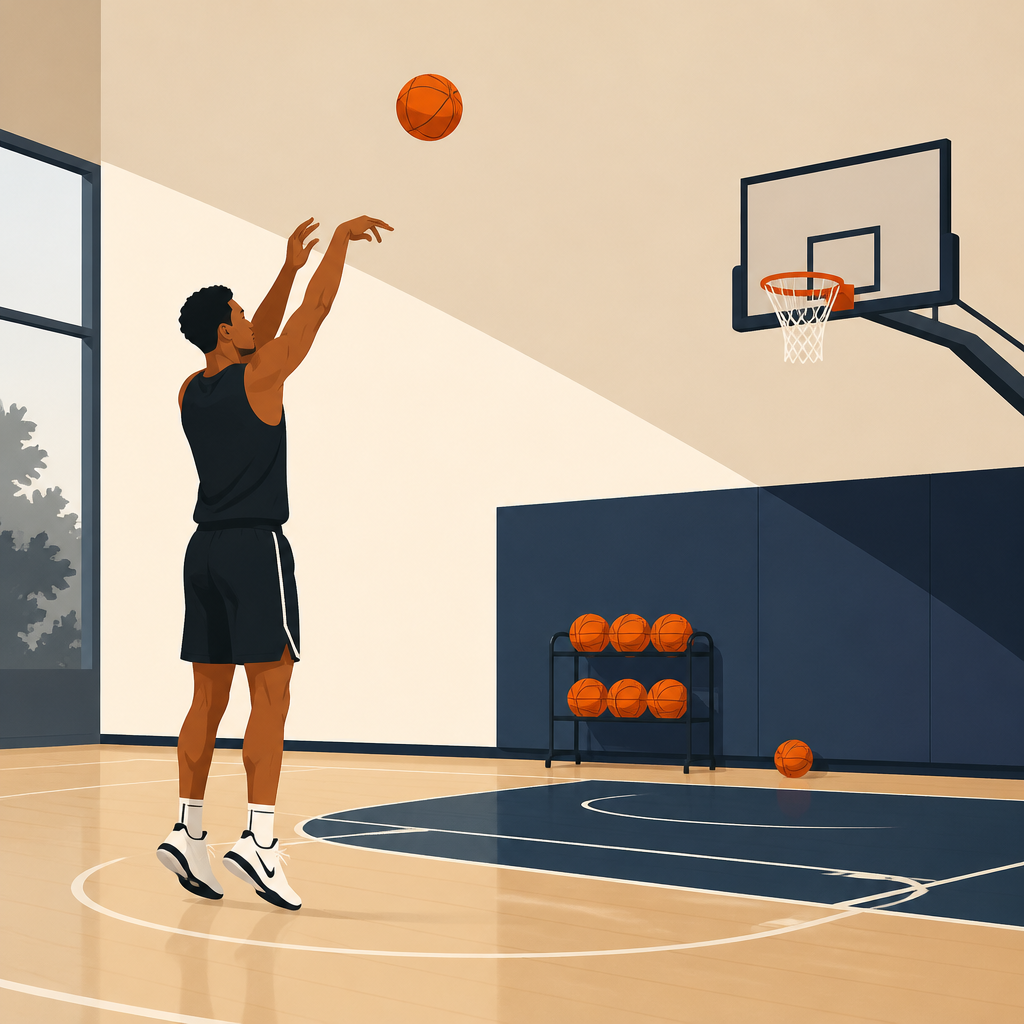
A complete form shooting routine starts close to the basket, usually inside the lane, and prioritizes perfect mechanics over volume. Most players begin one-handed or with a guide hand resting lightly on the side of the ball. The goal is to isolate the shooting hand, keep the elbow under or near the ball, align the feet, and finish with clean backspin. NBA shooters use this approach because close-range reps provide the clearest feedback. If the ball misses from eight feet with no defensive pressure, the issue is almost always mechanical, not tactical.
In practical terms, the routine teaches five essentials. First, stance: feet set comfortably, weight balanced through the midfoot, hips and shoulders organized toward the target. Second, hand placement: shooting hand under the ball, guide hand neutral, fingers spread without tension. Third, path: the ball travels upward efficiently rather than looping around the body. Fourth, release: wrist snaps through the center line with full finger extension. Fifth, finish: the shooter holds the follow-through long enough to confirm balance and trajectory. These details sound small, but they determine whether a player can repeat a shot under stress.
The reason professionals return to form shooting every day is not because they have forgotten how to shoot. It is because elite performance depends on calibration. A long season, weight-room fatigue, travel, soreness, and minor compensations can subtly distort mechanics. Ten focused minutes of close-range work reveals whether the release is on line, whether the ball is coming off the index-middle finger line cleanly, and whether the lower body is synchronized. That daily checkpoint is one of the most efficient investments in any shooting program.
The Core Mechanics Every Daily Warm-Up Must Reinforce
The best daily shooting workouts reinforce nonnegotiable mechanics. Balance comes first. If the torso sways backward or the heels rise too early, the shot loses energy transfer and directional control. I coach players to feel stacked: ankles, knees, hips, and chest working in sequence. Rhythm comes next. The shot should be one connected motion rather than a pause at the forehead followed by a push. Even players with slight variations in style need consistent timing between the dip, lift, and release.
Alignment is another pillar. Not every great shooter is perfectly square, but every great shooter repeats an alignment pattern that keeps the forearm and release line stable. Some athletes prefer a slight turn, especially to free the shoulder and wrist, but the ball still needs to travel on a predictable path. Arc matters too. Research from Noah Basketball and long-standing shot-tracking data consistently shows that shot arc influences entry angle and margin for error. Too flat reduces the effective size of the rim; too high can affect depth control. Form shooting lets players feel the ideal trajectory before moving farther out.
Finally, touch and rotation separate a rigid routine from an effective one. A clean shot should produce soft backspin, minimal sidespin, and a forgiving contact point on the rim. That softness starts with relaxed hands and proper fingertip control. Many players think of warm-ups as mechanical checklists only, but touch is trainable and must be part of the routine. Swishes, friendly bounces, and consistent depth are all outcomes of mechanics working together.
A Sample Daily Form Shooting Progression for Basketball Training Programs
A strong progression moves from simple to complex without sacrificing quality. I recommend using a rep-based structure rather than shooting mindlessly for time. Start directly in front of the rim with one-hand shots from three to five feet. Make 10 with the shooting hand only, then 10 with the guide hand lightly touching the side of the ball. Move to each side of the lane and repeat. Next, step back to short-range set shots from five to eight feet, focusing on balance and clean follow-through. Only after these reps look and feel consistent should a player expand to free-throw line work, short corners, and then game-speed catch-and-shoot or pull-up segments.
| Phase | Distance | Goal | Recommended Makes |
|---|---|---|---|
| One-hand form | 3–5 feet | Release path, wrist snap, backspin | 30 |
| Two-hand form | 3–8 feet | Guide hand discipline, balance | 30 |
| Spot set shots | 8–15 feet | Arc, depth, repeatable timing | 25 |
| Free throws | 15 feet | Routine transfer and composure | 10 |
| Game-speed transition | Variable | Carry mechanics into realistic reps | 20 |
This progression works because it layers skill. The player earns the right to move back only after demonstrating control up close. That principle should shape any basketball shooting workout, whether the athlete is 12 years old or playing professionally. Distance does not create form. Distance exposes form.
How Form Shooting Fits Into Larger Programs and Workouts
As a hub topic within basketball training, form shooting connects to nearly every program design decision. In youth programs, it prevents young players from forcing range before they have the strength and sequencing to shoot correctly. In middle school and high school plans, it becomes the daily quality-control piece before spot shooting, off-the-dribble work, and conditioning drills. In college and pro settings, it serves as a pre-practice reset and an offseason rebuilding tool when a player wants to refine release mechanics or eliminate a miss pattern.
A well-built weekly shooting program usually includes four layers: technical work, volume shooting, movement shooting, and competitive shooting. Form shooting sits at the technical layer. Volume shooting builds repetition totals from varied spots. Movement shooting adds footwork, cuts, relocations, and drifts. Competitive shooting introduces pressure through time, scoring standards, or defenders. If the technical layer is weak, the other three layers simply rehearse inconsistency faster. That is why experienced trainers rarely skip form work, even with advanced players who can already make difficult shots.
Programs should also account for training load. On heavy leg days, post-lift shooting may require shorter range and lower volume because fatigue changes mechanics. During in-season periods, players often reduce total makes but keep the form routine intact to preserve feel. This adaptability is part of smart workout design. The routine is stable; the surrounding volume changes with schedule, recovery, and goals.
Common Mistakes That Ruin a Shooting Warm-Up
The most common mistake is starting too far from the basket. When players open from the three-point line, they often compensate with extra shoulder involvement, a thumb flick from the guide hand, or a drifting base. Those compensations may produce makes in the short term, but they blur the true source of the shot. Another frequent error is rushing. Form shooting should be deliberate enough for the athlete to notice whether the ball rolled cleanly off the fingertips, whether the chest stayed still, and whether the landing matched the takeoff line.
Players also sabotage routines by ignoring outcomes that carry information. A left miss for a right-handed shooter can indicate shoulder rotation, a guide-hand influence, or an early opening of the front foot. A short miss often points to poor lower-body timing, not simply “not enough power.” A hard back-rim miss may reflect a flat arc or excess tension in the release. Effective shooters read these patterns instead of treating every miss as random.
Another problem is changing too many variables at once. If a player adjusts stance, release point, and hand placement in the same session, there is no way to identify what helped. Skilled trainers make one clear emphasis at a time and repeat it long enough to create a dependable feel. That discipline is especially important during form shooting, when the purpose is precision rather than entertainment.
Tools, Benchmarks, and Real-World Standards for Tracking Progress
Good programs measure progress. At minimum, players should track makes, spots, and how the shot felt that day. More advanced environments use tools such as Noah Basketball for arc and depth, Dr. Dish or The Gun for controlled rep delivery, and video analysis on Hudl Technique or standard slow-motion phone footage. These tools are useful because they turn vague impressions into observable trends. If a player believes the release is higher but the video shows the elbow flaring, the correction becomes concrete.
Benchmarks should match the athlete’s level. A youth player might aim for 50 technically sound form makes before every team practice. A varsity guard may target 100 to 150 total warm-up makes across close range, free throws, and short midrange before moving into movement shooting. Professional standards vary by schedule, but the principle remains the same: quality first, then complexity. I prefer benchmarks that combine accuracy and execution, such as “8 of 10 swishes from five feet with held follow-through,” because pure makes can hide poor mechanics.
Progress also shows up in transfer. Free-throw percentage, catch-and-shoot efficiency, and miss dispersion from game spots all reveal whether the warm-up is doing its job. If a player looks smooth in form shooting but sprays misses wide in live drills, the next step is usually footwork or pace integration, not abandoning the routine.
Building a Long-Term Shooting Plan From the Daily Routine
The biggest benefit of a form shooting routine is that it scales into a complete development system. Start with daily close-range mechanics. Add weekly shooting workouts built around spot shooting, movement patterns, and pressure constraints. Layer in strength and mobility work that supports thoracic extension, shoulder function, hip stability, and ankle mobility. Then evaluate game film to identify which shots actually occur in competition. This is how smart basketball programs and workouts stay connected to performance rather than chasing random drill lists.
For example, a wing player who gets corner threes and one-dribble pull-ups should use form shooting to stabilize the release, then build workouts around corner footwork, shot preparation, and stopping mechanics. A point guard who takes more shots off ball screens may progress from form reps into pocket catches, lateral movement into pull-ups, and late-clock decision shooting. In both cases, the warm-up remains the base layer that protects efficiency as complexity rises.
Consistency is the separating factor. Players do not need an elaborate routine every day, but they do need a dependable one. Ten to fifteen focused minutes of form shooting before practice or workouts can preserve mechanics, sharpen feel, and create a reliable starting point for every other shooting task. That is why NBA shooters swear by it, and why any serious basketball training plan should treat it as essential rather than optional.
Form shooting is the simplest daily habit with the highest return in a shooting program. It teaches mechanics, improves touch, exposes flaws early, and prepares players to carry clean technique into game-speed reps. More importantly, it gives structure to the wider category of basketball training programs and workouts. When the warm-up is built well, every spot-shooting drill, movement series, and competitive segment has a stronger technical foundation.
The key takeaway is straightforward: start close, demand precision, progress only when the shot is clean, and track what happens. Use the routine as both preparation and assessment. Over time, it becomes the link between isolated skill work and real performance. Players gain a repeatable feel, coaches gain a coaching window, and workouts gain purpose instead of empty volume.
If you want better shooting results, make form shooting your nonnegotiable daily start. Build your program around it, measure it, and revisit it whenever the shot feels off. Do that consistently, and the warm-up NBA shooters trust will become the foundation of your own long-term improvement.
Frequently Asked Questions
What is a form shooting routine, and why do great shooters take it so seriously?
A form shooting routine is a structured close-range shooting sequence designed to lock in mechanics before moving into faster, more demanding reps. It usually starts near the basket and focuses on the details that make a shot repeatable: balanced stance, steady eyes, clean hand placement, straight release path, proper arc, soft touch, and a disciplined follow-through. The purpose is not simply to “get loose.” It is to rehearse the exact movement pattern a player wants to own under pressure.
That is why high-level shooters treat form shooting like skill work, not filler. Every rep is feedback. If the ball comes off the wrong fingers, drifts left or right, comes out flat, or requires extra body movement, the player gets immediate information about what needs correcting. Starting close removes unnecessary variables, so the shooter can feel what a pure, efficient release actually is. Over time, that builds consistency, touch, and confidence.
The best daily warm-ups work because they connect precision with habit. Instead of jumping straight into threes and reinforcing rushed mechanics, players begin with shots they can control. That sequence helps groove timing, wake up the legs, engage the core, and sync the upper and lower body. When done correctly, form shooting becomes the foundation for everything that follows, from catch-and-shoot work to game-speed movement shooting.
How long should a daily form shooting warm-up last?
For most players, a strong form shooting warm-up lasts about 10 to 20 minutes, depending on age, level, and what the full workout looks like. Younger players or athletes in a shorter session may only need 8 to 12 focused minutes. Advanced players often spend 15 to 20 minutes because they use those early reps to make technical checks, build touch, and mentally settle into the workout. The key is not the clock by itself. It is whether the player is getting purposeful, high-quality repetitions.
A good rule is to stay in the warm-up until the shot looks and feels connected. That means the feet are under control, the guide hand is quiet, the release is clean, and the finish is consistent. If a player is just going through the motions, 20 minutes will not help much. If the player is locked in, even 10 concentrated minutes can set up an excellent session.
Another practical approach is to base the warm-up on makes or phases rather than time alone. For example, a player might make 10 to 20 shots with one hand, then 10 to 20 with the guide hand added, then work through spots on both sides of the rim, then take a few step-backs into short mid-range shots before expanding outward. This creates a natural progression from precision to rhythm. The goal is to leave the warm-up feeling technically sharp, physically ready, and mentally focused for game-speed reps.
What should a proper form shooting routine include?
A proper form shooting routine should move from simple to slightly more dynamic while keeping technique at the center. Most effective routines begin directly in front of the rim, close enough that the shooter does not need extra force. Early reps often include one-hand shooting to isolate the release. This helps the player feel the ball on the shooting hand, keep the elbow and wrist aligned, and finish cleanly through the target. Once that looks sound, the guide hand is added back in without letting it dominate the shot.
From there, the routine should expand in small steps. Common progressions include shooting from the front, then both sides of the basket, then slightly farther out while preserving the same mechanics. Many coaches like players to hold their follow-through, check whether the ball rotates cleanly, and notice where misses come from. Left-right misses can point to alignment or hand placement issues. Flat misses can suggest poor lift, rushed release, or not enough extension through the shot.
A complete warm-up also includes body organization. That means stable feet, slight knee bend, controlled rise, and smooth energy transfer from the floor through the fingertips. Players should pay attention to starting stance, shoulder tension, head movement, and whether the shot pocket is clean and repeatable. As the routine advances, a few rhythmic additions can be included, such as a small step-in, a one-two footwork pattern, or a short hop into the shot. These details prepare the player for real training without skipping the fundamentals.
The best routines are simple enough to repeat daily and specific enough to produce measurable consistency. You do not need a huge menu of drills. You need a sequence that teaches the same high-value mechanics every day and carries them into speed.
How many shots or makes should players aim for during form shooting?
There is no perfect universal number, but most players benefit from targeting makes rather than random attempts. A common range is 25 to 75 made form shots, depending on level and experience. Beginners may do well with 25 to 40 quality makes because they are still learning how to control the ball and repeat the motion. Intermediate and advanced shooters often land in the 40 to 75 range, especially if they break the routine into stages and spots.
What matters most is the quality standard attached to those makes. A made shot that comes off the wrong fingers, fades sideways, or requires a compensation is not as valuable as a clean miss that reveals a correctable issue. The warm-up should reward pure mechanics, not just results. Many serious shooters use internal benchmarks such as “10 clean makes in a row from the front,” “5 perfect swishes from each side,” or “do not move back until the arc and finish are consistent.” That approach encourages discipline instead of rushing to bigger distances.
Another useful strategy is to track both makes and feel. If the shot starts to drift as fatigue builds, the player may need to reset rather than pile on extra reps. Daily form shooting is supposed to sharpen patterns, not train sloppiness. Over time, players can increase volume, but only if they can maintain the same technical integrity from the first rep to the last. In other words, the right number is the one that builds consistency without letting fatigue or boredom lower the standard.
Can form shooting really improve game-speed shooting, or is it too slow to matter?
Form shooting absolutely improves game-speed shooting when it is done correctly and connected to the rest of the workout. The reason is simple: fast shooting only holds up if the underlying movement pattern is efficient and repeatable. In games, players deal with fatigue, closeouts, footwork changes, and split-second decisions. If the basic mechanics are unstable, those pressures expose every flaw. Form shooting gives players a daily chance to refine the foundation before adding speed and complexity.
What form shooting does best is build awareness and consistency. It teaches the body what a centered, balanced, on-line release feels like. It develops touch around the rim and trains the fingers, wrist, and elbow to work together cleanly. It also helps players recognize mistakes earlier. A shooter who has spent time on precise close-range reps can often feel when a miss came from poor balance, a drifting guide hand, or a rushed finish. That self-correction is a huge advantage in live workouts and games.
The key is sequencing. Form shooting should be the beginning of the ladder, not the whole ladder. After establishing mechanics up close, players should gradually move into mid-range rhythm shots, spot-up threes, movement shooting, and decision-based reps. That is how the warm-up transfers. It creates a reliable base, then challenges that base under increasing speed and pressure. So no, it is not too slow to matter. It is often the reason speed holds up at all.