
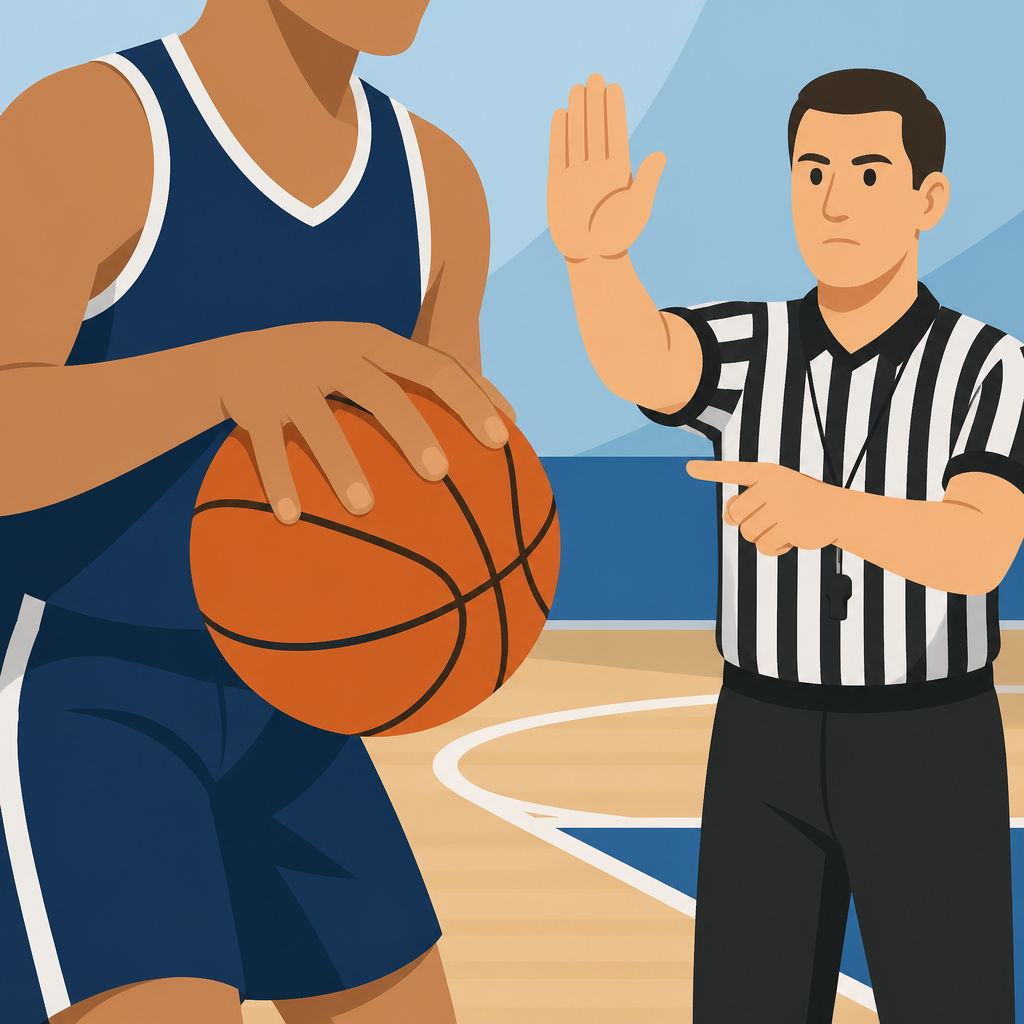
A palming violation in basketball occurs when a player turns the ball so the hand comes under it, pauses the dribble, or carries it in a way that gives extra control not allowed under the rules. Within NBA rules, this action is commonly called carrying, and it sits inside the broader category of dribbling violations that also includes double dribbling, traveling after an illegal gather, and discontinuing a legal dribble. For anyone trying to understand game rules, palming matters because it directly affects ballhandling, shot creation, defender reactions, and officiating consistency. I have coached youth guards, broken down NBA film, and reviewed rulebook language with officials, and palming is one of the rules fans think they know until a replay shows how technical the standard actually is. The rule exists to preserve a fair dribble. Basketball allows a player to bounce the ball and guide it from the top or side, but not to scoop it, rest it, or momentarily hold it while still moving as if the dribble remains alive. Once the hand gets under the ball and the ball comes to rest, the dribble has effectively ended. If the player then continues dribbling, the proper call is a violation. Understanding that principle helps explain why some flashy crossovers are legal and others are not, why stars get debated so often, and why this topic anchors any serious guide to NBA game rules.
As a hub topic, palming also opens the door to the larger structure of game rules. To judge a carry correctly, you need connected concepts: legal guarding position, gather step timing, traveling, hand-checking, and what counts as control of the ball. That is why this article does more than define one violation. It explains how referees read hand position, ball rotation, player rhythm, and advantage created on the play. It also places the rule in practical context for players, coaches, and fans. A young point guard wants to know how low to keep the dribble. A parent wants to understand why a move allowed in a youth league gets whistled in a varsity game. A fan watching the NBA wants to know why one possession is ignored while another is called immediately. Those are fair questions, and the answers come from the wording and enforcement philosophy of the game rules themselves. If you learn palming well, you also sharpen your understanding of dribbling mechanics, officiating judgment, and the balance basketball tries to maintain between creativity and competitive fairness.
Definition of a palming violation and the official rule idea
In plain terms, a palming violation happens when the dribbler places a hand under the ball and carries it so the ball is no longer being pushed to the floor in one continuous dribbling action. NBA and FIBA language differs slightly, but the core idea is stable across organized basketball: a dribble is legal when the player bats, pushes, taps, or throws the ball to the floor and it returns before the player touches it again. The violation appears when the player lets the ball come to rest in the hand, turns the hand underneath, or otherwise delays the bounce in a way that creates an extra advantage. Officials are not judging style points. They are judging control. If the ball stops while supported from below, the dribble has ended.
That distinction matters because many legal moves look dramatic. On a hesitation dribble, for example, the ball may rise high and the player may slow the body to freeze a defender. If the hand remains mostly on top or on the side and the ball keeps moving continuously, the move can be legal. Allen Iverson, Kyrie Irving, and Chris Paul all used hesitations that pushed right to the boundary, but the legal version still preserved a true dribble. By contrast, an illegal carry often shows a visible cup under the ball followed by a directional change. The player gains time to read the floor while the defender must respect both drive and shot. That extra beat is exactly what the rule aims to prevent.
How officials decide whether a dribble is legal
Referees do not call palming by staring only at the hand. They process several cues at game speed: whether the ball visibly pauses, whether the palm rotates beneath the midpoint of the ball, whether the player changes direction after the ball rests, and whether the action creates an obvious competitive advantage. In training, officials are taught to watch the relationship between hand, ball, and rhythm. A quick side-hand crossover with natural bounce is usually legal. A high, slowed dribble with the wrist turning under and the ball carried across the body is much more likely to be called.
Game level matters too. In youth basketball, officials often call obvious carries early to establish habits and protect basic skill development. In high school under NFHS guidance, points of emphasis can tighten enforcement if exaggerated dribbling is becoming common. In the NBA, where players handle the ball with elite dexterity and speed, officials often use a practical threshold. Marginal hand placement that does not clearly stop the ball may pass. A distinct pause, scoop, or reset usually should not. That difference can frustrate fans who want frame-by-frame consistency, but officiating is built around observable advantage in real time, not laboratory conditions.
| Situation | Usually Legal | Usually a Palming Violation | Why |
|---|---|---|---|
| Hesitation dribble | Hand stays on top or side; ball keeps bouncing smoothly | Hand slides under; ball pauses before next move | Continuous dribble versus suspended control |
| Crossover | Quick transfer while ball remains live | Ball is carried across with wrist under it | Direction change gained by illegal support |
| In-and-out move | Outside hand guides ball from the side | Ball is cupped and redirected after resting | Legal deception versus temporary hold |
| Escape dribble | Ball pushed out cleanly under pressure | Player lifts and relocates the ball before bouncing | Resetting the dribble is not allowed |
Why players palm the ball and what advantage it creates
Players palm because it makes difficult actions easier. When the hand gets under the ball, the dribbler can hesitate longer, change direction more sharply, keep the ball away from help defenders, and synchronize footwork with a shot or pass. In practical coaching terms, an illegal carry acts like a tiny pause button. That extra control widens windows that should stay narrow. It can turn a risky crossover into a safe one and a rushed pull-up into a balanced jumper. Guards who rely on rhythm changes are especially tempted because a carried dribble can freeze the on-ball defender just long enough to create separation.
The problem is competitive fairness. Defenders are trained to react when the dribbler appears to pick up the ball or commit to one direction. If the offensive player can suspend the ball and still keep the dribble alive, the defender is forced to guard an action the rules were designed to remove. This is similar in principle to traveling rules that limit extra steps after control. Basketball permits creativity, but the game depends on boundaries. Without them, the dribble stops being a repeated bounce and starts becoming a portable advantage tool. That is why every rule set, from school play to the NBA, preserves some version of the carrying restriction.
Palming versus carrying, traveling, and double dribbling
Many fans use palming and carrying interchangeably, and that is mostly fine in everyday conversation. Carrying is the broader officiating term, while palming describes the visual act of the palm moving under the ball. The overlap is so strong that broadcasts often treat them as synonyms. Still, it helps to separate related violations. Traveling concerns illegal foot movement after the player gains control. Double dribbling occurs when a player ends a dribble and then starts another dribble. A carry often sits right before both. If a player palms the ball, control may be established; the next steps can become a travel, or the next bounce can become a double dribble.
Consider a common sequence: a guard attacks, slows into a hesitation, turns the hand under the ball, takes a step as the ball rests, then bounces again. Depending on when the official judges control, that single move might be recognized first as a carry or later as a double dribble. In advanced film review, these connected violations matter because they explain why rule education cannot happen in isolated pieces. The same applies to the gather rule on drives. Fans often argue about steps when the original issue was illegal control on the dribble. Learning the chain of events makes game rules easier to read and far less mysterious.
NBA enforcement, common controversies, and why fans get confused
NBA enforcement of palming has always involved tension between strict rulebook language and the league’s tolerance for creative perimeter play. Older eras generally featured tighter dribble interpretation, partly because ballhandling styles were more upright and less reliant on extended hesitation moves. As guards became quicker and spacing improved, the modern game rewarded complex dribble packages, and enforcement loosened at the margins. That shift produced the familiar complaint that stars are allowed to carry constantly. There is some truth in the perception, but the fuller explanation is that officials distinguish between borderline side control and clear suspension of the ball.
Replay culture adds another layer. Slow motion makes many legal dribbles look suspicious because every crossover has a moment where the hand appears near the side-lower quadrant of the ball. Yet officiating cannot be based on still frames alone. The standard is continuous motion and observable control at live speed. At the same time, fans are right to notice inconsistency. Different crews have different thresholds, and points of emphasis can tighten calls for stretches of a season. The NBA has publicly emphasized freedom of movement and legal offensive skill at different times, and those priorities influence how closely dribble mechanics are scrutinized. The key takeaway is not that the rule is random. It is that the rule is judgment-based, applied in motion, and inevitably debated when elite ballhandlers operate on the edge.
How players can avoid a palming violation
The safest way to avoid palming is to keep the hand on top of the ball, or slightly to the side, and maintain a true bounce on every change of direction. In player development sessions, I teach guards to think about pushing the ball through the floor rather than lifting it across the body. Lower dribbles reduce temptation because the ball spends less time rising into a controllable pocket. Strong fingertips, flexible wrists, and core balance matter more than flashy sequencing. If a player needs to cup the ball to execute a move, the handle is not clean enough yet.
Specific drills help. Cone hesitation work teaches a player to vary pace without resting the ball. Two-ball pound dribbles reinforce hand position. Wall dribbles force control from the top and side. Filming from the front angle is particularly useful because players often do not realize when their wrist rotates beneath the ball. Coaches should also teach rule context, not just technique. When players understand that a carry can erase an advantage, trigger a turnover, and break offensive timing, they become more disciplined. Clean ballhandling is not less creative. It is more reliable under pressure, especially in officiated games where borderline habits eventually get exposed.
Why palming belongs at the center of NBA game rules education
Palming belongs near the center of any NBA game rules hub because it connects skill, officiating, and strategy in one rule. It helps explain how a legal dribble begins and ends, how gather timing affects steps, why defenders react the way they do, and why some highlights spark rule debates. From here, readers naturally branch into related rules such as traveling, double dribble, backcourt violations, closely guarded situations in other codes, legal screens, and hand-checking. In other words, palming is not a niche rule. It is an access point to understanding possession mechanics across the sport.
The most useful takeaway is simple. A legal dribble is continuous and controlled from above or the side; an illegal palming violation happens when the ball is carried, supported from underneath, or allowed to come to rest before the dribble continues. If you remember that standard, many game situations become easier to judge. Watch a few live possessions, focus on whether the ball pauses, and compare the dribbler’s hand position before the next move. That habit will sharpen how you see basketball. For deeper rules knowledge, keep exploring the rest of the NBA Rules game rules hub and use this article as your baseline reference.
Frequently Asked Questions
What is a palming violation in basketball?
A palming violation happens when a player places the hand too far under the basketball while dribbling and gains an unfair level of control. In simple terms, the dribbler is no longer pushing the ball naturally from the top or slightly to the side as part of a legal dribble. Instead, the player turns the ball, lets it come to rest, pauses it, or carries it in a way that effectively interrupts the dribble and then restarts it. That is why many rulebooks and broadcasters refer to palming as carrying. The key idea is that the ball cannot be supported underneath during a live dribble in a way that allows the player to manipulate defenders with a stop-and-go action not permitted by the rules. Palming is part of the broader family of dribbling violations, which also includes double dribbling and other illegal interruptions of the dribble.
Why is palming also called carrying in basketball rules?
Palming and carrying are closely related terms because they describe the same basic illegal action: the player gains too much control over the ball during the dribble by letting the hand move under it or by allowing the ball to momentarily come to rest. In many official contexts, especially under NBA terminology, carrying is the more common rules-based label. The word “palming” is often used by players, fans, and commentators because it vividly describes what appears to happen when the ball is turned and controlled in the palm or underneath the hand. The reason the rules treat this seriously is that a legal dribble is supposed to be a continuous bouncing action, not a moment where the player can hold, steer, hesitate, and then resume. Calling it carrying emphasizes that the player is effectively supporting or controlling the ball in a way that goes beyond a normal dribble.
How can you tell the difference between a legal dribble and a palming violation?
The difference usually comes down to hand position, ball control, and whether the dribble remains continuous. In a legal dribble, the player’s hand stays primarily on top of the ball, or at most slightly to the side, while pushing it to the floor in one flowing motion. Even on quick crossover moves or hesitation dribbles, the ball should not come to rest in the hand. A palming violation occurs when the player slides the hand under the ball, turns it noticeably, or pauses the dribble long enough to create extra control before continuing. One of the easiest visual clues is whether the ball appears to “stick” with the player rather than rebound naturally off the floor. If the dribbler seems to lift, cradle, or carry the ball through a move rather than bounce it cleanly, officials may rule it illegal. The challenge is that fast game speed can make borderline plays difficult to judge, but the principle stays the same: once the dribble is interrupted by illegal control, it can become a palming or carrying violation.
What happens when a player is called for palming during a game?
When an official calls palming, play stops and the team that committed the violation loses possession of the ball. The opposing team is then awarded the ball for an inbound from the nearest appropriate spot under the applicable rules. There is no personal foul charged for palming because it is a violation, not a contact infraction. Even though it may seem minor compared with fouls or turnovers caused by steals, palming can be important because it directly affects possession and can wipe out an offensive advantage. If a player uses an illegal carry to beat a defender, create space, or set up a shot, the play can be stopped before any scoring chance counts. From a strategy standpoint, repeated dribbling violations can disrupt offensive rhythm, frustrate coaches, and shift momentum, especially in close games where every possession matters.
Why does the palming rule matter for players, coaches, and fans?
The palming rule matters because it protects fairness and preserves the intended skill of ballhandling. Basketball allows creativity, quickness, and advanced dribble moves, but those moves are supposed to happen within a legal framework. If players were allowed to turn the ball over, pause it, and carry it freely, offensive players would gain a major advantage over defenders because they could change direction or timing with more control than the rules intend. For players, understanding palming helps develop fundamentally sound dribbling habits that translate across levels of competition. For coaches, it is an important teaching point because young players often imitate flashy moves without realizing some versions may be illegal. For fans, knowing what palming is makes games easier to follow, especially when commentators mention carrying, double dribbles, illegal gathers, or discontinuing a dribble. In short, the rule helps define the difference between legal ballhandling skill and an unfair manipulation of the dribble.