
The goaltending rule in basketball exists to protect a fair scoring opportunity, preserve the shape of the game around the rim, and stop defenders or attackers from interfering with shots once the ball reaches a legally protected phase of flight. In plain terms, goaltending is called when a player touches a shot at a time the rules say it must be left alone. That can happen on defense, when a player blocks a ball that is descending toward the basket or already has a chance to drop in, and it can happen on offense, when a teammate taps in or redirects a ball that is still above the cylinder. For anyone learning NBA rules, NCAA rules, or FIBA game rules, goaltending is one of the most important concepts because it sits at the intersection of timing, vertical space, scoring, replay review, and player technique.
I have spent years breaking down game tape and officiating interpretations, and goaltending is one of the calls that fans most often misunderstand in real time. Many viewers focus only on whether the block looked spectacular, but the officials are judging several separate elements at once: the ball’s path, whether it was on its upward or downward flight, whether it had touched the backboard, whether any part of the ball was above the rim, and whether a player reached through the basket area. Those details matter because basketball is designed to reward skillful shooting and legal rim protection at the same time. Without a clear goaltending rule, the tallest defenders could camp near the basket and erase shots that would otherwise score, while offensive players could unfairly tip live balls off the rim before defenders had any equal chance to react.
This article explains the goaltending rule in basketball, why it exists, when referees call it, how it differs from basket interference, and how the standard is applied across major levels of play. As a hub for basketball game rules, it also connects the concept to broader rule themes: legal guarding position, verticality, restricted area judgments, blocked shots, replay review, and scoring procedure. If you understand goaltending correctly, you also sharpen your understanding of how basketball protects competitive balance around the rim, why some highlight blocks count and others do not, and how one whistle can change possession, points, momentum, and late-game strategy.
What goaltending means and why basketball needs the rule
Goaltending in basketball is a violation involving contact with the ball during a shot attempt when that contact is prohibited by rule. In the NBA, defensive goaltending generally occurs when a defensive player touches a ball on its downward flight with an opportunity to score, or touches it after it has hit the backboard while any part of the ball is above the rim level. Offensive goaltending generally occurs when an offensive player touches the ball or the basket area while the ball is on or within the imaginary cylinder above the rim. The penalty is straightforward: if defensive goaltending is called, the offense is awarded the basket; if offensive goaltending is called, the basket does not count and possession changes according to the applicable rules.
The rule exists because basketball would look fundamentally different without it. The rim is only ten feet high, and elite players can reach well above it. If defenders were free to swat away any shot right before it dropped in, perimeter shooting and touch around the basket would be devalued, and interior defense would become disproportionately dominant. Rulemakers have always tried to balance the offense’s right to complete a shot with the defense’s right to challenge it. Goaltending is the line that keeps shot-blocking athletic but not absolute. It rewards timing and elevation, yet it prevents a defender from waiting until the ball is effectively in the basket before making contact.
The same logic applies on offense. Players cannot stand near the rim and manipulate balls that are already on the cylinder, because that would create easy points untethered from genuine shot-making. Offensive goaltending stops players from cherry-picking misses or bounces in a way that undermines the value of legal rebounding position and natural rim play. The result is a cleaner game: shots must be made or missed through normal flight, defenders may contest legally before the protected phase, and both teams know where the boundary lies.
When referees call defensive goaltending
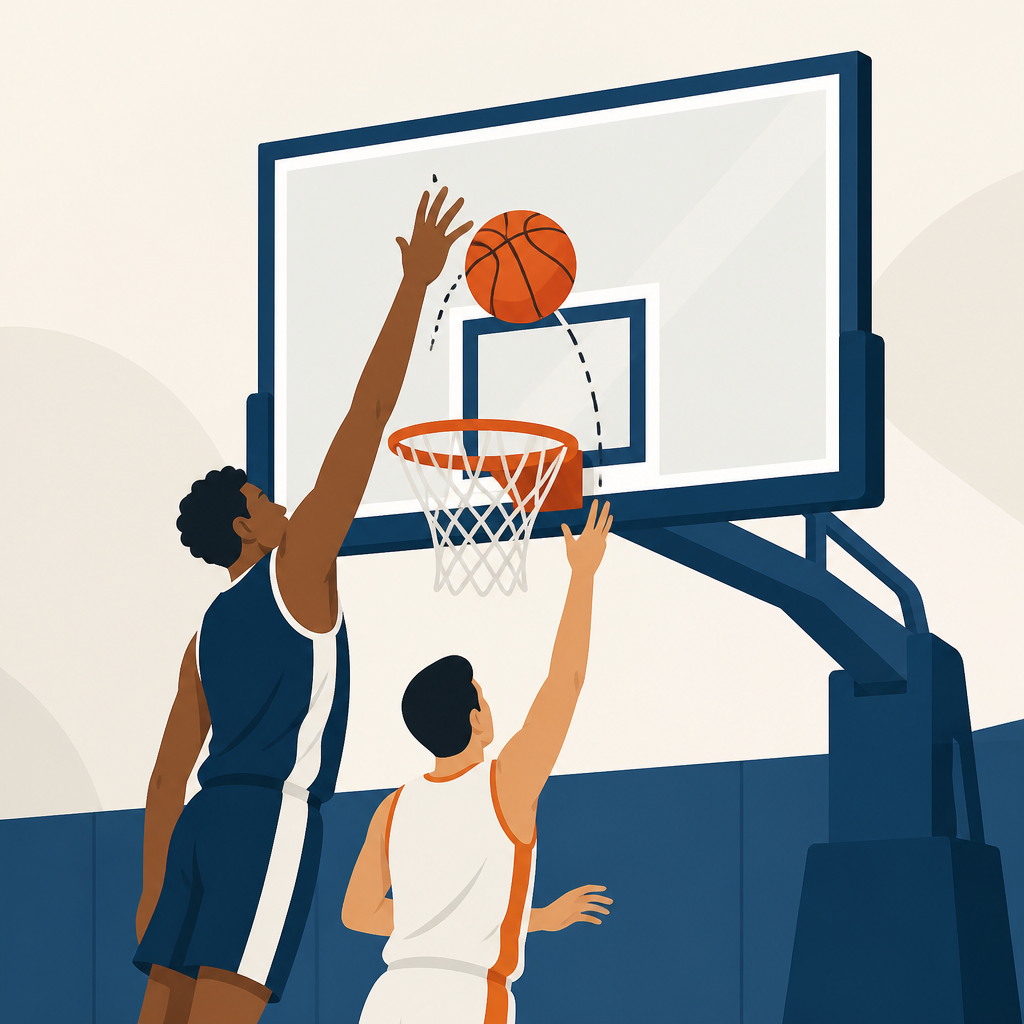
Defensive goaltending is called when a defender illegally touches a shot that has entered a protected state. The first common trigger is a ball on its downward flight toward the basket with a reasonable chance to score. Officials do not need certainty that the shot would have gone in; they judge whether it had an opportunity to score. The second trigger is contact after the ball hits the backboard, as long as any part of the ball remains above the rim. This is why chase-down blocks can be legal one moment and violations the next. The athletic play may look identical to fans, but the ball’s status changed in a fraction of a second.
A practical example is a layup that kisses the glass high on the square. If a defender pins or slaps the ball after it touches the backboard while the ball is still above rim level, that is defensive goaltending in the NBA. By contrast, if the same defender blocks the layup cleanly before it touches the board and before the ball starts descending toward the hoop, the block is legal. Officials are trained to read the entire sequence, not just the instant of contact. The lead official often has primary responsibility near the basket, but modern crews also rely on angles from the slot and center positions because side views can better reveal whether the ball had begun descending.
On television, slow motion makes many of these calls look obvious, but on the floor they are among the hardest real-time judgments in basketball. The ball may be rotating, the player’s hand may obscure the rim line, and contact may happen at full speed amid body contact underneath. That is why replay review matters in some situations, especially in the final minutes. Even then, replay only helps if camera angles clearly show the ball’s relationship to the rim, backboard, and cylinder. When angles are poor, the on-court ruling often stands because evidence is not conclusive enough to reverse it.
Offensive goaltending and basket interference around the cylinder
Offensive goaltending usually confuses fans because many assume any tip near the rim is legal if it helps the offense score. It is not. When the ball is on the rim or within the imaginary cylinder above it, an offensive player cannot touch the ball. That includes apparent put-backs that are actually too early. A classic example is a missed floater that bounces softly on the front iron. If a teammate reaches up and taps it while the ball is still on the rim or inside the cylinder, the play is dead, the score does not count, and the defense gets the ball. This is one reason good rebounders learn patience as well as bounce.
Basket interference is closely related but distinct from goaltending. It involves illegally touching the basket, net, rim, or ball while the ball is on the rim or within the cylinder, or reaching up through the basket from below. If a defender grabs the net and causes the rim to move while the ball has a chance to score, officials can award points because the contact altered the play. If an offensive player shakes the rim or reaches through from underneath to push the ball out, the basket is disallowed. In everyday conversation, fans often label both situations as goaltending, but the rulebook separates them because the prohibited acts are slightly different.
| Situation | Ruling | Result |
|---|---|---|
| Defender touches descending shot with chance to score | Defensive goaltending | Offense awarded points |
| Defender blocks ball after backboard contact above rim | Defensive goaltending | Offense awarded points |
| Offensive player taps ball while it is on the rim | Offensive goaltending | Basket waved off, defense ball |
| Player touches rim or net and affects live ball on cylinder | Basket interference | Points awarded or disallowed by team and play context |
| Clean block before downward flight and before backboard trigger | Legal play | Live ball continues |
The simplest way to separate the two ideas is this: goaltending usually focuses on illegal contact with the shot during flight, while basket interference usually focuses on illegal contact with the basket area or with a ball on the cylinder. In live officiating, though, both are protected-rim violations. Coaches teach players to avoid the gray area entirely: block the ball on the way up, leave it alone once it is on the iron, and never reach through the net to make a play.
How the call differs across the NBA, NCAA, high school, and FIBA
The core purpose of the rule is consistent across levels, but one major difference matters. In FIBA and many international competitions, once the ball touches the rim, players may legally play it off the rim as long as they do not commit basket interference by grabbing the basket or reaching through improperly. That means a soft bounce on the iron can be tapped away or in by either team after rim contact. In the NBA and NCAA, the cylinder restriction is tighter, and players must leave the ball alone while it is on the rim or within the cylinder. Fans who watch both the Olympics and the NBA often notice the difference immediately because a play that is legal internationally can be offensive goaltending or defensive basket interference in the NBA.
High school rules, governed in the United States by the NFHS, also define goaltending and basket interference with their own wording, though the same broad principles apply: protect shots in a defined phase, prohibit touching balls on the cylinder, and award or cancel points accordingly. The language used by commentators can blur these distinctions, so the best practice is always to ask which ruleset the game is using. A legal FIBA tip is not automatically legal in an NBA regular-season game, and a college interpretation may differ in replay procedure or mechanic even when the basic concept is the same.
These ruleset differences matter beyond trivia. They affect roster construction, player development, and scouting. A young big man raised in international play may instinctively swipe a ball off the rim because that habit is legal in his prior competition. In the NBA, that same instinct can cost his team points. Coaches often address this early in training camp with film sessions, especially for rookies and international veterans adjusting to a new league environment.
Technique, strategy, and common misconceptions
From a coaching perspective, the safest shot-blocking technique is to meet the ball early. Great rim protectors such as Tim Duncan, Hakeem Olajuwon, and Anthony Davis built reputations not only on vertical explosion but on reading release points and body angles. They challenged shots before the protected phase, often keeping the ball in play rather than sending it into the stands. That matters strategically. A controlled legal block can trigger transition offense; an emphatic but mistimed swat can become two free points for the other team through defensive goaltending.
One widespread misconception is that any ball above the rim cannot be blocked. That is false. A ball can be above the rim and still be legally blocked if it is on its upward flight and has not yet touched the backboard in the way that triggers protection. Another misconception is that goaltending depends only on whether the ball was “going in.” In reality, officials judge several criteria, including downward flight and backboard contact. A third misconception is that a player can avoid the violation if the contact is very light. The force of contact is irrelevant. If the touch occurs during a protected phase, the violation exists whether the defender spikes the ball or barely grazes it.
Late-game situations create added tension because one goaltending call can flip win probability. Teams know this, so they design end-of-clock actions that force rim decisions. A guard may use the glass on purpose because backboard contact can make a trailing blocker more likely to commit the violation. Defensively, coaches drill “wall up, then release” principles near the rim, teaching bigs to contest vertically and avoid swiping once the shot reaches its descending arc. Those details are part of broader game rules literacy: understanding legal verticality, restricted area responsibilities, and when a contested shot is better than a risky block attempt.
Replay review, officiating mechanics, and why the rule still sparks debate
Even with replay, goaltending remains controversial because the rule asks humans to judge a three-dimensional event in an instant. Officials use the rim line, backboard reference, ball rotation, and trajectory to decide whether the ball was rising, descending, or on the cylinder. In the NBA, replay can assist on specific reviewable plays, especially near the end of games or when officials need to determine whether points should count. Broadcast crews often draw telestrator lines to simulate the cylinder, but those visual aids are approximations, not the official ruling process.
Debate persists because some calls sit in genuine gray zones. Was the ball still rising? Did it touch the glass first? Was any part of it still above rim level? On a crowded alley-oop or put-back, did the player touch the ball or only the net? I have reviewed possessions frame by frame where smart basketball people still disagreed because the evidence never became perfectly clean. That does not mean the rule is broken. It means the play is difficult and the standard is precise. The answer is not to remove the protection; it is to keep improving camera coverage, officiating training, and fan education around game rules.
For anyone building a full understanding of NBA rules, goaltending is a foundation topic because it links scoring, rim protection, replay, and basket interference into one teachable framework. Learn the protected phases of the shot, watch how officials track the ball after backboard contact, and notice the difference between a legal block and an illegal touch on the cylinder. Do that, and many confusing whistle decisions start to make sense. The main benefit is simple: you will read rim plays faster, understand why points were awarded or erased, and follow games with the same logic officials and coaches use. Keep this rule in mind as you explore the rest of the game rules, and the entire structure of basketball becomes clearer.
Frequently Asked Questions
What is goaltending in basketball, and why does the rule exist?
Goaltending in basketball is a violation that occurs when a player touches a shot at a moment when the rules protect the ball from interference. Most people think of it as a defender blocking a shot too late, but the rule is broader than that. It is designed to protect a legitimate scoring chance once the ball has reached a legally protected phase of flight near the basket. In practical terms, that usually means a player cannot touch a field goal attempt when it is on its downward path toward the hoop, when it is directly above the rim with a chance to go in, or after it has contacted the backboard in certain situations, depending on the level of play and rule set.
The rule exists because basketball is meant to reward timing, shot-making, and legal rim protection without turning every close shot into a race to swat the ball after it is already effectively at the basket. Without goaltending rules, taller players could camp near the rim and knock away many shots that would otherwise be fair scoring attempts. That would dramatically distort offensive play, reduce the value of skilled finishing, and change how teams attack the basket. The rule helps preserve balance between offense and defense by allowing blocks, but only up to a certain point. It keeps the area around the rim competitive and exciting while still maintaining fairness.
When exactly is goaltending called on a defensive player?
Defensive goaltending is typically called when a defender touches a shot after it has started descending toward the basket, or when the ball is above the rim and still has a realistic chance to score. This is the version fans see most often. A defender may legally block a shot on its way up, but once the shot reaches the top of its arc and begins coming down, the rules generally treat it as protected. If the defender makes contact at that point, officials will usually call goaltending and award the basket.
Another common trigger is when the ball is directly over the cylinder, meaning the imaginary vertical space above the rim, and still has a chance to go through. Even if the ball has not clearly begun descending, touching it in that area can still be illegal. In many rule sets, a shot that has hit the backboard and is then touched while it is above the rim also qualifies as goaltending or basket interference, depending on the exact action. Officials must judge several things quickly: the ball’s flight, whether it is rising or descending, its location relative to the rim, and whether it had a chance to score. That is why these calls can happen fast and still create debate on replays. But the principle is straightforward: once the shot has entered a protected scoring phase, defenders must leave it alone.
Can offensive players commit goaltending too, or is it only a defensive violation?
Yes, offensive players can commit a similar violation, though many fans loosely refer to all of these plays as goaltending. More precisely, when an offensive player illegally touches the ball near or above the rim while it is still in play on a shot attempt, it is often categorized as offensive interference or basket interference rather than defensive goaltending. For example, if a teammate tries to tap in a shot while the ball is still on the rim, or reaches up through the cylinder to guide the ball into the basket, that is illegal. The offense is not allowed to help the ball into the hoop once it enters that protected space.
This matters because the goal is the same on both sides: protect the integrity of the scoring attempt. The defense cannot take a made basket away once the ball is in its protected phase, and the offense cannot manufacture a basket by touching the ball illegally near the rim. If an offensive player commits this kind of violation, the basket will not count. So while casual conversation may label many rim-touch violations as goaltending, the official terminology can differ depending on whether the illegal contact came from a defender or an offensive player and whether the ball was in flight, on the rim, or within the cylinder.
What is the difference between goaltending and basket interference?
Goaltending and basket interference are closely related, but they are not exactly the same thing. Goaltending usually refers to illegally touching a shot while it is still in flight during a protected phase, most commonly when the ball is descending toward the hoop or is above the rim with a chance to score. Basket interference, on the other hand, usually involves illegal contact with the ball, rim, net, or backboard while the ball is on or around the basket in a way that affects the play. A classic example is touching the ball while it is sitting on the rim, reaching through the basket from below, or grabbing the rim or net in a way that alters the shot’s outcome.
The distinction matters because the ball’s location and status determine which rule applies. If the ball is still clearly in flight, officials are more likely dealing with goaltending. If the ball is already on the rim, inside the cylinder, or affected by contact with the basket itself, the play may fall under basket interference. Fans often use the terms interchangeably because both involve illegal tampering with a shot near the hoop, and both exist to protect fair scoring chances. But at the rulebook level, they describe different kinds of prohibited actions. Understanding that difference makes it easier to see why one play is legal and another results in points being awarded or taken off the board.
What happens after a goaltending call, and does the exact rule vary by league?
After a defensive goaltending call, the usual result is that the offense is awarded the points the shot would have counted for, typically two or three depending on where the shot was taken. The ball is dead once the violation is recognized, and play resumes according to the applicable rules of the league. If the violation is on the offense, the basket is waved off and the other team gets possession. In either case, officials are not just judging contact; they are deciding whether the contact happened during a protected scoring moment that changed the outcome of the shot.
Yes, the exact wording and interpretation can vary by league, including the NBA, NCAA, FIBA, and high school basketball. The overall purpose stays the same, but details can differ, especially around what happens once the ball hits the rim. For example, in some levels of play, once the ball contacts the rim, players may have more freedom to play it, while in others there are stricter limits involving the cylinder or contact with the basket. That is why a play that looks legal in international basketball may be ruled differently in college or the NBA. Even with those differences, the core concept remains consistent: players are allowed to contest shots aggressively, but not once the ball has entered a protected phase where touching it would unfairly change a legitimate scoring opportunity.