
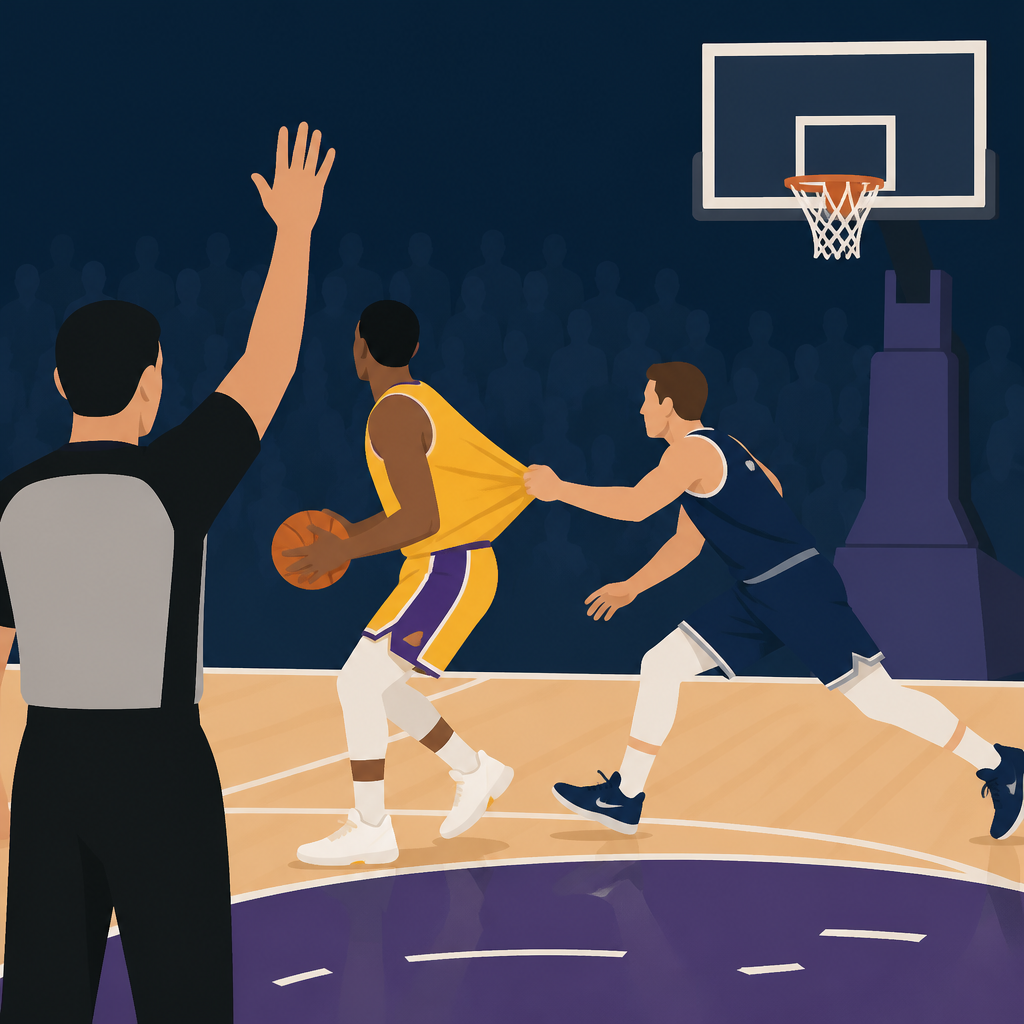
Late-game basketball used to feature a frustrating loophole: defenses could ignore the ball, grab a poor free-throw shooter, and turn the final minutes into a parade of intentional fouls. The away-from-the-play foul rule exists to stop that tactic. In the NBA, an away-from-the-play foul is a personal foul committed by the defense against an offensive player who is not in the immediate area of the ball during the final two minutes of the fourth quarter or overtime. The penalty is severe by design: one free throw for any offensive player on the floor, plus possession. That combination removes the incentive to foul weak shooters off the ball and protects the flow, fairness, and watchability of close games.
This rule matters because it sits at the intersection of strategy, officiating mechanics, and fan experience. It also serves as the best entry point for understanding the broader category of fouls explained in NBA rules. Once you understand why the league created a special penalty for a specific late-game tactic, the rest of the foul framework becomes easier to follow. Personal fouls regulate illegal contact. Team fouls trigger the penalty. Shooting fouls award free throws based on the shot attempt. Loose-ball fouls, clear-path fouls, and flagrant fouls each address a different problem. Away-from-the-play fouls are narrower, but they reveal how the NBA writes rules to shape behavior, not merely punish contact after it happens.
I have had to explain this rule repeatedly while breaking down film from close finishes, because it is often misunderstood in real time. Viewers see a grab and assume every intentional foul is treated the same. It is not. Timing, ball location, and player position all matter. The league’s language focuses on whether the foul occurs away from the play and whether the offended player is not directly involved in the action around the ball. Those details determine whether officials simply award side-out possession, free throws under the bonus, or the special away-from-the-play penalty. For anyone building a complete understanding of NBA fouls explained, this rule is essential because it shows how context changes enforcement.
What an away-from-the-play foul is, and when the special penalty applies
The clean definition is straightforward. During the last two minutes of the fourth quarter or any overtime period, if the defense commits a personal foul against an offensive player who is not in the play and not in the immediate vicinity of the ball, the offense gets one free throw by any player in the game and then keeps the ball. The rule does not apply earlier in the game, and it does not apply if the foul occurs while the offensive player is making a move directly connected to the ball. That time restriction is why broadcasts usually mention the rule only after the clock dips below 2:00.
Officials evaluate three questions. First, is the foul committed by the defense? Second, did it happen during the protected time window? Third, was the contact away from the play rather than in a legitimate attempt to guard the ball action? If the answer to all three is yes, the special penalty is triggered. This matters in practical terms because coaches cannot send a reserve center to hug an elite scorer’s teammate just to force a bad free-throw shooter to the line. The offense is rewarded with both points opportunity and retained possession, which sharply increases the expected value against the fouling team.
A common confusion involves inbound situations. If the ball has not yet been released on a throw-in during the final two minutes and the defense fouls an offensive player before the pass, the same concept can apply, though the exact administration depends on the sequence and whether the act also fits other late-game provisions. The key principle remains constant: the league does not want defenders exploiting dead-ball or near-dead-ball moments by targeting players who are not part of the immediate action. The rule is written to remove that option from the late-game playbook.
Why the NBA created the rule and the tactic it was designed to eliminate
The modern rule grew from a practical problem often called “Hack-a” strategy, shorthand for intentionally fouling poor free-throw shooters to gain a mathematical edge. Coaches discovered that fouling a non-ballhandler before a play developed could be more efficient than defending a half-court possession. The most famous versions involved big men with glaring free-throw weaknesses, including Wilt Chamberlain in an earlier era and, decades later, Shaquille O’Neal, Ben Wallace, Dwight Howard, and DeAndre Jordan. When used away from the ball, the tactic could distort the sport. Instead of offensive execution versus team defense, possessions became wrestling matches and timeout chess.
The NBA’s response reflects a larger philosophy. Rules should preserve legitimate strategy without rewarding anti-basketball behavior. Intentional fouling has always been part of clock management when a trailing team needs to extend the game. That remains legal because the foul is directed at the ballhandler or occurs naturally as the offense tries to advance the ball. What the league wanted to stop was the ambush of a weak shooter who was standing nowhere near the action. By changing the penalty to one free throw plus possession, the NBA made the cost of that tactic too high to justify. The rule does not erase intentional fouling; it channels it toward conventional endgame situations.
This distinction is important if you are reading this article as a hub for fouls explained. Many NBA foul rules are not just about contact severity. They are about competitive equity and entertainment value. Clear-path fouls protect transition scoring chances. Flagrant fouls address unnecessary or excessive contact. Defensive three seconds prevent camping in the lane. Away-from-the-play fouls do something similar for late-game possessions by preserving the integrity of live basketball action.
How officials distinguish away-from-the-play fouls from common, loose-ball, and clear-path fouls
In live action, the hard part is classification. Not every foul off the ball is an away-from-the-play foul. If two players are battling for rebounding position after a shot, that is usually a loose-ball or common personal foul, depending on the sequence. If a defender reaches in against the dribbler, that is a standard personal foul and can become free throws if the team is in the penalty. If a defender fouls from behind in transition with no defender ahead, officials may look at clear-path criteria instead. The label matters because each type of foul carries a different remedy.
When I review these plays on film, I tell viewers to look first at ball proximity and purpose. Was the fouled player actively setting a screen, receiving a handoff, cutting toward the pass, or screening for the ball? If so, the player may still be considered part of the play. If the player is standing weak side while the ball is isolated on the opposite wing and the defender wraps him up simply to stop the clock or target a poor shooter, that is the textbook away-from-the-play scenario. Officials are trained to recognize intent through context, positioning, and timing rather than through a coach’s stated plan.
| Foul type | Typical situation | Penalty | Main purpose of the rule |
|---|---|---|---|
| Away-from-the-play | Defense fouls an offensive player off the ball in final 2:00 of fourth quarter or overtime | One free throw by any player on court, plus possession | Stop intentional targeting of non-ballhandlers late |
| Common personal | Illegal contact in normal play | Side out or free throws if in penalty/shooting act | Penalize routine illegal contact |
| Loose-ball | Illegal contact while no team has clear control or during rebound battles | Team foul; free throws if in penalty in some cases | Regulate scrums for possession |
| Clear-path | Take foul in transition with path to basket protected by rule criteria | One free throw and possession | Protect fast-break opportunities |
| Flagrant | Unnecessary or excessive contact | Free throws and possession; possible ejection | Deter dangerous play |
Late-game strategy: what coaches can still do, and what they can no longer do
Coaches still have legal tools late in games. A trailing team can foul the ballhandler after the inbound or as the offense begins its action. Teams can switch matchups to put better free-throw shooters away from the ball and weaker ones in screening or inbound roles. Offensive coaches counter by using their best decision-makers as outlets and by substituting when they have timeouts available. What coaches can no longer do, at least without paying a steep price, is ignore the ball completely and tackle a poor shooter on the weak side during the protected period.
The strategic effect is significant. Before the rule, a team with a dominant but poor-shooting center could become vulnerable even when that player never touched the ball. After the rule, offensive coaches gain more freedom to keep certain lineups on the floor in the final two minutes because opponents cannot target those players away from the action as cheaply. That does not mean free-throw weakness stops mattering. If that same center catches the inbound or receives a pass and is then fouled as the ballhandler, normal intentional foul strategy still applies. The rule narrows the target zone; it does not make poor foul shooting irrelevant.
One practical example is how teams structure after-timeout sideline inbound plays. You will often see coaches place vulnerable free-throw shooters as screeners or decoys rather than primary receivers. Defenses know that grabbing those players before the pass in the final two minutes risks the special penalty. As a result, the offense can use them to create confusion without the same fear of immediate exploitation. That subtle tactical shift is one reason the rule improved late-game execution as much as aesthetics.
Edge cases, replay review, and the nuances fans most often miss
The toughest part for fans is that the rule is simple in principle but nuanced in application. Not every off-ball foul in the last two minutes qualifies. If the contact occurs in the normal course of an offensive action near the ball, officials may rule it a common foul. If the fouled player is setting a pin-down screen that springs the shooter and the defender grabs him, the player may be considered involved in the play. If the contact is excessive, the act can rise to a flagrant foul, which carries its own penalty structure regardless of late-game status.
Replay can assist with timing and with whether a player was in the act of shooting, but officials still rely heavily on judgment for classification. The NBA Replay Center helps confirm clocks, release points, and certain objective triggers. However, ball proximity and away-from-the-play context remain interpretation issues guided by the rulebook and officiating standards. That is why similar-looking clips can produce different outcomes if one happened at 2:03 and the other at 1:58, or if one player was cutting into the action while the other was standing weak side beyond the arc.
Another nuance is the relationship between this rule and the team foul penalty. In ordinary bonus situations, a non-shooting defensive foul can mean two free throws. Under the away-from-the-play provision, the offense receives one free throw by any player plus possession, which is often more valuable than two attempts by the fouled player. Analysts sometimes miss that expected value calculation. Giving Stephen Curry, Kevin Durant, or Jalen Brunson one chosen free throw and the ball back can exceed the value of sending a weak shooter to the line for two. The rule is calibrated to overcorrect intentionally, because only a strong disincentive changes behavior.
How this rule fits into the bigger picture of fouls explained in the NBA
If this page is your hub for fouls explained, the main lesson is that NBA foul rules are layered. Start with the basic personal foul: illegal contact that impedes freedom of movement, dislodges an opponent, or creates an unfair advantage. Add the shooting foul, which depends on whether the player was in the act of shooting. Add team fouls and the penalty, which determine when common fouls become free throws. Then learn the specialty categories built around context: offensive fouls, loose-ball fouls, technical fouls, flagrant fouls, clear-path fouls, and away-from-the-play fouls. Each category exists because the same physical contact can have very different strategic consequences.
The away-from-the-play rule is especially useful as a teaching tool because it answers a basic fan question: why doesn’t the NBA simply call every intentional foul the same way? The answer is that basketball is not one situation repeated fifty times. A wrap-up on a weak-side big man at 1:12 of overtime is not the same as a reach on the point guard crossing half court, even if both contacts are intentional. One is a legitimate endgame concession; the other is an attempt to bypass the sport’s normal contest. The rulebook recognizes that difference clearly.
For readers exploring the broader NBA Rules topic, this article should anchor the rest of the subtopic. From here, the logical next steps are understanding the bonus, the act of shooting, verticality, legal guarding position, offensive fouls, and replay-triggered foul reviews. Learn those concepts together, and controversial calls become easier to decode. More importantly, games become more enjoyable because you can identify not only what was called, but why the league structured the penalty that way in the first place.
The away-from-the-play foul rule is one of the NBA’s smartest late-game corrections because it attacks the incentive behind intentional off-ball fouling rather than merely scolding teams for using it. In the final two minutes of the fourth quarter and in overtime, defenders cannot gain an edge by grabbing an offensive player who is not in the immediate action. The penalty—one free throw by any player on the floor and retained possession—makes the tactic unprofitable, preserves real basketball possessions, and protects close finishes from devolving into loophole hunting.
As a hub for fouls explained, this topic also shows how NBA officiating works at its best. Rules are built around context. The same basic contact can be common, loose-ball, clear-path, flagrant, or away-from-the-play depending on timing, location, and purpose. That is why serious understanding starts with definitions but cannot stop there. You need the strategic reason behind each rule, the officiating criteria used to apply it, and the practical examples that show the difference in action.
If you want to read games more accurately, start with this principle: always ask who was fouled, where the ball was, what the clock said, and what competitive problem the rule is trying to solve. That framework will help you decode far more than this single call. Use this page as your foundation for the full fouls explained subtopic, then continue into related NBA rules so every whistle in crunch time makes sense.
Frequently Asked Questions
What is an away-from-the-play foul in the NBA?
An away-from-the-play foul is a specific late-game defensive foul that happens when a defender intentionally fouls an offensive player who is not in the immediate area of the ball. The rule applies only during the final two minutes of the fourth quarter and the final two minutes of any overtime period. It was created to stop teams from using deliberate grabbing, holding, or wrapping up poor free-throw shooters who are nowhere near the action, simply to gain a strategic advantage.
In practical terms, this means a defense cannot ignore the ballhandler and target another offensive player elsewhere on the floor just because that player is a weaker foul shooter. If officials determine that the foul occurred away from the play and during the rule’s time window, the NBA treats it differently from a normal common foul. The purpose is to protect the flow of the game, discourage obvious manipulation of the rules, and prevent end-of-game situations from turning into repeated stoppages built around intentional fouling tactics rather than actual basketball plays.
Why did the NBA create the away-from-the-play foul rule?
The NBA put this rule in place to close a loophole that made late-game situations less watchable and less fair. Before the rule existed, teams could intentionally foul weak free-throw shooters who were off the ball, especially in the final minutes, as a way to avoid dealing with the offense’s best creators or shooters. This strategy could completely disrupt the natural rhythm of the game and turn a dramatic finish into a sequence of calculated stoppages and mismatches at the foul line.
The issue became especially frustrating because the defense was not even making a legitimate play on the ball. Instead, it was exploiting a non-basketball tactic to improve its odds. The league wanted endings to be decided more by execution, defense on the ball, spacing, shot-making, and late-game composure than by defenders simply grabbing the worst shooter they could find. By imposing a harsher penalty, the NBA made the strategy much less appealing. The rule is severe by design because a mild punishment would not be enough to deter intentional fouling away from the action.
What is the penalty for an away-from-the-play foul?
The penalty is intentionally tough. When the defense commits an away-from-the-play foul during the final two minutes of the fourth quarter or overtime, the offensive team is awarded one free throw, and it also keeps possession of the ball. That combination is what gives the rule its real teeth. The offense gets an immediate scoring opportunity without losing the ball, which removes much of the incentive for the defense to use the tactic in the first place.
This is very different from a standard late-game foul, where a team might be willing to send a poor free-throw shooter to the line and then regain possession after the free throws. Under the away-from-the-play rule, the defense not only risks giving up a point but also has to continue defending the same possession afterward. That makes intentional off-ball fouling a costly mistake rather than a useful strategy. The league designed the punishment this way specifically to eliminate the so-called “grab-a-bad-shooter” approach in the most important moments of the game.
How do officials decide whether a foul counts as away from the play?
Officials look at both the location of the foul and the game situation. The key question is whether the defender fouled an offensive player who was not in the immediate area of the ball. If the contact happens clearly away from the main action, and it occurs within the final two minutes of the fourth quarter or overtime, it may qualify under this rule. Referees also consider whether the foul was part of a genuine basketball play or simply an intentional tactic meant to stop the clock and target a vulnerable free-throw shooter.
For example, if a defender is legitimately contesting a cut, fighting through a screen, or making a real play connected to the live action near the ball, the foul may be called differently. But if a defender reaches out, grabs, holds, or wraps up an offensive player on the weak side while the ball is elsewhere, that is exactly the kind of conduct the rule was designed to punish. Like many judgment calls in basketball, context matters, but the central principle is simple: if the defense intentionally fouls someone away from the action in those final two minutes, the offense gets special protection under the rule.
Does the away-from-the-play foul rule completely eliminate intentional fouling late in NBA games?
No, it does not eliminate all intentional fouling, but it does remove one of the most unpopular versions of it. Teams can still commit strategic fouls in late-game situations, especially against the ballhandler or in more conventional foul-to-stop-the-clock situations. What the rule specifically targets is the tactic of bypassing the ball entirely and fouling a weaker free-throw shooter away from the action. In that sense, it narrows the range of legal late-game strategies and pushes defenses toward more honest, basketball-based choices.
The result is a cleaner and more competitive finish. Coaches still have end-game options, but they cannot simply hunt an off-ball player and expect to benefit from it. That preserves suspense and makes the final possessions feel more authentic. Fans get to watch teams execute under pressure instead of sitting through repeated stoppages caused by defenders grabbing someone with no connection to the play. So while intentional fouling still exists in the NBA, the away-from-the-play foul rule plays an important role in keeping late-game strategy from crossing the line into pure exploitation.