
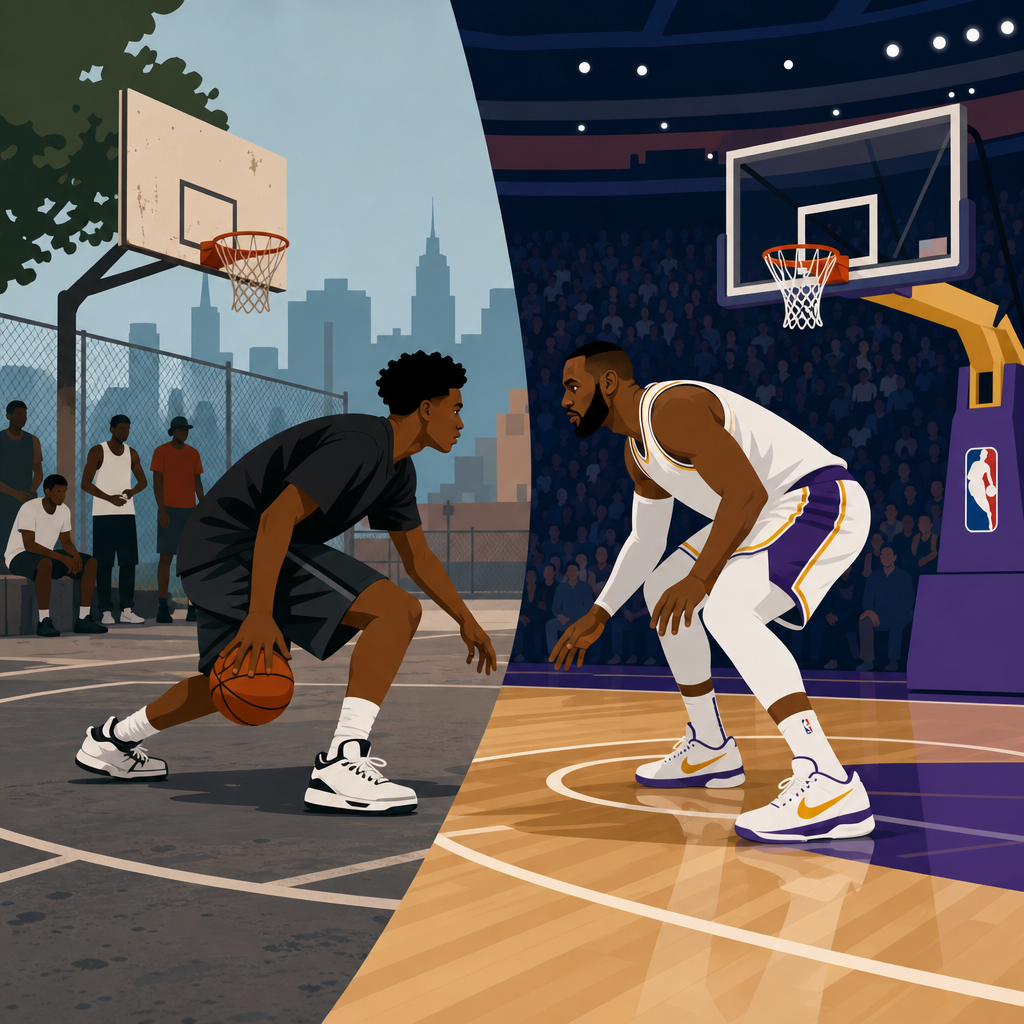
Streetball and the NBA have shaped each other for decades, turning playground improvisation into a visible force inside the professional game. Streetball refers to informal basketball played in parks, schoolyards, housing projects, and rec centers, usually without coaches, set plays, or strict officiating. The NBA, by contrast, is a structured league built on scouting, contracts, systems, and rules. Yet the boundary between the two has never been clean. Many of the league’s most memorable moves, styles, personalities, and marketing breakthroughs came from players who learned to create space, entertain crowds, and solve problems on outdoor courts before they entered organized basketball.
This relationship matters because player culture is not just about uniforms, endorsements, or social media. It is about how players learn confidence, identity, rhythm, creativity, toughness, and status within basketball communities. In my experience covering the game and studying player development pathways, the clearest lesson is that playground basketball has long functioned as a parallel academy. It teaches deception, timing, balance, recovery, and emotional control under pressure. A packed park can be harsher than a gym because reputation is always on the line. If a player gets crossed, blocked, or outworked, everyone remembers.
For an NBA Culture hub focused on player culture, streetball is essential because it connects skill development, fashion, language, music, mythology, and the economics of attention. It helps explain why certain players command devotion beyond box scores. It also explains how the league evolved from a conservative, system-heavy product into one that often celebrates individual expression. The influence is visible in ballhandling, isolation scoring, transition creativity, bench reactions, mixtape fame, signature shoes, and the way players build personal brands. To understand modern basketball culture, you have to understand the blacktop.
Streetball did not invent talent, and not every playground habit translates well to winning professional basketball. That nuance matters. The best NBA players who emerged from streetball environments did not simply bring flashy moves to the league. They adapted those instincts to spacing, shot quality, defensive rotations, and the physical demands of an 82-game season. The story is not that streetball replaced fundamentals. The story is that it expanded what basketball fundamentals could include: improvisation, handle under contact, body control, tempo shifts, and crowd-aware confidence. That broader definition changed how players play and how fans watch.
The Playground as a Basketball Laboratory
Outdoor courts have historically served as testing grounds where players refine moves against older, stronger, and less predictable opponents. Unlike tightly organized youth systems, playground runs force instant decision-making. There is little time for a coach to stop action and diagram a solution. Players must read angles, protect the ball on rough surfaces, and generate offense in cramped spaces. Those demands produce practical creativity. A hesitation dribble, shoulder fake, or spin move becomes valuable not because it looks good, but because it creates one clean step of separation.
Classic courts such as Rucker Park in Harlem, Venice Beach in Los Angeles, and West 4th Street in Manhattan became famous because elite talent gathered there. Julius Erving, Kareem Abdul-Jabbar, Earl Monroe, Tiny Archibald, Connie Hawkins, and later Rafer Alston, Kobe Bryant, Kevin Durant, and many others either played in or were influenced by legendary summer runs. These spaces rewarded style, but they also punished wasteful play. If a move failed, the other team scored quickly and the crowd turned. The best streetball players learned economy beneath the flair.
That environment influenced NBA player culture by creating a respect hierarchy separate from official credentials. A player could be overlooked by recruiters yet still become a local legend through performance. That idea remains powerful today in pro-am circuits like the Drew League, Dyckman, Seattle Pro-Am, and Goodman League. When NBA players show up at these events, they are not just training. They are reconnecting with a proving ground where status comes from beating real defenders in front of educated basketball audiences.
Signature Moves That Traveled from Parks to Arenas
One direct way streetball influenced the NBA is through skill vocabulary. The crossover existed before modern playground culture, but outdoor legends made it sharper, lower, and more performative. Tim Hardaway’s “UTEP two-step,” Allen Iverson’s lethal crossover, Jamal Crawford’s hang dribble, Kyrie Irving’s stop-start handle, and Stephen Curry’s relocation and rhythm dribbling all carry playground DNA. These moves rely on deception, change of pace, and reading a defender’s weight distribution, all staples of unscripted basketball.
Streetball also normalized playing with cadence instead of constant speed. Watch archival footage of Earl “The Pearl” Monroe or God Shammgod and the pattern is obvious: pause, bait, shift, attack. NBA guards now treat tempo as a weapon. Luka Doncic, though shaped outside American streetball traditions, applies the same principle by manipulating defenders with rhythm. The lesson streetball taught the professional game is that control over timing can be as devastating as vertical athleticism.
Footwork shows the same influence. Step-throughs, pivots into counters, wrong-foot layups, reverse finishes, and creative gathers all thrive in informal settings because defenders recover unpredictably. Modern trainers often break these moves into drills, but they were sharpened in competitive improvisation first. When fans celebrate “bag culture,” they are often praising a streetball-informed tool set: a deep inventory of counters a player can deploy when the first move fails.
| Streetball trait | NBA translation | Player example |
|---|---|---|
| Low, deceptive handle | Isolation creation against switches | Allen Iverson |
| Change of pace | Manipulating drop coverage and closeouts | Jamal Crawford |
| Crowd-aware flair | Highlight plays that build star identity | Jason Williams |
| Improvised finishing angles | Scoring through rim protectors | Kyrie Irving |
| One-on-one confidence | Late-clock shot creation | Kevin Durant |
From Reputation to Brand: The Rise of the Cultural Star
Streetball’s influence on the NBA goes beyond technique. It helped transform players from team pieces into cultural figures. At playground events, names, nicknames, and stories matter almost as much as outcomes. “Dr. J,” “The Goat,” “Skip to My Lou,” and “The Professor” are more than labels; they are identity systems that turn skill into narrative. The NBA absorbed that logic as television expanded and shoe companies realized charisma could sell as powerfully as championships.
Allen Iverson is the clearest case. His game was efficient enough to win an MVP, but his broader influence came from how he embodied authenticity. The braids, sleeve, tattoos, fearless handle, and refusal to conform to older corporate expectations made him a symbol of playground credibility entering the mainstream league. The NBA’s 2005 dress code, widely understood as a response to this cultural shift, showed how powerful player expression had become. Streetball had not merely influenced play style; it had challenged the league’s image management.
Mixtape culture accelerated that change. And1’s tours and videotapes turned local legends into national attractions and taught fans to value clips, moves, and personality in addition to formal resumes. This media language now dominates social platforms. A viral summer run clip can shape discourse around a player’s offseason as quickly as a preseason game. That is a straight line from blacktop storytelling to modern athlete branding.
Streetball, Development, and the Limits of Flash
Not every playground skill survives the jump to the NBA. This is where analysis has to stay honest. Streetball can produce bad habits if players mistake difficult shot-making for good offense. A dribble move that embarrasses one defender may stall an entire possession in a five-man system. NBA defenses are longer, smarter, and more organized than almost any park run. Coaches and front offices value processing speed, defensive discipline, and shot efficiency. Aesthetic skill only matters if it creates points consistently.
Still, the best development programs now understand that structure and improvisation must coexist. Trainers such as Micah Lancaster, Drew Hanlen, and Phil Handy often blend game-speed creativity with footwork precision and decision constraints. That mirrors what elite street players always discovered naturally: moves are useful only when they solve a real problem. Kyrie Irving’s handle works because it leads to balance, passing windows, and elite finishing touch. It is not decorative. The same is true of Shai Gilgeous-Alexander’s hesitations and Jalen Brunson’s stop-start footwork.
This balance also explains why many NBA veterans return to pro-am environments in summer. They use them to test counters, conditioning, and confidence without the rigid predictability of team practice. At the same time, smart players know that professional success requires editing. The NBA rewards selective creativity. The blacktop may inspire the move, but film study decides when to use it.
How Streetball Reshaped Modern NBA Aesthetics
The current NBA product is visually and emotionally closer to streetball than the league of the 1980s or early 1990s. Isolation spacing, spread pick-and-roll, freedom dribbles, and greener lights for skilled guards all increase the value of self-created offense. Rule interpretations that discourage hand-checking have amplified this shift. As perimeter players gained more freedom, streetball-informed handles and counters became even more valuable.
Broadcast culture changed too. Camera packages linger on pregame tunnels, bench celebrations, player reactions, and close-up dribble sequences because fans want personality and style, not only tactics. Signature sneakers, compression sleeves, tattoos, accessories, and warmup fits all sit within a player-culture ecosystem that playground basketball helped normalize. The message is simple: how a player carries himself is part of the spectacle.
Even team-building reflects this influence. In playoff basketball, half-court possessions often come down to whether one star can beat his man, force help, and make the correct read. That is a refined version of a playground problem. Teams still need spacing, rim protection, and rebounding, but late-clock creation remains the league’s premium skill. Streetball did not create the need for closers. It taught generations of players how to embrace those moments publicly and creatively.
Why Streetball Still Matters to NBA Player Culture
Streetball remains relevant because player culture still depends on authenticity, peer respect, and visible skill. Young prospects grow up in an ecosystem that includes AAU circuits, skills trainers, social clips, and local runs. The best ones learn quickly that organized basketball gets you recruited, but unscripted environments reveal whether your handle holds up, whether you can create under pressure, and whether older players respect your game. That social credibility continues to matter inside the NBA, where players judge each other’s craft with a sharper eye than fans do.
For readers exploring NBA Culture through the lens of player culture, this hub topic connects naturally to fashion, music, social media, pro-am leagues, sneaker history, and the evolution of guard play. It also connects to labor and economics. A player with a distinctive style can drive jersey sales, endorsement value, and global attention. Cultural influence has commercial consequences. The league knows this, which is why it increasingly markets stars as creators, curators, and personalities rather than just athletes.
The lasting lesson is not that every NBA player should play like a streetball legend. It is that playground basketball expanded the professional game’s imagination. It proved that creativity, rhythm, and self-expression could coexist with elite competition. When that energy is disciplined by film study, conditioning, and team concepts, it produces some of the most compelling basketball in the world. If you want to understand where today’s NBA player culture comes from, start at the park, then follow the moves, stories, and swagger all the way to the arena.
Frequently Asked Questions
What is the difference between streetball and NBA basketball?
Streetball and NBA basketball share the same foundation, but they developed in very different environments. Streetball is typically played in parks, playgrounds, schoolyards, housing projects, and community gyms where the game is informal, fast, and shaped by the players on the court. Rules are often flexible, officiating may be minimal or nonexistent, and the culture rewards creativity, confidence, improvisation, and one-on-one skill. Players learn to solve problems in real time, often against older, stronger, or more experienced opponents, which encourages resilience and a highly expressive style of play.
The NBA operates in a far more structured setting. Professional basketball is built around coaching systems, scouting reports, playbooks, contracts, officiating, analytics, and team strategy. Every possession is influenced by spacing, timing, defensive schemes, and the long-term demands of an 82-game season plus the playoffs. Even so, the contrast is not as absolute as it seems. Many of the traits celebrated in streetball—ball handling, footwork, deception, rhythm changes, and fearlessness—have become essential tools for NBA players. In that sense, streetball is not the opposite of professional basketball; it is one of the game’s most important creative engines.
How did streetball influence the style of play in the NBA?
Streetball influenced the NBA by expanding what was considered possible, effective, and entertaining on a basketball court. Moves that were once associated with playground flair—crossovers, hesitations, spins, no-look passes, ankle-breaking changes of direction, and highly individualized scoring packages—gradually became part of the professional skill set. Streetball culture encouraged players to treat the dribble not just as a way to advance the ball, but as a weapon for controlling tempo, creating space, and putting defenders at a disadvantage. That mindset reshaped perimeter play in the NBA.
The influence became especially visible as the league opened up for guards and wings with advanced handle and improvisational ability. Players who could create offense off the bounce started to define eras, and the NBA became more comfortable with isolation scoring, spread pick-and-roll creation, and highlight-worthy one-on-one play. Streetball also helped normalize a more expressive relationship with the game. Confidence, rhythm, and personal style became marketable parts of an NBA player’s identity, not just side notes. While coaches still demand discipline and efficiency, many modern offensive concepts benefit directly from the creativity that streetball helped popularize. What began as playground invention eventually became mainstream professional technique.
Which NBA players best represent streetball’s influence on the professional game?
Several NBA stars reflect streetball’s influence, though they each translated it differently. Players like Allen Iverson are often central to this conversation because they brought a level of improvisation, dribbling artistry, and attacking freedom that felt deeply connected to playground basketball. Iverson’s crossover was not just a move; it was a cultural moment that demonstrated how street-rooted creativity could thrive at the highest level. He played with a blend of toughness, flair, and fearless scoring that made the bridge between streetball and the NBA unmistakable.
Others carried that influence in more technical or modern forms. Jason Williams became known for daring passes and imaginative court vision that echoed the looseness and joy of outdoor basketball. Rafer Alston, who was famous in streetball circles before reaching the NBA, offered one of the clearest examples of direct crossover between the two worlds. Kyrie Irving represents a later evolution: his footwork, handle, balance, and finishing creativity are polished for the NBA, but the improvisational DNA is unmistakable. Even players who are not typically labeled “streetball” stars have benefited from its influence. The modern league is full of guards and wings whose scoring packages, counters, and space-creation methods owe something to the playground tradition. Streetball’s legacy is no longer limited to a few flashy individuals; it is embedded in how elite players train and compete.
Did the NBA always embrace streetball-style creativity?
No, and that tension is a major part of the story. For a long time, streetball-style creativity was often viewed with suspicion in professional basketball circles. Traditional coaches and executives sometimes saw flashy dribbling, extra moves, or expressive one-on-one play as inefficient, risky, or undisciplined. The NBA historically placed a premium on structure, execution, and minimizing mistakes, so not every playground-inspired skill was immediately welcomed. Players with creative styles sometimes had to prove that their flair could also produce results within a team framework.
Over time, the league’s attitude changed for several reasons. First, certain players were simply too effective to ignore; they showed that creativity and winning were not mutually exclusive. Second, rule changes and stylistic shifts increasingly favored perimeter players who could create their own offense. Third, media and fan interest rewarded individuality, highlights, and recognizable playing styles. As basketball strategy evolved, coaches began to see that many so-called streetball moves were not empty showmanship at all. They were advanced methods of generating separation, breaking defensive rhythm, and forcing help rotations. The NBA did not fully abandon structure, but it learned to absorb and refine streetball’s most useful elements. What was once dismissed as playground flair is now often taught as elite shot creation.
Why does the connection between streetball and the NBA still matter today?
The connection still matters because it explains how basketball keeps renewing itself. Streetball remains one of the game’s most important laboratories for experimentation. In informal settings, players test angles, counters, ball-handling patterns, finishes, and timing without the constraints of a formal system. That freedom often produces innovations that eventually appear in organized basketball, from youth levels all the way to the NBA. The professional game may refine those ideas with coaching, film study, and analytics, but the original spark often comes from environments where imagination comes first.
It also matters culturally. Streetball represents community, self-expression, local reputation, and basketball’s accessibility. You do not need a franchise, a major arena, or a national television contract to influence the sport. Some of the game’s most lasting contributions have come from public courts where style and survival blended together. The NBA’s global popularity owes a great deal to this relationship because fans are drawn not only to winning, but also to originality, personality, and memorable moves. Today’s professional stars train with more structure than ever, yet many of the skills that define elite perimeter basketball still carry the rhythm and daring of the playground. That is why the relationship between streetball and the NBA is not just historical trivia—it is a living part of how the sport looks, feels, and evolves.