

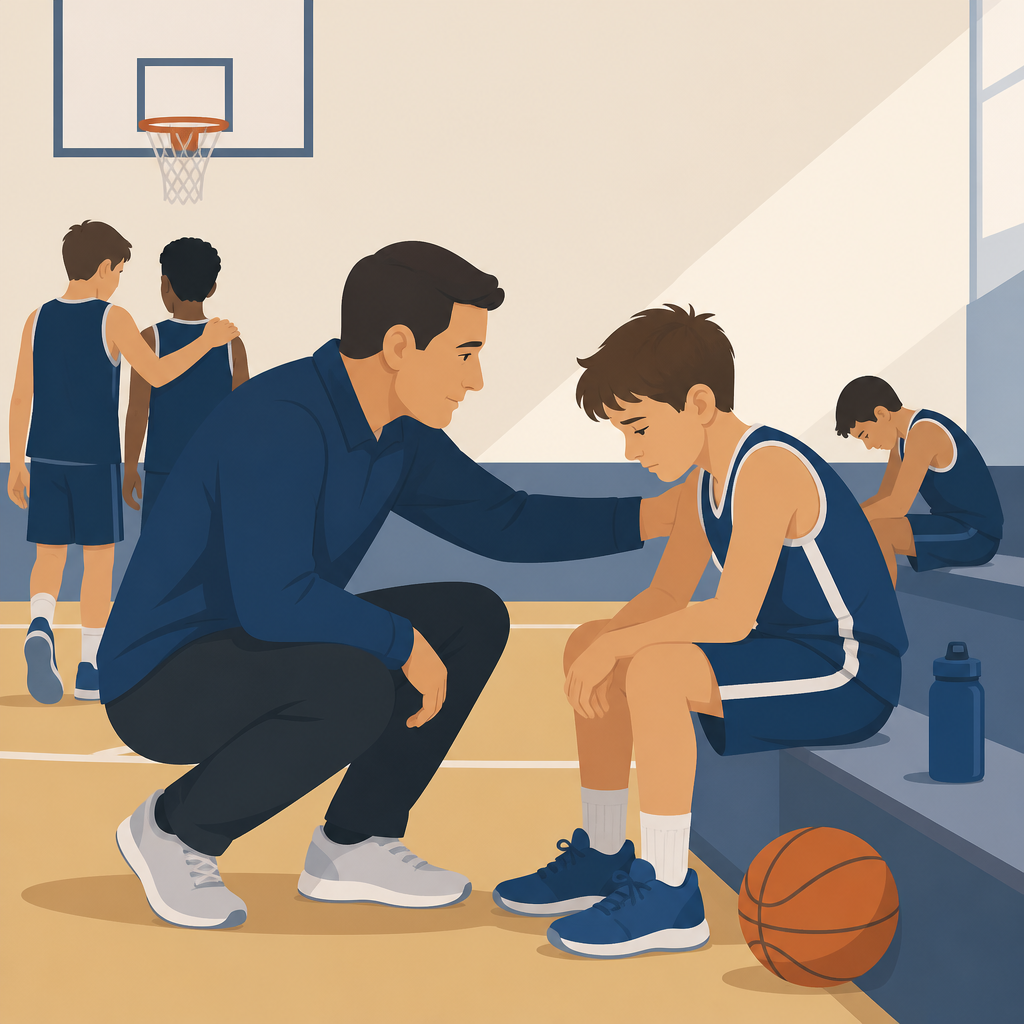
Tough losses are part of youth basketball, but they do not have to derail confidence, effort, or long-term development. The real coaching challenge is not avoiding defeat; it is helping young basketball players process disappointment, stay engaged, and return to practice ready to improve. Motivation after a loss comes from structure, communication, and a team culture that rewards growth as much as results. When coaches handle those moments well, players learn resilience, self-control, and a healthier relationship with competition.
In youth basketball, motivation means the internal and external reasons a player keeps showing up, working hard, and believing improvement is possible. Young players are influenced by many factors at once: playing time, parent reactions, peer approval, scoreboard pressure, physical fatigue, and the coach’s words immediately after the game. A tough loss can make those pressures feel bigger. Some players get quiet, some become angry, and some start protecting themselves by saying they do not care. I have seen all three responses, and each one needs a deliberate coaching approach.
This matters because early sports experiences shape whether kids stay in the game. Research from the Aspen Institute’s Project Play and long-running youth sports participation studies consistently show that children keep playing when sports remain fun, socially rewarding, and developmentally appropriate. They quit when the environment feels overly critical, confusing, or centered only on winning. Basketball is especially demanding because mistakes are public and frequent. A turnover, missed free throw, or defensive lapse can happen in front of teammates, parents, and opponents within seconds. If coaches do not actively teach players how to handle those moments, losses can chip away at motivation fast.
Coaching through losses also sits at the center of every other youth basketball coaching responsibility. Player development, communication, game management, leadership, practice planning, confidence building, parent relations, and team culture all meet here. That is why this topic works as a hub for the wider coaching conversation. If a coach can respond well after a bad defeat, many of the most important youth basketball habits are already in place: emotional control, clear standards, consistent feedback, and a focus on teachable next steps rather than blame.
Start with emotional recovery before technical correction
Right after a tough loss, young players are rarely ready for a full tactical breakdown. Their nervous systems are elevated, they are replaying mistakes, and many are searching your face to decide how bad the situation really is. In that window, the coach’s first job is emotional regulation. I prefer a short postgame routine: bring the team together, slow everyone down, acknowledge that the loss hurts, and give one or two stabilizing truths. For example: “We did not finish well tonight, but we stayed connected, and we know exactly what we need to work on tomorrow.” That kind of message validates feelings without letting emotion define the team.
This is different from softening the standard. Players know when they played poorly. They do not need fake positivity. They need perspective. Keep the immediate talk brief, specific, and calm. Avoid individual callouts in front of the group, especially after emotional games. Public criticism after a loss often makes players defensive rather than motivated. Save detailed corrections for film review, the next practice, or one-on-one conversations when the athlete can actually process them.
Young athletes also benefit from a consistent reset ritual. Some teams use controlled breathing for sixty seconds. Others use a “win, learn, improve” format where each player names one thing the team did well and one thing it must improve. The point is predictability. Routine reduces drama, and reduced drama helps motivation survive disappointment.
Build motivation around mastery, not just the scoreboard
One of the fastest ways to keep young basketball players motivated is to make improvement visible. Scoreboards matter, but they are not enough. If motivation depends entirely on winning, players on rebuilding teams or less experienced rosters will lose belief quickly. Effective youth basketball coaching creates multiple measures of success: defensive communication, transition effort, rebounding percentage, paint touches, assist-to-turnover habits, closeout technique, and free-throw routine quality. These are controllable performance indicators that tell players their work has value even before results fully change.
After hard losses, I often reset the team around three measurable goals for the next week. For a younger group, that might be “sprint back on every transition possession, make two passes before forced shots, and box out on every shot.” For an older team, it might be “hold opponents under one point per possession in the half court, keep live-ball turnovers under twelve, and generate ten corner threes from drive-and-kick action.” When players can see a path forward, motivation becomes practical rather than emotional.
This approach aligns with established coaching principles from organizations such as USA Basketball and the Positive Coaching Alliance. Their guidance consistently emphasizes process goals, age-appropriate instruction, and reinforcement of effort and learning behaviors. In plain terms, players stay motivated when the coach teaches them what improvement looks like and then notices it when it happens.
Use losses to teach basketball IQ with calm, specific feedback
Many young players assume a loss means they are not good enough. Good coaching replaces that vague feeling with concrete basketball understanding. Instead of saying, “We played selfish,” identify the exact decision pattern: “We drove into traffic without a kick-out read, and we missed the weak-side cutter three times.” Instead of “Defense was terrible,” say, “Our low man was late on baseline drives, so we gave up layups and collapse threes.” Specificity protects motivation because it turns failure into a solvable problem.
Film is powerful here, but it must be used carefully. Keep clips short. Show one correctable theme at a time. Include positive possessions, not only mistakes. I have found that a three-part film sequence works best with youth players: one clip showing the mistake, one clip explaining the read, and one clip from either the same game or a previous practice showing the team doing it correctly. That final example matters because it reminds players they are capable.
Questions also matter. Ask, “What did the help defender see here?” or “What was the best outlet after this rebound?” Guided questions improve basketball IQ while giving players ownership. When athletes help identify the fix, they buy into the next practice with more energy.
Plan the next practice to restore confidence quickly
The practice after a difficult loss should not feel like punishment. Conditioning may have a place in a season plan, but using running as an emotional reaction to losing usually backfires. Players leave associating mistakes with humiliation rather than growth. A better response is a tightly designed practice that starts with high-success actions, moves into targeted correction, and ends with competitive reps that let the team experience improvement.
For example, if a team lost because of poor transition defense and rushed offense, open practice with simple passing and finishing to rebuild rhythm. Then move into advantage-disadvantage transition drills, shell defense with communication constraints, and a half-court decision-making segment where players must create paint touches before shooting. Finish with a scoring game that rewards the exact habits you want, such as three points for a stop with a completed box out or two points for a possession with an extra pass leading to a quality shot.
Confidence grows from evidence. When players leave practice feeling, “We fixed something,” motivation returns. The key is sequencing. Do not spend ninety minutes rehearsing only what went wrong. Blend correction with competence.
| Coaching moment after a loss | Common mistake | Better coaching response |
|---|---|---|
| Immediate postgame talk | Long emotional lecture | Brief, calm message with one lesson and one next step |
| Next practice | Punishment running | Targeted drills tied to the actual causes of the loss |
| Film review | Showing only mistakes | Pair errors with teachable corrections and positive examples |
| Player confidence | Talking only about effort | Highlight specific skill and decision improvements |
| Team standards | Changing rules after every defeat | Keep standards consistent and measure progress clearly |
Know the different motivational needs on your roster
Not every player responds to losing the same way. Starters may fear letting teammates down. Bench players may quietly feel the loss confirms they are not trusted. Younger players may focus on one missed shot for days. Highly competitive athletes can turn frustration into effort, but they can also become self-critical to the point of paralysis. Good youth basketball coaching accounts for those differences.
Segment your communication. The player who is hard on herself may need reassurance that one mistake is not her identity. The disengaged player may need a clear role and a small, reachable challenge for the next game. The emotional leader on the team may need private coaching on body language because teammates read every reaction. In my experience, motivation improves most when each athlete can answer three questions after a loss: What is my role? What did I do that helped? What is one thing I will do better next time?
This is also where playing-time communication becomes critical. Nothing kills motivation faster than uncertainty paired with silence. You do not need to promise equal roles, but you do need to explain development paths honestly. If a player lost minutes because of defensive awareness or practice habits, say so clearly and respectfully, then define the route back. Clarity is motivating. Guesswork is not.
Shape the parent environment so it supports recovery
For younger athletes, postgame motivation is heavily influenced by the ride home. Coaches cannot control every conversation, but they can shape the environment. The best programs set parent expectations early: after games, lead with support, not interrogation. Questions like “Why did you miss those free throws?” or “Why didn’t the coach play you more?” keep players stuck in blame and anxiety. Better prompts are simple: “I loved watching you compete,” “What felt good tonight?” and “What do you want to work on this week?”
I recommend giving parents a communication framework before the season starts and revisiting it after a stretch of tough games. Many families appreciate practical guidance because they want to help but do not know what actually builds resilience. Point them toward behaviors that sustain motivation: praise for hustle, listening without immediate correction, consistent routines around sleep and nutrition, and trust in the coaching process.
When parent pressure becomes intense, players often start playing not to make mistakes. That is one of the clearest warning signs in youth basketball. They pass up open shots, avoid aggressive drives, and tense up late in games. Coaches need to recognize that pattern and counter it by rewarding brave, sound decisions even when the outcome is imperfect.
Create a team culture where losses have meaning
The most motivated teams are not the teams that never lose. They are the teams that know what a loss is for. In a healthy youth basketball culture, defeat provides information, not identity. That principle must be repeated all season in language players understand. If the team standard is built around competitiveness, accountability, unselfishness, and preparation, then every game becomes feedback on those habits.
Culture is reinforced through repetition. Use the same performance language in practice, games, and review sessions. Celebrate “response wins” after losses: a better defensive talk rate, stronger bench engagement, improved late-game composure, smarter shot selection. Those are signs the team is learning. Over time, players stop viewing adversity as proof they are failing and start seeing it as part of becoming better basketball players.
It also helps to connect current setbacks to long-term development. Young players often think in one-game terms. Coaches should widen the lens. A ten-year-old learning to handle traps, an eighth grader adapting to stronger competition, or a freshman guard learning varsity pace may struggle now and benefit later. Say that plainly. Players are more motivated when they understand the purpose behind hard phases of the season.
Use this page as the coaching hub for your youth basketball program
If you coach youth basketball, motivation after losses should connect to every other coaching topic you study and implement. Practice planning matters because players regain belief through well-designed reps. Skill development matters because confidence is rooted in competence. Communication matters because athletes need direct, age-appropriate feedback. Leadership matters because captains and high-energy teammates shape emotional recovery. Game strategy matters because repeated confusion can feel like failure to young players. Parent communication matters because home reactions influence whether a player returns excited or discouraged.
That is why coaching deserves to function as a hub within youth basketball. When you improve this one area, you strengthen retention, team chemistry, decision-making, and player enjoyment across the season. The coach who handles losses well usually runs clearer practices, teaches better habits, and creates a more durable learning environment. Those outcomes are not accidental. They come from consistency.
The key takeaways are simple. First, address emotions before mechanics. Second, make improvement measurable so motivation does not depend only on wins. Third, give specific basketball feedback that turns mistakes into teachable actions. Fourth, design the next practice to rebuild confidence while correcting real problems. Fifth, communicate differently with different players and align parents around supportive postgame habits. Finally, build a team culture where losses are used, not feared.
Young basketball players do not need a coach who pretends losing feels fine. They need a coach who can hold standards steady, teach clearly, and show them how to bounce back with purpose. If you want better effort, stronger confidence, and more resilient teams, start by changing what happens in the twenty-four hours after a tough loss. Make that response part of your coaching system, and your players will keep growing long after the scoreboard is forgotten.
Frequently Asked Questions
How can coaches help young basketball players bounce back emotionally after a tough loss?
Coaches can make the biggest difference in the first few hours after a loss by giving players structure, calm, and perspective. Young athletes often feel disappointment very intensely, and if that emotion is ignored or handled harshly, it can turn into embarrassment, fear of failure, or a drop in effort. A strong response starts with acknowledging the loss honestly without turning it into a personal judgment. Players need to hear that it is okay to be frustrated while also understanding that one result does not define their talent, character, or future progress.
After the game, it helps to keep the message simple: recognize the effort, identify one or two lessons, and remind the team what comes next. That keeps emotions from spiraling and gives players a clear path forward. Instead of replaying every mistake, coaches should focus on controllable factors such as communication, defensive effort, shot selection, and composure. This shifts attention away from shame and toward improvement. The goal is not to pretend the loss did not matter, but to show players how to respond in a productive way. Over time, this teaches resilience, emotional control, and the ability to stay motivated even when outcomes are disappointing.
What should coaches say to young players after a bad game to keep them motivated?
The most effective post-game communication is honest, specific, and steady. Young players usually know when they played poorly or when the team let a game slip away, so overly cheerful comments can feel empty. At the same time, criticism delivered in anger can damage confidence and make players associate mistakes with fear. The best approach is to validate the emotion, then redirect it. A coach might say that the loss hurts, that everyone shares responsibility, and that the team will learn from it together. That kind of message lowers defensiveness and keeps players connected to the group.
Specific language matters. Instead of saying, “We were terrible,” coaches should point to concrete areas the team can improve, such as transition defense, passing under pressure, or finishing possessions with rebounds. It is also helpful to mention what the players did well, especially behaviors that reflect growth, discipline, and competitiveness. Praising hustle, teamwork, and responsiveness to coaching reinforces values that remain important regardless of the scoreboard. When coaches consistently communicate that development matters as much as the final result, players are more likely to stay engaged, work through frustration, and return to practice believing they can get better.
Why is focusing on growth and effort so important after youth basketball losses?
Focusing only on wins and losses can be especially harmful in youth basketball because young athletes are still learning how to connect effort with long-term development. If players believe success is measured only by the scoreboard, tough losses can quickly feel like proof that they are not good enough. That mindset can lead to hesitation, lower confidence, and even burnout. By contrast, when coaches emphasize growth, players learn that setbacks are part of improvement, not the end of it. They begin to understand that discipline, habits, and response to adversity are all meaningful forms of success.
A growth-centered approach also helps players stay motivated through the natural ups and downs of a season. Not every team is going to win every weekend, and not every player is going to perform at their best in every game. What keeps young athletes moving forward is knowing that mistakes can be corrected and skills can be developed. Coaches who reward effort, focus, teamwork, and coachability create an environment where players feel safe to compete hard without fearing that one bad game will define them. That culture builds stronger confidence because it is based on progress and character, not just short-term results.
What role does team culture play in keeping young basketball players engaged after losses?
Team culture is one of the strongest factors in whether a tough loss becomes a learning moment or a motivation problem. In a healthy team environment, players understand that accountability and support go together. They know that mistakes will be addressed, but they also know they will not be singled out, blamed, or embarrassed. That kind of culture helps players stay emotionally secure enough to keep competing, asking questions, and working on weaknesses. When the team identity is built around effort, preparation, communication, and shared responsibility, players are much less likely to shut down after a disappointing result.
Culture is shaped by what coaches consistently reward and model. If the tone after a loss is panic, blame, or sarcasm, players often become defensive and lose trust. If the tone is demanding but constructive, they learn that adversity is manageable. Leaders can reinforce this by reviewing losses with purpose, encouraging teammates to lift each other up, and celebrating improvements that happen between games. Even small routines, such as ending practice with positive takeaways or setting one team goal for the next game, can strengthen motivation. A strong culture does not remove disappointment, but it gives players the emotional framework to handle it in a healthy and productive way.
How can coaches turn a tough loss into a productive practice plan for young basketball players?
The best way to restore motivation after a loss is to make the next practice focused, organized, and solution-based. Young players regain confidence when they can see how a disappointing game connects to clear improvement steps. Coaches should review the loss, identify a small number of correctable issues, and build practice around those areas. For example, if the team struggled with turnovers, the next session might include decision-making drills, passing under pressure, and composure in transition. If the problem was defensive breakdowns, practice can emphasize communication, help-side positioning, and closeouts. This approach turns frustration into action.
It is also important for practice to include success opportunities. If the entire session feels like punishment, players may leave even more discouraged. Productive practices challenge athletes while still allowing them to experience progress through repetition, feedback, and small wins. Coaches should explain why each drill matters, connect it to game situations, and reinforce improvement as it happens. Ending with a competitive segment that highlights the team’s response and energy can be especially effective. When players leave practice feeling that they learned something, fixed something, and moved forward together, motivation becomes much easier to sustain after a tough loss.