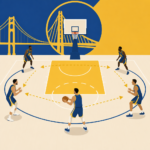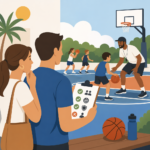

Youth basketball drills that kids actually look forward to share one trait: they feel like games while quietly building real skills. In youth basketball coaching, that balance matters more than many adults realize. Players between roughly ages six and fourteen learn best when movement is frequent, rules are simple, and success comes in small, visible wins. A drill is just a structured activity designed to teach a basketball skill, decision, or habit. A good youth drill improves technique without killing energy. A great one also protects attention spans, rewards effort, and gives every player enough touches to stay engaged.
I have coached enough youth practices to know the fastest way to lose a gym is to overtalk, overline, and overcomplicate. Kids do not show up excited to stand in a cone line waiting for one layup every ninety seconds. They show up wanting to dribble, pass, shoot, compete, laugh, and feel progress. That is why fun is not separate from development. Fun is the delivery system for development. When players enjoy a drill, they repeat quality reps with better focus, and that repetition is what changes footwork, ball control, spacing, and defensive habits over time.
This coaching hub explains how to choose, teach, and organize youth basketball drills so practices stay productive and players want to come back. It covers the core coaching principle behind effective drills, the categories every youth coach should use, and the common mistakes that make practices drag. It also gives examples you can adapt for beginners, rec teams, school programs, and travel groups. If your goal is better practices, stronger fundamentals, and more confident young players, this guide will help you build sessions kids remember for the right reasons.
What makes a youth basketball drill fun and effective
The best youth basketball drills combine three ingredients: lots of reps, clear purpose, and a competitive hook. Lots of reps means every child has a ball whenever possible, or at least regular involvement every few seconds. Clear purpose means the coach can answer, in one sentence, what the drill teaches: change-of-direction dribbling, jump-stop balance, help defense, passing to a moving target, or finishing through contact. The competitive hook can be as simple as beat-the-clock scoring, partner challenges, team points, or a “can your group finish before mine” race.
Age matters. Younger players usually need shorter rounds, simpler rules, and obvious targets. A third grader can handle dribble-tag, red-light green-light with the ball, or a layup game with one cue such as “outside foot, outside hand.” Older youth players can manage reads, constraints, and guided decision-making like 2-on-1 advantage drills or small-sided games that reward spacing. The coaching mistake is using high school structure for elementary attention spans. In youth basketball, complexity is rarely the bottleneck. Engagement is.
Effective drills also solve behavior problems before they start. When players are moving, there is less side talking, horseplay, and disengagement. I prefer drills that start within two minutes of practice, require minimal explanation, and allow immediate correction on the move. Instead of a long speech about defensive stance, for example, use mirror slides in pairs, then freeze and coach shin angle, chest position, and active hands. Kids remember feelings and actions faster than lectures.
How to organize a practice that keeps kids engaged
A strong youth basketball practice usually follows a simple flow: arrive active, build a skill, apply it in a game, and finish with something competitive. That sequence works because it matches how children learn. Early in practice, they need to burn nervous energy and get touches. In the middle, they can focus on a specific technique. Later, they need to test that technique under pressure. By the end, they want a challenge that feels meaningful.
A practical seventy-five minute plan might look like this: ten minutes of movement warm-up with a ball, fifteen minutes of dribbling and footwork, fifteen minutes of passing and finishing, fifteen minutes of defense or rebounding, fifteen minutes of small-sided games, and five minutes of free throws or team challenge. The exact clock can change, but the structure should not become random. Random practices feel long. Predictable rhythms feel faster and safer for young players.
Transitions are where many coaches lose momentum. Have cones and groups set before the previous activity ends. Use water breaks strategically instead of automatically. Keep teaching points to one or two per drill. If a drill is not working after three minutes, change it. Young athletes do not need a coach to rescue a bad drill through louder instructions. They need the coach to choose a better drill. Good coaching is often smart editing.
Best categories of youth basketball drills for coaching fundamentals
Every youth coaching plan should include five drill categories: ball handling, passing, finishing, defense, and decision-making. Ball-handling drills should teach control under movement, not stationary tricks alone. Passing drills should include timing, target hands, pivots, and receiving on the move. Finishing drills should train both sides of the rim, balance, and contact tolerance. Defensive drills should cover stance, slides, closeouts, and help position. Decision-making drills should force players to read teammates, defenders, and space instead of memorizing choreography.
Small-sided games are especially valuable because they compress the action and increase involvement. In 3-on-3, every child guards, handles, cuts, and makes choices more often than in 5-on-5. Research and coaching practice across basketball development pathways support this. Fewer players means more touches, more repetitions, and more teachable moments. If you want kids to improve faster, play more 1-on-1, 2-on-2, and 3-on-3 and less full-court scrimmage where weaker players disappear.
The table below shows how to match common drill types with coaching goals and the reason kids usually enjoy them.
| Drill type | Main skill taught | Why kids enjoy it | Coaching note |
|---|---|---|---|
| Dribble tag | Ball control, vision, change of pace | Feels like a chase game | Use a small space to force heads-up dribbling |
| Relay layup races | Footwork, finishing speed | Immediate team competition | Score technique, not just makes |
| Partner passing on the move | Chest pass, bounce pass, catching | Constant action with a teammate | Demand target hands and pivots |
| 1-on-1 from the wing | Triple threat, defense, containment | Clear challenge and ownership | Limit dribbles for beginners |
| 2-on-1 advantage | Spacing and decision-making | Fast breaks create excitement | Coach the pass-read, not only the finish |
| Closeout to rebound | Defensive footwork and finishing possessions | Short, intense reps | Add a score system for stops and boards |
Specific youth basketball drills kids usually love
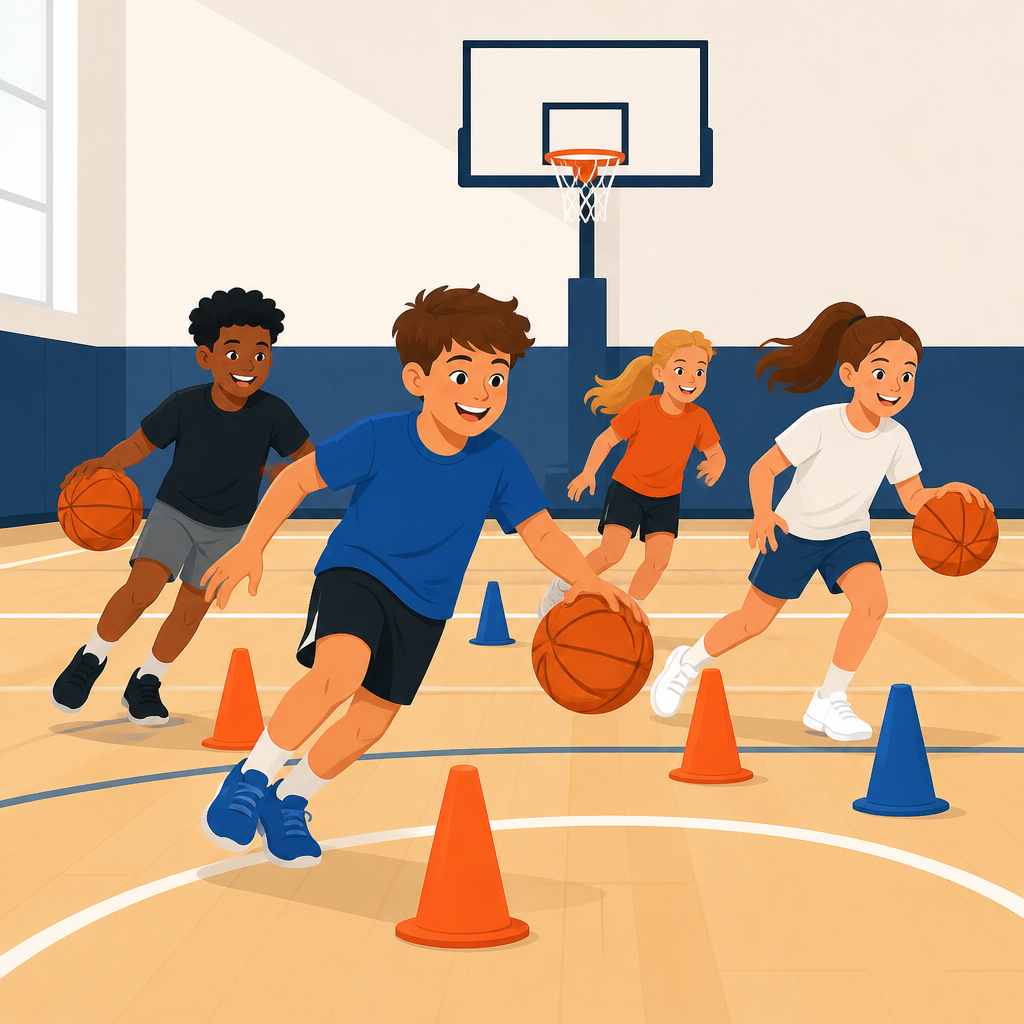
Some drills repeatedly work across age groups because they hide fundamentals inside competition. Dribble tag is one. Every player has a ball except one or two taggers. Players must protect their dribble while moving in a marked area. If tagged or if the ball is lost, there is a quick consequence such as five pound dribbles before rejoining. This drill teaches vision, control, changes of direction, and awareness with almost no waiting. It also lets you scale difficulty by shrinking space, requiring off-hand dribbles, or adding weak-hand-only rounds.
Another favorite is knockout-style finishing, adjusted for development. Instead of the classic elimination format that leaves players standing around, run “make and move” stations where players score from different angles and rotate quickly. You can create left-hand only rounds, jump-stop finishes, or pad-contact finishes. Kids like the pace and the visible challenge. Coaches like the volume of layup reps and the built-in pressure.
Sharks and minnows works well for younger groups learning change of direction. Ball handlers cross the court while defenders try to poke balls away. Players who lose the ball join the defenders. The game naturally teaches shielding, pace changes, and keeping the body between the defender and the ball. For passing, gate-passing games are excellent. Pairs score by completing passes through cone gates while moving. This rewards communication, angles, and timing better than static partner passing alone.
For defense, mirror drill remains one of the best options when kept short and competitive. One player leads with slides, retreats, and directional changes while the other mirrors. Add points for staying square or a finish line to create purpose. For older kids, 1-on-1 cutthroat and 3-on-3 no-dribble are outstanding because they force spacing, pivots, passing, and cutting without long explanations. The reason players enjoy these drills is simple: they feel like basketball, not homework.
Coaching cues that make drills teach better
A drill can be fun and still fail if the coaching language is vague. Young players respond best to short, repeatable cues linked to body positions. For layups, “eyes up, outside foot, soft touch” works better than a paragraph. For passing, try “step to target, snap wrists, show hands.” For defense, use “nose on chest, hands active, feet quiet.” These are specific enough to guide action and short enough to remember mid-rep.
Demonstration quality matters too. Show the drill at game speed once, then slower with the coaching cue. Use a player model when possible. Kids often learn faster from a peer whose movement looks achievable. After that, coach in bursts. Let the drill breathe for twenty to thirty seconds before stopping everyone. Constant interruptions reduce rhythm and repetition, which are the lifeblood of skill development.
Feedback should separate effort from execution. Praise the sprint back, the strong pivot, or the eyes-up dribble even when the shot misses. Correct the detail without discouraging the attempt. In my experience, players improve fastest when the gym feels demanding but emotionally safe. They should expect standards, not embarrassment. That is especially true in youth basketball coaching, where confidence often determines whether a child stays in the sport long enough to benefit from instruction.
Common drill mistakes youth coaches should avoid
The first mistake is lines. If more than two players are waiting in sequence, the drill probably needs redesign. The second is talking too much before the first rep. Explain just enough to start, then coach through action. The third is using drills with no transfer to games. Ten flashy cone moves may look busy, but if players never read a defender or finish under pressure, development stalls. Skill without context is fragile.
Another mistake is making every drill a sprint. Energy is useful, but not every rep should be frantic. Passing footwork, closeout angles, and finishing balance sometimes need controlled pace before speed is layered in. Coaches also often ignore spacing. A crowded gym can still run efficient practice if stations are clearly marked and groups are balanced. Poor spacing causes collisions, distractions, and dead time.
Finally, do not confuse fun with chaos. The best fun drills have clear boundaries, scoring, and consequences. They are playful, but they are not loose. When a drill breaks down, the answer is usually to simplify the rule, shrink the explanation, or adjust the space. Kids thrive when structure is visible and success feels within reach. That is the sweet spot of strong coaching.
Building a season-long coaching hub from your drills
A youth basketball coaching program works best when drills connect across the season instead of appearing as isolated activities. Start with foundational themes such as stance, stops, pivots, ball protection, passing angles, and finishing off one foot or two. Then revisit those themes in harder forms. A dribble-tag game in November can become advantage attack in January. A partner passing drill can grow into drive-and-kick decision-making later. This progression helps players recognize that drills are not random games; they are steps in a learning path.
It also helps to organize your broader coaching content around the questions parents and assistant coaches ask most: what skills should this age learn, how long should practice last, how much should we scrimmage, how do we teach defense, when do we introduce set plays, and how do we keep weaker players engaged? When this hub connects those topics, it becomes useful beyond one practice plan. That is what strong coaching resources do. They make daily decisions easier.
The main takeaway is straightforward: youth basketball drills that kids actually look forward to are not gimmicks. They are well-designed teaching tools built on movement, repetition, clarity, and competition. Choose drills that minimize waiting, match age and skill level, and lead naturally into game play. Coach with concise cues, adapt quickly when attention drops, and measure success by engagement as well as execution. If you build practices this way, players improve faster and enjoy the sport more. Use this hub as your starting point, then keep refining each session until your gym becomes a place kids cannot wait to reenter.
Frequently Asked Questions
What makes a youth basketball drill something kids actually enjoy instead of just tolerate?
The biggest difference is that enjoyable youth basketball drills feel active, achievable, and game-like. Kids usually lose interest when they are standing in long lines, listening to lengthy explanations, or repeating a movement with no clear purpose. They stay engaged when a drill gives them frequent touches on the ball, simple rules to follow, and a clear way to “win,” score, or improve. That is why the best youth basketball drills often look more like mini-games than formal instruction, even though they are still teaching real fundamentals.
For players roughly ages six through fourteen, motivation often comes from visible success. A drill that lets a player make a pass, finish a layup, steal a cone, beat a timer, or earn points for a team tends to hold attention much longer than a static technical drill. Enjoyment also increases when coaches adjust the challenge level. If a drill is too easy, kids get bored. If it is too hard, they get frustrated. The sweet spot is a task that stretches them while still allowing regular success.
Another key factor is pace. Good youth drills keep bodies moving and decisions happening. Instead of explaining for five minutes, strong coaches demonstrate quickly and let players learn by doing. They also rotate roles often so no one waits too long. When kids are dribbling, reacting, competing, and laughing, they are usually learning more than it appears from the outside. In practical terms, the most effective drills combine skill development, competition, repetition, and fun in a way that makes players want “one more turn.”
How can coaches make basketball drills fun without sacrificing real skill development?
Making drills fun does not mean lowering standards or turning practice into chaos. It means packaging fundamentals in a format kids want to repeat. The most effective youth coaches understand that repetition is necessary, but repetition works best when players do not experience it as boring. A dribbling drill becomes more engaging when it includes a tag element, a race, or a reaction cue. A passing drill becomes more meaningful when players have to make quick choices under light pressure. A shooting drill becomes more exciting when players track points, work against a clock, or compete in small teams.
The key is to identify the actual teaching goal first. If the goal is ball control, the game should require many dribbles under changing conditions. If the goal is passing accuracy, the scoring system should reward sharp, on-time passes. If the goal is defensive stance and movement, the drill should force repeated slides, closeouts, and recoveries in a realistic way. Fun is not separate from teaching; it is the delivery system that keeps effort high enough for learning to happen.
Coaches should also avoid overloading players with too many instructions at once. Young athletes rarely improve faster because they heard more words. They improve when one or two important points are emphasized repeatedly in a setting they understand. For example, a coach might run a dribble-relay game but only focus on “eyes up” and “change speed.” That keeps the learning clear. Over time, fun and structure work together. Kids compete hard, get many quality reps, and build skills almost without realizing how much technical work they are doing.
Which types of youth basketball drills usually work best for ages six to fourteen?
The most effective drills for this age range are usually simple, fast, and adaptable. Younger players especially benefit from activities with clear objectives and minimal downtime. Dribbling games, tag-based movement drills, relay races with ball-handling, partner passing challenges, layup competitions, and small-sided games like 1-on-1, 2-on-2, or 3-on-3 tend to work extremely well. These formats naturally build fundamentals while also teaching spacing, timing, reaction, and confidence.
For ages six to eight, drills should be especially short and easy to understand. At that stage, coordination, balance, listening, and general comfort with the ball matter as much as formal technique. Activities like red-light/green-light dribbling, cone knockdown games, dribble tag, and simple passing targets are ideal because they feel playful while building athletic habits. For ages nine to eleven, players can handle a bit more structure and competition. This is a strong age for layup games, passing on the move, pivot-and-pass drills, defensive mirror drills, and controlled 1-on-1 contests.
For ages twelve to fourteen, the same “fun” principle still matters, but players can benefit from more decision-based work. Advantage drills, transition games, closeout-and-contain drills, shooting under pressure, and small-sided games with constraints can be very effective. For example, requiring a paint touch before a shot or awarding extra points for completed passes encourages smart offensive habits without long lectures. Across all age groups, the best drills are the ones that fit the players’ developmental level and keep everyone involved. A great youth drill is not just age-appropriate; it is attention-appropriate and confidence-appropriate too.
How long should youth basketball drills last before kids lose focus?
In most youth practices, individual drills should be shorter than many adults expect. A common mistake is staying with one activity long after the players’ energy and concentration have dropped. For younger kids, five to eight minutes is often enough for one drill before changing the format, adding a new rule, or moving to a related activity. Older youth players may stay engaged a little longer, especially if the drill includes competition, decision-making, or scorekeeping, but even then, long stationary blocks usually reduce quality.
The better way to think about practice is in segments rather than in isolated, extended drills. A coach might spend six minutes on a dribbling game, then shift to a passing challenge, then move into a finishing activity, and finally connect those skills in a small-sided game. That variety maintains attention while still reinforcing the same core themes. The goal is not to entertain endlessly; it is to keep focus and effort high enough that repetitions stay sharp.
Coaches should watch for signs that a drill has run its course. When players stop moving with purpose, begin talking over instructions, lose technique, or seem more frustrated than challenged, it is usually time to modify something. That modification could be shortening lines, changing teams, adding a scoring target, or simplifying the rules. In youth basketball, attention is a coaching variable just like spacing or footwork. Shorter, more energetic drill blocks almost always produce better learning than one long activity that players mentally leave halfway through.
What are the biggest mistakes coaches and parents make when choosing basketball drills for kids?
One of the biggest mistakes is choosing drills based on what looks advanced instead of what actually helps kids learn. A drill can seem impressive to adults and still be poorly suited for young players. Overly complicated actions, too many steps, and long verbal explanations usually lower both enjoyment and retention. Kids need clarity, repetition, and movement. If they spend more time trying to understand the drill than performing the skill, the activity is probably not appropriate.
Another major mistake is relying on line-heavy drills where only one player works at a time. These drills may feel organized, but they often waste valuable practice minutes. Young players improve through touches, decisions, and repetition, not by watching others. Good youth practice design maximizes participation. That means using stations, partner work, multiple baskets, small groups, and game-based formats whenever possible. More involvement almost always means more learning and more fun.
Adults also sometimes underestimate how important emotional experience is in development. If a child leaves practice feeling unsuccessful, embarrassed, or bored every time, long-term improvement becomes less likely no matter how technically sound the drill was in theory. Players develop best when they feel challenged but capable. Coaches and parents should look for drills that create small wins, visible progress, and a sense of momentum. That does not mean avoiding discipline or standards. It means understanding that confidence and enjoyment are not extras in youth basketball; they are part of the learning process. The best drills build fundamentals, decision-making, and enthusiasm at the same time, which is exactly why kids are more likely to look forward to practice and keep coming back to the game.