
The NBA salary cap history tells a larger story than a rising dollar figure. It shows how the league transformed from a struggling 1980s sports business into a global entertainment company powered by media rights, sponsorships, streaming, and player-driven star power. If you want to understand modern roster construction, luxury tax bills, max contracts, and why one summer can reshape the league, you have to start with the cap itself. The salary cap is the leaguewide limit on how much teams can spend on player salaries in a season, but in the NBA it is a “soft cap,” meaning teams can exceed it through approved exceptions written into the collective bargaining agreement.
I have spent years tracking cap sheets, CBA changes, and team-building decisions, and one truth always stands out: the cap is not just an accounting rule. It is the central operating system of NBA business. Every major decision, from a rookie extension to a midseason trade, runs through cap mechanics. Fans often ask a simple question: how did the salary cap grow from $3.6 million in 1984-85 to well over $100 million today? The direct answer is basketball-related income, or BRI, the revenue pool that includes national and local media deals, ticket sales, sponsorships, merchandising, and other league-defined streams.
This matters because cap growth changes competitive balance, player salaries, franchise strategy, and even how dynasties are built. A rapidly rising cap can create sudden spending room, while a flat cap can trap teams that projected future growth. The NBA salary cap history also explains why older contract numbers look tiny by current standards and why direct comparisons across eras can mislead. To make sense of the modern NBA business landscape, you need both the timeline and the mechanism. This guide covers salary cap explained basics, the major turning points from 1984 to today, and what the growth of the number has meant in practical terms for teams, players, and the market.
How the NBA salary cap works and why 1984 changed everything
The NBA introduced a salary cap for the 1984-85 season, setting it at $3.6 million per team. That date matters because it marked the formal linking of payroll limits to league economics through collective bargaining. Before then, spending controls were looser and competitive disparities were harder to manage. The cap was designed to create cost certainty for owners while still allowing teams to retain talent through exceptions. Unlike the NFL’s hard cap, the NBA system lets clubs go above the cap in specific situations, most famously through Bird rights, which allow a team to exceed the cap to re-sign its own free agents after meeting service requirements.
Another key term is the salary floor, the minimum amount teams must spend, generally set as a percentage of the cap. Then there is the luxury tax line, a higher threshold above the cap that triggers tax payments for overspending teams. Modern cap analysis also includes aprons, sign-and-trade restrictions, mid-level exceptions, bi-annual exceptions, traded player exceptions, and maximum salary rules tied to years of service. These details changed repeatedly through successive CBAs, but the central formula remained stable: cap growth follows revenue growth, subject to negotiated percentages and smoothing mechanisms.
The original cap era coincided with a crucial business recovery for the league. Magic Johnson and Larry Bird had already elevated ratings and national interest, and Michael Jordan’s arrival in 1984 accelerated commercial momentum. Still, the NBA in the mid-1980s was nowhere near the financial scale it would later reach. The early cap numbers were modest because media rights were modest, local revenues were smaller, and international monetization was limited. In practical terms, the first cap functioned less like a giant spending engine and more like a disciplined framework for a league still establishing national business stability.
NBA salary cap history by era: from early growth to the modern explosion
From 1984 through the early 1990s, the cap rose steadily as the league’s television product improved and attendance strengthened. By 1990-91, the cap had climbed to $11.9 million, more than tripling from the starting point in six seasons. That growth reflected a healthier national profile, stronger gate receipts, and broader advertiser interest. The Jordan-era Bulls, the Pistons, Lakers, and Celtics all benefited from a league becoming more commercially attractive. Importantly, these increases were meaningful but not chaotic. Teams could plan with some confidence because cap rises generally tracked an upward business trend rather than sudden windfalls.
The mid-1990s and early 2000s brought another step up. Expansion fees, improved arena economics, cable partnerships, and the globalization of NBA stars helped push BRI higher. By 1995-96 the cap reached $23.0 million, and by 2005-06 it stood at $49.5 million. That period also showed how labor and economics interact. The 1998-99 lockout shortened the season and led to a new CBA that tightened several spending rules. Even so, long-term growth continued because the league’s core products, live games and media rights, kept appreciating. Teams increasingly treated cap management as a specialized front-office discipline, not a side task for general managers.
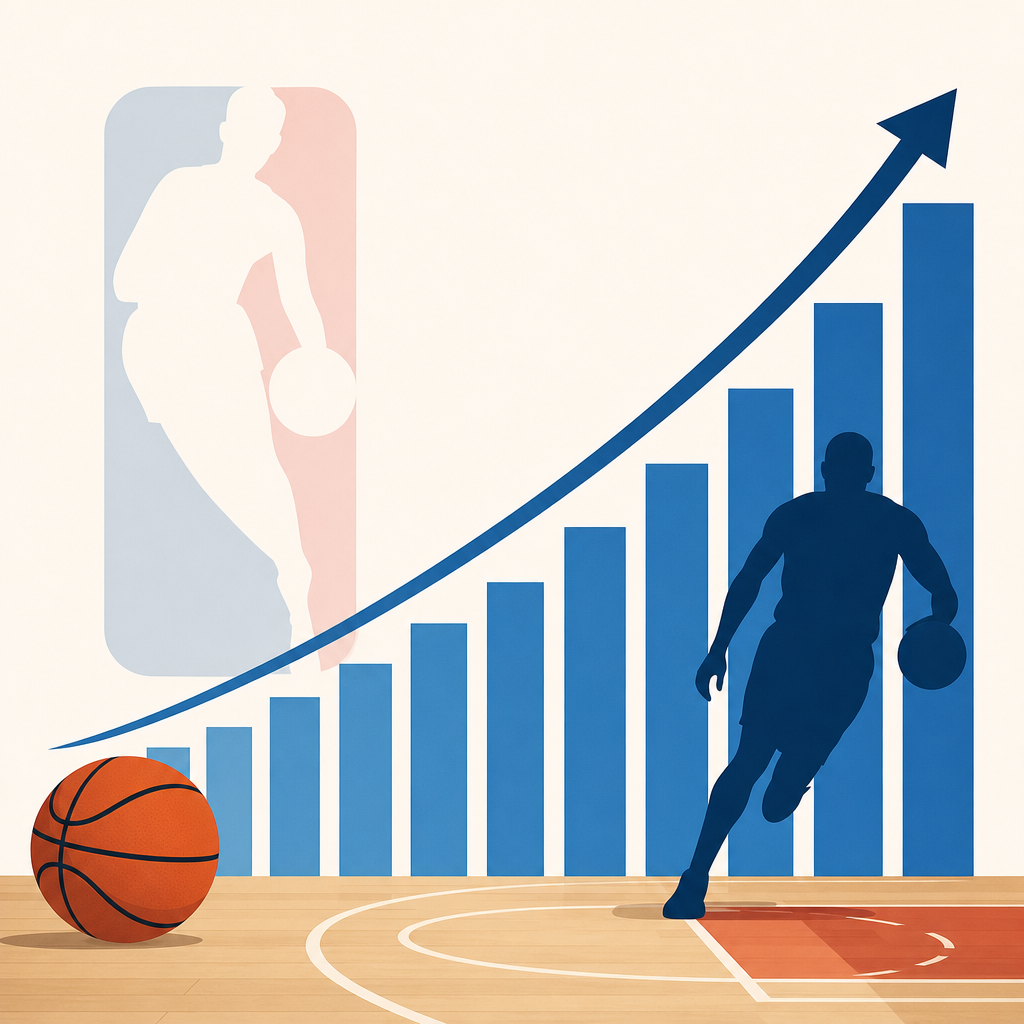
The real modern inflection points came with the 2011 and 2016 CBAs and the media rights cycle surrounding them. After the 2011 lockout, the league reset revenue sharing and player-owner splits, shaping future cap calculations. The cap was $58.0 million in 2012-13 and $63.1 million in 2014-15. Then the new national television deal hit. Instead of gradually smoothing the jump, the cap spiked from $70.0 million in 2015-16 to $94.1 million in 2016-17. That single-year leap changed team-building across the league. It created unusual max-space opportunities, inflated contracts for role players, and directly enabled major free agency shifts, including Kevin Durant joining Golden State.
| Season | Salary Cap | Why it mattered |
|---|---|---|
| 1984-85 | $3.6 million | First NBA salary cap under collective bargaining |
| 1990-91 | $11.9 million | Early national growth era becomes visible in payroll limits |
| 1995-96 | $23.0 million | Jordan era and stronger media economics lift team spending power |
| 2005-06 | $49.5 million | Modern front-office cap strategy becomes essential |
| 2015-16 | $70.0 million | Last season before the historic TV-driven spike |
| 2016-17 | $94.1 million | Largest one-year jump in league history reshapes free agency |
| 2023-24 | $136.0 million | New apron system raises the cost of keeping expensive contenders together |
| 2024-25 | $140.6 million | Continued growth under current media and CBA structure |
Recent seasons have brought both growth and caution. The pandemic disrupted gate revenue and temporarily slowed normal projections, but the cap did not collapse because the league and union negotiated adjustments. Then the latest CBA introduced a stricter team-building environment above the tax, especially through the first and second aprons. In other words, the cap kept rising, but spending flexibility for the most expensive teams became more constrained. Today’s cap number is far larger than any previous era’s, yet the system is also more punitive for teams that stack high-salary rosters without restraint.
What drives salary cap growth: media rights, BRI, and the business of basketball
The simplest explanation for cap growth is revenue growth, but the precise driver is BRI. Under NBA labor agreements, players receive a negotiated share of BRI, and the cap is derived from that framework after benefits and other agreed adjustments are considered. So when fans ask why the salary cap rises, the answer is not “because owners feel generous” or “because stars asked for more.” It rises because the business generated more basketball-related income. National media rights are the biggest accelerant because they deliver large, predictable cash flows to all teams, not just major-market franchises.
Local revenue also matters. Regional sports network deals, team-owned media ventures, premium seating, arena naming rights, and sponsorship packages all feed the broader economics around franchises. Some categories fluctuate by market, but stronger local businesses still support leaguewide leverage in negotiations and valuation growth. International expansion is another critical factor. The Dream Team, NBA League Pass, global social distribution, overseas preseason games, and the rise of international stars such as Dirk Nowitzki, Yao Ming, Giannis Antetokounmpo, Nikola Jokic, and Luka Doncic all expanded audience reach. More audience reach means more monetizable inventory.
Cap growth is not always smooth because revenue recognition and labor rules are not perfectly linear. The 2016 spike is the clearest example. The league had enough new television money to support a dramatic increase, but without a smoothing agreement, the cap jumped all at once. That had three practical effects. First, several teams gained room that did not exist under prior assumptions. Second, contract prices for non-stars rose because cap space suddenly exceeded top-tier free-agent supply. Third, competitive outcomes changed quickly because one or two teams could add an elite player without dismantling the existing core. That is how a business rule becomes a basketball turning point.
How cap growth changed player salaries, team strategy, and competitive balance
As the cap rose, so did the scale of every major contract category. Rookie deals, veteran minimums, max salaries, extensions, and exceptions all moved upward because many are pegged directly or indirectly to cap formulas. In the 1980s, a million-dollar annual salary carried enormous weight. Today, midlevel rotation players can earn well into eight figures per season. That does not automatically mean teams are spending recklessly. It means the entire market has reset around a much larger revenue base. Comparing nominal salaries across eras without cap context is one of the most common mistakes in NBA debate.
Front offices adapted by becoming much more technical. In my experience covering transactions, the smartest organizations rarely think only in terms of “Can we afford this player?” They ask, “What will this salary mean against the cap, the tax, the first apron, and the second apron over multiple years?” A team above the cap can still improve, but it must use exceptions, aggregation rules, matching rules, and Bird rights carefully. A team below the cap has room, but if it uses that room inefficiently, it can lose flexibility for years. Cap growth rewards good planning; it does not erase bad planning.
Competitive balance has moved in both directions. On one hand, the cap and tax system are designed to prevent unlimited payroll advantages. On the other, soft-cap exceptions let strong teams keep expensive cores together longer than a hard cap would allow. The Warriors, Cavaliers, Clippers, Bucks, Celtics, and Suns all illustrate versions of this tension. Wealthy ownership groups can pay tax, but under current rules there are sharper penalties for doing so repeatedly. The result is a league where talent retention is possible, yet each additional high-salary decision carries escalating opportunity cost. That balance defines modern NBA business strategy.
Salary cap explained today: the hub concepts every fan should know
For a complete salary cap explained foundation, focus on ten concepts. The cap is the spending guideline. The floor is the minimum payroll. The luxury tax line is the overspending threshold. Bird rights help teams re-sign their own players. Max contracts cap what individual stars can earn as a percentage of the cap. Exceptions create legal ways to add players without cap room. Cap holds occupy space during free agency. Dead money remains on the books after certain waivers or stretched contracts. Aprons add roster-building restrictions above the tax. BRI is the engine behind all of it.
The best way to read NBA salary cap history is not as a list of numbers but as evidence of a changing industry. The rise from $3.6 million in 1984-85 to $140.6 million in 2024-25 reflects four decades of stronger media rights, better arenas, global audience expansion, and increasingly sophisticated labor agreements. It also explains why modern roster decisions are so complex. Every extension, trade, and free-agent signing sits inside a web of thresholds and exceptions shaped by that history. If you follow the cap, you understand why contenders break up, why dynasties survive, and why one revenue cycle can reset the league.
The main takeaway is straightforward: the NBA salary cap has grown because the NBA business has grown, and that growth has changed every layer of team building. Knowing the timeline helps, but knowing the mechanism helps more. Use this page as your starting point for the broader NBA Business topic, then keep tracing how taxes, exceptions, max deals, and media money interact. Once you see those links clearly, the league’s biggest decisions stop looking random and start looking logical. Follow the cap, and the business side of basketball becomes much easier to understand.
Frequently Asked Questions
What was the NBA salary cap when it was first introduced in 1984?
The NBA salary cap was introduced for the 1984-85 season at roughly $3.6 million per team. That number looks tiny by modern standards, but it was a major structural shift for the league. At the time, the NBA was still building its business foundation, and the cap was designed to create a more stable economic system between owners and players. Rather than allowing spending to spiral without limits, the league adopted a “soft cap” model that set a spending threshold while still permitting certain exceptions.
That original cap matters because it marked the beginning of the modern NBA financial era. It gave the league a framework for linking basketball spending to basketball-related revenue, which became a core concept in future collective bargaining agreements. In other words, the cap was never just a number on a spreadsheet. It was an early sign that the NBA was moving toward a more organized, scalable business model, one that could grow as television deals, sponsorships, ticket sales, and global interest increased over time.
Why has the NBA salary cap grown so dramatically from the 1980s to today?
The biggest reason the NBA salary cap has climbed so sharply is revenue growth. The cap is tied to leaguewide basketball-related income, so when the NBA earns more money, the cap generally rises with it. In the 1980s, the league was nowhere near the commercial force it is now. Since then, national TV contracts have exploded in value, international distribution has expanded, corporate sponsorships have multiplied, arena revenues have improved, digital media has opened new monetization channels, and the league’s biggest stars have become global brands.
Media rights have been especially important. Each new television and streaming agreement has pushed league revenues to new highs, and that growth has flowed directly into the cap system. The famous cap spike in 2016 is the clearest example. A massive new national TV deal caused the cap to jump dramatically in a single offseason, changing free agency and roster-building across the league. That summer helped explain why cap history matters so much: when the number rises quickly, teams suddenly gain spending power, max contracts increase, and the balance of the league can shift almost overnight.
The growth also reflects the NBA’s evolution from a domestic sports league into a global entertainment business. Players drive social media engagement, merchandise sales, international fandom, and overall league visibility. As the NBA’s popularity has expanded across continents and platforms, the money generated by the sport has grown with it. So the salary cap’s rise is really a mirror of the NBA’s broader rise as a business.
How does the NBA salary cap actually work if teams can still spend above it?
The NBA uses a soft salary cap, which means the cap is a spending guide with built-in exceptions rather than a hard ceiling that teams can never cross. Every season, the league sets a salary cap based on projected basketball-related revenue. Teams can use that figure to determine how much room they have to sign players outright. However, a team that is already over the cap can still make moves through mechanisms such as Bird rights, mid-level exceptions, minimum contracts, rookie-scale deals, and various trade rules.
This is why the cap can be confusing to casual fans. A team may be “over the cap” and still re-sign its own star player, while another team with little flexibility may be unable to pursue outside free agents. The system rewards teams for retaining their own talent but limits how easily they can add expensive new players from elsewhere. That balance is intentional. It is meant to support competitive continuity while still imposing financial discipline across the league.
Above the cap sits another important threshold: the luxury tax line. Teams that spend beyond that level pay tax penalties, and repeat taxpayers face steeper rates. In more recent collective bargaining systems, additional tax aprons have further restricted high-spending teams by limiting trade flexibility, sign-and-trade options, and other roster-building tools. So while the NBA cap is technically soft, the league has built increasingly strong penalties around excessive spending. That is why cap history is not just about one line going up every year. It is also about how the league has layered in rules to shape competitive balance and control payroll inflation.
What impact have major salary cap jumps had on free agency and team building?
Large increases in the salary cap can completely change the league’s transaction landscape. When the cap rises gradually, front offices can plan years in advance, structure contracts carefully, and project future flexibility with reasonable confidence. But when the cap makes a big jump, teams suddenly gain extra room, player salary ceilings move higher, and the free-agent market can become unusually aggressive. That creates opportunities not only for stars, but also for solid starters and role players who happen to hit the market at the right time.
The most famous example is the 2016 offseason, when a major TV-driven cap spike gave teams far more spending room than expected under a smoother growth model. That offseason led to enormous contracts, accelerated player movement, and several roster decisions that shaped the league for years. It also highlighted a basic truth of NBA economics: timing matters. A good player entering free agency during a cap boom may earn dramatically more than a similar player in a flatter cap environment.
For team building, big cap jumps can create both flexibility and risk. Some franchises use the extra room wisely to add cornerstone talent or absorb contracts strategically. Others overspend in a seller’s market and get locked into deals that become burdensome later. Cap growth also affects max contracts because those salaries are tied to the cap as a percentage. As the cap rises, superstar deals rise with it. That means every major cap increase has ripple effects across the entire salary structure, from franchise stars to rotation players to tax bills for contenders.
Why is understanding NBA salary cap history important for fans today?
Understanding salary cap history helps fans make sense of the modern NBA. It explains why today’s contracts look so large compared with older eras, why some teams can keep expensive cores together while others have to make difficult trade-offs, and why one offseason can dramatically alter the championship picture. Without cap context, it is easy to view roster moves only through a basketball lens. In reality, many of the biggest decisions in the league are driven by financial structure as much as on-court fit.
Cap history also gives perspective. A max contract that seems outrageous in one era may be perfectly logical relative to league revenue at that time. A luxury tax bill that looks excessive may reflect an ownership group’s willingness to spend for contention in a system specifically designed to penalize high payrolls. Even debates about player empowerment, superteams, and competitive balance are connected to how the cap and tax system have evolved alongside the league’s revenues.
Most importantly, the history of the cap tells the story of what the NBA has become. The league that introduced a modest cap in 1984 is not the same business that operates today. It has grown through television, global marketing, digital distribution, sponsorships, and the enormous cultural power of its stars. The salary cap is one of the clearest ways to track that transformation. If you want to understand the NBA’s present, from max extensions to apron penalties to blockbuster free agency periods, the cap’s history is one of the best places to start.