

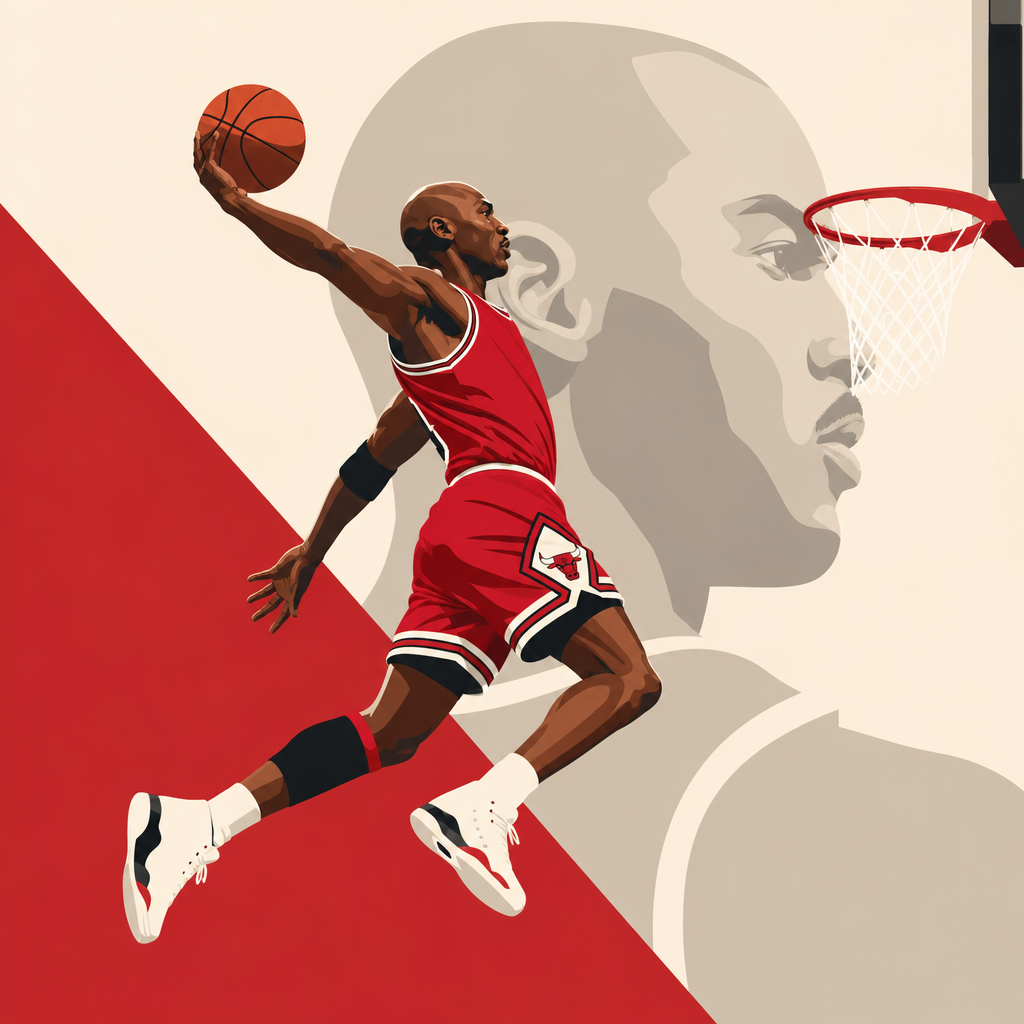
Michael Jordan remains the standard by which basketball greatness is measured because his career combined individual dominance, team success, cultural reach, and a relentless competitive edge that changed the NBA forever. In any discussion of NBA history and legends, Jordan sits at the center, not simply as a Chicago Bulls icon, but as the player who defined an era and still shapes how fans, coaches, executives, and players talk about excellence. Calling him the greatest of all time is not a casual opinion; it is a conclusion built from championships, awards, statistical efficiency, defensive impact, postseason performance, and influence beyond the court.
To understand why Jordan holds this place, it helps to define what “greatest” means in basketball. The term goes beyond raw scoring totals or highlight plays. It includes peak performance, longevity, consistency, playoff translation, adaptability, leadership, and the ability to raise the standard of a franchise and the league itself. Jordan checks every category. He won six NBA championships, six Finals MVPs, five regular-season MVPs, ten scoring titles, and a Defensive Player of the Year award. He was not only the best scorer in basketball for long stretches; he was also one of the best perimeter defenders, one of the game’s most efficient high-volume creators, and one of the fiercest closers ever seen.
This article serves as a hub for NBA History & Legends, with Jordan as the anchor point because his career touches nearly every major theme in league history: the rise of global branding, the evolution of superstar marketing, the importance of playoff legacy, the rivalry-driven growth of television audiences, and the benchmark against which later legends are judged. I have spent years studying game film, playoff runs, historical stats, and coaching systems from multiple eras, and Jordan’s profile remains unusually complete. Even when compared with other all-time greats with longer careers or more cumulative points, Jordan’s combination of peak value and postseason command stands apart. To place his legacy properly, it is also useful to explore the context around his career, his playing style, his accomplishments, and the broader NBA legends conversation he continues to define.
The Career Arc That Built the Standard
Michael Jordan entered the NBA in 1984 after a celebrated college career at North Carolina, where he hit the championship-winning shot in the 1982 NCAA title game. Drafted third overall by the Bulls, he immediately transformed a struggling franchise into a national attraction. As a rookie, he averaged 28.2 points, 6.5 rebounds, and 5.9 assists per game, won Rookie of the Year, and made the All-NBA Second Team. Those numbers were remarkable in any era, but what stood out even more was how quickly Jordan became the league’s most feared one-on-one player. His first step, body control, balance in the air, and ability to finish through contact gave him a scoring profile that defenses struggled to solve.
By the late 1980s, Jordan had become the league’s premier individual force. In 1986-87 he averaged 37.1 points per game, one of the highest marks in modern history. In 1987-88 he won MVP, Defensive Player of the Year, and the scoring title in the same season, a rare combination that illustrates his two-way dominance. I always point to this period when people reduce him to a pure scorer. Jordan was creating steals, shutting down top guards on the perimeter, attacking passing lanes without sacrificing team structure, and carrying enormous offensive usage. Before the Bulls became champions, he had already become the most complete guard in basketball.
The championships came after Chicago’s system matured under head coach Phil Jackson and assistant Tex Winter’s triangle offense. Jordan adapted from a constant isolation scorer into a more layered offensive hub who could post, cut, screen, and trust teammates in the flow of a possession. That adaptation mattered. Greatness in NBA history is not just about imposing a style; it is also about embracing a system that wins at the highest level. From 1991 to 1993, the Bulls won three straight titles. After Jordan’s brief retirement and baseball detour, Chicago won three more from 1996 to 1998. Across both three-peats, Jordan was the constant center of control.
Why Jordan’s Peak Was So Hard to Match
Jordan’s peak is the strongest argument for his place at the top of NBA history and legends. His career regular-season average of 30.1 points per game is the highest in league history, and his playoff average of 33.4 points per game is also the all-time best. Those are not inflated by a few huge nights. They represent sustained excellence across years of playoff pressure, elite opponents, and deep postseason runs. Jordan scored efficiently despite operating in an era with more physical perimeter defense, less spacing, and fewer three-point-heavy offensive systems than modern stars enjoy.
One reason Jordan’s game translated so well was shot versatility. He could explode to the rim, punish mismatches in the post, hit pull-up jumpers from the elbows, score in transition, and create late-clock offense without needing complex spacing around him. By the 1990s, his mid-post footwork had become nearly unguardable. Against larger defenders, he was too quick. Against smaller defenders, he could rise over the top or take them into the paint. His turnaround jumper became one of the signature weapons in league history because it was repeatable under pressure and difficult to contest cleanly.
His mental approach separated him further. Jordan did not merely want the final shot; he wanted the burden of making the correct play when every defender knew the ball was coming to him. That mentality is central to why so many former players and coaches still rank him first. In playoff film, you repeatedly see him processing double-teams, manipulating help defenders with his eyes and footwork, and attacking the weakest point in a coverage. His famous game-winners are remembered because they are dramatic, but the deeper truth is that his endgame decision-making was usually precise. For readers exploring the broader league context, the main NBA Basketball guide provides a useful foundation for how eras, rules, and team structures shaped legendary careers.
The Resume: Awards, Titles, and Signature Seasons
Jordan’s case is strengthened by how cleanly his biggest accomplishments align with winning. Six trips to the NBA Finals produced six championships and six Finals MVPs. He never needed a Game 7 in the Finals, and he delivered defining performances on the sport’s biggest stage. In the 1993 Finals, he averaged 41.0 points per game against Phoenix. In the 1998 Finals, he closed the Bulls dynasty with the iconic steal on Karl Malone and game-winning jumper over Bryon Russell in Utah. These moments matter because they were not isolated flashes. They capped entire playoff runs in which he was the game’s dominant force.
| Achievement | Total | Why It Matters |
|---|---|---|
| NBA Championships | 6 | Perfect Finals record as the lead star of a dynasty |
| Finals MVP Awards | 6 | Best player in every championship series he won |
| Regular-Season MVP Awards | 5 | Sustained dominance across multiple eras of competition |
| Scoring Titles | 10 | Most in NBA history, proving unmatched scoring consistency |
| Defensive Player of the Year | 1 | Rare two-way recognition for a high-usage superstar guard |
| All-Defensive First Team Selections | 9 | Elite perimeter defense over nearly a decade |
Several seasons stand out as landmark campaigns. In 1987-88, Jordan established himself as the league’s premier two-way force. In 1990-91, he broke through for his first title by defeating Magic Johnson’s Lakers, signaling a league transition. In 1995-96, after returning from retirement, he led Chicago to a then-record 72-10 season and another championship, proving that his dominance could resume immediately after a major interruption. I consider 1996 especially important when evaluating NBA legends, because it joined team excellence, individual motivation, and historical pressure in one campaign. The Bulls were expected to be great, and Jordan still delivered at the highest possible level.
Jordan’s Place Among NBA Legends
Any hub on NBA History & Legends must acknowledge that the greatest conversation includes Bill Russell, Wilt Chamberlain, Kareem Abdul-Jabbar, Magic Johnson, Larry Bird, LeBron James, Kobe Bryant, Shaquille O’Neal, Tim Duncan, and others. Each has a credible case in a specific dimension. Russell defined team success and defense. Kareem paired longevity with unstoppable skill. Magic and Bird revived the league’s popularity in the 1980s. LeBron offers unmatched longevity, versatility, and cumulative production. Yet Jordan remains the most balanced total package when peak, accolades, playoff scoring, two-way value, and cultural impact are weighed together.
The comparison with LeBron is the most common modern debate. LeBron has played longer, scored more total points, and reached more Finals. Jordan, however, has the stronger peak scoring profile, the superior Finals record, more scoring titles, a Defensive Player of the Year award, and a shorter list of postseason series in which his level clearly dropped. That does not diminish LeBron’s greatness; it highlights how narrow the margins are at the top. When I evaluate both, Jordan’s ability to dominate as a scorer, closer, and perimeter defender while preserving supreme efficiency in high-pressure moments gives him the edge.
Jordan also changed how a superstar could shape the business of basketball. His partnership with Nike and the rise of the Air Jordan brand redefined athlete marketing. The “Dream Team” in 1992 accelerated the NBA’s global reach, and Jordan became the face of basketball in Europe, Asia, and Latin America. By the late 1990s, the league’s international identity was deeply tied to his image. That cultural power is not separate from his basketball legacy. It helped expand the audience for the sport, influenced future player branding, and made the NBA a year-round global product rather than a domestic league with occasional international appeal.
The Lasting Legacy of the Greatest of All Time
Michael Jordan is the greatest of all time because his record leaves very few weak points. He had the highest standard-setting peak, the cleanest championship résumé among perimeter stars, elite defense, historic scoring efficiency for his role, and a competitive presence that reshaped every team and rival around him. In the larger story of NBA history and legends, he is both a final answer and a reference point. Players before him created the league’s foundation, and players after him expanded the boundaries of versatility and longevity, but Jordan remains the name most closely associated with complete basketball excellence.
His influence still appears in today’s game. Modern wings borrow his footwork in the mid-post, his jab-step rhythm, his fadeaway mechanics, and his emphasis on late-game shot creation. Coaches still use his film to teach balance, pivot discipline, and how to attack from triple threat position. Front offices still search for the rare star who can lead an offense, defend at a high level, absorb pressure, and define a franchise identity. That search continues because Jordan set the template so high that almost no one can fully match it.
For anyone building a serious understanding of NBA history, starting with Jordan makes sense because his career connects statistics, strategy, psychology, branding, and legacy better than any other player’s story. Study the titles, the Bulls system, the rivalry years, the playoff scoring explosions, and the global impact, and the argument becomes clear. Michael Jordan is not simply the most famous legend in basketball. He is the standard. Explore the wider history of the league through this hub, compare the greats across eras, and use Jordan as the measure that makes every debate sharper.
Frequently Asked Questions
Why is Michael Jordan so often called the greatest basketball player of all time?
Michael Jordan is so often called the greatest of all time because his career checks every major box people use to define basketball greatness. He dominated individually, won at the highest level, delivered in the biggest moments, and transformed the sport’s global profile in a way very few athletes in any sport ever have. Jordan was not just an elite scorer; he was a complete two-way player who combined explosiveness, footwork, body control, defensive intensity, and an unmatched competitive drive. He won multiple scoring titles, earned league MVP honors, made All-Defensive teams, and consistently elevated his game when the stakes were highest.
What separates Jordan from many other all-time greats is how cleanly his individual brilliance translated into championships. He led the Chicago Bulls to six NBA titles and won Finals MVP in all six of those championship runs, which reinforced the idea that he was the defining force behind those teams. His résumé also carries a sense of inevitability in big moments. Fans, opponents, and coaches expected Jordan to deliver, and he usually did. That combination of statistical dominance, postseason success, and iconic performances created a standard that still frames modern GOAT debates.
Beyond the numbers and trophies, Jordan became the symbol of basketball excellence itself. His style, confidence, and cultural impact made him larger than the game. For many people, calling Jordan the greatest is not based on nostalgia alone; it reflects the rare way he united performance, pressure, influence, and legacy into one career.
What made Michael Jordan different from other NBA superstars of his era?
Jordan stood out from other NBA superstars of his era because he brought together traits that are rarely found in one player at the same time. He had the scoring instincts of an all-time offensive force, the athletic gifts of a highlight machine, the discipline of a technician, and the mindset of someone who treated every possession as a test of dominance. Plenty of stars could score, and plenty of stars could lead, but Jordan combined ruthless consistency with spectacular shot-making and elite defense. He was just as capable of overwhelming a defense with 40 points as he was of shutting down an opposing perimeter player or taking complete control of a fourth quarter.
His psychological edge was also a major separator. Jordan’s competitiveness became legendary because it affected everything: his preparation, his practice habits, his body language, and his refusal to accept being outplayed. Opponents often described not just his talent, but the pressure of knowing he was constantly attacking weaknesses and looking to break a game open mentally as well as physically. That edge helped define the Bulls’ identity and pushed his teammates to meet a championship standard that could be demanding but effective.
Another major difference was his ability to be both fundamentally sound and visually unforgettable. Jordan’s footwork in the post, mid-range mastery, off-ball movement, and defensive positioning reflected deep technical skill, while his dunks, hang time, finishes through contact, and clutch shots made him a global attraction. He was not merely efficient or merely exciting. He was both, and that balance is a huge reason he became the centerpiece of NBA history in the modern era.
How important were Michael Jordan’s championships to his GOAT legacy?
Michael Jordan’s championships are central to his GOAT legacy because they turned his greatness from theoretical into undeniable. Before the Bulls won titles, Jordan was already recognized as one of the most gifted players the league had ever seen. He could score against any defense, dominate playoff series, and produce unforgettable performances. But in basketball, as in all team sports, the greatest players are ultimately judged by how far they can lead a team. Jordan’s six championships answered that question emphatically.
What makes those titles especially powerful in his legacy is the way they were won. Jordan did not collect championships as a secondary star or in the late stages of his career while others carried the burden. He was the clear centerpiece of every title team, and his six Finals MVP awards underline that point. In the defining series of each championship run, he was the player opponents feared most and the player his team relied on most. That kind of direct connection between best player status and championship success gives his case unusual strength.
The titles also mattered because they came with iconic moments that deepened the mythology around him. Whether it was clutch scoring, takeover stretches, defensive plays, or signature game-winners, Jordan built a reputation for rising when pressure was highest. Championships alone do not settle every GOAT debate, but in Jordan’s case they perfectly matched the eye test, the awards, and the historical impact. They were not the only reason people call him the greatest, but they are a major reason the argument remains so durable.
Did Michael Jordan change the NBA beyond his on-court performance?
Yes, Michael Jordan changed the NBA far beyond his on-court performance. He helped transform the league into a global entertainment and commercial force. While the NBA already had star power before Jordan reached his peak, his rise pushed the sport into a new category of international relevance. His appeal crossed team loyalties, age groups, and national borders. Fans who did not regularly follow basketball still knew who Michael Jordan was, and that level of recognition gave the NBA a powerful face during a period of major growth.
Jordan’s influence extended into marketing, branding, and athlete identity. He showed that a basketball player could become not just a sports star, but a worldwide cultural figure. His partnership with Nike and the growth of the Air Jordan brand changed the relationship between athletes, endorsements, and personal branding. That impact is still visible today in how modern stars build business empires, shape media narratives, and cultivate influence beyond the court. In many ways, Jordan created the blueprint for the modern superstar athlete.
He also changed how excellence was discussed inside basketball itself. Coaches, players, and executives began using Jordan as the benchmark for leadership, late-game performance, competitiveness, and complete two-way play. Even decades later, his name remains the reference point in debates about scoring ability, killer instinct, and championship mentality. That is a sign of influence deeper than popularity. Jordan did not just dominate his era; he helped redefine what the NBA looked like, how it was sold, and how greatness would be measured afterward.
Is Michael Jordan’s GOAT case still strong compared with modern players and changing eras?
Michael Jordan’s GOAT case remains extremely strong even when compared with modern players and across different eras. Basketball evolves constantly through rule changes, training methods, pace, spacing, analytics, and style of play, so comparing players from different generations will always involve some interpretation. Even so, Jordan’s case holds up because it is built on qualities that translate across eras: elite scoring, postseason dominance, defensive impact, physical control, mental toughness, and the ability to carry the expectations that come with superstardom.
Modern players may surpass Jordan in certain counting stats or play in systems that produce different kinds of efficiency, but Jordan’s overall body of work still has uncommon force. He won at the highest level repeatedly, controlled games in multiple ways, and produced one of the most intimidating competitive profiles in sports history. His prime is often remembered not just for excellence, but for authority. He was widely seen as the best player in the world, and once the Bulls broke through, he turned that status into an era of sustained championship success.
The reason his GOAT case endures is that it is not dependent on one argument alone. It rests on awards, championships, peak performance, iconic moments, cultural influence, and the lasting impression he left on the sport’s standards. Reasonable fans can debate other legends and modern superstars, but Jordan remains at the center of that conversation because his résumé is both historically complete and symbolically powerful. He is not just remembered as great; he is remembered as the model of basketball greatness itself.