
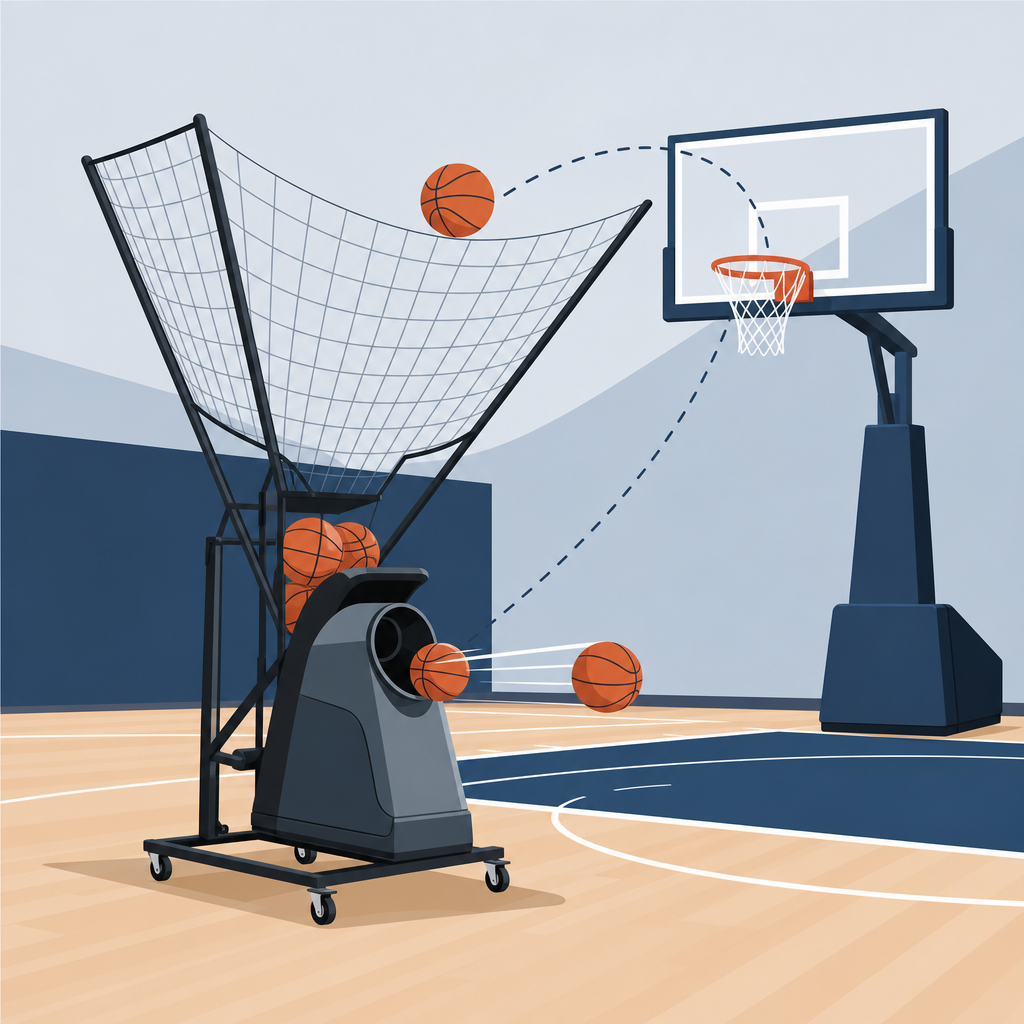
Basketball shooting machines have moved from specialty tools found only in college gyms to practical training gear for schools, clubs, private coaches, and serious home users. In 2026, the best basketball shooting machines combine three jobs in one system: they rebound made and missed shots, return accurate passes to repeatable spots, and track workout data that helps players improve faster. A shooting machine is essentially an automated rebounder and passer mounted around the rim, usually with a netted catch system, a ball return chute, and a programmable launcher. The value is simple and measurable: more repetitions in less time, with less fatigue spent chasing balls.
I have used these systems in team workouts, skill sessions, and off-season clinics, and the difference in volume is dramatic. A player working alone with a quality rebounder can take hundreds of game-speed shots in a single session while keeping footwork and rhythm intact. That matters because shooting improvement depends on consistent mechanics, immediate feedback, and enough repetitions to make small adjustments stick. For programs building out a complete basketball equipment plan, shooting machines sit at the center of training gear because they support guards, wings, posts, youth players, and pros with only minor setup changes.
This hub article reviews the best basketball shooting machines in 2026, explains what features matter, and shows where each model fits. It also covers the broader training gear ecosystem around these machines, including balls, racks, floor markers, and workout software, because the machine alone does not guarantee better shooting. Used correctly, though, it can transform how a player practices.
What a Great Shooting Machine Must Do
The best basketball shooting machines do three things exceptionally well: collect rebounds cleanly, deliver consistent passes, and survive heavy use. Rebound coverage is more important than many buyers expect. A narrow net or weak frame turns a good workout into constant resetting, especially for youth players who miss short or wide more often. Machines with broad capture nets and stable support arms save the most time because they collect both swishes and hard rim-outs. Pass consistency matters just as much. If the machine throws one ball at the chest and the next at the knees, players stop working on shooting and start compensating for bad feeds.
Durability is where price differences become easier to understand. Entry-level models can help a home user, but school and club buyers need welded frames, reliable motors, and easy-to-source replacement parts. In real gyms, machines are rolled across thresholds, bumped into bleachers, folded too quickly, and loaded into storage rooms by tired managers. A machine that performs well in a product demo but breaks under daily varsity and junior varsity use is not a bargain. Trusted brands usually separate themselves through uptime, service support, and app stability more than through headline claims about made-shot volume.
Programmability also matters in 2026. Basic oscillation and return speed controls are still useful, but modern buyers should expect preset workouts, spot sequencing, quick release adjustments, and shot tracking. Data is not a gimmick when it answers practical questions: Are shots short from the left wing? Does accuracy drop after the tenth rep in a movement series? Can a coach compare free throw percentages before and after conditioning? A good machine turns those questions into visible patterns instead of guesses.
Top Basketball Shooting Machines in 2026
For most schools, clubs, and advanced individual trainers, the Dr. Dish CT+ remains the best overall basketball shooting machine in 2026 because it balances portability, programming depth, and reliable passing. The touchscreen workflow is straightforward, the shot maps are useful rather than decorative, and the machine supports game-like drills without requiring a technician to operate it. In my experience, it is the easiest model to hand to an assistant coach and trust that practice will keep moving. It suits high school and small college programs particularly well because it offers enough analytics to be meaningful without pushing the budget into top-end pro territory.
The Noah Basketball Shooter System deserves mention for programs that want tightly integrated feedback on arc, depth, and left-right accuracy. Strictly speaking, Noah is strongest as a shot analysis platform paired with return equipment rather than just a rebounder-passer, but for player development departments focused on measurable form refinement, it is a serious option. Teams that already use video breakdown and player development software often benefit most, because Noah’s data becomes part of a larger feedback loop instead of an isolated dashboard.
For buyers prioritizing pure volume and facility-wide use, the Gun 12K and related premium Gun models continue to hold a strong position. They are built for heavy repetition, broad programmability, and recognizable durability in busy gyms. Coaches who run station-based practices often like the cadence and established reputation. The tradeoff is cost and footprint. These are easier recommendations for varsity programs, colleges, and training businesses than for a family garage court. On the value side, Dr. Dish All-Star and similar mid-tier units make sense for youth academies and private trainers who need a real machine but cannot justify flagship pricing.
| Model | Best For | Key Strength | Main Tradeoff |
|---|---|---|---|
| Dr. Dish CT+ | High schools, clubs, private trainers | Strong balance of portability, app features, and reliability | Still expensive for casual home use |
| Noah system setup | Data-driven player development programs | Detailed shot analytics on arc and depth | Best value comes with broader tech integration |
| Gun 12K | Colleges, varsity programs, training facilities | Heavy-duty build and high-volume workouts | Larger footprint and premium cost |
| Dr. Dish All-Star | Youth academies, home courts, skill coaches | Accessible price within a recognized platform | Fewer advanced capabilities than flagship units |
How to Choose the Right Rebounder and Passer
The first question is not which brand is best, but who will use the machine and how often. A player shooting three times a week in a home gym needs something different from an athletic department running twelve sessions a day. Start with usage volume. If the machine will handle team practices, individual workouts, camps, and rentals, buy for durability first. If it will serve one family or one trainer, storage size, setup speed, and power requirements may matter more. The second question is court environment. Ceiling height, doorway width, storage access, and whether the court is indoor or outdoor can eliminate options quickly.
Next, evaluate passing realism. Many product pages talk about “game-like reps,” but realistic training depends on pass speed, trajectory, and timing. A good machine lets players work on catch-and-shoot footwork from the corners, hop-ins at the slot, relocation threes, and short-roll finishes without awkward dead time. If your athlete development plan includes movement shooting, ask whether the unit supports customizable sequences and rapid transitions between spots. If your focus is form shooting for younger players, a simpler machine may be enough, especially if it offers lower return speeds and easy manual controls.
Software should be judged by how often it saves time, not by how many icons it displays. Coaches need to launch drills quickly, assign workouts, and review percentages without fighting the interface. In practical terms, that means intuitive drill libraries, stable wireless connections, and exportable reports. Battery life and power setup are also important. Some facilities want cord-free operation to avoid floor hazards, while others prefer plug-in consistency. Finally, ask about warranty terms, replacement nets, wheel assemblies, and service turnaround. The quality of support after purchase often determines whether a machine remains a trusted training tool or becomes an expensive storage item.
Training Gear That Makes a Shooting Machine More Effective
A shooting machine is the anchor of a training station, but the surrounding training gear determines whether sessions build useful habits. The first essential is a consistent set of basketballs. Mixed balls with different grip levels, inflation, and panel wear distort touch and rhythm. For serious work, use matched game-quality balls, checked regularly with a pressure gauge. Ball racks also matter more than they seem. A nearby rack speeds transitions between drills, supports partner workouts, and reduces the scramble that kills session pace.
Footwork aids are the next layer. Flat disc cones, floor dots, and lane markers help players standardize starting positions and movement patterns. I use them constantly for one-two steps, hop catches, flare relocations, and drift actions from the corner. Resistance tools can help in limited contexts, but they should not compromise shooting mechanics. Weighted balls are the most misused item in this category. They can support certain passing drills, yet they are usually a poor choice for actual shooting mechanics because they alter timing and wrist action. Better accessories include passing targets on the glass, portable video tripods, and tablets for instant replay.
Recovery and maintenance gear should also be part of the training hub. Good floor mops prevent slipping around machines during high-volume workouts. Extension management, spare net clips, pump needles, and replacement return straps prevent small failures from ruining gym time. If the machine tracks data, a coach should also plan where that data lives. Shared team accounts, athlete tags, and periodic benchmarking create continuity between shooting sessions, film review, and strength work. For a complete basketball equipment setup, that integration is what turns a rebounder and passer into a repeatable development system.
Best Use Cases: Home, School, Club, and Training Business
Home users should prioritize foldability, noise level, and setup simplicity. Many families imagine daily use, but a machine that takes too long to move or calibrate often sits idle. The best home shooting machine is usually a mid-tier model from a major brand with app-based drills and manageable storage dimensions. It should support one-player workouts without needing an adult to reset the net every few minutes. Buyers also need to think honestly about court size. A compact driveway hoop with limited run-off space will not let a player use the same movement patterns as a school court, no matter how advanced the machine is.
Schools and clubs need operational flexibility. A varsity coach may want scripted five-spot shooting, while a youth director wants simple catch-and-shoot reps and free throw competitions. Machines in this environment should roll easily, store safely, and survive being used by many hands. Multi-user profiles and quick drill selection are valuable here because they reduce downtime between groups. For clubs with limited court access, one reliable machine often delivers more value than several cheaper pieces of gear that need constant attention.
Training businesses should think like facility managers. The machine becomes part of the brand experience, so uptime, visible professionalism, and measurable outcomes matter. Clients expect structured sessions, shot charts, and clear progress markers. Premium machines usually justify their cost in this setting because they support back-to-back appointments and create more billable training density. If a trainer can run a solo workout with machine-assisted passing while tracking percentages by spot, the athlete sees the value immediately.
Common Mistakes Buyers and Coaches Make
The biggest mistake is assuming volume alone creates better shooters. Repetition only helps when mechanics, decision-making, and drill design are aligned. I have seen players take five hundred rushed shots from static spots and leave reinforced in bad habits. Machines should be used to sharpen specific outcomes: quicker preparation, balanced landings, cleaner dip timing, improved corner accuracy, or better conditioning at shooting pace. Another common mistake is buying too much machine for the actual environment. A top-end model in a cramped, low-use gym can be less useful than a simpler system used consistently and well.
Coaches also underuse data. If the machine records percentage by location, release timing, or workout completion, those numbers should shape the next session. Data without coaching context becomes decoration. The opposite problem appears too: overloading players with analytics when they really need one cue, one target, and a clear progression. Maintenance neglect is the final preventable error. Nets loosen, wheels wear, software needs updates, and batteries degrade. A monthly check keeps the machine trustworthy and protects the investment.
The best basketball shooting machines in 2026 are not just rebounders and passers. They are central pieces of training gear that increase repetition, preserve workout rhythm, and make player development more measurable. For most buyers, the right choice comes down to usage volume, passing quality, software usability, and service support. Dr. Dish CT+ remains the strongest all-around recommendation for many programs, premium Gun models fit heavy institutional use, and data-centered systems like Noah reward organizations that can act on the feedback they collect.
As the hub for basketball equipment training gear, this guide should help you evaluate not only the machine itself but the full practice environment around it: matched basketballs, footwork markers, video tools, maintenance supplies, and data workflows. When those pieces work together, athletes get more than extra shots. They get better structure, clearer feedback, and more efficient improvement. If you are building a serious training setup, start by defining your users, court space, and workload, then choose a shooting machine that fits those realities and can grow with your program.
Frequently Asked Questions
What does a basketball shooting machine actually do, and why are rebounder and passer features so important?
A basketball shooting machine is designed to automate one of the biggest bottlenecks in skill development: chasing rebounds and waiting on someone else to feed the next pass. In practical terms, the machine sits around or near the hoop, collects made and missed shots with a net or rebound system, funnels the ball into an internal mechanism, and sends it back to the shooter at a controlled speed, arc, and direction. The best models in 2026 do all three core jobs well: rebounding, passing, and tracking training data.
The rebounder matters because it determines how efficiently the machine captures shots from different angles and distances. A good rebound system keeps the drill moving, even when the player is shooting game-speed reps from the wing, corner, or top of the key. If the rebound net is too narrow or inconsistent, the machine becomes less useful because players lose time resetting balls or repositioning. The passer matters just as much because quality reps depend on repeatable passes. A consistent return lets players build footwork, timing, and shooting rhythm exactly the way they would in structured workouts. Instead of receiving random tosses, the player gets a predictable pass to the chest, shooting pocket, or a programmed spot on the floor.
That combination is what turns a simple rebound device into a true training system. Players can work on catch-and-shoot threes, one-dribble pull-ups, transition shooting, relocation shooting, or quick-release mechanics without needing a rebounder, partner, or coach standing under the rim. For schools, clubs, and trainers, that means more athletes can get more efficient repetitions in less time. For serious home users, it means professional-style shooting sessions become realistic in a driveway, gym, or indoor court setup. In 2026, the best machines go beyond convenience and become measurable development tools by logging makes, misses, shot locations, release pace, and workout volume.
Who should buy a basketball shooting machine in 2026: schools, coaches, clubs, or home users?
The short answer is that basketball shooting machines now make sense for far more buyers than they did a few years ago. They are still a natural fit for high schools, colleges, academies, and club programs because those organizations need to maximize gym time and player development across multiple athletes. A team environment benefits from the machine’s ability to create structured workouts, reduce downtime, and keep players rotating through stations. Coaches also gain consistency. Instead of relying on assistants or teammates to rebound and feed passes, the machine delivers controlled reps every time.
Private coaches and trainers are another major audience. For a trainer, a shooting machine can dramatically increase session quality. Rather than spending energy rebounding, loading balls, or manually passing, the coach can focus on mechanics, footwork, decision-making, and corrections. This makes one-on-one and small-group sessions more productive and often more professional in the eyes of clients. Many trainers also use the built-in stat tracking to show progress over time, which adds value for players and parents.
Home users are now a realistic market too, especially for serious players and families with access to a half-court, driveway hoop, backyard court, or home gym. The key question is not simply whether you love basketball, but whether you have the space, budget, and consistency to justify the investment. A machine can be a great buy for a motivated player who shoots several times per week and wants efficient reps without depending on someone else. On the other hand, casual users may be better served by a lower-cost rebound net or a traditional training routine.
When deciding, think in terms of usage and return on investment. A school may justify a premium model because dozens of athletes will use it. A trainer may justify it because it improves session throughput and revenue potential. A family may justify it because one player will use it year-round for skill development. The best buyer is the one who will use the machine consistently, understands the installation and storage needs, and values both repetition volume and data-driven feedback.
What features should I look for when comparing the best basketball shooting machines in 2026?
The most important features start with ball return quality. A great shooting machine should consistently collect both makes and misses from different spots on the floor and deliver accurate passes at adjustable speeds. If the return is inconsistent, every other feature becomes less valuable. Look closely at how many passing spots the machine supports, whether it can alternate locations automatically, and whether pass timing can be customized for different drill types. For game-like training, those details matter more than flashy marketing.
Next, pay attention to setup, portability, and compatibility. Some machines are built for permanent or semi-permanent gym use, while others are intended for easier movement and storage. Buyers should check whether the machine works with their hoop type, rim height setup, backboard dimensions, and available court space. This is especially important for home users and trainers who may move equipment between locations. A machine that is excellent on paper but difficult to transport, install, or store may not be the best real-world option.
Training technology is another major differentiator in 2026. Top machines often include touchscreen controls, app connectivity, drill programming, workout libraries, shot charts, make-rate tracking, and session history. These tools are useful because they turn repetition into measurable development. Coaches can monitor progress by spot, session, or player. Athletes can set goals for volume, percentage, release speed, or workout duration. Some systems also make it easier to run competitive drills, timed shooting series, and position-specific training plans.
Durability and maintenance should not be overlooked. A shooting machine is a mechanical system that will handle heavy use, repeated ball movement, and constant setup stress. The frame, netting, wheels, motors, and feeding components all need to hold up over time. Look for strong construction, commercial-grade materials when needed, reliable customer support, and reasonable warranty coverage. Replacement parts availability also matters, especially for schools and clubs that expect daily use.
Finally, consider total ownership cost rather than just purchase price. The best value may come from a machine that costs more upfront but performs better, lasts longer, and offers better software support. Buyers should weigh rebound coverage, pass precision, data features, portability, noise level, ease of use, and serviceability together. In most cases, the best basketball shooting machine is the one that fits your training goals, court environment, and frequency of use, not simply the one with the longest feature list.
Are basketball shooting machines worth the cost, and how do you judge value before buying?
For the right user, yes, a basketball shooting machine can absolutely be worth the cost. The value comes from efficiency, repetition, and consistency. A player working alone can get far more quality shots in a shorter session because the machine handles rebounding and passing automatically. That means less fatigue from chasing balls, more focus on mechanics and rhythm, and a better chance of building repeatable habits. Over weeks and months, that added efficiency can translate into real skill improvement.
For coaches, schools, and trainers, the financial value is often even easier to justify. A machine can save staff time, increase the number of athletes who can train effectively in one gym block, and create more structured skill sessions. For private trainers, it can help support premium instruction and more polished workouts. For clubs and schools, it can improve player development across an entire program rather than for just one athlete. When equipment is used by multiple teams or age groups, the cost per session drops significantly.
To judge value correctly, start by asking how often the machine will actually be used. A premium machine that runs several times a day may be a better investment than a cheaper model that causes frustration and ends up sitting unused. Next, compare what you are getting beyond basic rebounding. Is the passing accurate? Does the machine support multiple spots and drill sequences? Does it track data that helps guide training? Is it durable enough for your environment? Those factors often determine whether the machine feels like a long-term asset or an expensive novelty.
It also helps to think about hidden costs and practical limitations. Will you need a dedicated space? Are there shipping, assembly, software, or accessory costs? How easy is maintenance? Is customer support responsive if something breaks during the season? These details affect real ownership experience. In the end, a basketball shooting machine is worth the money when it is used consistently, matches the user’s level and goals, and delivers dependable reps that would otherwise require extra people, extra time, or less effective training.
Can a shooting machine really help players improve faster, and what are the best ways to use one in training?
Yes, a shooting machine can help players improve faster, but only when it is used with intention. The machine itself does not magically create better shooters. What it does is remove wasted time and make high-quality repetition easier to sustain. That matters because shooting improvement is built on thousands of technically sound, game-relevant reps. When the machine rebounds efficiently and returns accurate passes to repeatable spots, players can focus on footwork, shot preparation, balance, release, and decision speed instead of constantly resetting the drill.
The biggest advantage is volume with structure. A player can complete catch-and-shoot workouts from five spots, work on corner relocation, train transition threes, simulate