
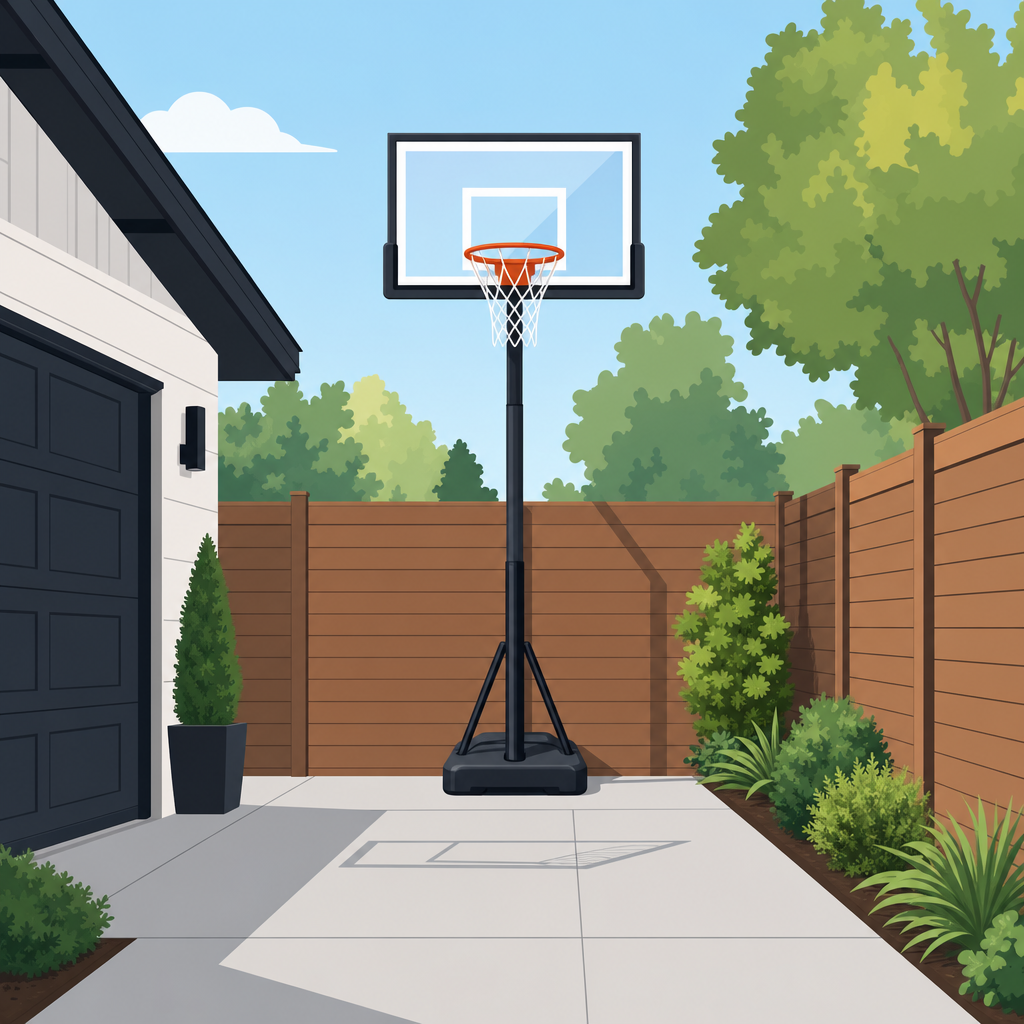
Finding the best basketball hoops for small driveways and tight backyard spaces starts with understanding what “small” really means in practice: a court area that cannot accommodate a full regulation setup, has limited setback from garage doors or fences, or must share space with cars, walkways, landscaping, or patio furniture. In these environments, the wrong hoop creates constant problems. It can block parking, tip under aggressive play, crack pavement from poor base design, or simply leave too little room to shoot safely. The right hoop does the opposite. It turns a narrow driveway, side yard, or compact patio edge into a reliable practice zone for kids, teens, and adults without overwhelming the space.
When I evaluate hoops for constrained layouts, I focus on five factors first: footprint, adjustability, backboard size, stability, and rebound clearance. Footprint is the amount of ground area the base or pole consumes. Adjustability matters because a family hub article must account for different ages and training goals, from six-foot beginner settings to the regulation ten-foot rim. Backboard size affects both bank-shot realism and whether the hoop physically fits. Stability determines safety and shooting consistency. Rebound clearance describes how much playable room exists between the front of the base or pole and the rim; in tight spaces, this measurement matters more than buyers expect.
This topic matters because small-space buyers often shop by brand alone and miss the geometry that decides whether a hoop works day to day. A 54-inch backboard may sound appealing, but if the overhang is shallow and the base projects too far into the lane, players end up planting their feet awkwardly. Likewise, an inexpensive portable hoop can look practical until windy conditions or repeated bank shots reveal severe shake. The best basketball hoops for small driveways and tight backyard spaces balance realistic play with compact design. They also fit into a broader basketball equipment plan, because the hoop is only one part of hoops and gear. Rim style, net material, ball type, pump, anchor system, protective padding, and lighting all influence the overall experience. This article serves as the main hub for that subtopic, helping you choose the right hoop format and understand the gear decisions that support it.
Portable hoops: the best starting point for narrow driveways
For most small driveways, a portable basketball hoop is the most practical choice because it avoids permanent installation and can be repositioned when cars need the space. The best models use polyethylene bases filled with water or sand, telescoping or crank-adjustment mechanisms, and backboards between 44 and 54 inches. In a constrained setting, 44 to 48 inches is often the sweet spot. That size allows realistic shooting development without pushing too far into garage clearance zones or fence lines.
Portable hoops work best when the base is compact but heavy enough to resist movement. I generally prefer sand-filled bases over water-filled bases for families who want maximum stability, although sand is harder to empty if the hoop needs seasonal storage. Water is simpler and cheaper, but it can freeze in cold climates and often provides less mass. Brands such as Lifetime and Spalding have long dominated this category, with Lifetime frequently offering better value at entry and midrange price points and Spalding typically focusing on a more authentic rebound feel in selected models. If a buyer asks me for a dependable small-driveway recommendation, I usually start with a 44-inch or 48-inch portable hoop with a weighted base and a three-piece steel pole.
The key limitation of portable systems is base intrusion. In a very short driveway, the base can sit directly where a player wants to gather for layups or where a parked car’s bumper needs to be. Some newer designs improve this by extending the pole backward from the front edge of the base, creating better offset. That extra clearance is not cosmetic; it directly affects footwork safety and how natural the hoop feels during close-range shots.
In-ground hoops: best performance when permanent placement is possible
If the space allows a fixed installation, an in-ground hoop is the best basketball hoop type for performance, durability, and reduced vibration. Unlike portable systems, in-ground hoops use a pole set in concrete, which dramatically improves rigidity. Shots off the glass feel cleaner, the rim responds more predictably, and the entire unit holds up better under repeated use. In compact backyards, in-ground systems also free up the ground area that a portable base would occupy, which can be a major advantage.
The tradeoff is permanence. Placement must be planned carefully around property lines, utility markings, drainage, and overhangs from roofs or gutters. Most manufacturers specify a footing depth and diameter based on pole size; common residential systems require a concrete footing around 16 to 24 inches in diameter and roughly 36 to 48 inches deep, though local frost lines can change that. Goaliath and Goalrilla are well-known in this category. Goalrilla systems, in particular, are frequently chosen by serious players because of thick tempered glass backboards, solid anchor systems, and strong rim assemblies.
For a tight backyard, the ideal in-ground setup often uses a 54-inch backboard rather than a larger 60-inch or 72-inch option. Regulation-sized backboards are excellent for full half-court builds, but they are often excessive in compact environments. A 54-inch tempered glass backboard delivers realistic rebound quality while preserving spatial efficiency. If your goal is skill development in a limited area, that is usually the smartest balance.
How to choose the right hoop size for a small space
Backboard width is the specification buyers notice first, but the more useful measurement is the total operating envelope: backboard width, rim offset, base or pole footprint, and side clearance for shooting angles. A narrow driveway might fit a 54-inch backboard physically, yet still feel cramped because the player cannot step into corner-bank positions or retrieve rebounds safely near a retaining wall. In practice, the best basketball hoops for tight backyard spaces are not always the biggest models you can squeeze in. They are the models that leave comfortable movement lanes.
A simple rule helps. For very tight areas, choose 44 to 48 inches. For compact but usable family spaces, choose 50 to 54 inches. Reserve 60 inches and above for larger pads or dedicated courts. Younger players do not need oversized backboards to build form, and adults benefit more from a stable, correctly placed smaller hoop than a large unstable one. Rim height adjustability is equally important. A hoop that moves from 7.5 to 10 feet supports early confidence, proper shooting progression, and dunk-resistant recreational play when used responsibly.
| Space Type | Recommended Backboard | Best Hoop Style | Main Benefit |
|---|---|---|---|
| Single-car narrow driveway | 44 to 48 inches | Portable | Easy repositioning with minimal footprint |
| Short suburban driveway | 48 to 54 inches | Portable or compact in-ground | Good balance of realism and parking clearance |
| Tight backyard patio edge | 50 to 54 inches | In-ground | No base intrusion into play area |
| Dedicated compact court pad | 54 to 60 inches | In-ground | Better rebound response and long-term durability |
This framework prevents the most common buying mistake: selecting a hoop by aspirational size instead of actual site dimensions. Measure width, depth, setback, and overhead obstructions before comparing models. Then match the hoop to the space, not the other way around.
Backboard materials, rims, and durability features that matter
Backboard material determines rebound quality, noise, weather resistance, and price. Polycarbonate is strong and impact resistant, making it common on entry-level portable hoops for younger families. Acrylic offers a clearer, more glass-like look and usually better rebound performance, but it can scratch and may yellow over time. Tempered glass is the premium standard and the closest to gym play. If you want the most authentic response, tempered glass wins. If you need a lower-cost hoop that survives everyday family use, polycarbonate remains a sensible option.
Rim type also matters in small spaces because many users will practice repeatedly from short range. A basic static rim is acceptable for younger children and casual use, but a breakaway rim reduces stress on the backboard and mounting hardware when players pull slightly on the rim during layup drills or recreational play. On adjustable family hoops, I strongly prefer a quality breakaway rim if the budget allows. It protects the system and usually feels better during real shooting sessions.
Check the pole gauge, bracket design, and hardware finish as well. Powder-coated steel resists corrosion better than painted low-grade components. On portable hoops, dual-compression springs and reinforced arm supports generally indicate a sturdier build. On in-ground systems, welded gussets and anchor-mount designs signal higher structural quality. These details are easy to ignore online, but they often separate a hoop that lasts three years from one that lasts ten.
Hoops and gear: what else you need beyond the basket
As the hub for hoops and gear within basketball equipment, this page should make one point clearly: a hoop performs only as well as the supporting gear around it. Start with the basketball itself. For outdoor driveway use, a rubber or composite leather ball is usually better than a premium indoor leather model. Wilson NCAA, Spalding Zi/O, and Baden outdoor options are common choices because they combine grip with pavement durability. Make sure the ball size matches the player: size 7 for most adult men’s play, size 6 for women and many youth divisions, and size 5 for younger children.
A pump with a pressure gauge is not optional. Incorrect inflation changes shooting feel, dribbling response, and hand comfort. Most basketballs perform near the manufacturer’s printed PSI range, and even slight underinflation can make outdoor practice inconsistent. Net choice matters too. Standard nylon nets are affordable, but all-weather or chain-style alternatives may last longer in rain and wind. For residential areas, though, chain nets can be noisy, so nylon or treated polyester is usually better.
Add safety and usability accessories based on your layout. Pole padding is useful in tight spaces where players may drive directly under the rim. Base padding helps on some portable systems. Rebounders and return ramps are valuable for solo practice but require more room, so they are often poor fits for the smallest driveways. Motion-sensor lighting or dedicated LED sports lights can extend safe evening use, and chalk or modular court tiles can define shooting spots without requiring a full court build. If you are planning related content, the logical internal paths from this hub are portable hoop reviews, in-ground hoop comparisons, best outdoor basketballs, basketball pump guides, hoop installation advice, and driveway court lighting.
Installation, safety, and maintenance in compact environments
Small spaces magnify installation errors. A hoop placed six inches too far forward can interfere with parking. A rim mounted too close to a wall can create dangerous rebound angles. Before buying, mark the proposed base or pole location with tape and simulate the backboard width using cardboard or a cut lumber strip. Then walk through jump shots, layups, and car parking. This simple mock-up prevents costly returns and concrete mistakes.
For portable hoops, keep the base fully weighted according to manufacturer instructions and inspect wheels, caps, and pole joints regularly. For in-ground systems, check anchor bolts, hardware torque, and rim condition at least twice a year. In coastal or wet climates, rinse exposed metal and watch for corrosion. Replace worn nets before they tangle around the rim and affect shots. If severe weather is expected, lower adjustable portable systems when possible and move them to sheltered positions.
Surface traction deserves attention. Smooth sealed concrete can become slick, especially with dust or moisture. Players in compact areas stop and cut near obstacles, so shoes with solid outdoor traction and routine sweeping matter more than many people realize. The goal is not just fitting a hoop into a small area. It is creating a safe, repeatable, enjoyable practice space that works every week.
The best basketball hoops for small driveways and tight backyard spaces are the ones that respect space limits without compromising daily play. For most households, that means a stable portable hoop with a 44- to 54-inch backboard, strong height adjustment, and enough offset to keep the base out of footwork zones. For buyers who can install permanently, a compact in-ground hoop delivers superior rebound quality, less shake, and a cleaner playing area. In both cases, accurate measuring matters more than marketing claims, and stability matters more than oversized dimensions.
As the central hoops and gear hub within basketball equipment, this guide also makes clear that hoop selection should never happen in isolation. Ball type, net material, pump accuracy, padding, lighting, and installation quality all affect how useful the system becomes. A well-chosen hoop paired with the right outdoor ball and basic maintenance will outperform a larger, flashier setup that does not fit the space or the players using it. That is especially true in compact environments, where every inch and every design detail counts.
If you are narrowing your options now, measure your space first, decide whether portable or in-ground makes more sense, and choose the smallest backboard that still supports your playing goals. Then build out the surrounding gear deliberately. Done right, even a short driveway or tight backyard can become a dependable home court.
Frequently Asked Questions
What size basketball hoop works best for a small driveway or tight backyard?
The best hoop size for a small driveway or compact backyard depends less on the official dimensions of a regulation court and more on how the hoop fits into the usable space you actually have. In most small areas, a portable or compact in-ground hoop with an adjustable height feature and a moderately sized backboard is the smartest choice. Backboards in the 44-inch to 54-inch range usually work best because they provide enough rebound area for real practice without overwhelming the space or extending too far into parking zones, walkways, patios, or landscaping.
If your driveway doubles as a place to park vehicles, open garage doors, or move trash bins and strollers, a huge backboard can quickly become a problem. It may look impressive, but in a tight setup it often creates more inconvenience than value. Larger systems also tend to require more overhang and more room behind the playing area, which many homeowners simply do not have. A smaller footprint helps keep the hoop playable while reducing the chance that it will interfere with daily use of the space.
For younger players or families with mixed ages, an adjustable system is especially useful. It allows the rim to be lowered for kids and raised as skills improve, making one hoop work for multiple players without needing a larger court. In very constrained spaces, the goal is not to recreate a full basketball court. The goal is to install a hoop that gives you safe shooting, layups, and casual play while preserving enough clearance to move around comfortably and avoid collisions with walls, fences, parked cars, and the garage.
Is a portable basketball hoop or an in-ground hoop better for limited space?
Both can work in a small area, but the better option depends on how permanent you want the setup to be and how much flexibility you need. Portable hoops are often the first choice for small driveways because they can be repositioned when necessary. That matters if the same space must also accommodate parked cars, delivery access, garage use, or seasonal furniture. A well-designed portable hoop lets you reclaim the area when not in use, which is a major advantage in tight spaces where every few feet matter.
That said, not all portable hoops perform equally well. Inexpensive models may have narrow bases, poor wheel design, or weak support poles that wobble during play. In a cramped area, that instability becomes even more noticeable because players are often closer to the pole, base, and surrounding obstacles. A quality portable hoop should have a stable base, a strong support structure, and a design that minimizes the chance of tipping. It should also be filled exactly as the manufacturer recommends, since an underfilled base is one of the biggest reasons portable hoops become unsafe.
In-ground hoops are typically more stable, more durable, and better for players who want a more solid feel. For a tight backyard or a driveway where the hoop will stay in one ideal location, an in-ground system can be an excellent investment. However, it requires careful placement. Once installed, you cannot simply slide it out of the way if it interferes with parking or traffic flow. In small spaces, that means the installation position has to be planned precisely. If flexibility is your top priority, portable usually wins. If long-term stability and performance matter more and the location is truly workable, in-ground is often the better option.
How much clearance do you need around a basketball hoop in a small space?
In a small-space setup, clearance is one of the most important factors and one of the most overlooked. At a minimum, you want enough room in front of the hoop for a shooting area, enough side clearance to avoid fences, walls, or landscaping, and enough space behind the pole or base so the system does not block garage doors, parked vehicles, or walking paths. There is no single perfect number for every property, but the key principle is simple: players need room to approach, stop, shoot, rebound, and turn safely without immediately running into something hard.
For many small driveways, the biggest issue is not the width of the playing surface but the depth. If the hoop sits too far into the driveway, it can eat up parking space and make it difficult to maneuver vehicles. If it sits too close to the garage, the backboard and rim may not leave enough usable play area in front. In backyards, fences, retaining walls, patio edges, and trees often create similar constraints. That is why it is important to measure the true active play zone rather than just the total dimensions of the yard or driveway.
Another detail that matters is overhang, which is the distance between the pole and the backboard or rim area. A hoop with decent overhang can make a small space feel more playable because it gives the shooter more room under the basket while keeping the pole farther out of the way. This is especially helpful for layups and short-range practice. Before buying, map the hoop location with a tape measure and imagine player movement, not just where the pole will stand. In tight environments, even a small placement mistake can make the system frustrating or unsafe to use every day.
What features should you look for to keep a hoop safe and practical in a compact driveway or backyard?
In a small area, practicality and safety are just as important as playability. Start with stability. If you are choosing a portable model, look for a heavy-duty base, a strong pole design, and clear instructions for ballast weight using water, sand, or both. A flimsy hoop may survive light shooting for a while, but in a tight driveway it can become a hazard quickly, especially if players are stopping abruptly near the base or if wind exposure is an issue. For in-ground systems, pay attention to anchor design, pole thickness, and overall construction quality.
Height adjustability is another major feature, particularly for families. It allows one hoop to serve younger children, teens, and adults without forcing everyone to play at a regulation rim height all the time. Tempered glass backboards generally provide the best rebound, but acrylic and polycarbonate can also be good options in space-conscious setups where budget, durability, and impact resistance matter more than elite-level performance. In many small residential settings, a durable mid-size backboard with solid rebound characteristics is more practical than a larger premium board that dominates the area.
You should also consider base shape, wheel quality, and weather resistance. In a narrow driveway, a bulky base can become a daily obstacle. Smooth-rolling wheels make it easier to move a portable hoop when needed, which is important if the space must frequently transition between sports and normal household use. Padding on the pole and backboard support is a worthwhile safety feature as well, especially when players are operating in a confined zone. Finally, look for a system that is known for long-term durability. In small spaces, the hoop tends to get used hard and up close, so weak materials and poor design flaws show up quickly.
Can a basketball hoop damage a driveway or create problems with parking and property layout?
Yes, it can, and this is exactly why choosing the right hoop for a small space matters so much. A poorly matched system can interfere with parking, reduce access to a garage, block pedestrian routes, and place repeated stress on the driveway surface. Portable hoops can cause issues if the base concentrates too much weight in one area, leaks, shifts unevenly, or is dragged across the pavement incorrectly. In-ground hoops can create layout problems if they are installed too close to parked cars, garage doors, gates, or lot lines. Once that happens, the hoop stops being a convenience and starts becoming a permanent frustration.
Driveway damage is usually tied to poor setup rather than the simple presence of a hoop. Cracks can develop when a base sits unevenly on compromised pavement, when excess weight is placed on a weak surface, or when the system is repeatedly slammed, tipped, or moved without care. The best prevention is to start with a hoop designed for residential use, place it on a sound surface, and follow the manufacturer’s filling and positioning instructions exactly. If the driveway already has settling, cracks, or drainage problems, those should be considered before installation.
Parking conflicts are also common in tight spaces. A hoop that extends too far forward can make it difficult to pull in or back out safely. If the base sits in a turning path or the rim lines up with a vehicle door zone, everyday use becomes inconvenient fast. The smart approach is to measure how cars enter, where doors open, and how much room remains for play after vehicles are parked. In compact backyards, the same principle applies to patios, grills, outdoor seating, and fencing. The best hoop is the one that fits the property layout without forcing constant workarounds or creating new maintenance and safety issues.