
Basketball shots are the language of offense, and learning the main types of basketball shots is one of the fastest ways to understand how the game is really played. A shot is any legal attempt to score, but not every attempt is built the same. A catch-and-shoot three, a turnaround fadeaway, a right-handed layup, and a jump hook may all count for two or three points, yet each relies on different footwork, balance, timing, release angles, and defensive reads. When I teach new fans or youth players how to watch a game, I start with shot types because they reveal a player’s role, a team’s system, and the choices a defense is trying to take away.
This matters because modern basketball is organized around shot quality. Coaches, scouts, broadcasters, and front offices evaluate possessions by asking where the shot came from, how much pressure the shooter faced, and whether the player created the look alone or within the offense. The NBA has made these distinctions familiar. Stephen Curry changed how fans think about pull-up threes. Nikola Jokic turned the one-legged floater and short push shot into routine weapons. Jayson Tatum wins with footwork-heavy jumpers, while Giannis Antetokounmpo overwhelms defenses with layups, dunks, and short paint finishes. If you know the categories, you can identify what an offense wants before the ball even reaches the scorer.
In basketball basics, “skills explained” means connecting the move to the game situation. The key terms are simple. A set shot is released without a jump. A jump shot is released in the air. A layup uses one hand near the rim after controlled steps. A dunk scores by forcing the ball down through the basket. A floater is a soft shot over taller defenders. A hook shot uses a one-handed sweeping release, usually from the side of the body. Fadeaways create space by leaning backward. Bank shots use the backboard intentionally. Free throws are uncontested foul shots from the line. Understanding these categories gives every fan a framework for reading possessions, comparing scorers, and following the links between shooting technique, spacing, and offensive efficiency.
Layups, dunks, and close-range finishes
The most basic scoring family includes layups, dunks, and other finishes at the rim. A layup is usually taken off one foot after a two-step gather, with the ball guided softly off the glass or dropped directly through. Coaches teach right-left footwork for a right-handed layup and left-right for a left-handed layup because rhythm and body control matter more than speed. At the NBA level, finishing also includes reverse layups, inside-hand layups, euro-step finishes, scoop shots, and power finishes through contact. These are all variations on the same objective: beat the shot blocker to the best release angle.
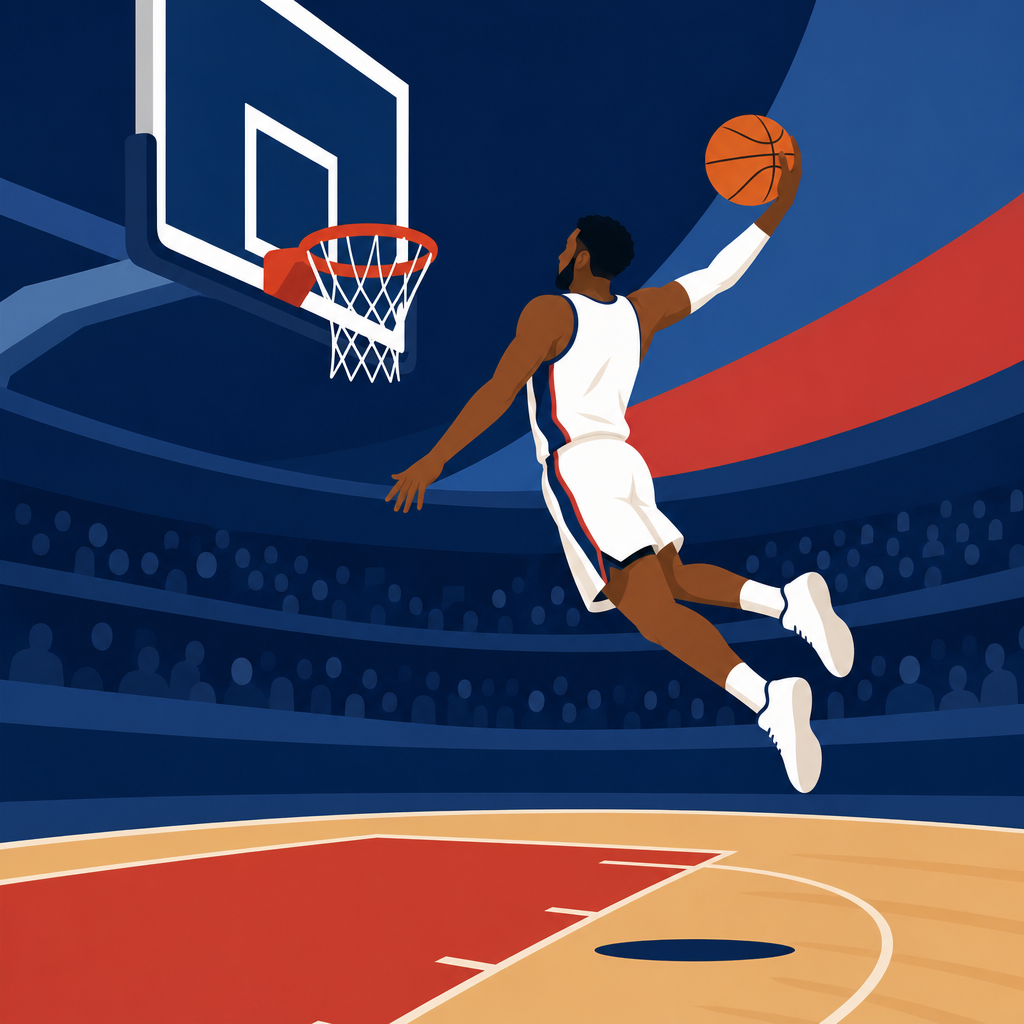
Dunks are the highest-percentage finish because they reduce touch variables. LeBron James built a large part of his scoring profile on transition dunks and power finishes where his strength eliminated contests. Giannis Antetokounmpo does the same in half-court settings, taking long strides from the slot, extending around help defenders, and finishing before the rim protector can establish position. Ja Morant offers a different example. He converts explosive one-foot finishes and acrobatic layups despite not having Giannis’s size, showing that vertical burst and body control can create rim scoring in another way. When fans ask why teams prioritize spacing, this is the answer: more room means cleaner paths to these efficient shots.
Close-range finishing is also where many advanced counters appear. Kyrie Irving is a textbook case. He uses either hand, changes spin off the glass, and manipulates defenders with late ball pickups. Nikola Jokic often avoids full elevation and instead delivers short push shots or awkward-looking touch finishes that are difficult to block because the release comes early and from unusual angles. These plays may not look dramatic, but they punish defenses that overplay shooters or switch mismatches near the basket.
Jump shots: set shots, pull-ups, and catch-and-shoot scoring
The jump shot is the foundation of perimeter scoring. Technically, a jump shot is released while the player is airborne, usually after a dip, upward lift, and high follow-through. A set shot, by contrast, is released with little or no jump and is now mostly seen on free throws, very deep heaves, or casual practice reps. In live NBA action, most perimeter makes fall into two jump-shot subtypes: catch-and-shoot attempts and pull-up jumpers. Catch-and-shoot means the player receives the pass already prepared to shoot. Pull-up means the player creates the shot off the dribble, stopping into a balanced rise.
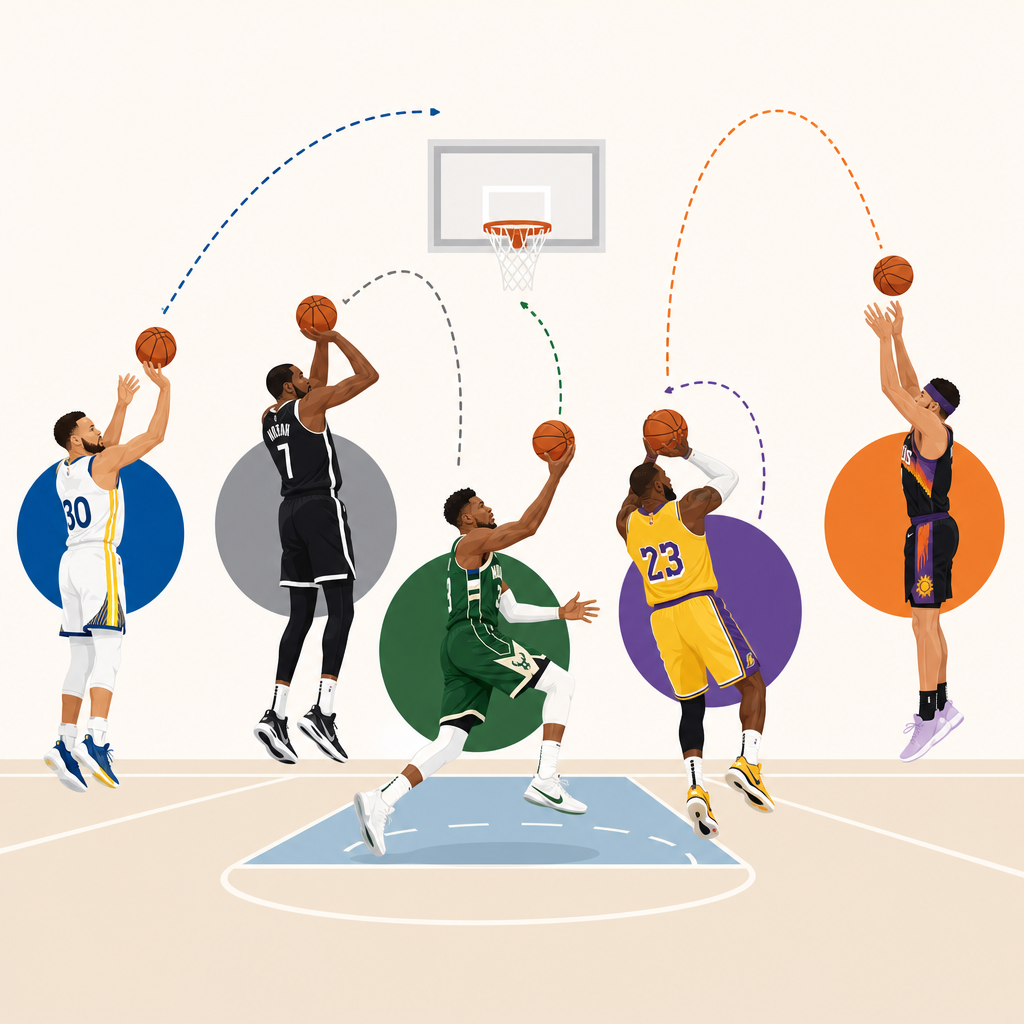
Klay Thompson is the classic catch-and-shoot example. His footwork on the catch is compact, his release is quick, and he needs very little time or space. Stephen Curry does that too, but his most disruptive shot type is the pull-up three. He can shoot while moving left or right, from well beyond the arc, forcing defenders to pick him up earlier than normal. That changes the geometry of the floor. Damian Lillard built a similar threat range, especially in late-clock situations where a high ball screen lets him rise into a deep pull-up before the big can recover.
Midrange jumpers still matter even in a three-point era. Devin Booker and Kevin Durant repeatedly show why. Against switching defenses, they get to elbows and nail smooth pull-ups over smaller or retreating defenders. These shots are harder than open threes in pure efficiency terms, but elite shotmakers can convert them at levels that justify the attempt. The real lesson for fans is that not all jumpers serve the same purpose. Catch-and-shoot attempts punish help defense. Pull-ups punish defenders who go under screens. Midrange pull-ups punish teams that remove the rim and the three-point line but concede space inside the arc.
Floaters, runners, and push shots in the lane
A floater is a soft, high-arcing shot taken before reaching the rim, usually over a shot blocker. It sits between a layup and a jump shot. The player typically releases it off one foot or two feet with touch rather than power, often from five to twelve feet. A runner is closely related but usually carries more forward momentum. A push shot is a compact one-hand release, often used by bigger players from short range. These shots exist because modern defenses are designed to funnel drivers toward rim protectors. If you cannot finish through size every time, you need a shot that rises over outstretched arms before full contact arrives.
Tony Parker was one of the NBA’s best floater users, snaking into the paint and releasing the ball before shot blockers could time his layup. Trae Young revived the move for a new generation by pairing it with pick-and-roll passing. Defenders who step up to stop Young’s floater leave the lob open behind them; defenders who stay back give him a clean teardrop. That is why the floater is more than a rescue attempt. It is a strategic shot that pressures the center to make an impossible choice.
Nikola Jokic and Joel Embiid often use push shots rather than classic floaters. From the dotted line or short middle, they create a little separation with strength and loft the ball with one hand. The move is efficient because it avoids charging directly into a second defender and does not require a full jump. Guards use these shots for survival; bigs use them for precision. When you hear commentators talk about “touch in the paint,” this family of shots is usually what they mean.
Hook shots, turnarounds, and post scoring moves
Post scoring starts with location and leverage. Once a player establishes position on the block or mid-post, the shot menu changes. The hook shot is a one-handed sweeping finish, commonly released with the body between the ball and the defender. It is difficult to block when executed properly because the shooter extends the ball away from pressure and uses the shoulder and torso as protection. Kareem Abdul-Jabbar’s skyhook remains the most famous version in basketball history, and no single shot better proves that a repeatable release point can become nearly unstoppable.
Today, the hook survives in modified forms. Nikola Jokic uses soft hooks over either shoulder, often after backing a defender just deep enough to force help. Alperen Sengun uses fakes, pivots, and mini-hooks to score without needing superior vertical lift. The turnaround jumper is another essential post shot. Michael Jordan and Kobe Bryant mastered it from the mid-post, pivoting away from the defender and rising into balance. Dirk Nowitzki’s one-legged fadeaway was a hybrid of turnaround and fade, and it became lethal because his height and release point made contests largely symbolic.
Post scoring is not old-fashioned when used correctly. It forces double teams, creates foul pressure, and punishes switches. Jayson Tatum and Luka Doncic both attack smaller defenders in the post, not because they live there every possession, but because the shot profile becomes efficient when the mismatch is clear. For fans, the important distinction is this: a post shot is not defined only by distance from the basket. It is defined by back-to-the-basket or side-on creation, footwork through pivots, and the use of strength to manufacture angle and space.
Specialized shots, situational choices, and when each one appears
Every major shot type exists because a specific game problem needs solving. The table below shows where fans most often see each shot and which NBA player offers a clean example of it in action.
| Shot type | Typical situation | NBA example |
|---|---|---|
| Layup | Beating first defender, attacking open lane | Kyrie Irving finishing with either hand |
| Dunk | Transition, cuts, strong drives, lob plays | Giannis Antetokounmpo in stride to the rim |
| Catch-and-shoot three | Kick-out pass after help defense | Klay Thompson off a pindown |
| Pull-up three | Ball screen when defender goes under | Stephen Curry above the break |
| Midrange pull-up | Drop coverage conceding elbow space | Devin Booker from 15 feet |
| Floater | Paint touch versus a waiting rim protector | Trae Young in pick-and-roll |
| Hook shot | Post-up with body shielding the ball | Nikola Jokic over either shoulder |
| Fadeaway | Need separation against close on-ball defense | Dirk Nowitzki one-legged version |
| Bank shot | Angle to the glass is cleaner than direct line | Tim Duncan from the lane |
| Free throw | After a shooting or team foul | Stephen Curry’s routine accuracy |
Bank shots deserve a quick mention because they are often misunderstood. A bank shot intentionally uses the backboard, usually from the wing, short corner, or inside the lane. Tim Duncan turned the mid-post bank into a signature. The angle made the shot more forgiving than a direct swish attempt, especially from fifteen feet and in. Free throws are their own category because they remove defenders and focus entirely on repeatable mechanics, breathing, and routine. Good free-throw shooting often predicts touch on other shots, though not perfectly. Shaquille O’Neal showed that elite interior scoring does not guarantee line accuracy, while Curry shows how stable mechanics translate everywhere.
How to recognize shot quality like a smarter fan
If you want to evaluate offense quickly, watch the shot before you watch the result. Ask four questions. First, where did the attempt come from: rim, midrange, or three? Second, was it contested? Third, was it created off the dribble, on the catch, or through a post mismatch? Fourth, does the shooter normally excel at that exact shot? Those questions are how coaches think during film review. The NBA’s tracking era, led by tools such as Second Spectrum and lineup efficiency dashboards on NBA.com, confirms the same principles possession after possession.
Shot quality is not the same as highlight value. A double-clutch reverse layup through traffic may be spectacular, but an open corner three generated by crisp ball movement is often the better process play. The best offenses blend both. The 2014 Spurs built beautiful catch-and-shoot opportunities through extra passes. The Warriors weaponized relocation threes and transition pull-ups. Denver uses Jokic’s passing to create layups, dunks, and short paint touch shots that feel simple because the read was correct before the pass was thrown.
Understanding shot types also helps you follow player development. A young guard who adds a floater becomes harder to scheme against. A wing who improves catch-and-shoot footwork can stay on the floor longer. A big who develops a reliable hook or short push shot punishes switches instead of merely reposting. That is why this hub matters within basketball basics. Once you can identify the shot family, you can connect mechanics to tactics, and tactics to winning.
The core takeaway is simple: every basketball shot answers a defensive problem. Layups and dunks attack space at the rim. Jump shots punish defenders who help too far or trail screens. Floaters solve the rim protector. Hooks and turnarounds solve strength mismatches and crowded paint. Bank shots use angle, and free throws reward disciplined mechanics. Learn those functions, and the game stops looking random. You start seeing patterns, counters, and intent on every possession.
For fans, that makes every broadcast better. You can recognize why a team wants a corner three instead of a long two, why a guard snakes into the lane for a floater instead of challenging a center, and why a star forward goes to the fadeaway late in the clock. For players and parents, it gives a clear roadmap of skill progression: master finishing, build a dependable jumper, add touch shots, then layer in counters. Use this page as your Basketball Basics hub for skills explained, and revisit each shot type the next time you watch an NBA game. The more precisely you name the shot, the more clearly you will understand the sport.
Frequently Asked Questions
What are the main types of basketball shots every fan should know?
The most important basketball shots to recognize are the layup, jump shot, three-pointer, floater, hook shot, dunk, fadeaway, and free throw. Each one solves a different problem on offense. A layup is the most basic close-range finish, usually taken off one or two steps near the rim, often using the backboard. A jump shot is the foundation of perimeter scoring and can happen off the catch, off the dribble, or after creating separation. A three-pointer is simply a jump shot taken from beyond the arc, but it has become one of the most valuable weapons in modern basketball because of the extra point and the floor spacing it creates. A floater is a soft, high-arcing shot used to score over taller defenders before reaching the rim. A hook shot is a one-handed sweeping release, often used by post players to shoot over defenders while keeping the ball protected. A dunk is the most forceful finish at the rim and usually comes from beating the defense with size, speed, or elevation. A fadeaway is a jump shot taken while drifting backward to create space from a defender. A free throw is an uncontested shot from the foul line and remains one of the purest tests of touch and mechanics.
NBA examples make these categories easier to understand. Stephen Curry is the clearest modern example of the three-point shot changing the game, especially with catch-and-shoot threes and pull-up threes off the dribble. Klay Thompson is famous for textbook catch-and-shoot form and quick release. Kyrie Irving is one of the best layup artists ever because of his touch, angles, and ability to finish with either hand. Tony Parker helped popularize the floater as a signature guard weapon in the lane. Kareem Abdul-Jabbar’s skyhook remains the most iconic hook shot in basketball history. Michael Jordan, Kobe Bryant, and Dirk Nowitzki turned the fadeaway into a signature scoring tool. Giannis Antetokounmpo and LeBron James show how dunks and power finishes can overwhelm a defense in transition and half-court situations. Once fans learn these shot types, games become much easier to read because you start noticing not just whether a player scored, but why that specific shot was the right choice in that moment.
How is a layup different from a floater or a dunk?
A layup, floater, and dunk are all close-range shots, but they are used in very different situations. A layup is usually taken when a player gets all the way to the basket and wants to finish with touch off the glass or directly into the rim. It depends on body control, timing, and the ability to shield the ball from defenders. Players often use a layup when they have a step on their defender or when they can attack a gap and reach the basket before a shot blocker arrives. A dunk is also a finish at the rim, but it requires more explosion and extension. It is less about finesse and more about finishing above or through the defense. A dunk is generally the highest-percentage shot when available because it eliminates some of the touch variables that affect layups.
A floater is different because it is designed for the space between the perimeter and the rim, especially when a guard beats the first defender but meets a taller help defender in the lane. Instead of taking the ball all the way into the chest of a shot blocker, the offensive player releases a soft, high-arching shot from several feet away. That extra height and early release make the floater a smart counter to rim protection. Trae Young is a great example because he uses the floater when big men drop back in pick-and-roll coverage. Kyrie Irving represents elite layup craft because he can finish around defenders from difficult angles using either hand. Ja Morant and Anthony Edwards show how the dunk can immediately punish a defense when there is a clear path or a late rotation. Understanding the difference between these three shots helps fans see how offensive players read traffic in the paint. The choice is rarely random. It is usually a direct response to spacing, defender position, and the player’s own physical tools.
What is the difference between a catch-and-shoot jumper and an off-the-dribble shot?
A catch-and-shoot jumper happens when a player receives a pass and goes right into the shooting motion with little or no extra dribbling. It is usually faster, more efficient, and easier to repeat because the player can prepare their feet, shoulders, and balance before the ball arrives. This is why catch-and-shoot opportunities are so valuable in well-run offenses. Ball movement forces the defense to rotate, and that split second of separation creates a clean look. Players like Klay Thompson, Ray Allen, and Kyle Korver built much of their reputations on this kind of shot. Their footwork, readiness, and compact release allowed them to punish even small defensive mistakes.
An off-the-dribble shot is more difficult because the player has to create the shot while handling the ball. That means generating separation with a crossover, hesitation, step-back, or screen, then quickly gathering into a balanced release. These shots demand more from a scorer because they involve timing, rhythm, and body control after movement. Defenders are usually tighter, and the shooter often has to rise into the attempt without perfect balance. Stephen Curry, Damian Lillard, Luka Doncic, and Kevin Durant are excellent examples of players who can score this way. Curry can pull up from deep before the defense is set. Doncic uses pace and step-backs to create space. Durant can rise over defenders even when the shot is contested.
For fans, this distinction matters because it tells you something about the offense. Catch-and-shoot jumpers often reflect strong team play, spacing, and passing. Off-the-dribble jumpers often reflect shot creation skill, late-clock problem solving, or a mismatch being attacked. Both are essential, but they carry different degrees of difficulty and usually come from different offensive situations.
Why is the fadeaway such a famous basketball shot, and when do players use it?
The fadeaway is famous because it combines skill, style, and difficulty. On a fadeaway, the shooter leans or jumps backward while releasing the ball, creating separation from the defender. That backward movement makes the shot harder to block, especially against tight on-ball defense or in the post. The tradeoff is that it is also harder to make because the shooter is moving away from the rim and must maintain touch, balance, and alignment under pressure. It is not the first shot coaches usually want young players to rely on, but in the hands of elite scorers, it becomes one of the most reliable ways to get a shot off against great defense.
NBA history is full of legendary fadeaway scorers. Michael Jordan used it to punish defenders in the mid-post. Kobe Bryant expanded it into one of the deepest shot-making bags the league has ever seen. Dirk Nowitzki added his own twist with the one-legged fadeaway, turning a seemingly awkward motion into an almost unguardable weapon. Kevin Durant also uses a high-release fadeaway to score over smaller defenders. The reason players use it is simple: when defenders are physical, long, and disciplined, clean separation is hard to create. The fadeaway buys just enough room to get the shot off.
Fans should also know that the fadeaway shows how scoring is not just about athleticism. It is about footwork, timing, and reading the defender. A great fadeaway scorer knows when a defender is leaning, when help is coming, and how to use body position to create a clean look. That is why this shot is so respected. It is a high-level answer to high-level defense, and when it goes in consistently, it often signals a truly elite offensive player.
Which basketball shots are considered the most efficient, and which are the hardest to master?
In general, the most efficient shots are layups, dunks, free throws, and open three-pointers. Layups and dunks happen near the basket, where shooting percentages are naturally highest. Open threes are highly efficient because they are worth more than mid-range shots and, for good shooters, can produce strong value over time. Free throws are efficient because they are uncontested and repeatable. This is one reason modern NBA offenses prioritize shots at the rim, shots beyond the arc, and free-throw opportunities. Teams want to avoid low-value attempts unless the player taking them is exceptionally skilled in that area.
The hardest shots to master are usually contested off-the-dribble jumpers, floaters with touch over size, fadeaways, and advanced post moves like the hook shot against pressure. These shots require precision even when the defense takes away easier options. A step-back three, for example, demands balance, timing, lower-body strength, and exact release mechanics after a sudden separation move. A floater requires delicate touch and arc from awkward distances. A hook shot sounds simple, but it takes years to develop proper footwork, shoulder alignment, and feel with either hand. A fadeaway is even tougher because the shooter must stay accurate while moving backward.
NBA stars help define these categories. Giannis Antetokounmpo is devastating at the rim, which is one reason his scoring is so efficient. Stephen Curry has made the three-pointer so accurate and versatile that even difficult threes