

Basketball has its own language, and learning that language changes how you watch every possession, lineup change, and late-game decision. This basketball glossary explains the NBA terms every fan should know, from basic scoring and foul rules to advanced strategy, roster mechanics, and modern analytics. When I help new fans follow games, I start with terminology because the sport moves fast and broadcasters assume a shared vocabulary. If you know what a pick-and-roll, defensive rating, restricted free agent, and clear-path foul mean, the game becomes easier to read in real time. This guide serves as a hub for the broader Fan Guide by defining the core terms that show up in game recaps, broadcasts, highlight clips, trade deadline coverage, and playoff analysis. It also helps when you move into deeper topics like team-building, player development, officiating, or betting content. In plain terms, a basketball glossary is a reference list of words and phrases used to describe actions, roles, rules, stats, and transactions in the NBA. Some terms come directly from the official rulebook, some come from coaches and scouts, and others developed through media and fan culture. All matter because NBA conversation blends technical language with shorthand. A “drop coverage” is a specific pick-and-roll defense, while “three-and-D” describes a player archetype. A “usage rate” is a stat, while “bird rights” are a cap mechanism. This article organizes those terms so you can understand not just what happened, but why it happened and what it means next.
Core game terms every NBA fan hears first
Start with the foundation: possession, pace, half court, transition, paint, perimeter, and spacing. A possession is one team’s opportunity to score before the ball changes hands through a made basket, turnover, defensive rebound, or period ending. Pace estimates how many possessions a team uses per 48 minutes. A fast team like recent Indiana groups creates more transition chances, while slower teams may prefer organized half-court offense. The paint is the lane near the basket, where shots are efficient but heavily contested. The perimeter is the area outside the lane, especially around the three-point line. Spacing refers to how offensive players position themselves to stretch defenders and open driving lanes. Good spacing is why shooters stand in corners and above the break rather than crowding the ball.
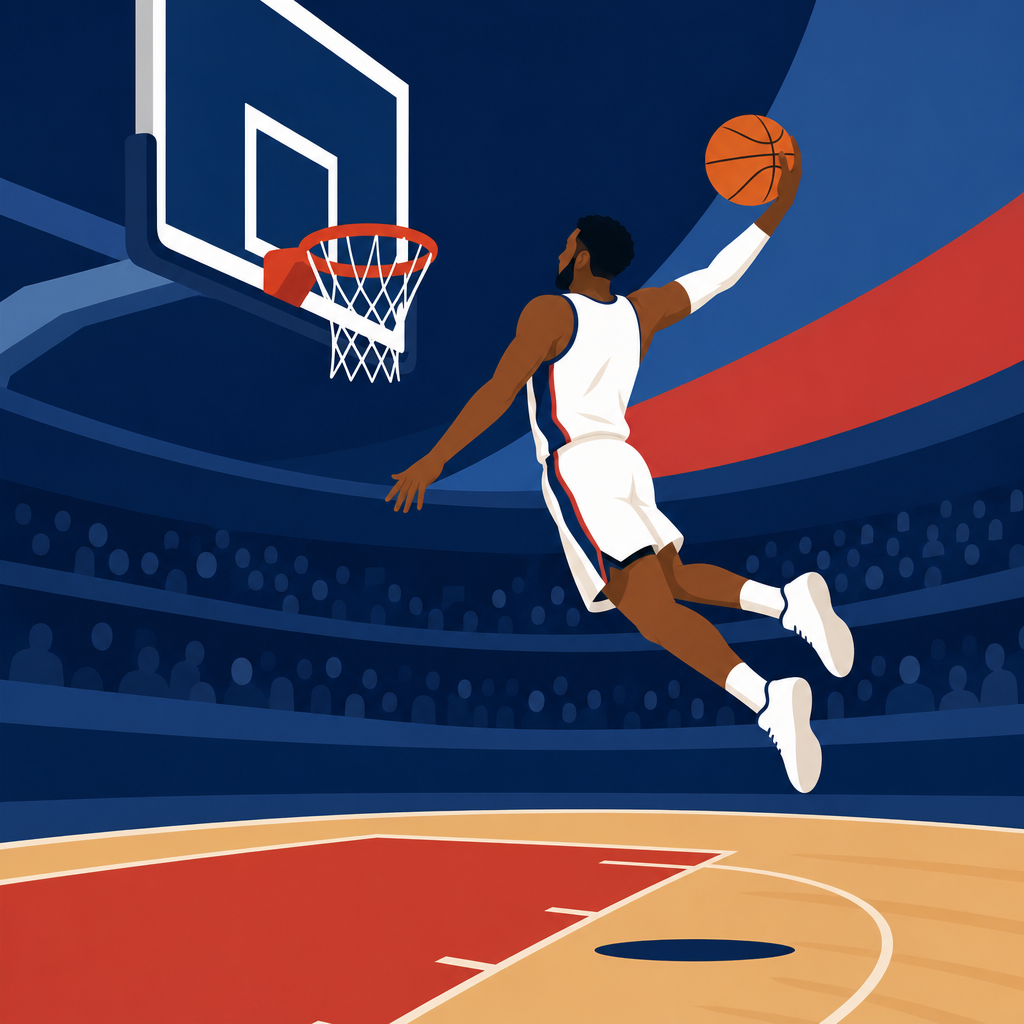
Fans also need scoring and shot-type terms. A field goal is any made shot from the floor, worth two points unless it is behind the arc, where it counts for three. Free throws come after certain fouls and are worth one point each. A layup is a close-range shot near the rim; a dunk is a forceful finish above the cylinder; a floater is a soft runner over rim protectors; and a pull-up is a jump shot taken off the dribble. An and-one happens when a player makes the basket while being fouled and then gets one free throw. A putback is a score immediately after an offensive rebound. When announcers say a team is “living at the rim,” they mean it is generating many close shots, usually a sign of strong offensive pressure.
Several terms describe mistakes and game flow. A turnover is any lost possession caused by a steal, bad pass, offensive foul, travel, shot-clock violation, or other error. An assist is credited when a pass directly leads to a made basket. A rebound is secured after a missed shot, with offensive rebounds extending possessions and defensive rebounds ending them. A steal is a defender taking the ball away; a block is legally deflecting a shot attempt. The shot clock gives teams 24 seconds to attempt a shot that touches the rim. The backcourt is the team’s defensive half after gaining possession; once the offense advances the ball over midcourt, it generally cannot return it there without a backcourt violation. These are the terms that make the box score readable and the game watchable.
Offensive actions, player roles, and spacing language
Most NBA offense is built from repeatable actions. The pick-and-roll is the league’s most common play: one player sets a screen for the ball handler, then rolls to the basket or pops to open space. A pick-and-pop is the variation where the screener fades for a jumper instead of diving inside. Spain pick-and-roll adds a back screen on the rolling big, creating confusion for the defense. Dribble handoff, often shortened to DHO, means the ball handler literally hands the ball to a teammate while acting like a moving screen. Iso, short for isolation, clears one side so a star can attack a defender one-on-one. Post-up means an offensive player catches near the block or elbow with his back or side to the basket and tries to score or pass from there.
Player-role terms explain why lineups work. A primary ball handler initiates the offense and makes most decisions. A secondary creator attacks closeouts, runs second-side pick-and-roll, and eases pressure on the star guard. A spot-up shooter spaces the floor and punishes help defense. A roll man screens and dives, often creating lobs or kickout threes. A stretch big is a center or power forward who can pull rim protectors away from the basket by shooting from distance. A lob threat pressures the weak side because defenders must account for vertical finishing. Three-and-D players earn minutes by hitting catch-and-shoot threes and guarding perimeter scorers. When analysts call a lineup “switchable,” they mean multiple defenders can guard different positions without breaking the scheme.
Shot-quality language matters because not all 20-point nights are equal. A catch-and-shoot three is usually cleaner than a step-back three because it requires less self-creation. Corner threes are shorter than above-the-break threes and are among the most efficient perimeter shots. A closeout is the defender’s sprint to contest a shooter after helping elsewhere. Attacking the closeout means driving past that defender before the defense resets. The dunker spot is the short-corner area along the baseline where a non-shooting big waits for dump-off passes. Gravity describes how much defensive attention a player attracts, even without touching the ball; Stephen Curry is the classic example. When one shooter’s movement pulls two defenders away, everyone else gains space. That is why offensive language often sounds geometric: angles, gaps, tags, and weak-side help all determine whether a play works.
Defensive terms that explain stops, matchups, and scheme
Defense has its own vocabulary, and it often reveals more about a team than scoring does. Man-to-man means each defender is primarily responsible for one matchup, though NBA man defense still includes constant help and rotation. Zone assigns defenders to areas instead of fixed players. Switching means defenders exchange assignments after a screen, a common tactic against versatile lineups. Drop coverage asks the big defender to retreat toward the paint on pick-and-rolls, protecting the rim while conceding some pull-up space. At the other extreme, blitzing or trapping sends two defenders to the ball to force it out of a star’s hands. Ice coverage pushes a side pick-and-roll away from the middle. Hedge means the screener’s defender steps out aggressively, then recovers back.
Help defense and rim protection are central concepts. The low man is the weak-side defender responsible for rotating to the rim when the primary defender is beaten. A tag is the brief bump a helper gives the rolling big to delay his path to the basket. Nail help comes from a defender stationed near the center of the free-throw line area, often used to clog driving lanes. Stunt means a defender fakes help with a quick step toward the ball, then recovers to his shooter. Rim deterrence goes beyond blocks; elite centers reduce attempts at the basket simply by being there. Charge circle, verticality, and legal guarding position all matter here. When a broadcaster says a defender “met him at the summit,” they usually mean a clean, vertical contest near the rim.
Individual defensive reputation is often described with role-specific terms. A point-of-attack defender guards the ball at the start of the action and tries to prevent clean penetration. Screen navigation describes how well that defender fights over or under picks. Chasing over a screen helps against pull-up shooters; going under can work against weak shooters but is punished by guards who can rise into threes. A rim protector anchors the back line. A free safety is an off-ball defender who roams to create steals and blocks, as Giannis Antetokounmpo often does from the weak side. Deflections, contested shots, and defensive rebound rate matter because a stop is not finished until the rebound is secured. That is why coaches talk about “getting two stops”: first the contest, then possession.
Fouls, violations, and officiating language
NBA fans hear officiating terms constantly, especially in close games. A personal foul is illegal contact that affects play. A shooting foul occurs during a shot attempt and leads to free throws. A blocking foul is usually called when a defender is not in legal guarding position, while a charge is an offensive foul on a driver who barrels into a stationary defender outside the restricted area. A reach-in is informal language for illegal hand contact, though the box score simply records a personal foul. Loose-ball fouls happen while neither team has full control. Clear-path fouls are transition fouls with no defender between the offensive player and the basket under specific criteria. Flagrant fouls involve unnecessary or excessive contact, with Flagrant 2 carrying an ejection.
Violations are different from fouls because they do not involve illegal contact. Traveling means moving the pivot foot illegally or taking too many steps without properly dribbling. A double dribble occurs when a player stops dribbling and starts again, or dribbles with both hands simultaneously. Palming, or carrying, happens when the hand goes under the ball and controls it unnaturally. Goaltending is touching a shot on its downward path or above the cylinder in a way the rules prohibit. Basket interference involves illegally touching the rim or ball around the basket. Three seconds can be offensive or defensive: offensive players cannot camp in the lane too long, and defenders cannot remain there without actively guarding. Eight-second and five-second counts govern how long teams or players can hold the ball in specific situations.
Replay and challenge language has become part of everyday fandom. Coaches can challenge certain calls, and replay centers review clock issues, out-of-bounds decisions, and foul classifications. The Last Two Minute Report, published by the league for close games, evaluates officiating decisions in the final stretch. It does not change results, but it gives fans a standardized postgame explanation. Referees also use advantage-disadvantage principles, meaning not every contact is automatically called if it does not affect the play. That frustrates fans who want perfect consistency, yet it reflects how fast and physical NBA action is. Learning the officiating vocabulary helps you separate rule misunderstandings from legitimate debate, which makes game discourse more informed and less emotional.
Stats, analytics, and front-office language fans should recognize
Modern NBA coverage mixes classic box-score numbers with advanced metrics and salary-cap terminology. Points, rebounds, assists, steals, and blocks remain the basics, but efficiency stats tell more of the story. Field-goal percentage measures total makes over attempts, while effective field-goal percentage adjusts for the added value of threes. True shooting percentage goes further by incorporating twos, threes, and free throws into one scoring-efficiency metric. Usage rate estimates the share of team possessions a player ends with a shot, free throws, or turnover while on the floor. Offensive rating and defensive rating estimate points scored or allowed per 100 possessions. Net rating is the difference between them and is one of the quickest ways to judge lineup or team performance.
| Term | Simple meaning | Why fans use it |
|---|---|---|
| True shooting percentage | Scoring efficiency including free throws and threes | Compares scorers fairly across shot types |
| Usage rate | How often a player finishes possessions | Shows offensive role and workload |
| Net rating | Points per 100 possessions scored minus allowed | Summarizes overall impact of lineups or teams |
| PER | Box-score-based all-in-one metric | Quick snapshot, though limited defensively |
| Win shares | Estimate of wins contributed | Useful for season-level comparisons |
No single advanced stat is definitive, so smart analysis uses several. Player Efficiency Rating, win shares, box plus/minus, estimated plus-minus, and RAPTOR-style models all try to summarize impact, but each weighs context differently. Tracking data from Second Spectrum adds information such as touch time, defender distance, drives, and shot location. Front offices pair those numbers with film because stats alone can miss scheme responsibilities or teammate effects. Cap language matters too. A restricted free agent can receive offers that his current team has the right to match. Bird rights allow teams to exceed the salary cap to re-sign their own players under defined conditions. The mid-level exception, rookie scale contract, luxury tax, hard cap, player option, and sign-and-trade are all terms that shape roster building as much as talent evaluation does.
To use this basketball glossary well, keep it open while watching games, reading recaps, or following trade news, then connect each term to a real play or roster move. The key takeaway is simple: NBA terminology is not jargon for its own sake. It is the shortest path to understanding strategy, officiating, player roles, and team construction. Once you know the language, a broadcast says far more in fewer words, and debates about matchups or transactions become easier to judge on the merits. This hub should be your starting point for the Fan Guide because every deeper article in the subtopic builds on these definitions. Revisit it during the season, especially around opening night, the trade deadline, and the playoffs, when the language gets denser and the stakes get higher. If you want to become a sharper fan fast, bookmark this basketball glossary and use it as your reference point for every NBA game you watch.
Frequently Asked Questions
What are the most important NBA terms a new fan should learn first?
If you are just starting to follow basketball, focus on the terms that explain how points are scored, how possessions work, and why the game stops. The basics include field goal, three-pointer, free throw, rebound, assist, turnover, foul, and possession. A field goal is any made shot from the floor, while a three-pointer is a made shot from beyond the arc. Free throws are uncontested shots awarded after certain fouls. A rebound happens when a player secures the ball after a missed shot, and an assist is credited when a pass directly leads to a made basket. A turnover means the offense gave the ball away before getting a shot attempt that counts.
From there, learn a few structural terms that commentators use constantly. The paint is the lane area near the basket, the perimeter refers to the outer area of the court, and transition describes the phase when a team is attacking quickly before the defense is set. Half-court offense refers to possessions where both teams are already set in their offensive and defensive positions. You should also know what a shot clock is, because it controls pace by requiring a team to attempt a shot within a set amount of time. Once you understand those terms, game action becomes much easier to follow because you can recognize whether a team is creating good shots, wasting possessions, or forcing the pace.
What does pick-and-roll mean, and why is it such a central part of NBA offense?
A pick-and-roll is one of the most common and important actions in basketball. It begins when an offensive player sets a screen, also called a pick, for the ball handler. The purpose is to block or delay the defender guarding the ball. After setting the screen, that screener moves toward open space, often rolling to the basket, which is the roll part of the play. This action forces the defense to make fast decisions: switch defenders, fight over the screen, trap the ball handler, or drop the big defender back into the lane. Because multiple defenders are involved, the pick-and-roll is designed to create confusion and open scoring chances.
What makes the pick-and-roll so powerful is how many options it creates from one simple action. The ball handler might drive to the rim, pull up for a jumper, pass to the rolling screener, or kick the ball out to shooters if help defenders collapse. Teams also use variations such as the pick-and-pop, where the screener moves away from the basket for a jump shot instead of rolling inside. When analysts talk about spacing, screen navigation, weak-side help, or rim pressure, those ideas often connect directly to the pick-and-roll. If you understand this action, you will immediately see more of the strategy behind NBA possessions instead of just watching players move at full speed.
What is the restricted area, and how does it affect charge and block calls?
The restricted area is a marked semicircle under the basket that helps officials determine certain charge and blocking foul situations. In general, a defender cannot establish legal guarding position inside that restricted zone to draw a charge against a driving offensive player who is attacking the rim. If the defender is standing inside the restricted area and contact occurs, officials will often call a blocking foul instead of an offensive foul. This rule exists to reduce dangerous collisions directly under the basket and to give offensive players a fair chance to finish plays at the rim.
That said, the restricted area rule has important nuances. It does not erase every possible offensive foul near the basket. For example, if an offensive player leads with an elbow, pushes off, or crashes into a defender in a way that is clearly illegal, an offensive foul can still be called. Broadcasters often slow these plays down because fans naturally focus on the collision, while officials are looking at feet position, timing, legal guarding stance, and whether the offensive player was under control. Understanding the restricted area helps explain one of the most debated parts of NBA officiating, especially on bang-bang plays where a help defender rotates late and tries to absorb contact near the rim.
What do advanced stats like offensive rating, defensive rating, and true shooting percentage actually tell you?
Advanced stats are meant to give a clearer picture than traditional box score totals alone. Offensive rating estimates how many points a team or player produces per 100 possessions, while defensive rating estimates how many points a team allows per 100 possessions. Using possessions instead of raw game totals matters because pace varies from team to team. A fast team may score a lot simply because it plays quickly, while a slower team may be more efficient on each trip down the floor. Ratings help normalize that difference, which makes comparisons more meaningful.
True shooting percentage is another widely used metric because it measures scoring efficiency while accounting for twos, threes, and free throws together. A player who scores 25 points inefficiently is not helping the offense the same way as a player who scores 25 on fewer shots and more accurate shooting. That is where true shooting percentage becomes useful. It rewards players who generate efficient offense rather than just high volume. These numbers are not perfect and should not replace watching games, but they are valuable tools when used with context. They help explain why one lineup works better than another, why a player with modest point totals may still be highly impactful, and why modern analysis focuses so heavily on efficiency, spacing, and shot quality.
What roster and transaction terms should NBA fans understand to follow the league beyond the games?
To follow the NBA fully, fans need to understand more than on-court strategy. The league is shaped by contracts, trades, and roster rules, and those terms show up constantly in news coverage. A salary cap is the system that limits how much teams can spend on player salaries, though the NBA uses a soft cap with many exceptions. Free agency is the period when eligible players can sign with new teams. A trade sends players, draft picks, or other assets from one team to another. Draft picks are future selections in the NBA Draft, and they often become major parts of trade packages because they represent future talent or flexibility.
Other key terms include rookie scale contract, veteran minimum, two-way contract, bird rights, and luxury tax. A rookie scale contract is the structured pay system for first-round draft picks. A veteran minimum is the lowest standard salary a team can offer based on experience rules. A two-way contract allows a player to split time between the NBA and the G League under specific restrictions. Bird rights let teams exceed the salary cap to re-sign their own players, which is one reason franchises can keep star cores together. The luxury tax is a financial penalty for teams that spend above a certain threshold, and it can heavily influence front-office decisions. Once you understand these terms, the league starts to make more sense not just as competition on the floor, but as a year-round ecosystem of team building, asset management, and long-term planning.