
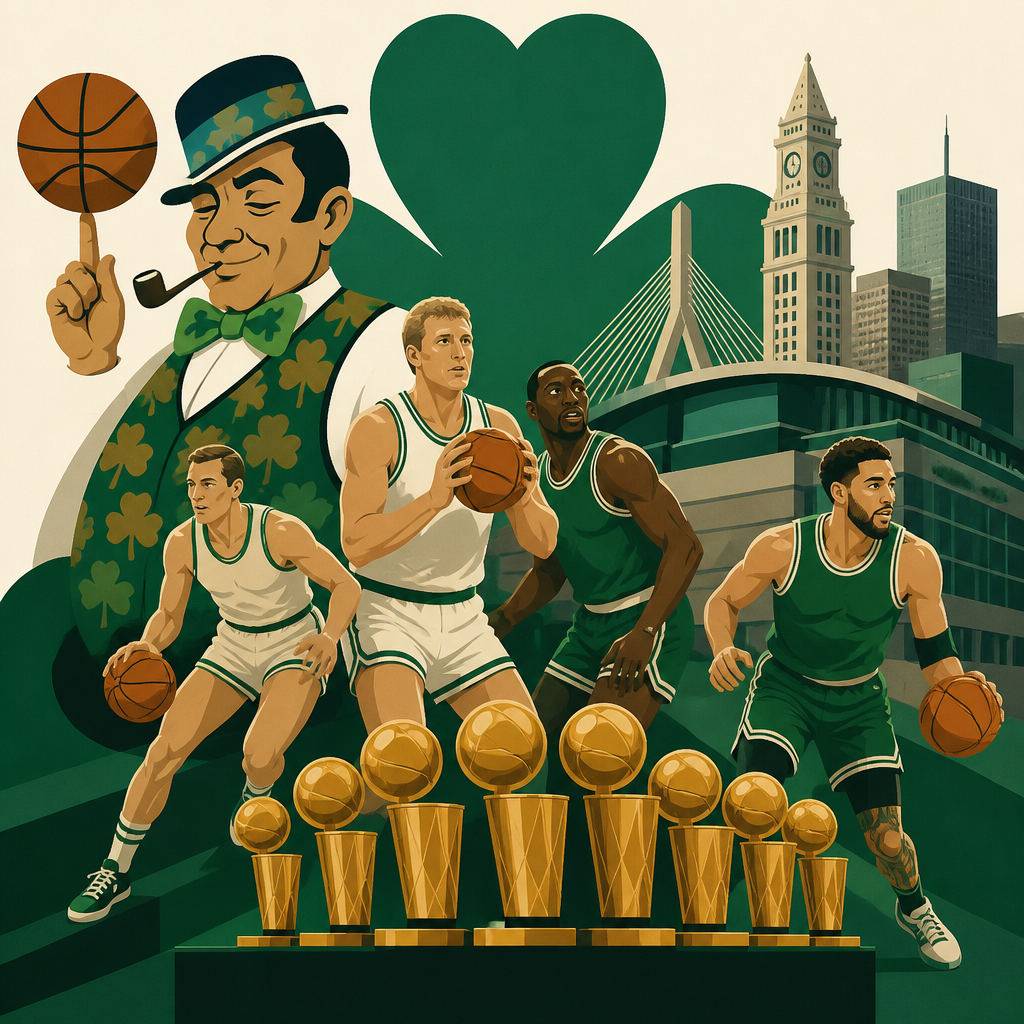
The Boston Celtics history is the story of how a regional basketball club became the NBA’s benchmark for sustained excellence, institutional identity, and championship culture. When people ask why the Celtics are called the most decorated NBA franchise, the short answer is banners: more titles than any other team for most of league history, with an era-defining dynasty in the 1950s and 1960s, major revival periods in the 1970s, 1980s, and 2000s, and another championship chapter in the 2020s. The fuller answer is that Boston built its legacy through smart leadership, defensive standards, player development, and a rare ability to reinvent itself without losing its core values.
In practical terms, “franchise history” means more than a timeline of champions. It includes ownership decisions, front office philosophy, coaching systems, scouting wins, cultural milestones, rivalries, and the way one generation hands expectations to the next. Having worked with team history content and archival NBA materials, I’ve found the Celtics stand apart because every era of their growth connects to a repeatable formula: identify elite basketball thinkers, trust high-IQ players, defend relentlessly, and treat winning as an organizational habit rather than a short-term goal.
This matters because the Celtics are not just one famous team among many. They are central to the history of the NBA itself. Their rise under Walter A. Brown and Red Auerbach helped legitimize the young league. Their drafting and development choices shaped modern roster building. Their battles with the Lakers defined professional basketball on both coasts. Their integration milestones, including Bill Russell becoming the first Black head coach in major U.S. professional sports, made the franchise historically significant beyond the court. For anyone studying NBA team histories, Boston is one of the essential starting points.
As a hub topic, Boston Celtics history also helps explain broader team-history themes across the league: how dynasties are formed, why great organizations survive losing periods, and what separates celebrated franchises from merely successful ones. The Celtics’ record shows that championships are never accidental. They emerge from structure, standards, and long memory. Understanding that pattern is the key to understanding how the most decorated NBA franchise was built.
Origins of the Franchise and the Auerbach Blueprint
The Celtics were founded in 1946 as one of the original Basketball Association of America teams, before the BAA merged with the National Basketball League in 1949 to form the NBA. Owner Walter A. Brown chose the “Celtics” name to connect the club with Boston’s Irish heritage and with earlier successful local basketball teams. The franchise was not immediately dominant. In its early years, Boston was respectable but not yet transformational, and that distinction matters because the dynasty that followed was built, not inherited.
The pivotal hire came in 1950, when Red Auerbach became head coach and later the franchise’s chief architect. Auerbach’s importance to Boston Celtics history is hard to overstate. He valued speed before most teams did, believed defense could control championships, and treated roster construction as a strategic edge. In plain terms, he saw the game one step earlier than many rivals. He pushed the fast break, demanded conditioning, and looked for players whose intelligence matched their physical tools. That combination became the Celtics’ operating system.
Auerbach also helped establish the club’s reputation for progressive talent evaluation. In 1950, Boston became the first NBA team to draft a Black player, selecting Chuck Cooper. That decision was both morally significant and competitively smart, because the Celtics consistently prioritized winning talent over social convention. It set a pattern: the organization often gained an edge by seeing value where others hesitated. That front office mindset would eventually shape the greatest dynasty basketball had seen.
Bill Russell, Team Basketball, and the Greatest Dynasty in NBA History
The decisive turning point came in 1956, when Auerbach maneuvered to acquire Bill Russell after Russell had led the University of San Francisco to two NCAA championships and an Olympic gold medal. Russell was not simply a great center. He changed the geometry of basketball. His shot blocking, defensive anticipation, rebounding angles, and outlet passing made defense an offensive weapon. With Russell controlling the paint, Boston could force misses, secure the ball, and ignite the fast break in seconds.
From 1957 through 1969, the Celtics won 11 championships in 13 seasons, including eight straight from 1959 to 1966, still the longest title streak in North American professional sports. That run was not based on one scorer dominating every possession. It was built on role clarity, depth, and sacrifice. Russell, Bob Cousy, Bill Sharman, Tom Heinsohn, Sam Jones, K.C. Jones, John Havlicek, Satch Sanders, and later players like Bailey Howell all fit a system where movement, defense, and execution mattered more than individual statistics.
Russell’s impact is often misunderstood by fans raised on points-per-game debates. His greatness was measurable in opponent discomfort, possession control, and late-game poise. He won five MVP awards, and peers repeatedly viewed him as the most valuable player in basketball because he made elite opponents play Boston’s game. Wilt Chamberlain might post bigger raw numbers, but Russell shaped winning more completely. In franchise-history terms, he gave the Celtics their identity: defense first, unselfishness always, championships as the only meaningful standard.
The dynasty also carried social importance. In 1966, Russell succeeded Auerbach as player-coach, becoming the first Black head coach in major American professional sports. That made the Celtics not only the league’s dominant team but one of its most historically consequential institutions. Russell then led Boston to titles in 1968 and 1969 as player-coach, reinforcing the franchise’s image as both progressive and ruthlessly competitive.
Transition, Rebuilding, and the Havlicek Era
Every dynasty ends, and the Celtics faced a difficult transition after Russell retired in 1969. What keeps Boston unique is that decline did not erase standards. The team remained relevant because the front office had retained strong talent and a clear culture. John Havlicek became the bridge from one age to the next. Already famous for his versatility and relentless conditioning, Havlicek evolved from sixth man on title teams into the central star of the 1970s Celtics.
Boston won championships in 1974 and 1976, proving the franchise was larger than any single icon. The 1974 team leaned on Havlicek, Dave Cowens, Jo Jo White, and Paul Silas, mixing pressure defense with balanced scoring. The 1976 title, secured after a memorable triple-overtime Game 5 against Phoenix in the Finals, is often cited by historians as one of the most dramatic championship series ever played. These teams did not replicate the Russell formula exactly, but they preserved the essentials: depth, competitiveness, and high-level decision-making.
The 1970s also showed that great franchises must survive instability. Coaching changes, aging rosters, and league expansion created turbulence. Boston had uneven seasons late in the decade, yet it never lost its gravitational pull as a destination and a standard. That staying power set the stage for another defining rebuild.
Larry Bird, the 1980s Renaissance, and the Lakers Rivalry
The modern image of the Celtics owes as much to Larry Bird as to Russell. Boston selected Bird in 1978 under the then-legal “junior eligible” rule, then signed him in 1979 after his final season at Indiana State. The turnaround was immediate. Boston improved from 29 wins in 1978-79 to 61 in Bird’s rookie year. Few draft additions in league history have changed a franchise so quickly.
Bird’s game was built on passing vision, shooting touch, rebounding, and competitive intelligence. He was not overwhelming in pure speed or vertical explosiveness, but he processed the floor faster than almost anyone. Under coach Bill Fitch, then later K.C. Jones, Boston built around Bird with elite frontcourt balance and toughness. The key move was acquiring Robert Parish and the pick that became Kevin McHale in 1980, creating one of the best frontcourts ever assembled.
| Era | Core figures | Defining traits | Championships |
|---|---|---|---|
| 1957-1969 | Bill Russell, Auerbach, Cousy, Havlicek, Sam Jones | Defense, fast break, depth, sacrifice | 11 |
| 1970s revival | Havlicek, Cowens, Jo Jo White, Silas | Balance, pressure defense, resilience | 2 |
| 1980s renaissance | Bird, McHale, Parish, Dennis Johnson | Half-court precision, versatility, toughness | 3 |
| 2008 contender cycle | Pierce, Garnett, Allen, Rondo | Elite defense, star buy-in, execution | 1 |
| 2020s contender cycle | Tatum, Brown, Holiday, White | Two-way wings, spacing, switchability | 1 |
The Celtics won titles in 1981, 1984, and 1986, and reached five Finals in the decade. Their rivalry with the Los Angeles Lakers became the NBA’s signature storyline, contrasting East Coast physicality and tradition with West Coast flair and pace. The 1984 Finals win over Magic Johnson’s Lakers was especially important to Boston’s identity; it restored a rivalry that linked the Russell era to a national television age. The 1986 Celtics, featuring Bird, McHale, Parish, Dennis Johnson, Danny Ainge, and Bill Walton, are regularly ranked among the greatest single-season teams ever because they combined skill, depth, and home-court dominance.
The 1980s also included heartbreak. Len Bias, drafted second overall in 1986, died two days after the draft, a franchise-altering tragedy. Bird’s body began to break down from years of strain. By the early 1990s, the Celtics were no longer title favorites. Still, the Bird era preserved Boston’s place as a premier franchise and introduced the team to a new generation of fans worldwide.
The Post-Bird Years, the Pierce Foundation, and the 2008 Title
The years after Bird’s retirement were difficult. Reggie Lewis died in 1993, another devastating loss. Coaching turnover, inconsistent drafting, and roster instability pushed Boston away from contention. Yet even this period is important in Boston Celtics history because it shows how elite franchises rebuild from pain. The foundational piece arrived in 1998 when the Celtics drafted Paul Pierce. Pierce brought shot creation, durability, and composure, becoming the team’s offensive anchor through uneven seasons.
The franchise’s modern restoration accelerated under basketball executive Danny Ainge. His most consequential move came in 2007, when Boston traded for Kevin Garnett and Ray Allen to join Pierce. On paper, the new “Big Three” delivered star power. In practice, the transformation was even more about accountability and defense. Garnett changed everything with communication, rim protection, screen coverage, and emotional force. Under Doc Rivers and defensive coordinator Tom Thibodeau, the Celtics posted a historically elite defense and won the 2008 NBA championship over the Lakers.
That team remains a textbook case of fast contender building. Rajon Rondo emerged as the playmaking engine, Kendrick Perkins handled interior physicality, and veterans accepted sharply defined roles. The lesson was familiar: Boston won not because it collected famous names, but because star players committed to a system. The Celtics returned to the Finals in 2010 and remained contenders for several years, but aging and injuries gradually closed the window.
The Tatum-Brown Era and Boston’s Modern Model
The current chapter of Boston Celtics history was shaped by another front office reset. In 2013, Ainge traded Pierce and Garnett to Brooklyn for a package of picks that became one of the most important asset hauls in modern NBA history. Those selections, combined with patient team building, helped Boston draft Jaylen Brown in 2016 and Jayson Tatum in 2017. Both wings developed into All-NBA caliber players, giving the franchise a contemporary foundation built around size, shot creation, and defensive versatility.
Boston reached the Eastern Conference finals repeatedly before breaking through. The roster evolved through targeted moves rather than dramatic overreaction: Marcus Smart set the tone defensively for years, Al Horford provided connective passing and positional intelligence, Derrick White added efficient two-way guard play, and Jrue Holiday sharpened the team’s perimeter defense and decision-making. Kristaps Porzingis added spacing and rim protection when healthy. Under Joe Mazzulla, Boston emphasized drive-and-kick offense, volume three-point shooting, and switchable defense.
The result was the 2024 championship, which pushed the franchise back to the top of the league and reaffirmed a familiar truth: the Celtics are at their best when stars play within structure. Tatum and Brown gave Boston elite wing scoring, but the title was secured by depth, matchup flexibility, and a defense with few weak links. In that sense, the modern team echoes every great Celtics era before it.
What Built the Celtics: Lessons From a Model Franchise
Across generations, the Celtics have followed a consistent blueprint. First, they identify cornerstone players whose games scale to winning basketball. Russell, Bird, Garnett, Pierce, Tatum, and Brown all brought skills that worked in playoff environments. Second, Boston values coaches and executives with strong tactical identities, from Auerbach to Rivers to modern front offices centered on lineup versatility and cap discipline. Third, the franchise treats defense as nonnegotiable. Even its best offensive teams have usually been grounded by rebounding, communication, and transition control.
Another key lesson is adaptation. The Russell Celtics dominated with rebounding and the fast break; the Bird teams thrived with half-court execution and frontcourt skill; the 2008 group won with physical defense and mid-post shot creation; the 2024 team spread the floor with shooting and switchable lineups. The style changed, but the standards did not. That is why Boston’s history matters beyond nostalgia. It offers one of the clearest examples in sports of how a franchise can evolve without surrendering its identity.
For readers exploring NBA team histories, the Celtics are the benchmark because their success spans rule changes, ownership shifts, social change, television eras, and multiple basketball revolutions. Few teams have remained this relevant for this long. If you want to understand how champions are really built, start with Boston, then follow the links into the rest of the NBA Teams hub to compare how other franchises chased, challenged, or copied the Celtics standard.
Frequently Asked Questions
Why are the Boston Celtics considered the most decorated franchise in NBA history?
The Boston Celtics are considered the most decorated franchise in NBA history because their success spans multiple eras, not just one great run. Their reputation was built first and most dramatically during the dynasty years of the 1950s and 1960s, when Boston established a championship standard that no other organization could match. Under legendary coach and executive Red Auerbach, the Celtics won titles with remarkable consistency, creating a blueprint for winning that emphasized defense, unselfish play, depth, and team-first culture. Those early championships did more than fill the trophy case; they created an identity that became inseparable from the franchise itself.
What makes the Celtics’ legacy especially significant is that the winning did not end with the Bill Russell era. Boston returned to prominence in the 1970s, surged again in the 1980s behind Larry Bird, Kevin McHale, and Robert Parish, and reestablished itself in the modern era with the 2008 championship team led by Paul Pierce, Kevin Garnett, and Ray Allen. More recently, another title run in the 2020s reinforced the idea that the Celtics are not simply living off history. They are one of the few NBA organizations that can point to meaningful championship relevance across nearly the entire life of the league.
In other words, the Celtics are called the most decorated not only because of the number of banners hanging in Boston, but because those banners represent sustained excellence, repeated reinvention, and deep cultural influence. Their championships have come in different basketball eras, under different ownership structures, coaching philosophies, and roster builds. That long-range ability to evolve while preserving a recognizable winning identity is what sets Boston apart in the history of the NBA.
How did the Celtics dynasty of the 1950s and 1960s shape the franchise’s identity?
The Celtics dynasty of the 1950s and 1960s is the foundation of everything the franchise represents today. During that period, Boston did not just win championships; it defined what a championship organization looked like. Red Auerbach assembled teams that prioritized intelligence, sacrifice, conditioning, defense, and fast-paced ball movement. That philosophy became the organizational DNA of the Celtics. The franchise’s image as disciplined, unselfish, and relentlessly competitive can be traced directly to those dynasty years.
Bill Russell was central to that identity. While many dynasties are built around scoring stars, the Russell-era Celtics became great through defense, rebounding, leadership, and collective trust. Russell’s impact transformed the value system of the team. Winning was not about individual numbers; it was about controlling the game, elevating teammates, and doing whatever was necessary to secure championships. That mentality helped Boston win an extraordinary number of titles in a compressed period and turned the franchise into the NBA’s ultimate example of team basketball.
The dynasty also gave the Celtics a mythology that still shapes how the team is discussed. The championship banners, the parquet floor, the packed Boston Garden atmosphere, and the expectation that the Celtics should contend every generation all grew from that era. Even decades later, every successful Celtics team is measured against the standards established in those years. That is why the 1950s and 1960s matter so much in Boston Celtics history: they built the franchise’s legend, set its standards, and created a cultural legacy that continues to influence the organization and its fan base.
Who were the most important figures in building Boston Celtics history?
Several figures are absolutely essential to understanding how Boston became the NBA’s benchmark franchise, but Red Auerbach stands at the center of the story. As coach, general manager, and long-term architect, Auerbach did more than collect talent. He created a system and culture that valued smart roster construction, player development, and competitive discipline. He understood early that great franchises are built from the top down, and he made decisions that allowed Boston to dominate over long stretches rather than chase short-term success.
Bill Russell is just as vital, if not more so, when discussing the team’s on-court identity. He redefined winning basketball by making defense and rebounding the backbone of championship play. Russell’s leadership, intensity, and selflessness made him the emotional and strategic anchor of the dynasty. Bob Cousy, John Havlicek, and Sam Jones also played major roles in building the early Celtics brand, helping the team establish a level of consistency that became historic. Later generations added to that legacy, especially players like Dave Cowens, Larry Bird, Kevin McHale, Robert Parish, Paul Pierce, Kevin Garnett, and others who carried the franchise into new eras.
Coaches and executives beyond Auerbach also helped sustain the Celtics standard. Tommy Heinsohn became both a championship player and coach, illustrating the continuity that defines the organization. In the modern era, front-office leadership once again proved critical, particularly when Boston assembled title-level rosters through bold trades, smart drafting, and patient team building. The most important takeaway is that Celtics history was not built by one person alone. It was created through a chain of influential leaders who preserved the same core ideals: toughness, intelligence, accountability, and an unwavering expectation to compete for championships.
What were the biggest revival periods in Boston Celtics history after the original dynasty?
After the original dynasty, the Celtics proved their greatness by rising again in multiple distinct eras. The first major revival came in the 1970s. Although the Russell era had ended, Boston remained a serious force and won championships behind stars such as John Havlicek and Dave Cowens. This period was important because it showed the franchise could survive the departure of an all-time icon and still function at an elite level. That ability to remain relevant after a historic run is rare in professional sports and helped solidify Boston’s status as more than a one-era dynasty.
The next enormous revival came in the 1980s with Larry Bird. This was one of the defining periods in NBA history, not just Celtics history. Bird, along with Kevin McHale, Robert Parish, and a deep, physical, highly skilled supporting cast, brought Boston back to the center of the basketball world. The Celtics of the 1980s combined toughness, passing, shot-making, and emotional intensity, and their rivalry with the Los Angeles Lakers helped elevate the entire league. This era refreshed the franchise’s greatness for a new generation and expanded the Celtics’ national and global profile.
The modern revival began in the 2000s, culminating in the 2008 championship. That team restored the Celtics to the top of the league after years of inconsistency and did so with a roster built on star power, elite defense, and veteran urgency. Then, in the 2020s, another championship chapter reinforced Boston’s ability to evolve again in a fast-changing NBA landscape. Each revival mattered for a different reason: the 1970s preserved the standard, the 1980s renewed the myth, the 2000s modernized the identity, and the 2020s confirmed that the Celtics’ championship culture still translates to contemporary basketball.
What makes Celtics championship culture different from simple winning?
Celtics championship culture means more than collecting titles. It refers to a long-standing institutional belief system that shapes how the franchise sees itself and how it is expected to operate. In Boston, success is not treated as an occasional peak; it is treated as the standard. That expectation influences roster decisions, coaching pressure, player accountability, and even the way fans interpret each season. A strong regular season is respected, but in Celtics history, teams are ultimately judged by playoff substance, resilience, and whether they add to the banner tradition.
What separates this culture from simple winning is continuity. Many NBA teams have won championships, but fewer have built a recognizable identity that survives across generations. The Celtics have repeatedly returned to familiar principles: team basketball, defensive commitment, smart decision-making, and emotional toughness. Those values have appeared in different forms depending on the era, but they remain visible whether you are looking at the Russell teams, the Bird teams, the 2008 champions, or later contenders. That consistency gives the franchise a sense of institutional memory, where players are not only representing themselves, but also entering a historical lineage.
There is also a psychological dimension to Celtics culture. The banners in the arena are not just decoration; they are a constant reminder of expectation. Players, coaches, and executives inherit both privilege and pressure when they join the organization. That can be difficult to carry, but it also creates a powerful internal standard that few franchises can replicate. In that sense, Celtics championship culture is not just about what the team has already achieved. It is about how history actively shapes the present, pushing every new era to live up to one of the most demanding and successful traditions in professional sports.