
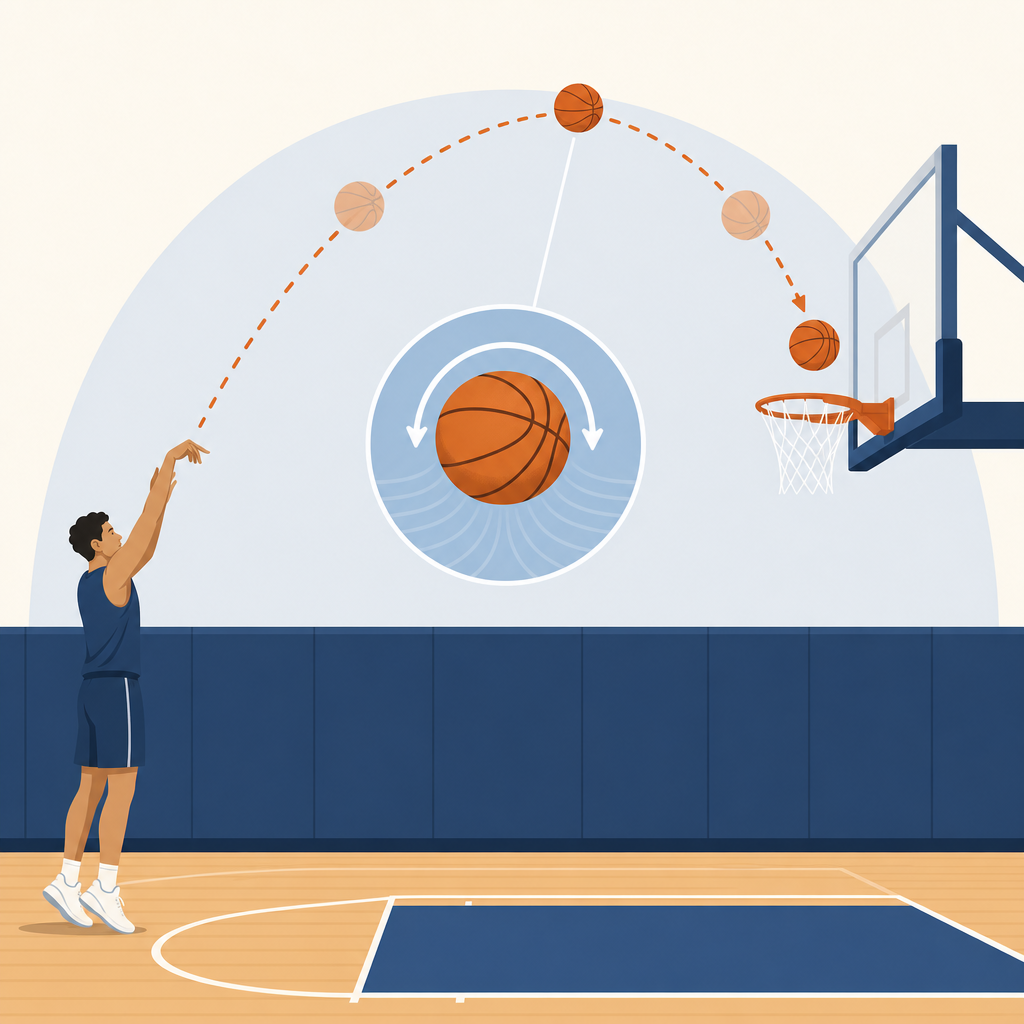
Basketball physics shapes every made shot, whether the player understands the science or only feels it through repetition. In practical terms, arc is the ball’s launch angle relative to the floor, and backspin is the backward rotation created by the fingers as the ball leaves the hand. Those two variables affect entry angle, rim interaction, touch, and the margin for error on every jumper, floater, and free throw. I have seen this firsthand in gym workouts where two players with similar strength and form get very different results because one launches a flatter ball with almost no rotation, while the other produces a cleaner arc and consistent spin. The second shooter usually survives bad days better because the shot gives the rim more ways to help.
This matters because shooting is not just muscle memory. It is a repeatable flight problem governed by gravity, velocity, angle, rotation, and collisions. Coaches often tell players to “put air under it” or “get good rotation,” but those cues only stick when a player knows what they change. A higher arc can increase the effective size of the rim from the ball’s perspective. Backspin can soften contact with the backboard and rim. Together, they influence whether a shot drops cleanly, rattles out, or dies short. For anyone learning basketball basics, understanding these ideas makes skill development faster because mechanics stop feeling random and start feeling measurable.
As a hub for skills explained, this guide covers the core physics behind shot trajectory, release mechanics, touch, and common shooting adjustments. It also connects naturally to related basketball basics topics such as shooting form, footwork, layups, passing spin, rebounding angles, and free throw routine design. If a player, parent, or coach wants one page that explains why the ball behaves the way it does in the air and at the rim, this is that page.
What Arc Really Does to a Shot
Arc matters because it changes the ball’s descent angle as it approaches the rim. A flatter shot enters on a shallower path, which reduces the opening available through the hoop. A steeper shot drops more vertically, effectively creating a larger target window. This is why many elite shooters look effortless even when they shoot from deep: the ball is not only accurate left to right, but also arriving at an angle that gives the rim room to forgive small misses.
The geometry is straightforward. A regulation basketball rim is 18 inches in diameter, while a men’s ball is about 9.5 inches and a women’s ball is about 9 inches. That leaves limited clearance even before angle is considered. When the ball approaches too flat, the front rim becomes a larger obstacle. Raise the entry angle and the available path widens. Research cited by shooting coaches and sport scientists often points to an optimal release neighborhood that produces entry angles around the low-to-mid 40 degree range at the rim, though exact numbers vary by player height, distance, and release point.
In the gym, I usually explain arc using free throws first because they strip away movement. Players who miss long and flat tend to push the ball from the shoulder with a low release. Players who get the ball up and let it descend softly see more friendly bounces. The key is not to chase a rainbow for its own sake. Too much arc can require extra force control and may increase depth inconsistency. Good arc is a balance: high enough to improve the target window, but not so high that distance control becomes unstable.
Why Backspin Changes Rim and Backboard Contact
Backspin matters after release and especially at contact. A well-shot ball usually carries moderate backward rotation, often described by coaches as two to three rotations from shooter to rim on a standard jump shot, though the exact count depends on distance and release speed. That rotation helps the ball behave more softly when it touches iron or glass. On the backboard, backspin can reduce the ball’s forward rebound speed, increasing the chance of a gentle drop. On the rim, it can slightly slow horizontal momentum and create a softer bounce instead of a hard carom.
This is not magic, and it does not mean spin can rescue a badly aimed shot. The effect comes from friction during collision. When a spinning ball meets the rim or backboard, the contact forces interact with the surface differently than they would with a dead ball. In practical terms, the shot tends to look softer. That is why coaches emphasize finishing the release with the fingers and wrist rather than “shot-putting” from the palm. A palm-driven release often produces low spin, side spin, or a wobble, all of which make the ball less stable in flight and less forgiving at contact.
Bank shots are the easiest place to see this. A soft, spinning layup or short banker can kiss the glass and settle. A hard ball with little rotation often rebounds sharply. Tim Duncan built a Hall of Fame scoring package around controlled angles and touch off the backboard, and that touch was inseparable from spin. Youth players also notice it quickly on free throws: the ball with clean rotation tends to hit, pause, and fall more often than the ball that slams and jumps.
The Flight of the Ball: Release Angle, Speed, and Gravity
Every shot is a projectile. Once the ball leaves the hand, gravity pulls it downward at about 9.8 meters per second squared. The shooter controls the initial conditions: release height, release angle, release speed, and spin. Air resistance affects the flight slightly, but for normal basketball distances, the major factors are still the launch variables and the collisions at the end of the flight. This is why shooting coaches obsess over a repeatable release. If those inputs are stable, the outcome becomes more predictable.
Release height is often underrated. A taller player, or any player who shoots from a higher set point, can use a slightly flatter launch than a shorter player and still create a good entry angle because the ball starts closer to rim height. Stephen Curry is a useful example. He does not shoot with exaggerated arc on every attempt, but his release is fast, coordinated, and efficient, letting him optimize angle and speed under pressure. His mechanics are evidence that “high arc” is not a single look. It is a functional result shaped by body type, range, and timing.
For developing players, the biggest mistake is compensating for weak lower-body involvement by forcing the ball with the arms. That usually lowers arc and flattens the shot. Good shooters generate force from the floor, transfer it through the hips and torso, and let the upper body guide direction. When the kinetic chain works, players can shoot with enough lift and spin without heaving the ball. The physics become easier because the body is producing the right launch conditions naturally.
How Mechanics Create Arc and Backspin
Arc and backspin come from mechanics, not from trying to manipulate the ball in midair. The foundational pieces are stance, balance, hand placement, elbow alignment, wrist mobility, and follow-through. A stable base gives the shot a consistent power source. The shooting hand should sit under and slightly behind the ball, while the guide hand stays to the side without adding sideways force. The elbow does not need to be perfectly under the ball in every body type, but it must be aligned enough that force travels toward the basket rather than across the body.
The wrist and fingers create the last contact. When players finish with a relaxed “gooseneck,” the ball usually leaves the pads of the index and middle fingers with clean backspin. If the ball rolls off the ring finger or pinky side, side spin appears and accuracy suffers. I often use slow-motion phone video to show this because players rarely feel side spin accurately in real time. A shot can seem smooth in the hand and still come off crooked. Video exposes whether the ball is centered, whether the guide hand interferes, and whether the shooter is cutting off the follow-through.
Arc also depends on release timing. If the player releases on the way down from the jump, the ball often comes out flatter because the body is losing vertical momentum. Releasing near the top, or slightly before the apex depending on style and game context, makes it easier to maintain touch. This is one reason one-motion shooters often produce natural range and clean trajectory: the upward force flows continuously into the ball instead of stopping and restarting.
Common Shooting Errors and the Physics Behind Them
Most misses tell a physical story. Short misses usually signal insufficient force, but they can also come from excessive arc paired with low speed, where the ball reaches the target line without enough depth. Long misses often come from overpowered legs or a push from the shoulder. Left-right misses frequently trace back to alignment, guide-hand interference, or thumb flick. Flat shots create more front-rim misses because the ball arrives with less clearance above the iron. Wobbling shots often reveal off-center release and inconsistent finger pressure.
Players also confuse “good touch” with shooting soft at all costs. Soft touch means controlled energy at the rim, not weak force from the hand. The best shooters are precise with speed. They know that a three-pointer cannot float aimlessly; it must carry enough velocity to reach the basket on line while still descending with useful arc. That precision is why shot quality drops when fatigue hits. Tired legs reduce lift, forcing compensations from the upper body, and the ball starts coming out flatter with less spin.
| Observed miss | Likely physics problem | Typical mechanical cause | Practical correction |
|---|---|---|---|
| Front rim | Low arc or low speed | Pushing from shoulder, poor leg drive | Use legs first, release earlier, finish high |
| Back rim | Excess speed or depth | Overpowered upper body, drifting forward | Stabilize base, reduce arm force, hold follow-through |
| Miss left or right | Side force on release | Guide-hand interference, thumb flick | Center the ball, quiet guide hand, check elbow path |
| Hard bounce off glass | Low backspin, high impact speed | Palm release, stiff wrist | Let ball roll off fingers, relax wrist snap |
How Players and Coaches Can Train These Variables
The best way to train arc and backspin is to make them visible and repeatable. Start close to the rim with one-hand form shooting. The goal is not makes alone, but a clean launch, centered rotation, and a soft descent. From there, step back gradually while preserving the same release quality. This progression teaches players to add power from the lower body instead of changing the hand action. It is one of the most effective basketball basics drills because it links feel to flight.
Technology helps, but it is not mandatory. Noah Basketball systems track arc, depth, and left-right accuracy in real time, giving objective feedback that many colleges and pro programs use. HomeCourt and other video tools can support self-review. Even without tech, a coach can stand to the side and watch entry angle, count visible rotations, and note whether the ball hits the rim softly. The standard matters more than the tool: measure the flight, not just the result.
Constraints also work well. Put a visual target on the back rim mentally, ask the shooter to clear the front rim with visible space, or use a floor marker to check whether drift changes the release. For backspin, listen as much as you look. Clean shots often sound different, especially on the glass. Over time, players build calibration. They stop guessing whether a shot felt right and begin identifying what the ball actually did.
Where This Fits Within Basketball Basics and Skills Explained
Understanding basketball physics turns shooting from a mystery into a connected skill tree. Arc and backspin tie directly to shooting form, footwork into the shot, balance on the catch, finishing at the rim, and free throw consistency. They also support smarter rebounding and defense. Rebounders read trajectories differently when they know how a flat shot comes off compared with a soft, high-entry shot. Defenders contest more effectively when they understand how release point and angle change the window a shooter sees.
That is why this page works as a hub for skills explained. A player studying layups should also study spin off the glass. A player learning pull-up jumpers should understand how speed into the shot changes release angle. A beginner working on chest passes can benefit from the same basic idea that spin stabilizes flight. Basketball skills are often taught in separate drills, but on the court they operate under the same physical rules. When players grasp those rules, improvement becomes faster and more durable because each drill reinforces the next.
The central lesson is simple: good shooters do not rely on luck. They create favorable physics. They launch the ball on a useful arc, impart clean backspin, and repeat those patterns under fatigue and pressure. If you want to improve your jumper, start paying attention to the ball’s flight, not just whether it went in. Film your release, watch the entry angle, study the spin, and build from close range outward. That approach will sharpen every shooting skill you develop next.
Frequently Asked Questions
Why does arc matter so much on a basketball shot?
Arc matters because it directly changes how big the basket effectively plays. A higher shot reaches the rim at a steeper entry angle, which gives the ball more usable space to drop through the hoop. When the ball comes in too flat, it has less room for error because it approaches the front and back of the rim on a shallower line. Even a well-aimed shot can be punished if the angle is too low. By contrast, a properly arced shot increases the chance of a clean make, a soft bounce, or a favorable rim roll.
From a physics standpoint, arc is tied to launch angle, release speed, and release height. Players do not need to calculate those numbers in real time, but they absolutely feel the results. A shot with good arc usually looks effortless because the player is matching force and angle efficiently. That is why coaches often talk about “getting the ball up” without wanting the player to simply heave it. The goal is not a rainbow for its own sake. The goal is a repeatable trajectory that improves entry angle while still preserving control, rhythm, and range.
In real gym workouts, this is easy to spot. Two players with similar strength can have very different shooting results because one creates a cleaner, more forgiving arc. The flatter shooter may hit hard misses and need perfect accuracy to score consistently. The player with better arc often gets softer misses, kinder bounces, and a larger practical margin for error. Over the course of a game or season, that difference adds up.
What does backspin actually do when the ball reaches the rim or backboard?
Backspin helps the ball behave more softly when it contacts the rim, backboard, or even the net. When a ball rotates backward, some of its energy is managed in a way that reduces the harshness of the bounce compared with a dead ball or one with the wrong spin. That softer interaction is one reason good shooters seem to get “friendly” rolls. The ball is not magically attracted to the basket, but the spin changes the nature of the contact in a very useful way.
On the rim, backspin can slightly slow the forward motion of the ball at impact, which can make misses less violent and give the shot a better chance to settle in. On the backboard, especially on floaters, bank shots, and certain free throw line extended angles, backspin helps the ball rebound more gently toward the hoop instead of shooting away from it. This is why touch shooters and skilled finishers pay so much attention to fingertip control and follow-through. They are not just aiming the ball; they are shaping how it will react if it does not go straight in.
Backspin also reflects sound mechanics. It usually comes from a clean release off the shooting hand and fingers rather than a push from the palm. When the ball leaves the hand smoothly, with the wrist snapping through and the fingers finishing down, the shot tends to have more consistent rotation. That consistency matters because predictable spin leads to more predictable misses, and predictable misses are easier to correct in practice.
Is there such a thing as too much arc or too much backspin?
Yes. More is not always better. Arc and backspin help shooting only when they are within a useful, controllable range. Too much arc can make a shot harder to regulate because the player may need to apply extra force inefficiently, causing inconsistency in distance and timing. Extremely high shots also spend more time in the air, which can make them easier to contest and harder to repeat under pressure. The best shooters are not chasing exaggerated height. They are searching for an optimal window where the ball enters steeply enough to help, but not so steeply that the motion becomes unstable.
The same is true with backspin. Clean backspin is valuable, but excessive spin can sometimes signal that the player is overemphasizing the wrist or manipulating the release unnaturally. If the ball is spinning wildly, the issue may not be “great touch” at all. It may indicate poor hand placement, unnecessary tension, or a release that changes from shot to shot. In most cases, effective backspin should look natural and controlled, not forced.
What players want is balance. Good shooting mechanics blend alignment, rhythm, release angle, and spin. If one part becomes exaggerated, the rest of the shot often suffers. That is why elite shooters usually look simple rather than dramatic. Their arc is high enough to create a favorable entry angle, and their backspin is strong enough to soften contact, but neither variable overwhelms the shot.
How do arc and backspin affect free throws, floaters, and jump shots differently?
The underlying physics stay the same, but the importance of arc and backspin shows up a little differently depending on the shot type. On free throws, players have the luxury of a fixed distance, no defender, and a repeatable routine, so arc and backspin become especially visible. A good free throw usually has enough arc to let the ball descend softly and enough backspin to produce a forgiving bounce if it catches rim. Because conditions are stable, small improvements in trajectory and rotation can dramatically improve percentage over time.
On floaters, arc becomes critical because the shot must travel over help defenders while still dropping softly into a tight target area. A flat floater often gets blocked or hits too hard. A well-arched floater can clear the defense and land with touch. Backspin matters here too, especially when the shot catches the front rim or kisses the glass. Skilled guards rely on that soft spin to turn difficult in-between attempts into controllable scoring shots.
On jump shots, especially from midrange and three-point distance, arc and backspin must work together with power generation. The shooter needs enough lift on the ball to create a favorable entry angle, but not so much that the shot loses line or range. Backspin helps maintain touch and rim friendliness, but the biggest challenge is preserving those qualities when speed, fatigue, and defensive pressure increase. That is why practice matters so much. Players are training not just to “make shots,” but to reproduce the same launch conditions across many game situations.
How can a player improve arc and backspin without overthinking the science?
The best approach is to use the science as a guide, not as something to obsess over during every rep. Players improve arc and backspin through simple habits: balanced footwork, a consistent set point, relaxed hands, a smooth upward motion, and a clean follow-through. If the shot starts from a stable base and finishes with the wrist and fingers naturally extending through the ball, useful arc and backspin tend to appear on their own. Most players do better with a few clear cues than with a list of technical calculations.
Helpful coaching cues include “finish high,” “shoot the ball up, not out,” “hold your follow-through,” and “let the ball roll off your fingers.” Video can also be valuable because arc and spin are easier to judge when the player sees the shot from the side and from behind. Slow-motion clips often reveal whether the ball is coming off the hand cleanly, whether the release is too flat, or whether the player is pushing the ball instead of shooting it. That kind of feedback makes adjustment easier and more objective.
Drills can reinforce these habits. One-hand form shooting encourages a clean release and true backspin. Close-range swishes help players feel proper trajectory without forcing distance. Free throw routines build repeatability. Target-based shooting over a raised obstacle can improve arc. The key is repetition with awareness. Players do not need a physics lecture before every workout, but understanding why arc and backspin matter can make each rep more purposeful. Over time, that blend of feel and science is what turns decent shooters into reliable ones.