
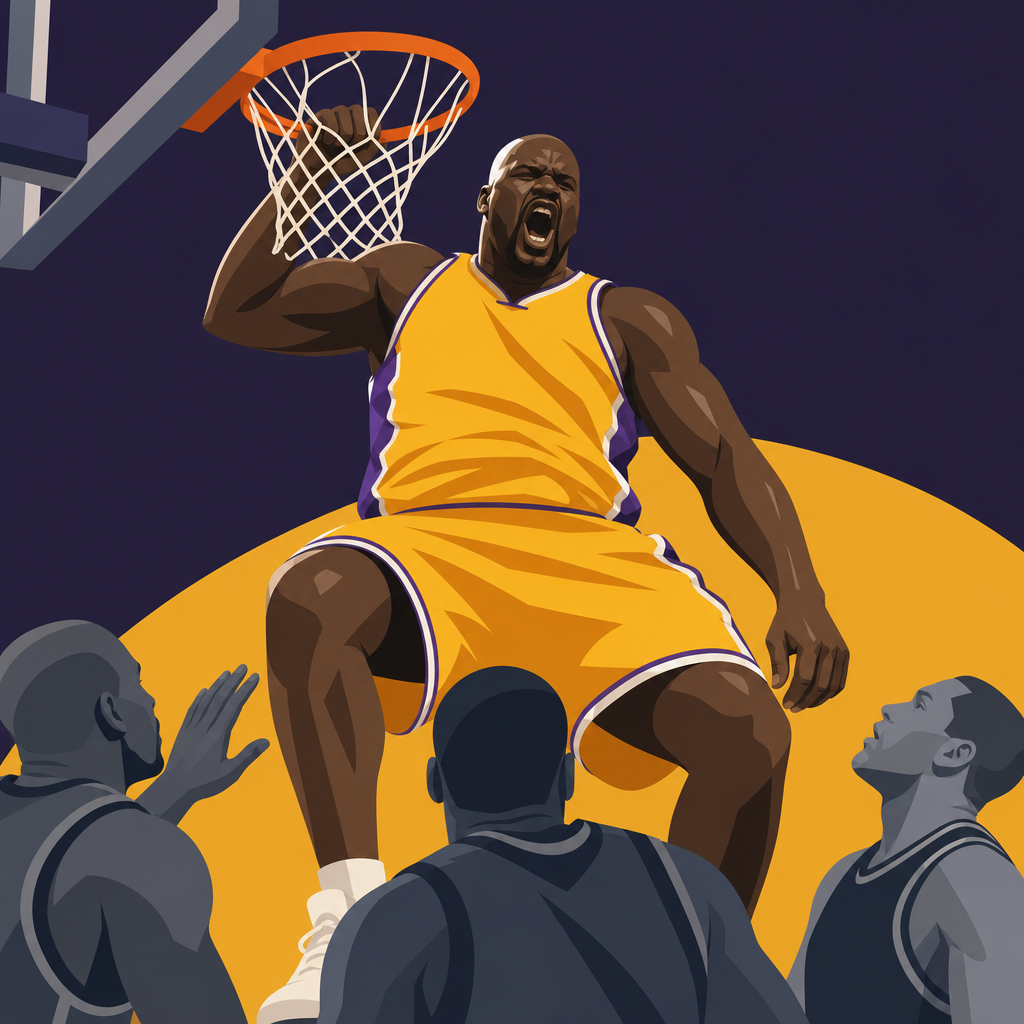
Shaquille O’Neal at his peak was not simply a great center; he was a force that bent the geometry, pace, and psychology of an NBA game. Any serious player profile of peak Shaq has to start with definitions. “Dominance” in basketball is not just scoring volume. It includes efficiency, foul pressure, rebounding control, rim protection, matchup distortion, and the ability to force coaches into strategies they would never otherwise choose. “Unstoppable” does not mean a player scores every possession. It means opponents understand what is coming, throw multiple counters at it, and still fail often enough that the player remains the central fact of the game. By that standard, Shaquille O’Neal has one of the strongest cases ever.
This matters because discussions about the best NBA players often flatten eras and styles into highlight clips or ring counts. A proper player profile asks harder questions: What translated nightly? What held up in playoff basketball? What tools did defenses actually have? I have spent years studying playoff tape, possession data, and coaching adjustments, and peak Shaq stands out because his pressure points were constant. He generated deep post seals before help arrived, punished single coverage with power finishes, and forced weak-side rotations that opened clean looks for guards and shooters. Even when his free-throw shooting created a vulnerability, the tradeoff was usually worth it because his interior efficiency and foul creation overwhelmed the downside.
Peak Shaq also anchors the broader “NBA Players” conversation because he is a reference point for player evaluation. When analysts discuss gravity, physical scalability, scheme dependency, and postseason portability, they are often describing concepts that Shaq embodied in extreme form. His best seasons with the Los Angeles Lakers, especially from 1999-2000 through 2001-02, produced a version of offensive control that few players in league history can match. He combined size listed at 7-foot-1 and well over 300 pounds with uncommon footwork, soft touch around the rim, and explosive second jumps. That blend is why his profile remains essential for anyone comparing all-time peaks across positions and eras.
The physical toolkit that broke conventional defense
Most giant centers have one or two elite physical traits. Shaq had several that mattered simultaneously. He had overwhelming mass, but he was not a stationary bruiser. Early Lakers-era Shaq ran the floor hard, established post position in transition, and could spin baseline before the second defender fully committed. He had unusually nimble feet for his size, broad shoulders that displaced defenders legally or near-legally, and strong hands that secured difficult entry passes. On film, one of the most important details is how early the possession was often won. By the time the pass arrived, the defender was already under the rim or leaning the wrong direction.
That distinction explains why many strong centers still failed against him. Traditional post defense teaches a big man to push the scorer off the block, absorb contact, and force a turnaround. Against Shaq, even a quality initial stance could collapse once he got his hips aligned. If he caught the ball within eight feet, the possession usually shifted from “guard the move” to “survive the impact.” Teams tried fronting, three-quarter denial, immediate doubles from the top, and baseline traps. None solved the root problem: his catch radius and sealing power made entry denial difficult, while his passing improved enough that reckless doubles were punished.
His physical dominance also extended to rebounding. Missed shots against Shaq often turned into second-chance points because he moved bodies simply by pursuing position. Offensive rebounds are not just extra possessions; they are emotional drain. Defenses that had worked for 20 seconds still gave up a dunk or free throws. That repeated strain changed lineup choices. Coaches played larger centers they might not otherwise trust, used extra fouls from reserve bigs earlier than planned, and accepted slower offensive groups just to survive interior contact. Very few stars force that many roster-level concessions.
Why the Lakers’ offense made him even harder to contain
Shaq’s peak did not happen in isolation. The triangle offense under Phil Jackson and Tex Winter gave structure to his dominance without reducing him to static post-ups. In common memory, the Lakers simply dumped the ball inside and watched him overpower people. In reality, their spacing, cutting, and weak-side timing mattered. The triangle created clear passing angles from the wing, occupied help defenders with split action, and let Shaq catch closer to his preferred spots. Because the offense did not require heavy dribbling to initiate, the ball reached him before the defense fully loaded the paint.
Kobe Bryant’s growth was equally important. He punished defenses that overcommitted to Shaq, especially when doubles came late. If the strong-side defender dug down, Bryant could attack closeouts. If the weak-side low man rotated early, perimeter shooters and cutters found openings. This is one reason peak Shaq should be understood as a scalable superstar. He did not need heliocentric usage in the modern sense. He could dominate the possession while still fitting within a system that generated efficient shots for others. The defense had to choose between a deep-post avalanche and clean perimeter offense flowing out of help.
From my review of playoff possessions, the underrated feature of those Lakers teams was tempo control. Shaq could run enough to create early seals, then slow the game once the ball entered the post. That duality exhausted opponents. Bigs had to sprint back to protect the rim, wrestle with him in the half court, and avoid foul trouble, all while staying engaged on the glass. Over a seven-game series, that wear showed up in smaller details: late box-outs, softer doubles, less resistance at the nail, and more transition opportunities for Los Angeles after misses or turnovers forced by interior panic.
The playoff evidence behind the “most unstoppable” argument
Regular-season dominance matters, but the strongest case for Shaq comes from the playoffs, where scouting sharpens and weaknesses are targeted. In the 2000 NBA Finals against Indiana, O’Neal averaged 38.0 points, 16.7 rebounds, and 2.7 blocks. The Pacers were not careless; they mixed Rik Smits, Dale Davis, and help looks, but none could keep him from reaching his launch points. In the 2001 Finals against Philadelphia, with Dikembe Mutombo fresh off Defensive Player of the Year honors, Shaq averaged 33.0 points and 15.8 rebounds. In the 2002 Finals versus New Jersey, he put up 36.3 points, 12.3 rebounds, and 2.8 blocks. Those are not good numbers. They are era-defining numbers against championship-level preparation.
The broader playoff run from 2000 through 2002 is just as compelling. During that three-peat, the Lakers went 45-13 in postseason games. Shaq was the central pressure source in every series because opponents had no stable answer at the rim. Even when teams used intentional fouling, the tactic worked more as a speed bump than a shutdown method. “Hack-a-Shaq” lowered efficiency in certain stretches, but it also put opponents into rigid game scripts and could disrupt their own rhythm. Many teams lacked the depth to keep fouling large bodies through six or seven games while still defending competently in live action.
| Finals Year | Opponent | Points Per Game | Rebounds Per Game | Notable Context |
|---|---|---|---|---|
| 2000 | Indiana Pacers | 38.0 | 16.7 | Controlled paint against multiple veteran bigs |
| 2001 | Philadelphia 76ers | 33.0 | 15.8 | Dominated against Mutombo, reigning top rim protector |
| 2002 | New Jersey Nets | 36.3 | 12.3 | Ended series with total interior command |
What makes this evidence especially strong is the consistency of the mechanism. Shaq was not riding unsustainable jump shooting or matchup luck. He won with paint catches, drop-steps, jump hooks, put-backs, duck-ins, and transition seals. Those actions are among the most stable playoff scoring sources because they depend on leverage, timing, and force rather than touch variance alone. That is why the “unstoppable” label holds up under pressure. Everyone knew the menu. Stopping it was still a different matter.
The weaknesses in his profile and why they did not cancel the dominance
No honest player profile should ignore limitations. Shaq was a poor free-throw shooter for most of his career, finishing at 52.7 percent. That invited late-game hacking and reduced lineup flexibility in certain situations. He could also be less effective when pushed into high pick-and-roll coverage, especially as he aged and conditioning fluctuated. In some regular seasons, his focus and fitness were uneven by the standards of the very greatest all-time peaks. Those critiques are real and belong in any balanced assessment.
But the key question is whether those weaknesses outweighed the advantages at his apex. They did not. His true shooting remained strong because he finished so efficiently near the basket and generated so many fouls. He routinely placed opposing frontcourts under immediate pressure, changing substitution patterns by the second quarter. On defense, while he was not a switch big in a modern sense, peak Shaq still provided meaningful rim deterrence simply by occupying space and contesting with size. He was not an all-scheme defender, but he was far from a one-way player.
It is also important to separate career longevity debates from peak-value debates. If the question is who had the longest run of perimeter scalability, other names enter strongly. If the question is whose absolute best version was hardest to neutralize with era-appropriate defenses, Shaq rises quickly. His flaws were visible, yet coaches still spent entire series reacting to him rather than dictating terms. That is the signature of a historically dominant player.
How peak Shaq compares with other all-time offensive forces
Comparisons with Michael Jordan, LeBron James, Kareem Abdul-Jabbar, Wilt Chamberlain, and Stephen Curry require care because “unstoppable” appears in different forms. Jordan overwhelmed defenses with shot creation from the mid-post and relentless scoring versatility. LeBron combines downhill force with elite passing. Kareem had the skyhook, perhaps the most reliable individual shot ever. Curry breaks defensive spacing itself. Shaq’s case is narrower but more extreme: he may have been the most inevitable interior scorer at peak force the league has seen in the modern televised era.
Against single coverage, his efficiency profile was devastating. Against doubles, he created high-value shots for teammates. Against small-ball counters, he crushed the glass and lived at the rim. Unlike perimeter stars, he did not need a hot shooting night to bend the defense. His pressure was built into his body, positioning, and touch. That made his baseline level of dominance unusually stable. The modern game’s spacing might create even cleaner entry angles for a player like him, though defensive three seconds and quicker rotations would add different complications.
My conclusion from studying elite player profiles is simple: peak Shaq had one of the highest “answer this or lose” burdens ever placed on an opponent. Few stars forced such immediate physical compromise while also sustaining championship-level offense. Whether someone ranks him first, second, or fifth all time, the evidence supports the main point. Peak Shaquille O’Neal was not just dominant for his era; he represented a version of basketball power that made fully prepared defenses look temporary. For anyone building out an NBA Players hub, his profile is essential because it clarifies how greatness can look when strength, skill, system fit, and playoff translation all align. Revisit the film, the numbers, and the matchup history, and the conclusion remains hard to escape: peak Shaq may have been the most unstoppable player ever.
Frequently Asked Questions
What made peak Shaquille O’Neal feel more “unstoppable” than other all-time great scorers?
What separated peak Shaquille O’Neal from most legendary scorers was that his dominance was not based on hot shooting, rhythm, or difficult shot-making. It was rooted in physical inevitability. At his best, Shaq generated offense from areas of the floor where defenses are most vulnerable: deep post position, the restricted area, and offensive rebounding space. Once he caught the ball close to the rim, many possessions were effectively over. Defenders often could not move him off his line, could not challenge him vertically without risking contact, and could not recover once he gained leverage.
That is a major distinction. Many elite scorers are unstoppable in the sense that they can make contested shots anyway. Peak Shaq was unstoppable because he made it extraordinarily hard to force him into contested shots in the first place. He collapsed the geometry of the court. Help defenders had to sink earlier and more aggressively, weak-side rotations had to cheat toward the paint, and entire defensive schemes became preoccupied with preventing one player from catching the ball where he wanted it. That opened passing lanes, rebounding lanes, and cleaner perimeter looks for teammates.
His dominance also came with relentless foul pressure. Even when teams prevented a dunk, they often did so by sending him to the line, which still put opposing frontcourts in danger of foul trouble. Backup centers were forced into larger roles, rotations changed, and coaches had to abandon preferred lineups simply to put enough size on the floor. That kind of strategic distortion is a strong marker of true dominance. Peak Shaq did not just score a lot; he forced defenses into choices they did not want to make, and he did it night after night against opponents who knew exactly what was coming.
How should “dominance” be defined when evaluating peak Shaq?
Dominance in basketball should be defined broadly, especially in the case of a player like Shaq. It is not just about points per game. A truly dominant player controls possessions and dictates terms. For peak Shaq, that meant elite interior scoring efficiency, huge foul pressure, overwhelming offensive rebounding presence, strong defensive rebounding, credible rim protection, and the ability to warp matchups so severely that opposing coaches changed their game plans around him.
That wider definition matters because Shaq’s impact was cumulative and systemic. He did not need to score on every trip to dominate a game. If he forced a double-team, that was dominance. If he drew two early fouls on the opposing starting center, that was dominance. If he made a team play a slower, bigger lineup than it wanted to, that was dominance. If he created second-chance points through offensive boards or took away easy paint attempts on the other end, that was part of the same overall control.
Dominance also includes psychological pressure. Opponents entered games knowing they would absorb contact, lose ground in the post, and spend forty-eight minutes trying to solve a problem with no ideal answer. That mental burden affects execution. Guards hesitate on entry passes, bigs overhelp, teams rush their offense after physical defensive possessions, and coaching staffs become reactive rather than proactive. Peak Shaq was dominant because he influenced nearly every layer of the game: tactical, physical, statistical, and emotional. That is a much richer and more accurate way to understand his peak than simply looking at raw scoring totals.
If Shaq had weaknesses, why is he still described as nearly impossible to stop at his peak?
The key is understanding what “unstoppable” really means in basketball. It does not mean flawless. It does not mean a player has no weaknesses. In Shaq’s case, the obvious counterpoint is free-throw shooting. Teams certainly tried to exploit that, and at times they preferred sending him to the line over allowing dunks or deep post finishes. But even that strategy shows how extreme his interior pressure was. Opponents were often reduced to choosing the least damaging bad option rather than finding a genuinely effective answer.
His weaknesses existed, but they rarely eliminated his central advantage. If a defender played him one-on-one, he could power through, seal deeper, or finish with touch near the rim. If teams doubled, he could create open shots by forcing the defense to collapse. If they fronted the post, his size and strength still made him a dangerous target on lobs, seals, and offensive rebounds. If they fouled him, they risked team foul accumulation, disrupted rotations, and tired out already overmatched big men. Even a “successful” defensive possession against peak Shaq often came at a cost.
That is why the word nearly matters. Shaq was not literally scoring every possession, and no player does. The point is that defenses could not remove his influence from the game. They could only redirect it. If they took away one outcome, he often produced another: fouls, rotations, kick-outs, put-backs, or lineup stress. His vulnerabilities were real, but they did not outweigh the sheer force of what he imposed. In practice, that made him feel less like a star you could contain and more like a problem you could only manage imperfectly.
How did peak Shaq change the way opposing teams built and used their rosters?
Peak Shaq had one of the rarest effects a single player can have: he influenced roster construction across the league. Teams did not just prepare for him with a normal scouting report; they often carried extra size specifically because they knew they would need multiple large bodies to absorb minutes against him. Traditional centers who might have seemed limited in other matchups suddenly had value because they could provide six hard fouls, physical resistance, or at least temporary bulk in the post.
This impact showed up in game planning as well. Coaches frequently used more conservative defensive principles around the paint, sent earlier help, and adjusted substitution patterns to preserve fouls for big men. In some cases, teams tolerated lineups that were worse offensively or less mobile defensively simply because they needed size against Shaq. That tradeoff is important. When one player pushes opponents into less efficient versions of themselves, he is creating an advantage before the box score even starts to fill.
There was also a chain reaction effect. Bigger lineups can reduce spacing, slow transition defense, and make perimeter coverages less flexible. Extra help on the post can give shooters cleaner looks. More fouls on centers can force smaller players to overhelp in rebounding situations. All of that stems from one source: the need to survive Shaq’s interior force. This is why discussions of his dominance should go beyond highlights and counting stats. The true scale of his impact includes the strategic compromises he forced on entire organizations, not just the defenders standing in front of him on a given possession.
Where does peak Shaq rank in the debate over the most dominant player ever?
Peak Shaq belongs at or near the very top of that conversation because his dominance was both overwhelming and uniquely direct. Basketball has seen many all-time great offensive engines, but not many players who could consistently create high-efficiency offense through raw interior force while simultaneously reshaping the opponent’s entire structure. His best seasons and playoff runs combined scoring volume, elite efficiency near the basket, huge foul generation, rebounding strength, and an ability to command help that few players in history have matched.
The argument for Shaq becomes especially strong when the question is framed around “most unstoppable” rather than “greatest overall career” or “most complete player.” Those are different debates. Shaq had limitations, and other legends offered broader shooting range, more perimeter creation, or more defensive versatility. But if the focus is on who placed defenses in the most impossible no-win scenarios at their peak, Shaq has an exceptionally powerful case. He forced teams into hard doubles, emergency fouls, oversized lineups, and constant paint concessions, often all within the same game.
Ultimately, ranking him depends on the criteria being used, but under any definition centered on pressure, inevitability, and matchup distortion, peak Shaq is firmly in the inner circle. He was not simply productive. He was disruptive to the logic of normal defense. That is what made him feel historic. Opponents knew what he wanted to do, designed entire plans to stop it, and still often could not prevent him from controlling the game. That combination of predictability and helplessness is exactly why so many analysts and fans regard peak Shaquille O’Neal as one of the most dominant, and perhaps the most unstoppable, players the sport has ever seen.