
The greatest NBA dynasties are more than championship counts; they are sustained systems of dominance that define eras, reshape tactics, and create the legends fans use to measure every later contender. In NBA history, a dynasty usually means a team that wins multiple titles within a compressed window, returns to contention year after year, and leaves a strategic or cultural imprint that outlasts its roster. That definition matters because not every champion becomes a dynasty. Some teams catch a favorable playoff bracket, peak for one unforgettable spring, then fade. Dynasties are different. They survive injuries, adapt to rule changes, replace role players, and continue winning under the pressure that comes from being every opponent’s measuring stick.
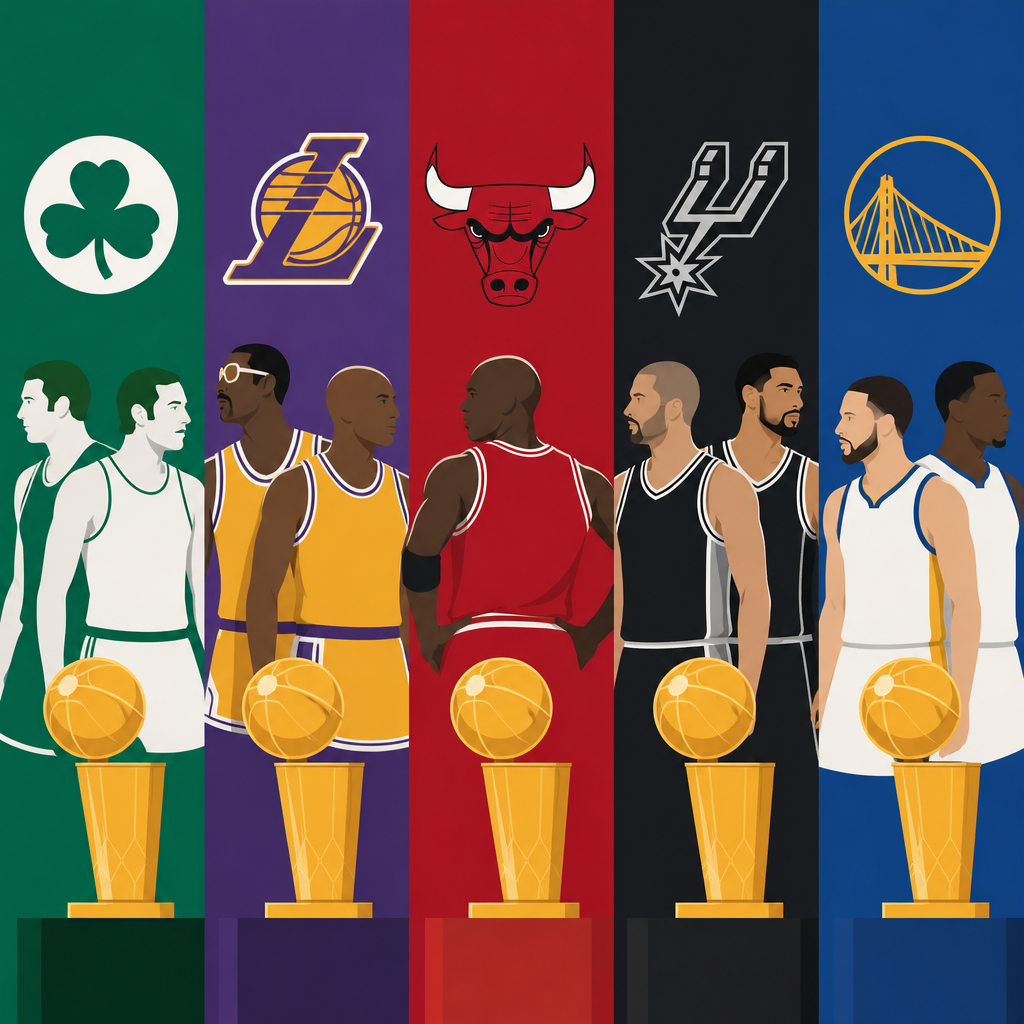
This article ranks five franchises that best meet that standard: the Celtics, Lakers, Bulls, Spurs, and Warriors. Together they span nearly the full modern history of the league, from the early television age to the three-point revolution. They also anchor the broader “Legends and Eras” conversation inside NBA History because each dynasty produced defining stars, iconic coaches, and signature styles of play. When I compare dynasties, I look at four factors I have always used when building historical tiers: total titles, peak level, longevity, and influence on how basketball is played and discussed. Context matters too. Winning eight straight in a smaller league is not the same challenge as surviving modern free agency, salary-cap restrictions, and global player movement, but earlier eras should not be dismissed simply because the game looked different.
Fans often ask direct questions that deserve direct answers. Which NBA dynasty was the most dominant at its peak? Michael Jordan’s Bulls have the strongest short-run case because they never lost an NBA Finals and completed two separate three-peats. Which lasted the longest while staying elite? The Spurs are unmatched for sustained relevance across nearly two decades. Which changed the sport the most? The Warriors transformed spacing and shot selection, while the Showtime Lakers redefined pace and entertainment. Which won the most? The Bill Russell Celtics remain the standard for championship volume. Ranking them requires balancing accomplishment against competitive environment, and that is why this comparison is still debated by historians, analysts, and former players.
As a hub page for Legends and Eras, this guide also helps frame related topics: Russell versus Chamberlain, Magic versus Bird, Jordan’s 1990s supremacy, Tim Duncan’s model of sustainable excellence, and Stephen Curry’s impact on modern offense. Those subjects deserve their own deep dives, but the dynasty lens ties them together. Teams are where eras become tangible. A dynasty shows how a front office drafts, how a coach teaches, how stars coexist, and how role players execute under playoff pressure. If you want to understand NBA history efficiently, start with the dynasties, because they reveal what winning looked like in each age and why certain names still carry unmatched weight across generations.
1. Boston Celtics: the benchmark for championship dominance
The Boston Celtics rank first because no dynasty in North American team sports matches the sheer championship compression of the Bill Russell era. From 1957 through 1969, Boston won 11 titles in 13 seasons, including eight straight from 1959 to 1966. Russell anchored the defense, Red Auerbach built the culture, and the roster repeatedly featured Hall of Fame talent such as Bob Cousy, John Havlicek, Sam Jones, K.C. Jones, and Tom Heinsohn. The defining fact is simple: when the pressure was highest, Boston almost always finished the job. Russell went 10-0 in winner-take-all games, a statistic that captures the Celtics’ composure as well as their talent.
Context is essential. The league was smaller, playoff rounds were fewer, and talent concentration was different from today. Those realities make direct comparison difficult, but they do not erase the achievement. Boston’s dominance was not just offensive firepower; it was a repeatable formula built on elite team defense, rebounding, and transition play generated by stops. Russell’s value is often misunderstood by fans who look first at scoring totals. He was the defensive system. He protected the rim, controlled possessions, and ignited the fast break with quick outlet passes, concepts modern analysts can easily connect to impact beyond points per game. That is why the Celtics dynasty remains the historical benchmark even as later teams faced more complex league structures.
2. Los Angeles Lakers: multiple dynasties, unmatched star power
The Lakers rank second because they produced more than one authentic dynasty and because their best runs combined titles with enormous influence on the league’s popularity. Minneapolis began the story with George Mikan, but the franchise’s strongest claim comes from Los Angeles. The 1980s Showtime Lakers won five championships in nine seasons behind Magic Johnson, Kareem Abdul-Jabbar, James Worthy, and coach Pat Riley. Their style was instantly recognizable: defensive rebound, outlet, lane-filling wings, and a fast break executed with uncommon precision. In practical basketball terms, Showtime proved that pace, size, and creativity could coexist without sacrificing efficiency or postseason toughness.
The Lakers’ case is also strengthened by continuity across eras. After Showtime, the franchise assembled another dynasty from 2000 to 2002, when Shaquille O’Neal and Kobe Bryant led a three-peat under Phil Jackson. Those teams were different from the 1980s versions. They played through interior force, half-court execution, and playoff matchup pressure, especially when O’Neal bent entire defenses around the paint. If this ranking counted total franchise dynastic windows rather than selecting one composite historical profile, the Lakers might be first. I place them second because their greatest eras were separated rather than uninterrupted, but no franchise better represents star power translating into banners across generations.
| Dynasty | Core championship window | Titles in window | Signature identity |
|---|---|---|---|
| Celtics | 1957–1969 | 11 | Defense, rebounding, ruthless consistency |
| Lakers | 1980–1988; 2000–2002 | 8 | Showtime pace; later interior dominance |
| Bulls | 1991–1998 | 6 | Wing excellence, triangle offense, clutch execution |
| Spurs | 1999–2014 | 5 | System continuity, defense, ball movement |
| Warriors | 2015–2022 | 4 | Spacing, shooting gravity, switching versatility |
3. Chicago Bulls: the most perfect peak
The Bulls rank third, but if the question is “Who had the cleanest peak résumé?” Chicago may be first. From 1991 to 1998, the Bulls won six championships in six Finals appearances, interrupted only by Michael Jordan’s retirement and brief baseball detour. They completed two three-peats, something no team besides the Russell Celtics has done. Jordan was the central reason, yet reducing the dynasty to one player misses how complete the machine became. Scottie Pippen gave them an elite secondary creator and defender. Phil Jackson installed the triangle offense, which balanced structure with read-and-react spacing. Role players such as Horace Grant, Dennis Rodman, Steve Kerr, Ron Harper, Toni Kukoc, and Luc Longley filled precise functions around the stars.
What separated the Bulls was their ability to win in multiple ways without sacrificing identity. Early titles leaned more on transition force and slashing pressure. The second three-peat featured a more methodical attack, post entries, mid-post isolations, and a defense that could smother opponents late in games. In my experience reviewing Finals tape, the Bulls’ psychological edge stands out almost as much as the scheme. Opponents entered series believing they needed near-perfect execution to survive Jordan’s closing shot creation. Chicago also excelled in the possession game: limiting turnovers, controlling tempo, and forcing difficult looks in the final six minutes. Their only weakness in this ranking is shorter duration than Boston or San Antonio.
4. San Antonio Spurs: the model of sustainable excellence
The Spurs rank fourth, and they are the dynasty executives most often cite when discussing sustainable team building. From 1999 through 2014, San Antonio won five championships and reached the playoffs every year, an astonishing feat in an era shaped by deeper talent pools, stronger conference competition, and increasing roster churn. Tim Duncan was the foundation, pairing all-time defensive value with low-maintenance offensive efficiency. David Robinson helped launch the first title, then Tony Parker and Manu Ginobili extended the window, while Gregg Popovich evolved from defense-first disciplinarian to one of the most flexible tacticians in league history.
San Antonio’s greatness lies in adaptation. The 1999 and 2003 teams were built more around size, rim protection, and deliberate execution. By 2005 and 2007, Parker’s penetration and Ginobili’s improvisation gave the offense more dynamism. Then came 2014, a title run many coaches still reference as a clinic in spacing, extra passing, and decision speed. That version of the Spurs dismantled Miami with beautiful ball movement, but it was not a sudden invention; it was the final stage of a 15-year evolution. The Spurs never felt flashy in the way the Lakers or Warriors did, yet they were brutally effective. Their case against teams ranked higher is simple: unmatched consistency over time, even without a long uninterrupted streak of titles.
5. Golden State Warriors: the dynasty that changed modern offense
The Warriors rank fifth, though their historical importance may rise with time because their style has already changed basketball at every level. From 2015 to 2022, Golden State won four championships, reached six Finals in eight seasons, and posted one of the most dominant regular seasons ever at 73-9 in 2015-16. Stephen Curry is the engine of the dynasty, not just because of his shooting percentages, but because of his gravitational effect. Defenses stretch far beyond the arc to track him, opening driving lanes and weak-side cuts before the possession appears to start. Klay Thompson provided complementary shot-making and perimeter defense, Draymond Green quarterbacked the back line, and Steve Kerr blended motion principles with read-based freedom.
The Warriors are the clearest example of a dynasty changing how the sport is played. Their success accelerated the league-wide shift toward high-volume three-point shooting, versatile defenders, and lineups that prioritize spacing over traditional size. The “Death Lineup,” with Green at center, showed that switching, speed, and decision-making could overwhelm bulk in many playoff matchups. The Kevin Durant years added an almost unfair scoring safety valve, but Golden State’s legitimacy does not depend on those titles alone. The 2015 championship and 2022 title, won with different supporting casts, prove the core system traveled across phases. Their challenge in all-time rankings is total count. Four championships are extraordinary, yet Boston, Los Angeles, Chicago, and San Antonio each built either longer or larger title portfolios.
How these dynasties compare across eras
Cross-era ranking is difficult because the NBA kept changing around these teams. Expansion altered talent distribution. The introduction of free agency and the salary cap changed roster control. Illegal defense rules, hand-check enforcement, and the three-point line reshaped offensive geometry. Travel, sports science, and global scouting improved player quality and depth. These variables mean no single metric can settle the debate. Still, useful principles exist. Championship volume rewards finishing power. Finals record captures peak conversion. Longevity measures whether a team could refresh itself. Influence asks whether later contenders copied the formula.
By those standards, Boston owns the volume crown, Chicago owns the perfect-peak argument, San Antonio owns the longevity case, Golden State owns modern influence, and the Lakers sit closest to the center of all categories because they repeatedly paired titles with cultural reach. That balance is why reasonable historians can shuffle the middle three without sounding uninformed. What should not be controversial is that these five franchises form the essential map of NBA dynastic history. They connect Russell’s defense, Magic’s pace, Jordan’s killer precision, Duncan’s stability, and Curry’s spacing into one continuous story of how basketball excellence evolves while still obeying the same playoff truths: elite decision-making, adaptable schemes, and stars who remain efficient under maximum pressure.
The greatest NBA dynasties ranked list ultimately begins with the Celtics, followed by the Lakers, Bulls, Spurs, and Warriors, but the value of the exercise goes beyond ordering five famous teams. Dynasties explain eras better than isolated MVP awards or single championship runs because they show which ideas kept working after the league adjusted. Boston proved defense and collective discipline could become a title machine. Los Angeles showed that charisma and winning can scale together across generations. Chicago delivered the cleanest burst of supremacy the modern league has seen. San Antonio demonstrated that culture, player development, and tactical flexibility can sustain excellence for fifteen years. Golden State reoriented offensive basketball around spacing, shooting gravity, and versatile lineups.
For readers exploring NBA History, this hub should serve as a foundation for every major Legends and Eras debate. If you want to understand why Bill Russell is central to all defensive conversations, why Magic Johnson changed the presentation of the sport, why Michael Jordan remains the standard for peak greatness, why Tim Duncan is often called the easiest superstar to build around, or why Stephen Curry altered youth basketball worldwide, start with their dynasties. Team context sharpens individual legacy. It reveals who elevated teammates, who fit evolving systems, and who could repeat under the burden of expectations. That is the real lesson of dynasty analysis: greatness is not one hot postseason, but excellence preserved through pressure, adaptation, and time.
Use this ranking as your launch point into the rest of the Legends and Eras coverage, then compare the surrounding questions for yourself: peak versus longevity, stars versus systems, and championships versus influence. The debate is part of the enjoyment, but the evidence is clear enough to build a strong framework. Study the film, the numbers, the coaching adjustments, and the roster construction choices that sustained each run. The more closely you look, the more these dynasties explain the entire history of the NBA. Continue through the related articles in this hub, and you will see how every major basketball era is rooted in one of these five towering standards.
Frequently Asked Questions
What actually qualifies an NBA team as a dynasty rather than just a great champion?
An NBA dynasty is usually defined by sustained dominance, not a single championship run. The key difference is repetition at the highest level over a relatively concentrated period of time. A team becomes a dynasty when it wins multiple titles, consistently reaches the Finals or conference finals, and remains the standard that every rival is trying to dethrone. In other words, a dynasty is not just a champion that got hot at the right moment; it is a system of excellence that keeps reproducing elite results year after year.
That distinction matters when comparing teams like the Celtics, Lakers, Bulls, Spurs, and Warriors. Each of those franchises combined elite talent with organizational continuity, coaching identity, and strategic adaptability. The dynastic label is strengthened when a team does more than collect rings. It should also shape the league around it, whether through style of play, roster construction, defensive philosophy, or cultural impact. The 1960s Celtics redefined winning through depth and defense, the Showtime Lakers transformed pace and entertainment, the Bulls globalized star-driven excellence, the Spurs became the model of long-term institutional stability, and the Warriors altered modern offensive geometry with three-point volume and spacing.
So while championship count is the starting point, it is not the only measure. Longevity, consistency, innovation, and historical influence all matter. That is why some title teams are remembered fondly, but only a select few are ranked as true dynasties.
Why are the Celtics, Lakers, Bulls, Spurs, and Warriors almost always included in the greatest NBA dynasty conversation?
These five franchises are included because each represents a different version of long-term dominance, and each left a clear historical imprint on the league. The Celtics built the earliest and most overwhelming dynasty, especially during the Bill Russell era, when they captured an extraordinary run of championships and made winning itself a franchise identity. Their case is rooted in unmatched title accumulation and foundational importance to NBA history.
The Lakers belong in the conversation because they produced multiple dynastic periods rather than just one. From Minneapolis to Showtime to the Shaq-and-Kobe years, and even into later championship eras, the franchise repeatedly returned to the center of the sport. Few organizations have matched their blend of championships, star power, stylistic influence, and broad cultural reach. The Lakers were not just winners; they often helped define what basketball looked like in a given era.
The Bulls, despite having a shorter dynastic window than some others, are nearly impossible to leave out because their peak was so clean and dominant. Six championships in eight seasons, two separate three-peats, and the presence of Michael Jordan created one of the most iconic periods in all of sports. Their dynasty is often viewed as the gold standard of peak efficiency and star-driven supremacy.
The Spurs make the list because they are perhaps the clearest example of sustainable excellence in the modern NBA. Their dynasty was built less on flash and more on precision, culture, development, and adaptability. Across nearly two decades, San Antonio remained relevant, won multiple championships, and evolved stylistically without losing its identity. That kind of durability is exceptionally rare.
The Warriors are included because they defined the modern game in ways that extended beyond their title count. Their dynasty combined championships, record-setting regular-season performance, and a revolutionary offensive approach centered on shooting, pace, and spacing. They did not just win; they changed how teams build rosters and how offenses are conceptualized across every level of basketball. Taken together, these five franchises combine rings, longevity, influence, and unmistakable era-defining status.
How should fans compare dynasties from very different eras of NBA history?
Comparing dynasties across eras requires more nuance than simply stacking championship totals. The NBA has changed dramatically in terms of league size, playoff structure, travel demands, free agency, salary cap rules, sports science, media pressure, and the overall global talent pool. A dynasty that dominated in an eight- or nine-team league faced a different competitive environment than one trying to survive in a 30-team league with constant roster churn and player movement. That does not mean one era should be dismissed in favor of another; it means context has to be part of the ranking process.
A fair comparison starts with asking how thoroughly a team controlled its own time. Did it consistently beat elite competition? Did it maintain dominance despite injuries, roster changes, and tactical adjustments from the rest of the league? Did it force opponents to copy it or specifically construct teams to counter it? Those questions help balance raw numbers with historical reality. For example, the Russell-era Celtics benefited from a smaller league, but they also won at a level that no one else could match. The Jordan Bulls had a shorter timeline than the Spurs, but their championship efficiency and cultural impact were extraordinary. The Warriors faced deeper league-wide talent and more modern scrutiny, while also transforming offensive strategy on a global scale.
It also helps to separate peak from longevity. Some dynasties were nearly unbeatable at their absolute best, while others were less overwhelming year to year but remained contenders for much longer. Depending on whether a ranking prioritizes maximum dominance, total titles, consistency, or innovation, the order can change. That is why reasonable people can disagree on which dynasty belongs first. The best comparisons do not force every era into one rigid formula; they weigh dominance, context, influence, and endurance together.
What are the strongest arguments for ranking the Bulls, Spurs, or Warriors above the Celtics or Lakers?
The main argument is that modern dynasties often had to navigate a deeper, more complex competitive landscape. The Bulls, Spurs, and Warriors played in eras with more teams, more advanced scouting, broader international talent, modern free agency pressures, and nonstop media attention. Winning repeatedly under those conditions can be framed as more difficult than sustaining control in earlier decades. Supporters of these later dynasties argue that dominance should be judged not only by titles, but by the level of structural difficulty involved in staying on top.
For the Bulls, the strongest case is peak perfection. Six championships in eight seasons, no Finals losses, and two separate three-peats give them a uniquely clean résumé. Their best version felt definitive, and their dynasty was anchored by the sport’s most iconic player in Michael Jordan, plus elite support from Scottie Pippen, Phil Jackson, and a system that maximized postseason execution. If someone values peak dominance and championship conversion over sheer length, the Bulls have a compelling claim.
The Spurs have perhaps the best case if the ranking emphasizes longevity and organizational excellence. They remained relevant for nearly two decades, won titles across different phases of the league, and evolved from a defense-first, post-centered model into a beautiful, movement-heavy offense. Their ability to bridge eras with Tim Duncan, Tony Parker, Manu Ginobili, and Gregg Popovich is almost unmatched. A Spurs-first argument says that no dynasty better combined sustainability, adaptability, and championship credibility over time.
The Warriors have the strongest argument if influence and modern-era transformation are heavily weighted. Their offensive style changed the geometry of basketball, and their combination of Stephen Curry, Klay Thompson, Draymond Green, and later Kevin Durant created one of the highest peaks ever seen. They won multiple titles, posted a record-breaking regular season, and fundamentally shifted how franchises value shooting, spacing, and versatile defense. If a ranking prioritizes strategic impact and top-end brilliance in a highly competitive modern context, the Warriors can reasonably be placed above older dynasties.
When ranking the greatest NBA dynasties, what factors matter most beyond total championships?
Total championships are essential, but they are only one part of a serious dynasty ranking. The most important additional factor is sustained contention. A dynasty should not just win titles; it should repeatedly place itself in position to win them. Finals appearances, conference finals runs, elite regular-season records, and long stretches of relevance all help show whether a team truly controlled an era or simply had a few exceptional playoff runs.
Another major factor is peak dominance. Some dynasties had seasons or multi-year stretches where they looked nearly unsolvable. That matters because the greatest dynasties are not merely successful; they impose a sense of inevitability. Point differential, win totals, playoff dominance, defensive or offensive supremacy, and head-to-head success against other contenders all help measure that quality. The difference between “very good champion” and “historic force” often shows up in how convincingly a team separated itself from the field.
Strategic and cultural impact should also be weighed heavily. The greatest dynasties change the sport. They introduce new tactical ideas, reshape positional expectations, popularize coaching philosophies, or establish a model that other organizations spend years trying to imitate. This is where teams like the Showtime Lakers, the Spurs, and the Warriors gain added strength in rankings. Their influence extended beyond wins and losses into the very way basketball was played and understood.
Finally, context matters. The strength of competition, the number of teams in the league, the rules of the era, roster stability, and the difficulty of maintaining continuity under modern economic systems all shape how impressive a dynasty really was. The best rankings blend titles, longevity, peak performance, influence, and historical conditions rather than relying on one statistic alone. That approach creates a fuller and more credible comparison of the Celtics, Lakers, Bulls, Spurs, and Warriors.