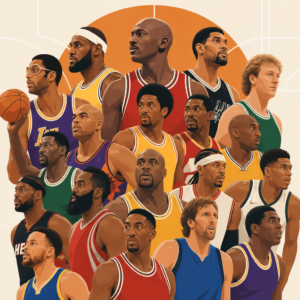

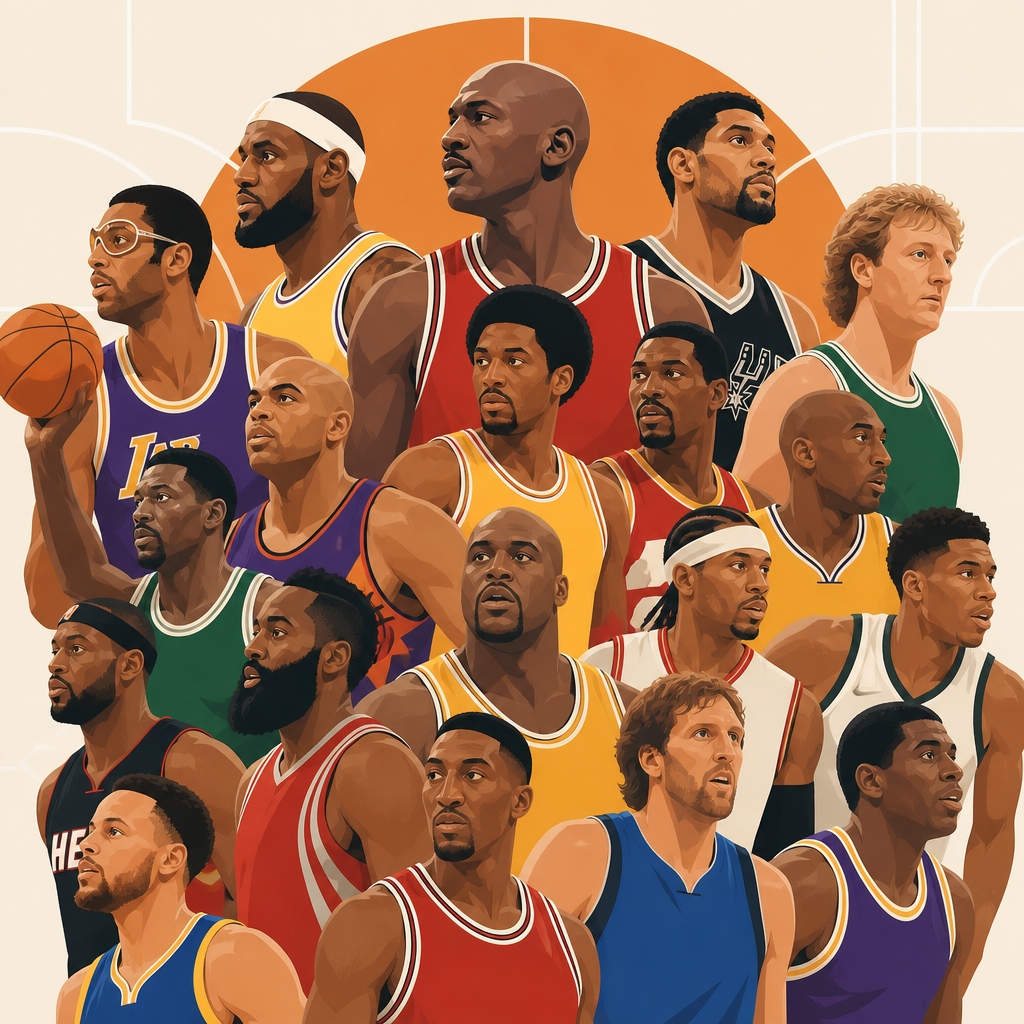
Basketball legends define more than highlight reels; they establish the standards by which every generation measures greatness. In any serious discussion of all-time rankings, fans quickly discover that the conversation is not just about points, rings, or awards, but about influence, context, and the ways certain players changed how the sport is played, coached, and marketed. This hub on basketball legends every fan should know brings together 25 names that shaped the game, from the league’s early superstars to modern icons whose careers are still reshaping record books.
When people ask who belongs in the greatest-of-all-time tier, they are really asking several questions at once. Who dominated their era? Who won at the highest level? Who transformed strategy? Who held up against elite competition over time? As someone who has spent years studying player film, comparing eras, and building all-time rankings across positions, I can say the strongest lists balance peak performance, longevity, playoff impact, individual honors, and historical influence. No single metric settles the debate. PER, Win Shares, Box Plus/Minus, usage rate, defensive versatility, and championship equity all help, but each leaves something out.
That is why a hub article on all-time rankings matters within the broader NBA Players landscape. Fans need one place that explains the pillars of greatness and introduces the central figures in the debate. Some legends built dynasties in black-and-white footage. Others expanded the geometry of the floor with three-point shooting, point-forward creation, or switchable defense. Together, these 25 names form the backbone of basketball history. If you understand what each contributed, you understand how the NBA evolved from a regional league into a global sport with distinct eras, styles, and standards of excellence.
The list below is not arranged as a strict one-to-25 ranking because hub pages should orient readers before narrowing into deeper player-specific breakdowns. Instead, it groups legends by the kind of impact they made. That approach gives fans a cleaner framework for comparing careers across eras, especially when rules, pace, travel, medicine, and competition changed dramatically over decades. The names remain essential because each left evidence that still holds up: championships, MVPs, revolutionary skills, enduring records, and visible influence on the players who followed. If you want to evaluate all-time rankings well, these are the basketball legends you need to know first.
The foundation: pioneers who built the standard
Any all-time rankings hub has to start with the players who created the league’s first model of superstar value. George Mikan was the NBA’s earliest dominant big man, so physically overwhelming for his time that rules and lane dimensions changed in response to his presence. Bob Cousy helped define playmaking flair and backcourt creativity in the 1950s. Bill Russell then established the clearest winning template the sport has ever seen: elite defense, rebounding, leadership, and sacrifice in service of team success. His 11 championships with the Boston Celtics remain the most powerful argument for valuing defensive impact and leadership in historical rankings.
Wilt Chamberlain is Russell’s necessary counterweight in any serious basketball history. His statistical dominance still reads like myth: a 100-point game, a 50.4 points-per-game season, and absurd rebounding totals in an era with extreme pace. Yet his legacy also illustrates a core ranking principle: individual production and team success are related, not identical. Jerry West, meanwhile, combined elite scoring, late-game shot-making, and two-way guard play, making him one of the strongest pre-merger ranking cases. Oscar Robertson expanded what a lead guard could be, blending size, rebounding, and playmaking long before jumbo initiators became common.
These early legends matter because they established the categories still used in all-time debates. Russell proved that defense can anchor dynasties. Chamberlain showed statistical ceilings that may never be touched. Robertson normalized all-around guard excellence decades before triple-doubles became routine. West became a model of perimeter leadership under championship pressure. Elgin Baylor, often overshadowed, brought aerial creativity and high-volume wing scoring that foreshadowed later stars. Without this generation, there is no meaningful baseline for greatness, and every modern ranking discussion becomes distorted by recency bias.
The expansion era: stars who broadened the game’s possibilities
As the league matured, new stars expanded both style and public reach. Kareem Abdul-Jabbar belongs at the center of every top-three conversation because his resume is nearly unmatched: six MVP awards, six championships, elite longevity, and the most reliable signature shot in basketball history, the skyhook. Julius Erving was crucial to the sport’s visual and cultural growth, blending ABA flair with high-level scoring, transition play, and above-the-rim artistry that helped make professional basketball more dynamic for fans. Moses Malone brought a different kind of dominance, punishing the glass and interior with relentless physicality and earning three MVPs through force, effort, and production.
Larry Bird and Magic Johnson then changed the league’s trajectory entirely. Their rivalry did not just produce championships; it revived the NBA’s commercial relevance in the 1980s. Bird’s case rests on elite shooting, passing, rebounding, and competitive control, while Magic redefined the point guard position at 6-foot-9 with transition orchestration, half-court manipulation, and unmatched playmaking vision. Isiah Thomas also deserves firm inclusion in this tier of essential names. As leader of the Detroit Pistons’ Bad Boys, he showed that a smaller guard could still be the offensive engine of a title team against some of the greatest rosters ever assembled.
| Legend | Primary historical value | Why fans still study him |
|---|---|---|
| Kareem Abdul-Jabbar | Longevity plus MVP-level dominance | Model for sustained excellence across eras |
| Magic Johnson | Size and playmaking at point guard | Blueprint for jumbo creators and pace control |
| Larry Bird | All-around skill and competitive shot-making | Elite example of versatility and offensive feel |
| Julius Erving | Transition flair and wing athleticism | Bridge between old-school fundamentals and modern style |
| Moses Malone | Rebounding and interior scoring force | Proof that effort dominance can be historically great |
This era matters in all-time rankings because it connected winning, star power, and stylistic evolution. Kareem proved that a center could remain the best player in basketball deep into his career. Bird and Magic demonstrated that contrasting strengths could each support dynasty-level success. Erving made athletic wing play central to the game’s identity. Moses showed that offensive rebounding and paint pressure could overwhelm more glamorous skill sets. For a hub covering NBA Players and all-time rankings, these legends form the bridge between the foundational era and the modern debate.
The benchmark era: the names that dominate greatest-ever debates
No player shaped the modern language of greatness more than Michael Jordan. His case combines a dominant peak, six championships in six Finals appearances with the Chicago Bulls, ten scoring titles, elite perimeter defense, and perhaps the strongest global cultural impact any basketball player has had. Jordan became the benchmark because he paired aesthetics with results. The footwork, midrange precision, transition explosiveness, and relentless competitive pressure were not just beautiful to watch; they repeatedly translated to postseason control. Hakeem Olajuwon belongs in this section as well because his two-way center play was among the most complete the league has seen.
Hakeem’s footwork, rim protection, switch comfort, and post scoring make him one of the most scalable all-time greats for any era. Shaquille O’Neal represents another form of benchmark dominance: overwhelming interior force at his peak, especially from 1999 to 2002, when opponents often had no practical answer for his size, touch, and power around the basket. Tim Duncan then provided the cleanest case for substance over flash. His bank shot, positional intelligence, drop coverage timing, outlet passing, and emotional steadiness made the San Antonio Spurs a model franchise for nearly two decades.
Kobe Bryant rounds out this core set because his influence extends beyond counting stats. His all-time standing comes from high-level shot creation, difficult-shot shot-making, championship pedigree, and a work ethic that shaped player development culture league-wide. Many younger stars studied Bryant’s footwork and isolation counters the way earlier generations studied Jordan. In strict ranking terms, Duncan usually gets the efficiency and defensive consistency edge, while Kobe’s supporters point to scoring versatility and burden against set playoff defenses. Both belong in any serious hub because the debate itself teaches fans how to weigh style, efficiency, and role difficulty.
The modern era: versatility, spacing, and new models of dominance
LeBron James sits at the center of the current all-time rankings conversation because his resume is unmatched for breadth. He has sustained elite production across two decades, won championships with multiple franchises, functioned as a primary scorer and primary playmaker, and adapted to dramatic style shifts from post-heavy basketball to five-out spacing. His case is built on longevity and versatility at a level no predecessor matched. If Jordan remains the clearest peak-and-perfection argument, LeBron is the strongest total-career argument. Both standards are valid, which is why this debate has endured for years without a definitive universal answer.
Stephen Curry changed the geometry of the sport more visibly than any player since Shaquille O’Neal, but in the opposite direction. His shooting range, off-ball movement, relocation habits, and willingness to fire under minimal daylight forced defenses to extend far beyond traditional coverage zones. Entire youth systems and NBA offenses shifted because Curry proved that extreme perimeter gravity could become championship offense. Kevin Durant belongs alongside him as one of the most difficult individual covers ever: near seven feet, handle of a guard, release point impossible to contest cleanly, and efficient scoring from every level.
Dirk Nowitzki and Kevin Garnett are also essential names for understanding modern rankings. Dirk legitimized the championship ceiling of a jump-shooting seven-footer and paved the way for stretch bigs by weaponizing the one-legged fadeaway and pick-and-pop spacing. Garnett offered the mirror image: defensive communication, mobility, rim help, mid-post scoring, and playmaking from the elbows. Add Giannis Antetokounmpo, whose downhill force and defensive range have already produced an MVP-heavy resume and a title, and Nikola Jokic, whose passing and efficiency have reimagined center offense, and the modern list gains even more nuance. Contemporary greatness is increasingly about adaptable skill stacks, not just one dominant trait.
How to compare eras and use this hub for deeper player rankings
The hardest part of all-time rankings is comparing players across radically different contexts. Pace was faster in many earlier decades, inflating counting stats. Illegal defense rules once shaped spacing and isolation opportunities differently. Travel, sports science, nutrition, and roster construction have improved over time, while the talent pool has become more global. That is why smart rankings use layered criteria rather than one stat or one narrative. For this hub, the 25 names every fan should know are George Mikan, Bob Cousy, Bill Russell, Wilt Chamberlain, Jerry West, Oscar Robertson, Elgin Baylor, Kareem Abdul-Jabbar, Julius Erving, Moses Malone, Magic Johnson, Larry Bird, Isiah Thomas, Michael Jordan, Hakeem Olajuwon, Shaquille O’Neal, Tim Duncan, Kobe Bryant, LeBron James, Stephen Curry, Kevin Durant, Dirk Nowitzki, Kevin Garnett, Giannis Antetokounmpo, and Nikola Jokic.
Use these names as anchors when exploring deeper NBA Players coverage by position, era, or franchise. If you are comparing centers, start with Russell, Wilt, Kareem, Hakeem, Shaq, Duncan’s big-man role, Jokic, and Giannis as a frontcourt outlier. If you are ranking guards, weigh West, Robertson, Magic, Isiah, Jordan, Kobe, Curry, and LeBron’s point-forward responsibilities. If you prefer championship value, Russell, Jordan, Duncan, Magic, and Kareem rise quickly. If you prioritize portability to any roster, Bird, Hakeem, Curry, Durant, and Garnett gain strength. Keep the categories clear, revisit the film, and test your assumptions against what actually won. That process is how fans move from hot takes to informed all-time rankings.
Basketball history becomes clearer when you know the legends who established its standards. These 25 names shaped the game through winning, innovation, statistical dominance, cultural reach, and skills that changed what teams thought was possible. Some built dynasties through defense, others through scoring, spacing, playmaking, or sheer physical force, but all belong in the foundation of any credible all-time rankings discussion. The value of this hub is simple: it gives you the essential map before you dive into individual player cases, positional lists, or era-specific debates.
If you want stronger opinions about NBA greatness, start with stronger frameworks. Compare peak versus longevity, offense versus defense, individual load versus team fit, and era context versus universal skill. Then return to these 25 basketball legends and ask not just who was famous, but who truly moved the sport forward. Use this page as your starting point for deeper NBA Players research, and build your own all-time rankings with evidence instead of impulse.
Frequently Asked Questions
What makes a basketball player a true legend rather than just a great star?
A true basketball legend stands apart from a merely excellent player because the conversation goes beyond statistics and into lasting impact. Great stars may dominate for a few seasons, pile up awards, or become fan favorites, but legends reshape the standards of the game itself. They influence how basketball is played, how coaches build systems, how younger players model their careers, and how fans understand greatness across eras. In other words, legends leave fingerprints on the sport that remain visible long after they retire.
That is why any serious list of basketball legends includes more than scoring titles, championship rings, or MVP trophies. Context matters. A player who transformed the center position, popularized a new style of guard play, elevated the league’s national profile, or changed the business and culture of basketball can be every bit as important as someone with overwhelming numbers. Some legends were pioneers in the sport’s early years, setting the foundation for everything that followed. Others arrived later and redefined athleticism, skill, leadership, or global popularity.
Longevity also plays a role, but it is not the only measure. Some legends built their status through sustained excellence over 15 or 20 seasons, while others had shorter peaks so dominant that the game had to adjust around them. Ultimately, a legend is someone whose name continues to matter in all-time debates because their influence outlived their era. If fans are still using that player as a benchmark for greatness, leadership, innovation, or competitive will decades later, that player belongs in the legend category.
Why do older players remain essential in all-time basketball discussions?
Older players remain essential because basketball history is cumulative. The modern game did not simply appear in its current form; it was built step by step by earlier stars who introduced techniques, tactics, and standards that later generations expanded. When fans discuss the greatest players ever, they are really discussing the full evolution of the sport. Ignoring early legends would erase the people who helped define professional excellence before television exposure, advanced sports medicine, global scouting, and the marketing machinery of the modern NBA existed.
Many of the league’s earliest icons played under very different conditions. The game was more physical, travel was harder, training resources were limited, and financial rewards were nowhere near what they are today. Yet those players still established the blueprint for dominance, leadership, and winning. George Mikan helped prove that a dominant big man could shape the sport. Bill Russell elevated defense, team play, and championship culture to a nearly unmatched level. Wilt Chamberlain forced the basketball world to rethink statistical possibility and individual dominance. Jerry West and Oscar Robertson brought all-around excellence and professionalism that still resonate in modern player comparisons.
Including these names is not about nostalgia for its own sake. It is about giving proper weight to foundational influence. The legends from earlier eras made the league viable, meaningful, and compelling enough for later superstars to inherit. Without them, there is no clear pathway to the eras of Magic Johnson, Larry Bird, Michael Jordan, Kobe Bryant, LeBron James, and Stephen Curry. To understand where basketball is now, fans need to understand who made the current version of the sport possible.
How should fans compare basketball legends from different eras fairly?
Comparing legends across eras is one of the hardest and most fascinating parts of basketball debate because conditions change dramatically over time. Rules evolve, pace fluctuates, training improves, competition expands internationally, and player roles shift with strategy. A fair comparison starts by avoiding the temptation to judge every player through a modern lens alone. Instead of asking whether an older legend would post today’s numbers in the exact same way, it is more useful to ask how dominant that player was relative to the era in which he played and how much he influenced the sport around him.
That means looking at several layers at once. First, consider peak performance: how unstoppable was the player at his best? Second, evaluate longevity: how long did he remain elite? Third, study winning impact: did his presence consistently lift teams into contention or championship territory? Fourth, account for innovation and influence: did the player redefine a position, a skill set, or a style of play? Finally, consider context: what rules, level of league depth, quality of support, and social or business environment shaped that career?
For example, Bill Russell’s greatness cannot be reduced to raw scoring because his legend is rooted in defense, leadership, and winning on a historic scale. Michael Jordan’s case includes scoring brilliance, two-way dominance, championships, and cultural impact. Magic Johnson and Larry Bird revitalized the NBA at a critical moment. Shaquille O’Neal changed how teams had to construct defenses. Stephen Curry reshaped spacing and shot selection across all levels of basketball. The fairest comparisons recognize that legends can arrive at greatness through different paths. The question is not whether every all-time great looked the same; it is whether each player commanded his era and left the sport permanently changed.
Why are influence and cultural impact so important when ranking basketball legends?
Influence and cultural impact matter because basketball legends shape the sport far beyond the box score. The greatest players do not just win games; they alter the way basketball is seen, sold, taught, and remembered. A player’s legacy can include style, confidence, marketability, social significance, and the ability to bring entirely new audiences into the game. That broader effect is part of what separates historically important figures from stars whose accomplishments, while impressive, remain more narrowly confined to the court.
Consider how certain legends changed the visibility of basketball itself. Magic Johnson and Larry Bird helped rescue and elevate the NBA during a pivotal period, turning individual rivalry into league-wide momentum. Michael Jordan became a global icon who expanded basketball’s reach into international markets and popular culture in a way no player had before. Kobe Bryant inspired a generation with his approach to preparation and competitiveness. LeBron James extended the model of the athlete as not only superstar performer but also business force, media presence, and public voice. Stephen Curry transformed what young players practice, making deep shooting and perimeter creativity central to modern basketball identity.
Cultural impact also includes symbolism and representation. Some legends changed perceptions of race, leadership, and player empowerment. Others helped define franchise identities or gave cities an enduring connection to basketball history. These contributions affect how future players carry themselves, how brands invest in the sport, and how fans tell the story of the game. Rankings will always involve debate, but any serious discussion of basketball legends should include not only what a player achieved, but also what that player made possible for everyone who came after.
Which qualities do the most important basketball legends tend to share?
While every all-time great has a different style, the most important basketball legends usually share a few defining qualities. The first is sustained excellence. Legends do not flash briefly; they establish a level that other players spend years trying to reach. Whether through scoring, defense, playmaking, rebounding, leadership, or versatility, they become reliable reference points for what elite basketball looks like. The second quality is adaptability. Truly great players thrive even as opponents adjust, teammates change, and the league evolves around them.
Another common trait is command of the moment. Legends tend to deliver when the stakes are highest, whether that means closing playoff games, anchoring championship defenses, carrying undermanned rosters, or setting a tone of confidence that elevates an entire organization. They also possess a distinct identity. Fans know exactly what made them special, whether it was Kareem Abdul-Jabbar’s unstoppable skyhook, Hakeem Olajuwon’s footwork, Larry Bird’s all-around brilliance, Tim Duncan’s quiet consistency, or Allen Iverson’s fearless individuality.
Perhaps most importantly, legends create a legacy that extends beyond personal accolades. They influence how future players train, how coaches design systems, and how the game is discussed across generations. Some become symbols of winning, some of innovation, some of artistry, and some of competitive fire. The names that shaped basketball are remembered because they combined elite skill with unmistakable significance. Their careers gave the sport new possibilities, and that is why every fan should know them—not simply as famous players, but as the figures who helped define basketball’s past, present, and future.