
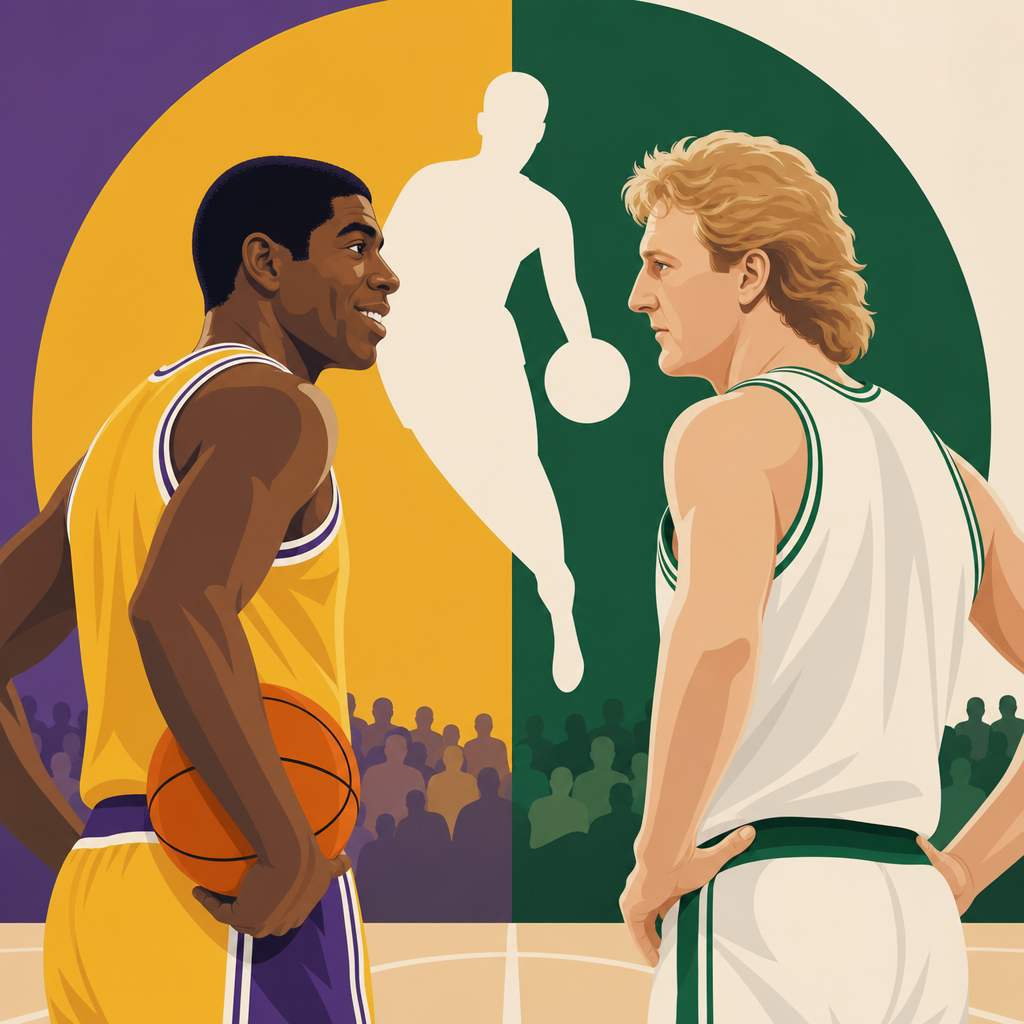
Magic Johnson vs Larry Bird is more than a classic sports debate; it is the rivalry that pulled the NBA from tape-delay obscurity into mainstream American culture and built the foundation for the modern league. In the language of player profiles, this matchup offers everything a hub article should cover: biography, playing style, defining moments, leadership, awards, team context, cultural impact, and lasting legacy. When I evaluate great players, I look beyond raw totals and ask a simpler question: who changed the sport, who won at the highest level, and who made people care? Johnson and Bird did all three at once.
Earvin “Magic” Johnson and Larry Bird entered the NBA in 1979 after meeting in the NCAA championship game, where Bird’s unbeaten Indiana State team lost to Magic’s Michigan State squad. That game delivered one of the largest television audiences in college basketball history and introduced a contrast that the league would soon amplify: Magic was a 6-foot-9 point guard from Lansing with flair, pace, and charisma; Bird was a 6-foot-9 forward from French Lick with shooting touch, anticipation, and relentless competitiveness. Their differences in style, background, and personality made the comparison easy for fans and irresistible for broadcasters.
Why did this rivalry matter so much? Because the NBA of the late 1970s had serious problems. Television ratings were weak. Some Finals games aired on tape delay. The league struggled with image issues, uneven attendance, and a lack of national momentum. Magic and Bird arrived at exactly the right time, joining the Los Angeles Lakers and Boston Celtics, the league’s most historic glamour franchises. Their presence turned old brands into national appointment viewing. By the mid-1980s, the NBA had become faster, more visible, and far more commercially powerful. Any serious examination of NBA players has to start here, because Johnson and Bird established the template for how superstar profiles are discussed today.
A player profile hub should answer core questions directly. Who were they as players? Magic was the game’s greatest oversized playmaker, a floor general who controlled tempo, delivered passes others never saw, and could score efficiently when needed. Bird was one of basketball’s smartest all-around forwards, a lethal shooter and elite passer whose understanding of spacing and timing made everyone around him better. What did they win? Magic won five championships and three MVP awards. Bird won three championships and three consecutive MVPs, a feat matched by only a handful of legends. Why are they linked? Because their teams met in the Finals three times, their primes overlapped almost perfectly, and each pushed the other to higher standards.
Player Profiles: Backgrounds, Skills, and Basketball Identity
Magic Johnson’s player profile begins with versatility. Listed at 6-foot-9, he handled the ball like a guard but saw the court like a chess master. With the Lakers, he became the engine of “Showtime,” the transition attack that defined 1980s pace and spectacle. He led the league in assists four times and retired with 11.2 assists per game, still the highest average in NBA history. That number matters because it captures both style and substance. Magic did not collect empty passes. He created efficient offense before defenses were set, hit bigs in stride, rewarded wings for running, and weaponized every rebound as a chance to attack.
Bird’s player profile is built on precision and control. Officially a forward, he functioned as a point-forward long before the term became common. He was a three-time league leader in three-point percentage during an era when the shot was used less frequently, and he paired that accuracy with elite rebounding, passing, and late-game shot-making. Bird averaged 24.3 points, 10.0 rebounds, and 6.3 assists for his career, numbers that only hint at his actual influence. He bent defenses with pump fakes, touch passes, and instant reads. Coaches trusted him because he understood possession value and never wasted movement.
Both players also challenged positional labels. Magic redefined what a point guard could look like, proving that ballhandling, height, and rebounding could exist in one primary creator. Bird expanded the creative role of a forward, showing that frontcourt players could be offensive hubs rather than finishers. This matters for modern player profiles because many stars, from LeBron James to Nikola Jokić and Luka Dončić, are discussed through ideas Johnson and Bird helped normalize: heliocentric playmaking, cross-positional initiation, and offense built through decision-making rather than rigid positions.
Context strengthens their profiles. Magic entered a Lakers roster with Kareem Abdul-Jabbar, already one of the greatest centers ever, plus a franchise ready to embrace speed under coach Paul Westhead and later Pat Riley. Bird joined a Celtics team that improved dramatically after his arrival, helping transform a 29-win club into a 61-win contender in his rookie season. That immediate turnaround is one reason Bird’s impact is often described as uniquely structural. He did not merely add scoring; he changed the team’s identity. Magic inherited more top-end talent early, but Bird may have had the larger overnight effect on team competence.
How the Rivalry Saved the NBA
The statement that Magic Johnson and Larry Bird saved the NBA is not exaggeration. It is a practical description of what happened between 1979 and the late 1980s. Their college showdown created a ready-made storyline. Their arrival in Boston and Los Angeles revived the league’s flagship franchises. Their repeated battles gave networks a narrative simple enough for casual fans and rich enough for committed viewers. In my experience reviewing sports media trends, leagues grow fastest when they can convert complexity into recognizable conflict. Magic versus Bird did exactly that.
Television was central. The 1979 NCAA title game between Michigan State and Indiana State drew a massive audience and remains one of the most watched college basketball games ever. The NBA then capitalized by spotlighting every Lakers-Celtics collision. Ratings rose because these games had contrast: coast versus heartland, fast break versus half-court execution, Hollywood flair versus blue-collar focus. Those themes were simplified by media coverage, sometimes too much, but they worked as marketing. Viewers who did not know weak-side rotation or post entry timing still understood that these teams represented opposite basketball worlds.
Economics followed attention. Better ratings improved broadcast value. Stronger national interest increased ticket demand, merchandise sales, and the star power of individual players. By the time Michael Jordan became the league’s next transformational force, the NBA already had a healthier stage because Magic and Bird had rebuilt credibility. Commissioner David Stern deserves credit for scaling the product, but the product needed stars people cared about. Johnson and Bird gave the league dependable excellence, annual stakes, and authenticity. Fans believed the games mattered because the players clearly did.
| Category | Magic Johnson | Larry Bird |
|---|---|---|
| NBA Debut | 1979, Los Angeles Lakers | 1979, Boston Celtics |
| Championships | 5 | 3 |
| MVP Awards | 3 | 3 |
| Finals Meetings | 1984, 1985, 1987 | 1984, 1985, 1987 |
| Signature Strength | Transition playmaking | Shooting and anticipation |
| Cultural Role | Face of Showtime | Face of Celtics revival |
Head-to-Head Matchups and Defining Finals
The best way to understand the rivalry is through the three NBA Finals between the Lakers and Celtics. In 1984, Boston beat Los Angeles in seven games in a bruising series that elevated the feud from entertaining to personal. Bird was not statistically dominant in every game, but his competitiveness set the tone, and the Celtics’ physicality disrupted the Lakers’ rhythm. For Magic, the loss hurt his reputation because late-game mistakes became part of the narrative. Great player profiles should include adversity, and this series is essential to his story because it sharpened him.
In 1985, the Lakers answered with a six-game victory, becoming the first Los Angeles team to beat Boston in the Finals. Kareem was brilliant, but Magic controlled the emotional and tactical flow. The win mattered historically because it erased a psychological barrier. For years, the Celtics represented a mountain the Lakers could not climb. Johnson’s command in that series signaled growth from prodigy to fully formed leader. When people describe him as a joyful player, they can miss how fiercely competitive he was. This championship showed both.
The 1987 Finals completed the trilogy, with the Lakers defeating the Celtics in six games. Magic’s junior sky hook in Game 4 became one of the defining shots of the era, not only because of difficulty but because of circumstance: Boston was at home, the score was tight, and the shot came over elite defenders. Bird still had immense moments, including clutch baskets that kept Boston alive, but the larger arc favored Los Angeles. By then, Magic was at the center of the league’s most polished machine, while Bird was fighting through increasing physical wear.
Regular-season meetings added fuel, yet the Finals are why the rivalry endures. Each series tested more than skill. Coaching adjustments, roster depth, travel, fatigue, and pressure all mattered. Bird had to solve the Lakers’ pace and size in the open floor. Magic had to navigate Boston’s discipline, help defense, and emotional edge in half-court possessions. When fans search for player profiles, they often want to know whether stars were truly challenged by equals. Johnson and Bird were, repeatedly, on the biggest stage available.
Leadership, Intangibles, and Style of Greatness
Leadership separated both men from stars with similar talent. Magic led loudly. He celebrated teammates, pushed tempo after made baskets, and transmitted confidence across an arena. His passing was not just a skill; it was a leadership tool. Players ran harder because they knew he might reward them. Coaches trusted him because he could improvise without losing structure. I have always thought his greatest gift was emotional management. He made difficult basketball feel playable, which is rare even among elite point guards.
Bird led differently. He challenged teammates with blunt honesty, obsessive preparation, and a standard that bordered on confrontational. Stories about his trash talk endure because they reveal how certain he was in his reads and routine. Yet the more important trait was his consistency. Bird showed up with the same seriousness in November that he brought to May. He rebounded in traffic, made the extra pass, sprinted to spots, and defended with anticipation rather than raw speed. That is why coaches and veteran players hold him in such high esteem. He made every winning detail visible.
Comparing their styles clarifies the debate. Magic was the better transition creator and pure point guard. Bird was the better outside shooter and, for many observers, the more instinctive half-court tactician. Magic generated advantages early in possessions; Bird solved them late. Magic was a kinetic force who expanded the floor with pace. Bird was a manipulator of space who punished every defensive error. Neither profile is complete without defense, where Bird’s team concepts and active hands often outweighed Magic’s size-based versatility, though neither was primarily defined by lockdown individual stopping power.
Accolades support what the eye test showed. Bird won three straight MVP awards from 1984 to 1986, a remarkable run in a league filled with prime Hall of Famers. Magic won MVP in 1987, 1989, and 1990, reflecting both sustained excellence and the Lakers’ continued dominance. They were perennial All-NBA selections, frequent All-Stars, and unquestioned first-option organizers on championship teams. When building an NBA players hub around player profiles, this is the standard: describe production, role, versatility, and context together, not as isolated trivia.
Legacy, Influence, and Why This Rivalry Still Matters
The legacy of Magic Johnson vs Larry Bird extends far beyond the 1980s. Modern basketball still reflects their ideas. Big initiators, positionless offense, the point-forward role, and star-driven league marketing all trace part of their lineage to this rivalry. LeBron James carries obvious echoes of Magic’s transition orchestration and size-based passing. Nikola Jokić reflects Bird’s processing speed, touch, and offensive centrality from the frontcourt. Even team-building lessons endure: surround playmakers with runners and shooters for a Magic-style attack, or use spacing and read-and-react passing for a Bird-style ecosystem.
Their personal relationship also deepened the story. Fierce competitors on the court, they developed mutual respect off it, especially during the filming of a famous Converse commercial in the mid-1980s. That evolution mattered because it gave the rivalry human dimension. It was never fake theater. They genuinely wanted to beat each other, and because they were secure in their own greatness, they could eventually acknowledge what the other represented. That honesty is part of why the story has aged so well.
For readers exploring NBA player profiles, this rivalry remains the ideal entry point because it connects individual evaluation to league history. You can study Johnson to understand playmaking, pace, and charisma as strategic assets. You can study Bird to understand shooting gravity, anticipation, and competitive discipline. You can study both to understand how superstars shape not only wins and losses but also television, business, culture, and the way future players are imagined. If you want a clear lens on why NBA players matter beyond box scores, start with Magic and Bird, then keep building outward through the legends they inspired.
Frequently Asked Questions
Why is the Magic Johnson vs Larry Bird rivalry considered the one that saved the NBA?
The Magic Johnson vs Larry Bird rivalry is widely credited with rescuing the NBA because it gave the league something it desperately needed at the turn of the 1980s: a compelling, easy-to-follow story built around two transformational stars. Before their arrival, the NBA struggled with inconsistent television ratings, image problems, and a level of national interest that fell far short of the NFL and Major League Baseball. In some markets, NBA Finals games were even shown on tape delay, which tells you how limited the league’s mainstream pull had become. Then Magic and Bird arrived with instant credibility, championship expectations, and a ready-made narrative that fans could latch onto.
What made the rivalry so powerful was that it worked on every level. It started in college with the 1979 NCAA championship game between Michigan State and Indiana State, a matchup that drew massive attention and introduced millions of viewers to their contrasting personalities and styles. Magic was charismatic, flashy, and joyful, the face of fast-break creativity and Hollywood basketball. Bird was cold-blooded, relentless, and ruthlessly efficient, the symbol of blue-collar precision and competitive toughness. When they entered the NBA and landed on the league’s most storied franchises, the Los Angeles Lakers and Boston Celtics, the rivalry immediately felt larger than the players themselves. It became coast versus coast, style versus substance, glamour versus grit, but in reality both men were complete winners.
Just as important, they delivered. Rivalries only matter if the stars keep meeting in meaningful games, and Magic and Bird did exactly that. Their teams won championships, faced each other in the NBA Finals, and dominated the decade. Fans were not being sold a marketing concept; they were watching the best teams, the smartest players, and the highest stakes. That credibility helped the NBA build a stronger TV product, grow nationally, and establish the emotional investment that later allowed players like Michael Jordan to take the league to another level. In that sense, Magic and Bird did not simply entertain the NBA back into relevance. They restored prestige, urgency, and cultural momentum to the league.
How did Magic Johnson and Larry Bird differ in playing style, and why did those differences make the rivalry so compelling?
Magic and Bird were both basketball geniuses, but they expressed that genius in very different ways, and that contrast is a huge reason the rivalry remains so fascinating. Magic Johnson was a 6-foot-9 point guard who redefined what a lead ball-handler could be. He controlled games with pace, vision, improvisation, and joy. His passing was not just effective; it was theatrical in the best possible sense, turning routine possessions into highlights and making teammates better in real time. Magic thrived in transition, pushing the ball relentlessly and rewarding movement, speed, and trust. The “Showtime” Lakers were built around his ability to turn rebounds into instant offense and force defenses into chaos before they could get set.
Larry Bird, by contrast, was less about spectacle and more about surgical destruction, though that should never be confused with a lack of creativity. Bird was a devastating half-court player, an elite shooter, passer, rebounder, and decision-maker whose understanding of spacing and timing often made him feel one step ahead of everyone else on the floor. He could score from outside, punish smaller defenders in the post, hit cutters with perfect touch, and dominate late-game situations through sheer poise. Bird’s game looked controlled rather than explosive, but that control was exactly what made him so dangerous. He dictated tempo through anticipation and precision rather than speed.
Together, they represented two different pathways to greatness. Magic embodied tempo, flair, and collective motion. Bird embodied calculation, shot-making, and ruthless execution. Yet both were unselfish, both elevated teammates, and both cared more about winning than personal numbers. That overlap is what gave the rivalry depth. It was never a shallow debate about flash versus fundamentals. It was a clash between two complete players who could each score, pass, rebound, lead, and deliver under pressure. Fans were not just choosing personalities; they were comparing two equally legitimate visions of basketball excellence.
What were the defining moments and biggest games in the Magic Johnson vs Larry Bird rivalry?
The defining moments of the Magic-Bird rivalry begin before the NBA. The 1979 NCAA championship game remains one of the most important contests in basketball history because it introduced their rivalry to a national audience in dramatic fashion. Magic’s Michigan State defeated Bird’s Indiana State, and the television audience for that game became a foundational data point in understanding how magnetic the matchup could be. It was the first proof that these two players, when placed opposite each other, could make basketball feel like an event.
In the NBA, the rivalry reached its peak in the Finals matchups between the Lakers and Celtics in 1984, 1985, and 1987. The 1984 Finals were especially significant because they restored the Lakers-Celtics championship collision to center stage and gave Bird’s Celtics a grueling seven-game victory over Magic’s Lakers. That series helped deepen the emotional stakes of the rivalry, especially because it reinforced Boston’s physical identity and the pressure on Los Angeles to prove it could beat the Celtics when it mattered most. In 1985, the Lakers answered by defeating the Celtics in the Finals, a breakthrough that carried symbolic weight because Los Angeles had long struggled against Boston on the biggest stage. Then in 1987, Magic and the Lakers won again, with Magic’s famous junior sky hook in Game 4 standing as one of the signature plays of the era.
Beyond those headline moments, the rivalry was defined by the consistency of excellence both players brought to the decade. They were not occasional contenders who happened to cross paths. They were annual standards. Bird led Boston to three championships and three straight MVP awards from 1984 to 1986. Magic led the Lakers to five championships and became the engine of one of the greatest dynasties ever assembled. Every regular-season meeting carried emotion, but the larger story was that both men repeatedly justified the hype with deep playoff runs, iconic performances, and championship-level leadership. Their rivalry mattered because its biggest moments were always attached to meaningful basketball.
Who had the greater overall impact on winning: Magic Johnson or Larry Bird?
This is the heart of the debate, and the honest answer is that both had enormous, franchise-defining impact on winning, just in somewhat different ways. Magic Johnson’s case starts with team success at the very highest level. He won five NBA championships, reached nine Finals, collected three MVP awards, and changed the geometry of offense with his size and playmaking. As the leader of the Showtime Lakers, he made elite teammates even more dangerous by turning the game into a constant test of decision-making and transition defense. Magic’s presence did not simply improve Los Angeles; it gave the Lakers an identity that overwhelmed opponents physically, mentally, and stylistically. When you talk about offensive orchestration at the championship level, he is one of the definitive examples in league history.
Larry Bird’s case is just as strong because his influence on winning was arguably the most complete of any forward of his era. Bird won three championships, three consecutive MVPs, and transformed Boston into the dominant Eastern power of the mid-1980s. He impacted games in every area: scoring, rebounding, passing, spacing, clutch shot-making, and emotional leadership. Bird had a gift for controlling outcomes without needing the ball in a flashy way. He punished mistakes, made impossible passes look routine, and elevated the Celtics’ collective intelligence with his feel for the game. He was the kind of superstar who could be your best scorer, your smartest passer, your best rebounder on a given night, and your most feared closer at the same time.
If someone chooses Magic, they are usually emphasizing championships, playmaking scale, and the revolutionary nature of his role as a giant point guard. If someone chooses Bird, they are usually emphasizing all-around control, ruthless competitiveness, and the breadth of his half-court dominance. The stronger conclusion is that both players were ultimate winning forces whose value cannot be reduced to box-score totals alone. Magic was the engine of pace and creation. Bird was the master of leverage and execution. Each changed what championship basketball looked like, and each forced the other to sustain an extraordinary standard.
What is the lasting legacy of the Magic Johnson vs Larry Bird rivalry in today’s NBA?
The lasting legacy of the Magic-Bird rivalry is visible everywhere in the modern NBA, from the way the league markets star-driven narratives to the way fans discuss all-time greatness. First and most obviously, their rivalry helped establish the NBA as a national entertainment force built around identifiable superstars. The league learned that when elite players have distinct styles, personalities, and competitive history, fans become invested not just in teams but in basketball as an ongoing story. That model helped create the environment in which later icons, especially Michael Jordan, could turn the NBA into a global phenomenon.
On the court, both players expanded the imagination of what positions and skill sets could look like. Magic normalized the idea that size and playmaking could coexist at the highest level, paving the way for bigger initiators and position-bending offensive systems. Bird showed that a forward could dominate through shooting, passing, anticipation, and mental pressure rather than pure athleticism, a template that still resonates in today’s spacing-heavy game