

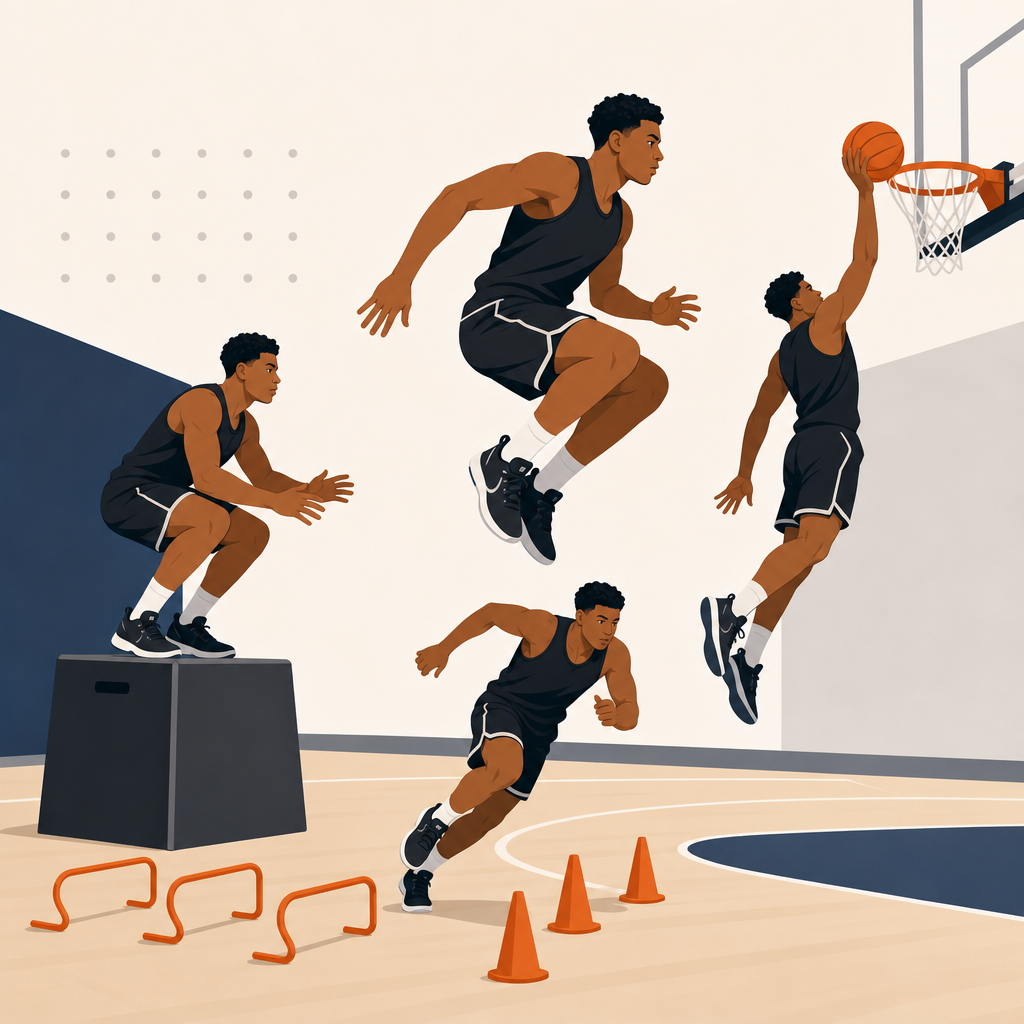
Plyometric exercises for basketball players are one of the fastest ways to build the explosive power, first-step speed, and reactive strength that decide rebounds, blocks, finishes at the rim, and late-game defensive stops. In basketball training, plyometrics refers to drills that teach muscles and tendons to absorb force quickly and then produce force even faster, usually through jumping, hopping, bounding, and medicine ball throws. The goal is not random jumping volume. The goal is improved athletic development: better movement quality, more usable power, stronger landing mechanics, and a body that can repeat explosive efforts across an entire game. I have programmed plyometric work for guards needing a sharper change of pace, forwards trying to improve vertical pop, and youth players who first needed to learn how to land before they learned how to jump higher. Done well, these drills bridge the gap between weight room strength and on-court performance. Done poorly, they add fatigue, reinforce bad mechanics, and increase avoidable stress on knees, shins, and ankles. That is why this hub article matters. It explains what plyometric exercises are, which types belong in a basketball program, how to progress them safely, and how they connect to sprinting, strength training, mobility, recovery, and skill work within a complete athletic development plan.
What Plyometric Training Does for Basketball Performance
Plyometric training improves the stretch-shortening cycle, the rapid sequence in which muscles lengthen under load and then contract forcefully. In plain terms, it helps a player plant, reverse direction, and explode. Basketball depends on that quality constantly. A putback jump off two feet, a chase-down block off one foot, and a hard closeout into a lateral slide all rely on fast force production. Research and applied coaching both show that well-designed jump training can improve vertical jump, sprint acceleration, and change-of-direction ability when paired with sound strength work. The mechanism is not magic. Athletes develop better neuromuscular timing, stiffer and more efficient tendons, and greater confidence in forceful movement.
For basketball players, the biggest performance benefit is transfer. A stronger squat matters, but only if the athlete can use that strength quickly. Plyometrics help convert weight-room force into game-speed action. They also sharpen landing skill, which is just as important as takeoff. Most noncontact basketball injuries happen during deceleration, landing, or cutting, not at the top of a jump. Teaching players to absorb force with good trunk position, stable knees, and active feet is a core part of athletic development. This is why the best programs include low-level landing and jump preparation before they chase maximal box jumps or depth jumps.
Plyometrics also support repeatability. Basketball is not a one-jump sport. Players need repeated explosive efforts with short recovery. Extensive jump series, pogo variations, and low-amplitude reactive drills can build the elastic qualities needed for that demand without the fatigue cost of constant maximal jumping. In practice, that means a player can contest, sprint back, and rise again on the next possession with less drop-off.
Core Categories of Plyometric Exercises for Basketball Players
Not every jump drill serves the same purpose. The most effective basketball training uses categories based on movement direction, intensity, and ground contact demands. Vertical plyometrics target straight-up power. Examples include squat jumps, countermovement jumps, tuck jumps used carefully, and box jumps performed as a projection drill rather than a test of hip mobility. Horizontal plyometrics develop acceleration and broad-force application through broad jumps, bounds, and skater jumps. Lateral plyometrics matter because basketball is full of shuffles, cutoffs, and angled takeoffs. Lateral bounds, heiden variations, and snap-down-to-stick drills are valuable here.
Another useful split is bilateral versus unilateral work. Bilateral jumps, where both feet take off together, help with maximal force and are usually easier to coach. Unilateral drills, including single-leg hops and bounds, reflect many game actions more directly but demand much greater control. In my experience, players often want to skip to flashy single-leg depth hops before they can control a basic single-leg stick landing. That is backwards. Unilateral power should be earned through progressive exposure.
Coaches should also separate extensive and intensive plyometrics. Extensive drills use lower intensity and higher contacts to build rhythm, tissue tolerance, and movement efficiency. Pogo jumps, line hops, and repeated low box snap-downs fit here. Intensive drills use higher outputs and lower contact volumes to develop maximal explosiveness. Depth jumps, high hurdle hops, and repeated maximal bounds belong in this category and should be used sparingly. This distinction helps manage fatigue and protect joint health across a long season.
| Category | Primary Goal | Basketball Examples | Best Use |
|---|---|---|---|
| Landing and deceleration | Absorb force safely | Snap-downs, stick landings, drop landings | Beginners, return to play, warm-ups |
| Extensive reactive | Rhythm and stiffness | Pogos, line hops, ankling series | Prep work, in-season maintenance |
| Bilateral power | Max vertical force | Squat jumps, countermovement jumps, box jumps | General power development |
| Horizontal and lateral | Acceleration and cutting power | Broad jumps, bounds, skater jumps | Game-transfer emphasis |
| Unilateral reactive | Single-leg explosiveness | Single-leg hops, bounds, heidens | Advanced players with solid landing skill |
How to Choose the Best Drills by Age, Level, and Position
The best plyometric exercises for basketball players depend on training age, not just biological age. A 15-year-old who has spent two years learning strength fundamentals may be more prepared than a 19-year-old with poor mechanics and no structured background. Youth athletes should begin with jump literacy: posture, arm action, landing quietly, and controlling knee position. Low box step-offs to stick, pogo jumps, and simple vertical jumps are enough at first. The target is coordination and confidence, not high contact counts.
High school and college players can handle more variation when they have baseline strength and movement quality. At that stage, I like pairing bilateral vertical work with horizontal or lateral drills in the same session. For example, trap bar jumps followed by broad jumps or countermovement jumps followed by skater bounds creates a useful blend of general and specific power. More advanced players may use depth jumps, repeated hurdle hops, or single-leg reactive series, but only when their landing quality stays consistent.
Position matters too, though less than many people think. Guards usually benefit from more acceleration-focused and unilateral work because they create separation, stop-start more often, and finish from varied footwork. Wings need a broad profile: vertical explosion, lateral reactivity, and repeatability. Posts still need vertical power, but they also need contact tolerance and stable landings in crowded spaces. Regardless of position, every player should train takeoff mechanics, landing mechanics, and frontal-plane control.
Body type also affects drill choice. Taller athletes with long levers often accumulate more tendon stress from high-volume contacts, especially if they are still growing. For them, fewer contacts and higher quality often work better. Smaller, springier players usually tolerate more reactive work, but that does not mean unlimited volume. Shin soreness, patellar tendon irritation, and declining jump sharpness are clear signs the load is too high.
Programming Plyometrics Within a Complete Athletic Development Plan
Plyometric exercises work best when placed correctly inside the larger basketball training week. They should usually come early in a session, after movement prep and before heavy fatigue. Power is a high-skill quality. If a player performs reactive jumps after exhausting conditioning, the drill becomes conditioning, not power development. A practical structure is dynamic warm-up, landing prep, primary plyometric exercise, strength or sprint work, then accessories and conditioning as needed.
Frequency depends on season and athlete readiness. In the off-season, two to three plyometric exposures per week is effective for many players, provided total jump contacts are managed alongside on-court work. In-season, one or two short exposures often maintain power well, especially if games and practices already create high jumping loads. The key is counting total stress, not just the drills in the strength session. A week with three games may already include dozens of high-intensity jump and landing actions.
Progression should move from simple to complex and from low amplitude to high intensity. First teach landing. Then teach repeated low-level contacts. Then build bilateral power. After that, layer in directional complexity and unilateral intensity. Volume should rise slowly. A beginner may start with 40 to 60 low-level contacts in a session. An advanced athlete may use fewer total contacts but much higher intensity. Rest periods matter. Maximal jumps need enough recovery to preserve output, often 45 to 90 seconds between sets and longer when pairings are demanding.
Plyometrics should also complement strength qualities. Stronger athletes often respond well to lower-volume, higher-intensity jumps because they already have force capacity to express. Weaker athletes may need more time building foundational strength through squats, split squats, hinges, calf work, and isometrics before advanced shock methods make sense. This hub connects naturally to strength training, speed development, mobility, and recovery because none of those qualities stand alone in basketball athletic development.
Technique, Safety, and Common Mistakes That Limit Results
Good plyometric technique starts with intent and position. Players should attack the ground, but they should also own the landing. That means ribs stacked over hips, active arm swing when appropriate, feet contacting under control, and knees tracking without collapsing inward. A quiet landing is a useful coaching cue because noise often reflects poor force absorption. On repeated reactive drills, ground contact should be quick without turning the movement into a stiff, uncontrolled bounce.
The most common mistake is choosing drills that are too advanced. Social media has made depth jumps look like a standard exercise, but they are a specialized high-intensity tool. If an athlete cannot stick a basic drop landing or produce a solid bodyweight squat, depth jumps are not the next step. Another mistake is chasing box height. A very high box jump often measures hip flexion and risk tolerance more than explosive power. For power development, the quality of takeoff matters more than the height of the box.
Surfaces and footwear matter. Hardwood courts, rubber flooring, and well-maintained turf usually work. Concrete does not. Shoes should provide enough traction and structure without being so soft that they dampen the athlete’s interaction with the ground. Recovery matters as well. Sore patellar tendons, stiff calves, and persistent shin pain should not be ignored. Isometric holds, calf raises, tissue load management, and temporary reductions in jump volume can solve small issues before they become long layoffs.
Finally, testing should be simple and repeatable. Use a Vertec, jump mat, force plates if available, or consistent video-based jump testing. Track broad jump, approach jump, and reactive indicators over time. If jump numbers are falling, contacts are rising, and the athlete feels flat, the program needs adjustment. Effective basketball training respects both performance and durability.
Plyometric exercises for basketball players deliver real results when they are coached as part of a full athletic development system, not treated as random jump challenges. The strongest programs teach force absorption before force production, build from low-level contacts to advanced reactive work, and match drill selection to the athlete’s age, strength, position, and current workload. Basketball players need more than a higher vertical. They need sharper acceleration, safer deceleration, stronger single-leg control, and the ability to repeat explosive actions without breaking down. That is exactly what well-planned plyometric training can provide.
The practical takeaway is simple. Start with landing mechanics, use the right category of drill for the goal, place plyometrics early in the session, and progress only when movement quality stays high. Pair jump training with strength work, sprint development, mobility, and recovery habits so the gains transfer to games. If you are building out your basketball training plan, use this athletic development hub as the starting point, then apply each subtopic with the same discipline: train explosiveness with purpose, measure what matters, and keep the athlete healthy enough to use those gains when the game is on the line.
Frequently Asked Questions
What are plyometric exercises, and why are they so effective for basketball players?
Plyometric exercises are explosive drills designed to improve how quickly your body can absorb force and then produce force again. For basketball players, that matters because nearly every important movement in the sport depends on rapid power: jumping for rebounds, elevating for blocks, exploding into a first step, changing direction on defense, and finishing through contact at the rim. Instead of focusing only on raw strength or conditioning, plyometric training develops reactive strength, which is your ability to transition from landing to takeoff with minimal delay.
That quality is what separates players who look athletic from players who actually move differently on the court. A strong athlete may squat a lot of weight, but if they cannot apply force quickly, they may still look slow getting off the floor or reacting to a loose ball. Plyometrics help close that gap by training the stretch-shortening cycle, the natural mechanism your muscles and tendons use to store and release elastic energy. In practical terms, that means better jump timing, improved burst, faster lateral reactions, and more efficient movement patterns under game-speed demands.
For basketball specifically, good plyometric work also improves movement economy. Players who learn to land well, absorb force cleanly, and re-accelerate efficiently often place less unnecessary stress on their knees and ankles during repeated efforts. That is a major advantage during long practices, tournament weekends, and late-game possessions when fatigue affects mechanics. The best results come when plyometrics are programmed with purpose, not treated like random jump workouts. Quality, intent, and proper progression are what turn these drills into real on-court performance gains.
Which plyometric exercises deliver the best real-world results for basketball performance?
The best plyometric exercises for basketball are the ones that match the demands of the game and the athlete’s current level. A few consistently effective options include box jumps, countermovement jumps, depth drops, pogo jumps, lateral bounds, skater hops, split squat jumps, broad jumps, single-leg hops, and medicine ball chest passes or overhead throws. Each one trains a slightly different quality, and that matters because basketball is not just vertical jumping. It is vertical power, horizontal acceleration, lateral force production, deceleration control, and quick reactivity all working together.
For improving vertical explosiveness, countermovement jumps, squat jumps, and box jumps are popular staples. They teach players to produce force rapidly and improve jump intent without excessive complexity. For reactive strength and quicker ground contact, pogo jumps and low-level repeated hops are extremely useful, especially when teaching rhythm and ankle stiffness. For defensive movement and change of direction, lateral bounds and skater jumps are excellent because they build side-to-side power and landing control. For first-step speed and transition explosiveness, broad jumps and bounding variations train horizontal force, which is often overlooked in jump-focused programs.
Single-leg plyometrics are also important because basketball is full of unilateral actions. Most layups, cuts, closeouts, and directional changes happen off one leg more than two. That makes single-leg hops, split stance jumps, and controlled unilateral landing drills very valuable once an athlete has built enough strength and coordination. Medicine ball throws deserve attention as well because they develop upper-body power and total-body sequencing for passing, absorbing contact, and overall athletic explosiveness.
The key is choosing drills based on training age and movement quality. Advanced exercises like depth jumps can be highly effective, but only for players who already demonstrate strong landing mechanics and enough strength to tolerate the intensity. Beginners usually get better results from mastering lower-intensity jumps and hops first. The best exercise is not the flashiest one. It is the one the athlete can perform explosively, safely, and consistently enough to create adaptation.
How often should basketball players do plyometrics to improve vertical jump, speed, and quickness?
For most basketball players, plyometric training two to three times per week is enough to produce meaningful gains when the sessions are well designed. More is not automatically better. Plyometrics place high stress on the muscles, tendons, joints, and nervous system, so recovery is part of the training effect. If jump quality starts dropping, landing mechanics get sloppy, or the athlete feels heavy and flat, that usually means the volume or frequency is too high for their current capacity.
In the off-season, two to three sessions per week often works well because there is more room to develop performance qualities without the constant fatigue of games. During pre-season, many players benefit from maintaining two focused sessions weekly while practice intensity rises. In-season, one to two lower-volume sessions is often enough to preserve explosiveness without interfering with recovery and performance. The exact structure depends on age, training history, game schedule, strength levels, and the amount of running and jumping already happening in practices.
Session length does not need to be excessive. A productive plyometric session may include only a handful of exercises performed for high quality and low to moderate volume. For example, a player might do three to five exercises for a few sets each, with full recovery between sets so each effort stays explosive. That approach is usually more effective than doing endless reps while tired. Plyometrics are about power output, not conditioning. Once the athlete cannot produce force quickly, the training effect changes and injury risk goes up.
It also helps to place plyometrics early in a workout, usually after a thorough warm-up and before heavy fatigue sets in. Many coaches pair them with strength training, speed work, or movement sessions. The goal is to stay fresh enough to move with intent. When done with the right frequency and proper recovery, plyometric work can improve jump height, first-step acceleration, and reactive movement without burying the athlete in unnecessary volume.
Are plyometric exercises safe for basketball players, and how can they reduce injury risk instead of increasing it?
Yes, plyometric exercises can be very safe for basketball players when they are coached correctly and progressed appropriately. In fact, one of the biggest benefits of smart plyometric training is that it teaches athletes how to handle force better. Basketball already includes frequent jumping, landing, stopping, and cutting. Structured plyometric work gives players a chance to improve those mechanics in a controlled setting, which can reduce the stress that poor movement places on the knees, ankles, hips, and lower back.
The biggest safety factor is not the exercise name. It is the athlete’s readiness. Before progressing to high-intensity depth jumps or repeated single-leg bounds, players should show they can land quietly, control knee position, maintain balance, and absorb force without collapsing through the hips or ankles. Basic landing drills, snap-downs, low-level hops, and simple jump patterns are often the right starting point. That foundation matters because many injuries happen not on takeoff, but on landing or during deceleration.
Good programming also reduces risk. Plyometrics should be introduced with manageable volume, enough rest, and proper surfaces when possible. A beginner does not need the same intensity as a highly trained college or professional athlete. Footwear, fatigue levels, recent game load, and prior injury history all matter. If a player is dealing with patellar tendon pain, ankle instability, or poor recovery, the program may need adjustments in exercise selection, volume, or contact intensity.
Technique cues can make a major difference. Players should learn to land with control, use the hips effectively, keep the trunk organized, and avoid letting the knees cave inward. Strong coaching around posture, alignment, and intent can turn plyometric sessions into movement-quality sessions as well as performance sessions. When done intelligently, plyometrics do not just increase explosiveness. They help prepare the body for the exact high-force actions basketball demands, which is one reason they are such a valuable part of long-term athletic development.
How long does it take to see results from plyometric training for basketball?
Many basketball players begin to notice early improvements in explosiveness, jump timing, and movement sharpness within four to six weeks of consistent plyometric training. More measurable changes in vertical jump, reactive strength, and on-court quickness often become clearer over eight to twelve weeks, especially when the program is combined with strength training, sound recovery, and good nutrition. The timeline depends on the athlete’s starting point. A beginner may see rapid gains because almost any quality training is a new stimulus, while an advanced athlete usually needs more precision and patience to create smaller but meaningful improvements.
It is also important to understand what “results” look like. Some players expect immediate dramatic increases in vertical jump, but real progress often shows up first in movement quality. They may feel bouncier, get off the floor faster on second jumps, react better on closeouts, or cover more ground on their first step. Those are real performance improvements, even before testing numbers jump significantly. In basketball, better reactive movement and faster force application can be just as valuable as adding inches to a max vertical.
The fastest progress usually happens when plyometrics are part of a complete program rather than a stand-alone fix. If an athlete lacks basic strength, cannot control landings, or is constantly fatigued from excessive playing volume, the results from jump training alone will be limited. On the other hand, when plyometrics are paired with lower-body strength work, mobility where needed, sprint mechanics, and smart recovery, the transfer to basketball performance is much stronger