

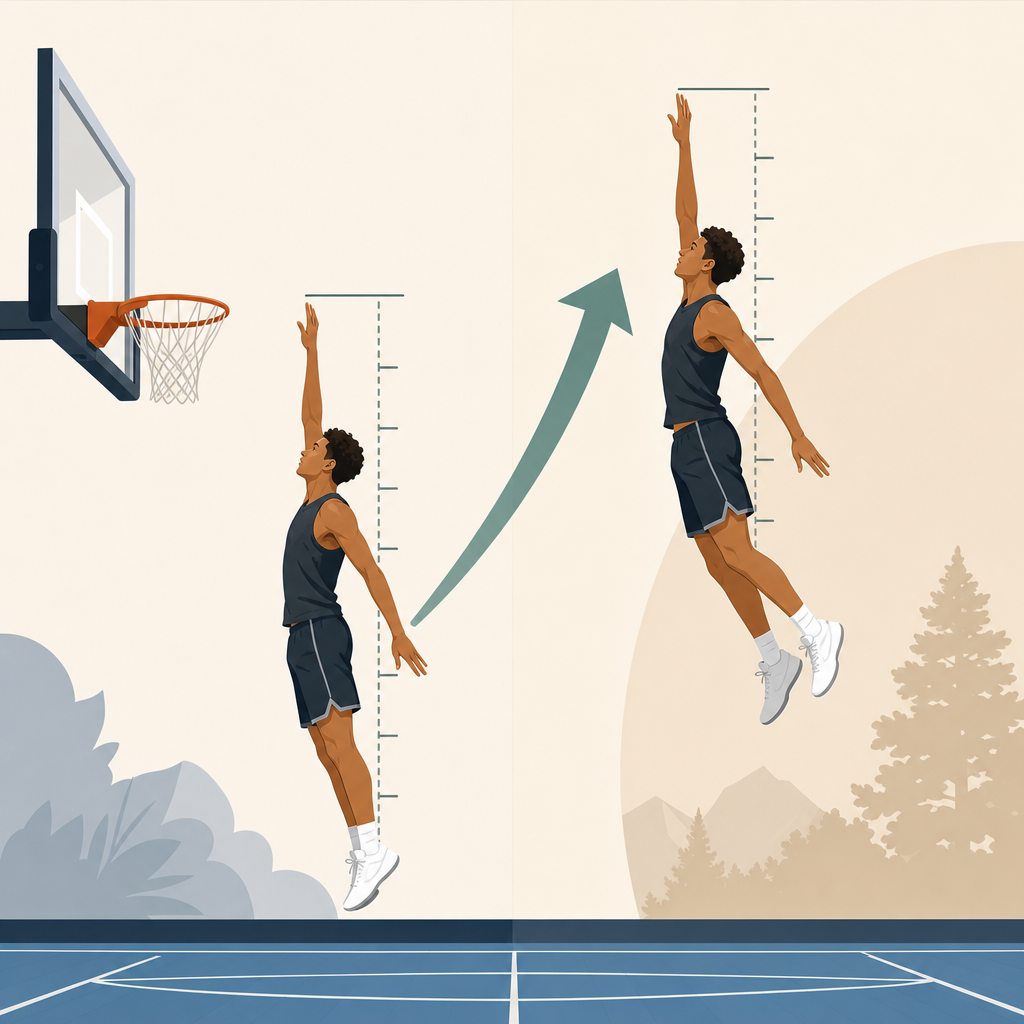
Vertical jump gains in one basketball season can be meaningful, but realistic progress depends on your training age, strength level, body composition, injury history, schedule, and how precisely you build athletic development around actual game demands. In basketball training, athletic development means improving the physical qualities that raise on-court performance: force production, rate of force development, reactive strength, coordination, landing skill, sprint speed, and resilience. A vertical jump is not just a test of leg power. It reflects how efficiently you absorb force, create stiffness through the ankle and knee, sequence the hips, swing the arms, and express strength quickly enough to leave the floor before the moment passes. That is why two athletes with similar squat numbers can have very different jumps.
When players ask me how much they can increase their vertical jump in one season, I answer with ranges, not promises. For a beginner who has never followed a structured basketball training plan, a four- to eight-inch improvement across an entire offseason plus season is possible, especially if poor technique and weak strength levels are the main limiters. For an intermediate athlete, two to four inches is a strong result. For advanced players who already lift well, sprint well, and jump often, even one to two inches can be a major gain. The key phrase is one season. In a competitive calendar, you are not training in a vacuum. Practices, games, travel, soreness, school, and sleep all affect adaptation.
This matters because vertical jump is tied to rebounding, shot blocking, finishing through contact, and first-step explosiveness. It also matters because many players waste months chasing generic “bounce” workouts that create fatigue without raising usable power. A smart athletic development plan improves jump performance while protecting knees, ankles, hips, and the lower back. As the hub for basketball training and athletic development, this guide explains what realistic jump gains look like, what drives them, how to measure progress, and how to organize training so your jump improves when it counts.
What a Realistic Vertical Jump Increase Looks Like in One Season
A realistic vertical jump increase depends first on your baseline. If your standing vertical is 18 inches and you cannot squat your body weight with control, your ceiling for short-term improvement is larger than that of a college guard already jumping 33 inches with solid strength metrics. In practice, I usually group athletes into three buckets. Novices often gain fastest because almost any organized exposure to strength training, landing mechanics, and jump technique creates adaptation. Intermediates need more precise programming. Advanced athletes require small, targeted improvements in weak links, because broad training no longer moves the needle much.
For most basketball players, a realistic in-season gain is modest: roughly zero to two inches, with maintenance sometimes being the true win during dense competition. Across the full season, including preseason and offseason work leading into competition, one to four inches is realistic for many healthy high school and college athletes. Four to eight inches can happen, but it is not normal and usually reflects low starting strength, poor prior training, improved body composition, or major technical inefficiency that gets corrected. Claims of ten-inch gains in a single season are outliers and often involve inconsistent testing, growing adolescents, or a shift from no training to serious training.
The best way to think about improvement is by percentages and performance context. A two-inch increase from 24 to 26 inches is an 8.3 percent jump gain. That is substantial. It can change whether you finish above a shot blocker, get your hand to the ball on a rebound, or contest at the rim without fouling. Players often underestimate how valuable small improvements are because social media conditions them to expect dramatic transformations. On the court, one extra inch delivered repeatedly, without knee pain and without losing speed, is useful athletic development.
The Factors That Actually Determine Your Jump Gains
Vertical jump training works when you identify what is limiting the athlete. The most common limiters are maximal strength, explosive strength, reactive strength, movement quality, body composition, and exposure to quality jumping. Maximal strength gives you the horsepower to produce force. Explosive strength determines how quickly you can access that force. Reactive strength reflects how well you transition from landing to takeoff, which matters in approach jumps, second jumps, and putbacks. Movement quality includes pelvic position, foot stability, trunk control, and arm swing timing. If one of these is weak, your jump stalls.
Strength matters more than many players realize. Research and field data consistently show strong relationships between lower-body strength and jump performance, especially in undertrained athletes. If a player cannot produce force in a trap-bar deadlift, squat, split squat, or rear-foot-elevated split squat, they usually struggle to express force vertically. That said, after a certain point, simply adding strength is not enough. A player with a double-bodyweight trap-bar deadlift but poor stiffness and timing may still jump below expectation. Then the limiting factor shifts toward elasticity, tendon behavior, and jump skill.
Body composition also matters. If you gain ten pounds during a season, your jump may drop unless force production rises enough to offset the extra mass. This is why “getting stronger” and “improving your vertical” are related but not identical goals. Sleep, nutrition, and tendon health are equally important. I have seen athletes follow excellent weight-room plans and still lose bounce because they sleep six hours a night, play year-round without deloads, and ignore patellar tendon soreness until every jump becomes guarded. Athletic development is always systemic.
How to Assess Your Starting Point Before Chasing More Bounce
Before writing a vertical jump program, test the athlete. Use a consistent countermovement jump, standing vertical jump, and approach jump. If available, tools such as a Vertec, jump mat, My Jump app, or force plates improve accuracy. Force plates are the gold standard because they show jump height, contraction time, peak force, asymmetry, and strategy. But simple tools still work if testing conditions stay the same: same warm-up, same shoes, same arm-swing rules, same surface, same time of day when possible.
You should also assess strength and movement. In basketball training, I commonly pair jump testing with trap-bar deadlift numbers, split-squat strength, isometric mid-thigh pull or isometric squat if available, 10-yard sprint, and repeated pogo or drop-jump quality. Watch how the athlete lands. Do the knees cave? Does the heel collapse inward? Is trunk stiffness poor? Can the player stick a landing quietly? A high jump with bad landing mechanics is not a success if it creates knee pain by January.
Testing helps answer practical questions. Is the player force dominant or velocity dominant? Do they jump better off one foot or two? Is the standing jump much lower than the approach jump, suggesting strong elastic qualities but weak concentric force? Is the athlete strong in bilateral lifts yet poor in unilateral control, which often shows up in layup takeoffs and deceleration? Once you know those answers, athletic development becomes specific instead of random.
What Training Methods Improve Vertical Jump Most Reliably
The most reliable vertical jump gains come from combining strength training, plyometrics, sprint work, and jump practice in doses the athlete can recover from. There is no single best program for every player, but there are reliable categories. Strength work raises the ceiling for force production. Plyometrics teach you to use that force fast. Sprinting improves stiffness, projection, and hip function. Jump practice builds coordination and sport-specific transfer. Remove any one category for too long and progress usually slows.
In the weight room, priority lifts are usually trap-bar deadlifts, squats, split squats, step-ups, Romanian deadlifts, calf raises, and isometric variations for the patellar tendon and ankle complex. Olympic lift derivatives like hang cleans or high pulls can help if coached well, but they are not mandatory. For plyometrics, use pogo jumps, snap-downs, box jumps, countermovement jumps, depth drops, and eventually depth jumps when the athlete has enough strength and landing quality. For basketball transfer, include approach jumps, repeated jumps, and game-like takeoff patterns from different angles.
| Athlete profile | Likely limiter | Best training emphasis | Realistic full-season gain |
|---|---|---|---|
| Beginner, low strength, poor mechanics | Force production and technique | Basic strength, landing drills, simple jumps | 3 to 6 inches |
| Intermediate, decent strength, inconsistent bounce | Explosive strength and reactive quality | Plyometrics, sprinting, targeted strength | 2 to 4 inches |
| Advanced, strong and trained | Specific weak links, recovery margin | High-quality low-volume power work | 1 to 2 inches |
Volume is where many plans fail. More jumps are not always better. Quality contacts matter more than endless fatigue circuits. For most in-season athletes, twenty to forty high-quality jump contacts in a session is plenty, especially when practices already include sprinting, cutting, and repeated takeoffs. If performance drops sharply during the session, the stimulus has probably shifted from power to fatigue management. That may have value sometimes, but it should not be confused with jump development.
How the Basketball Season Changes What Is Possible
The season itself is the biggest constraint on vertical jump improvement. During preseason, you can push strength and plyometric development more aggressively because game stress is lower. Once the schedule fills up, the goal often shifts from building to preserving and timing performance. Two heavy lower-body sessions per week may work in October. In January, with two games, a travel day, and a hard practice block, that same plan can flatten the athlete.
This is why periodization matters. Early phases should build tissue tolerance, foundational strength, and landing capacity. Mid phases can emphasize maximal strength and explosive work. Competitive phases should use lower volume and higher intent. A simple in-season structure might include one neural-focused lower-body lift, one brief jump exposure, and one microdose of tendon or isometric work to manage stiffness and pain. Team coaches often underestimate how much fatigue accumulates from practice alone. Every closeout, every transition sprint, and every rebound contest counts as workload.
Age and training age also change expectations. A 14-year-old new to training may add inches rapidly because maturation, coordination gains, and first-time strength work all stack together. A 22-year-old college player with five years of lifting should expect slower progress and tighter margins. Neither athlete is failing. They are simply at different points on the adaptation curve. Good basketball training respects that reality.
Common Mistakes That Kill Vertical Jump Progress
The biggest mistake is copying advanced dunk programs without building prerequisites. If an athlete lacks eccentric control, ankle stiffness, and basic strength, high-intensity depth jumps and marathon jump sessions usually produce shin pain, patellar tendon irritation, or flat legs. Another mistake is treating every workout like conditioning. Power training depends on freshness and intent. If rest periods are too short, jump height falls and the movement quality you are trying to improve disappears.
Another common error is neglecting unilateral work and deceleration. Basketball is full of one-leg takeoffs, lateral plants, and awkward landings. Players who only back squat and do bilateral jumps often look strong in testing but leak force during games. Poor ankle function is another hidden limiter. If the foot cannot create stiffness and the calf complex is weak, the athlete loses energy at ground contact. That is why serious athletic development includes calf raises, soleus work, isometrics, and barefoot or low-level foot drills when appropriate.
Finally, many athletes test too often and train too little. They chase a peak jump every week instead of accumulating quality work. Measure progress every four to six weeks under consistent conditions. In between, focus on execution. The body adapts to repeated, intelligent stress, not to constant proving.
How to Know If Your Program Is Working
A good vertical jump program shows progress in more than one place. Jump height may rise, but so should approach efficiency, landing control, repeated jump quality, sprint sharpness, and joint tolerance. Subjective markers matter too. The athlete should feel springier, not chronically heavy. Knees should tolerate practices better. Warm-ups should require less time to feel explosive. If jump numbers are static but game pop is improving and pain is down, the program may still be working.
Track trends, not isolated sessions. A force-plate countermovement jump can reveal whether peak force, impulse, or contraction time is changing before jump height does. Simpler setups can still track standing vertical, approach jump, broad jump, and reactive pogo quality. Pair that with wellness measures: sleep, soreness, and tendon pain scales. The best coaches blend objective numbers with daily observation.
For athletes building a complete athletic development base, vertical jump is one important KPI, not the only one. If you want better results this season, assess honestly, train the real limiter, control fatigue, and connect every drill back to basketball performance. Then explore the rest of this Basketball Training hub for deeper guides on strength, plyometrics, sprint mechanics, recovery, and in-season programming. Small, well-earned gains in bounce can change games, and the right system makes those gains repeatable.
Frequently Asked Questions
How much can you realistically increase your vertical jump in one basketball season?
For most basketball players, a realistic in-season or single-season vertical jump increase is usually noticeable but not extreme. Beginners or younger athletes with limited training history may gain around 2 to 6 inches over the course of a full season if their program is well structured and they are consistent. Intermediate athletes often see more modest improvements, commonly in the 1 to 4 inch range, especially if they already have a solid strength and jumping base. Advanced players who have trained seriously for years may only improve by a fraction of an inch to 2 inches, but even that can be meaningful in basketball because small gains can change finishing angles, rebounding reach, shot-block timing, and overall explosiveness.
The biggest mistake is assuming every athlete should expect the same outcome. Your current strength level, body composition, tendon health, movement quality, schedule, sleep, and game volume all affect how much progress is realistic. A player who is weak relative to body weight, has never trained explosively, and improves both strength and mechanics can make fast progress. A player who is already strong, lean, and technically efficient usually needs much more precise programming to earn smaller gains. That is why realistic expectations matter: one season can absolutely produce meaningful improvement, but the exact amount depends on where you are starting and how effectively your training supports actual basketball performance.
What factors have the biggest impact on how much your vertical jump can improve in one season?
Several factors strongly influence vertical jump progress, and they all interact. Training age is one of the most important. If you are new to strength training, plyometrics, sprint work, and landing mechanics, you often have a lot of untapped potential. Strength level also matters because jumping is ultimately about producing force against the ground quickly. Athletes who improve lower-body strength and stiffness while maintaining efficient mechanics often raise their jump more effectively than athletes who only do random jump workouts.
Body composition plays a major role as well. If a player gains useful strength without gaining unnecessary body mass, jump performance usually benefits. On the other hand, carrying excess body fat can make it harder to express power vertically. Injury history is another major limiter. Athletes dealing with knee pain, ankle instability, tendinopathy, or recurring soft-tissue issues may struggle to tolerate the volume and intensity needed for jump gains. Schedule is just as important. A player in a long season with heavy practice loads, games, travel, and poor sleep may have less room for aggressive jump training than a player in a lighter competitive environment.
Precision of training is often the deciding factor. Athletic development for basketball is not just “jumping more.” It means improving force production, rate of force development, reactive strength, coordination, landing skill, sprint speed, and resilience in a way that fits the real demands of practices and games. The best programs balance strength work, explosive work, recovery, and movement quality so the athlete improves without getting overtrained. When those pieces are aligned, vertical jump gains become much more realistic and repeatable.
Can you improve your vertical jump during the season, or is the off-season the only time that really matters?
Yes, you can improve your vertical jump during the season, but the type and pace of progress are different from the off-season. During the season, the goal is often to maintain or slightly improve explosive qualities while staying fresh enough to perform in games. Practices, competition, travel, and fatigue reduce how much training volume most players can handle. Because of that, in-season improvements usually come from efficient, targeted work rather than high-volume training blocks. Small gains in strength, jump efficiency, reactivity, and freshness can still translate into better jump numbers and better game explosiveness.
The off-season typically offers more room for bigger development because there is more time to build foundational strength, improve body composition, address movement limitations, and gradually progress plyometric and sprint workloads. That said, many athletes leave gains on the table during the season by treating it as a period where no development is possible. A smart in-season plan can absolutely help. Short strength sessions, carefully dosed plyometrics, quality sprint exposure, and recovery management can maintain or even improve the physical qualities behind jumping.
The key is understanding that in-season training should support basketball, not compete with it. If you crush your legs with fatigue-heavy workouts and then expect to jump higher in games, you are missing the point. The most effective in-season approach uses just enough stimulus to preserve or raise performance while controlling soreness and keeping the athlete elastic, coordinated, and healthy. So yes, the off-season is usually better for larger improvements, but one season of properly managed training can still produce measurable vertical jump gains.
What kind of training actually helps increase vertical jump for basketball players?
The best vertical jump training for basketball combines several qualities instead of relying on one method. Strength training matters because stronger athletes can often apply more force into the ground. Exercises such as squats, trap bar deadlifts, split squats, Romanian deadlifts, and step-ups can build the lower-body force production needed for jumping. But strength alone is not enough. You also need to improve how quickly you can use that force, which is where explosive lifting variations, medicine ball throws, sprinting, and plyometrics become valuable.
Plyometric training is especially important because it develops reactive strength, stiffness, timing, and the ability to produce force quickly during short ground contacts. Jumps, bounds, pogo variations, depth drops, and low-to-moderate volume reactive drills can help if they are chosen at the right level for the athlete. Sprint work also deserves more attention than many players give it. Sprinting and jumping are closely connected because both require powerful force application, coordination, and elasticity. Improving acceleration mechanics and short sprint ability often supports better explosiveness overall.
Landing mechanics and resilience are just as important as peak jump output. If a player cannot absorb force well, stabilize efficiently, and manage repeated contacts, it becomes harder to train explosively over time without pain or breakdown. That is why a complete program includes deceleration work, single-leg control, ankle and foot strength, core stability, and progressive exposure to game-like jumping demands. The strongest programs are individualized. A weak athlete may need more force development. A strong but slow athlete may need more reactive and speed-focused work. A bouncy athlete with recurring pain may need better landing strategy and load management. Vertical jump improvement happens fastest when training addresses the athlete’s actual limiting factor rather than chasing generic “bounce” workouts.
Why do some players train hard all season and still see little or no vertical jump improvement?
Hard work does not always equal effective progress. One common reason players fail to improve is that their training lacks direction. They may do lots of jumping, lifting, conditioning, and basketball, but without a plan that targets their specific weak points. For example, an athlete who already jumps often in practice may not need more random jump volume. They may need greater maximal strength, better ankle stiffness, improved recovery, or reduced fatigue. Another athlete may be strong enough already but lack reactive ability and coordination. If the training stimulus does not match the real limitation, results stay flat.
Fatigue is another huge reason. Basketball seasons create constant stress through games, practices, travel, school or work demands, and inconsistent sleep. Even if an athlete is technically getting stronger or fitter, accumulated fatigue can hide those gains and suppress jump performance. Poor recovery, under-eating, pain, and excessive conditioning can all interfere with explosiveness. In some cases, the player is improving physically, but they never feel fresh enough to express it. That is why timing, monitoring, and load management matter so much.
Technique and movement quality also matter more than many athletes realize. Two players with similar strength can have very different jump outputs based on coordination, approach mechanics, arm swing, penultimate step quality, stiffness, and force direction. Injury history can further reduce progress by limiting training consistency or causing the athlete to subconsciously avoid forceful movement. Finally, expectations may simply be unrealistic. Social media often makes it seem normal to add 8 to 12 inches quickly, but for many serious basketball players, even a 2-inch gain in one season is valuable. When training is specific, recovery is respected, and progress is judged realistically, even modest improvements can be a major win on the court.