
Backcourt violation in basketball is one of the simplest rules to state and one of the easiest plays for fans and young players to misunderstand in live action. In plain terms, a backcourt violation happens when the offensive team establishes control of the ball in the frontcourt and then is the first to touch that ball again in the backcourt, unless the defense caused the ball to go there. The rule matters because it protects offensive and defensive balance, prevents teams from retreating endlessly to avoid pressure, and keeps possessions moving toward scoring action. Within the broader set of basketball game rules, the backcourt rule sits beside traveling, double dribble, three seconds, eight seconds, and shot clock regulations as a core possession rule every player, coach, and viewer should know. I have had to teach this rule to guards, wings, and even experienced adult players, and the same questions come up every season: When is frontcourt status established? Does a tipped pass reset the rule? What if both feet are over the line? The answers depend on control, team control, and location, not just where the ball bounces. Once those concepts are clear, the call becomes far less mysterious.
To understand a backcourt violation, you need a few key definitions used across organized basketball. The frontcourt is the half of the playing court where a team is trying to score, bounded by the division line, endline, and sidelines. The backcourt is the half containing the team’s own basket. Team control exists when a player is holding or dribbling a live ball, or when teammates are passing among themselves inbounds. Player and ball location also matters. For frontcourt status, the ball and the player in control must satisfy location requirements recognized by the rules code in use, whether NBA, NCAA, or NFHS. Although wording differs slightly among leagues, the underlying principle is consistent: once the offense has advanced the ball and established frontcourt control, it may not be the team to return the ball to the backcourt and regain it there. This article serves as a game rules hub within NBA rules coverage, so it explains not only what the violation is, but also how officials judge it, why it exists, how it differs by level, and what related rules every fan should connect to it.
What a Backcourt Violation Is and the Exact Sequence Officials Look For
A backcourt violation is not just “the ball crossed the half-court line and came back.” The full sequence has to occur. First, the offensive team must have team control. Second, that team must cause the ball to gain frontcourt status. Third, the ball must then be the first to touch the backcourt after frontcourt status has been established, or an offensive player who is in the frontcourt must be the last to touch it before it goes back. Fourth, the offense must be the first team to touch the ball in the backcourt. If the defense tips, bats, or knocks the ball into the backcourt, the offense may retrieve it legally. That is the point most fans miss.
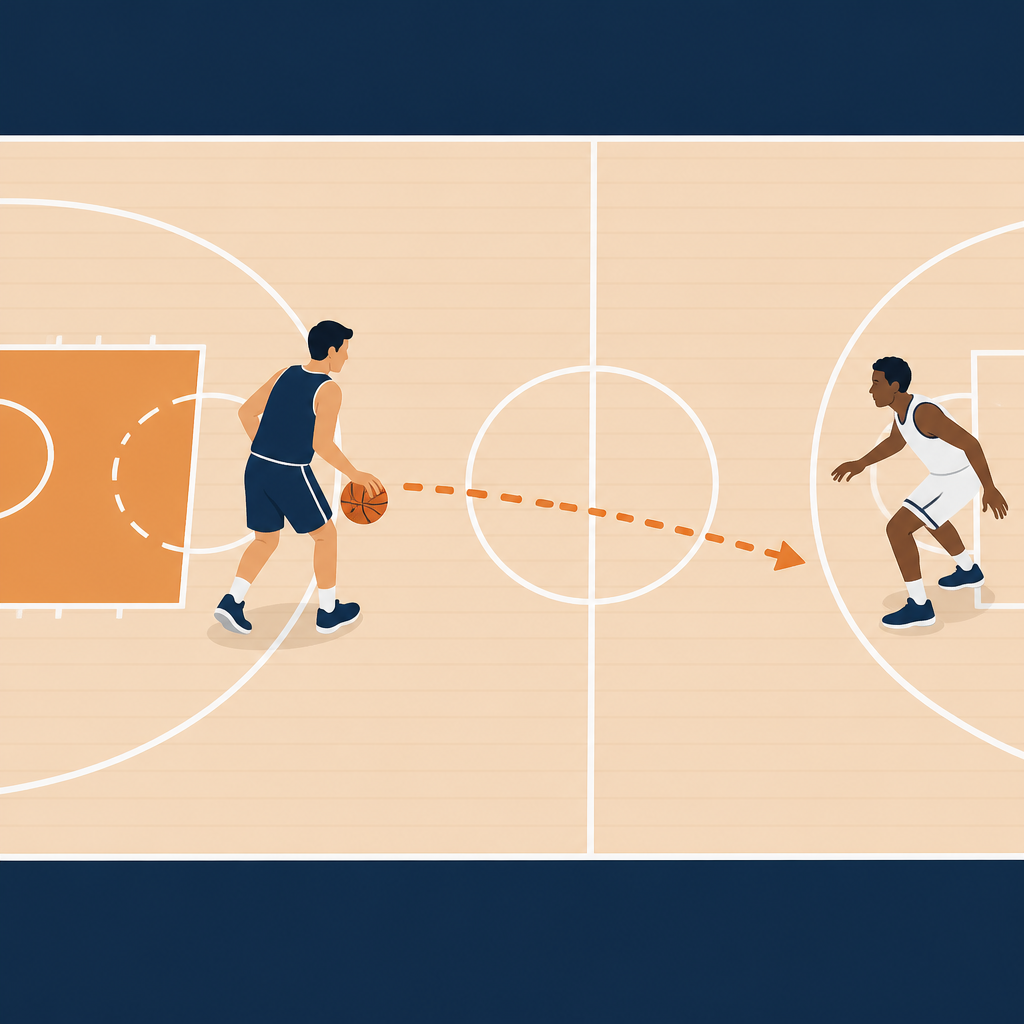
Officials do not guess on this play. They track the last player to touch the ball, whether team control existed, and whether the defense altered the path. In practical terms, imagine a point guard dribbling over midcourt, picks up the dribble, and throws a soft reversal pass toward a teammate near the logo. If the pass sails backward over the division line untouched by the defense and the original team runs back to recover it, that is a violation. If a defender gets fingertips on the pass and deflects it into the backcourt, it is legal for the offense to chase it down. That one touch by the defense changes the ruling entirely because the offense no longer caused the return by itself.
The rule is enforced by awarding the ball out of bounds to the opposing team at the nearest spot, subject to the applicable league’s inbounding procedures. There are no free throws attached, and the violation does not count as a personal foul. Still, the possession cost is significant. In a close game, a backcourt violation wipes out scoring chances, can trigger transition opportunities the other way, and often reflects poor spacing or panic against pressure defense.
How Frontcourt and Backcourt Status Are Determined
The hardest part of the rule is usually location. A player’s status is determined by where the person is touching the floor. The ball’s status depends on where it is relative to the court and to the player in control. In the NBA, a team in control in the frontcourt may not be the last to touch the ball in the frontcourt and then the first to touch it in the backcourt. In high school and college interpretations, frontcourt status is also tied to whether the ball and player have both achieved frontcourt location. Because the division line is part of the backcourt in most rule sets, a player straddling or touching the line has not fully established frontcourt status.
This is why dribblers get special instruction on crossing midcourt. If the dribbler’s back foot is still in the backcourt while the ball and front foot are in the frontcourt, the ball may not yet have full frontcourt status under that code’s interpretation. Once both feet and the ball have crossed and team control is in the frontcourt, returning the ball becomes restricted. I have seen youth coaches teach “two feet and the ball” as the safe habit because it removes ambiguity and keeps players from making risky retreat dribbles near the line.
The line itself creates many bang-bang plays. A player standing with one foot on each side of the division line is considered in the backcourt because line contact counts there. A pass caught while airborne is judged by the location of the player when returning to the floor. If a player jumps from the frontcourt, catches the ball, and lands in the backcourt, the landing spot controls the status. Those details explain why some plays that look legal at full speed are called violations after all.
Common Game Situations That Produce the Call
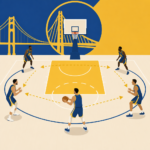
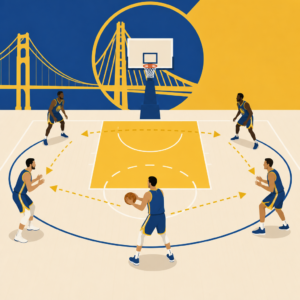
Most backcourt violations come from four situations: pressure defense, careless reversal passes, trapped ball handlers, and misunderstandings after loose balls. Full-court pressure is the classic trigger. A guard beats the first line, crosses half court, sees a trap forming, and instinctively throws the ball backward to escape. If no defender touched it and a teammate retrieves it in the backcourt, the whistle is automatic. Coaches drill against this by teaching diagonal outlets to the middle or sideline safety valves already in the frontcourt.
Careless reversal passes near the logo are next. Teams that run delay action or flow offense often swing the ball above the top of the key. A passer who relaxes and floats a pass without recognizing a teammate’s momentum can easily send the ball over the line. At the NBA level, where spacing is wide and passing windows are tight, these turnovers often happen when teams are trying to reset late-clock offense after the initial action stalls.
Loose-ball confusion also creates problems. Suppose an offensive player in the frontcourt fumbles the ball off a foot and it rolls untouched into the backcourt. Because the offense caused the ball to go there, that same team cannot be first to recover it. But if a defender pokes it free, legal recovery changes. The distinction is not whether the play looked accidental; it is which team last touched it and whether team control existed when the sequence began.
| Situation | Last touch before ball goes back | First touch in backcourt | Ruling |
|---|---|---|---|
| Guard throws backward pass after crossing midcourt | Offense in frontcourt | Offense | Backcourt violation |
| Defender deflects pass into backcourt | Defense | Offense | Legal play |
| Offensive player fumbles dribble untouched into backcourt | Offense in frontcourt | Offense | Backcourt violation |
| Jump ball tap in frontcourt with no team control established | No team control | Either team | Legal play |
| Shot attempt hits rim and bounces to backcourt | Shot ends team control | Either team | Legal play |
Exceptions, Edge Cases, and Why Some Plays Are Legal
The rule has important exceptions. The biggest is that there must be team control before the violation sequence can occur. On a try for goal, team control ends when the shot is released. If the ball hits the rim and flies into the backcourt, either team may recover it legally. The same logic applies on a tapped rebound or a scramble where no team control exists. Fans often think any offensive touch after a ball returns over half court is illegal, but without prior team control in the frontcourt, there is no backcourt violation.
Deflections are another major exception. If the defense bats the ball, even slightly, and that touch sends it into the backcourt, the offense can retrieve it. Officials are trained to identify intentional or accidental defensive contact because that touch resets the offensive team’s freedom to pursue the ball. This is why coaches tell players under pressure to throw firm passes; soft floaters are easier to tip, and once tipped, the offense may get a second chance rather than a violation, but it also risks a live-ball steal.
There are also save plays near the division line. A player in the frontcourt may jump, catch, and attempt to save a loose ball, but the landing spot and last-touch sequence still matter. A player cannot gain frontcourt control and then be the one to return it illegally. However, a defender’s touch or the absence of team control can keep the play legal. These are mechanics-heavy judgments, which is why replay sometimes enters the conversation in leagues that permit review of boundary and possession elements.
Differences Between NBA, NCAA, and High School Interpretations
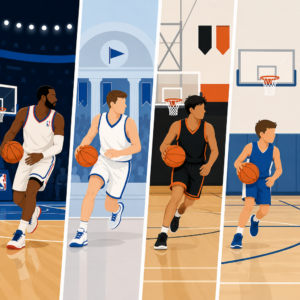
The backcourt rule is broadly similar across levels, but wording and emphasis differ. In the NBA rulebook, the principle centers on a team in frontcourt possession not being the last to touch the ball in the frontcourt and the first to touch it in the backcourt. NCAA and NFHS rules use language that ties frontcourt status to the ball and player location more explicitly. For practical viewing, the result is usually the same, but instructional details can change how coaches teach guards to establish safe frontcourt possession.
The NBA also pairs the backcourt concept with the eight-second rule, which requires teams to advance the ball from the backcourt to the frontcourt within eight seconds. NCAA men’s basketball uses a 10-second count, while women’s NCAA and many other levels have adopted different timing structures over time. These timing rules interact with backcourt decisions because a team that barely beats the count and then commits a backcourt violation has not only survived pressure but wasted the advance.
In high school games, officials often emphasize the division line and player location because developing players make more line-related mistakes. In the NBA, where skill level is higher, many backcourt calls come from advanced defensive pressure, late-clock spacing, or unusual deflections. The standard is not looser at the professional level; the players are simply better at avoiding obvious errors, so the violations that do occur often involve subtle touches and fast rotations rather than basic confusion.
Why the Rule Exists and How Teams Use It Strategically
The backcourt rule exists to prevent stalling and to reward successful defensive pressure. Without it, an offense could cross half court to relieve a count or improve spacing and then retreat whenever a trap appeared. That would make pressing less effective and slow the game down. Basketball rules are designed to create fair constraints that produce action, and the backcourt rule is a prime example. It forces offensive decision-making under pressure and gives defenders a real incentive to cut off passing angles once the ball has advanced.
Strategically, teams exploit this rule with half-court traps set just after the ball crosses the line. The sideline and division line act as extra defenders, shrinking usable space. Veteran guards know they must keep dribbles alive, pivot away from the trap, or hit an immediate release valve in the frontcourt. Coaches often script “press offense into attack” actions so that crossing half court is not the end of the press break but the start of a scoring opportunity. That approach reduces panic and lowers the chance of an illegal retreat pass.
Defenses also teach controlled deflections. Getting even a fingertip on a reversal pass can turn a certain violation into a live-ball scramble, but it can also create steals. Offensively, spacing solves many problems. A middle receiver, a diagonal safety, and a deep sideline runner give the ball handler legal outlets. When those outlets are absent, backcourt violations rise because the dribbler sees only one escape: backward.
How Players, Coaches, and Fans Can Read the Play Correctly
The easiest way to judge a possible backcourt violation is to ask three questions in order. Did the offense have team control? Did it establish frontcourt status? Did the offense cause the ball to return to the backcourt and touch it there first? If all three answers are yes, it is a violation. If the defense touched the ball, if no team control existed, or if frontcourt status had not yet been established, the play is legal. This checklist works on almost every disputed sequence.
For players, the prevention habits are straightforward: cross decisively, keep spacing wide, avoid casual retreat dribbles near the line, and know your safety outlets before the trap arrives. For coaches, the best teaching method is film review. I have found that players learn faster when clips are paused at the exact moment of last touch and again at recovery. That turns a fuzzy rule into a visible sequence. For fans, understanding this rule makes press defenses, replay reviews, and late-game turnovers much easier to follow.
Backcourt violation in basketball is ultimately a possession rule built on control, court location, and responsibility for the ball’s movement. Learn those three ideas and most controversial calls become clear. As part of the wider game rules landscape, it connects directly to the eight-second count, inbounds procedure, shot attempts, and defensive pressure concepts. If you want a stronger grasp of NBA rules, start by mastering possession rules like this one, then build outward to timing, contact, and scoring situations. Watch the next game with the three-question checklist in mind, and you will spot the call before the whistle.
Frequently Asked Questions
What is a backcourt violation in basketball?
A backcourt violation happens when the offensive team has already established control of the ball in the frontcourt and then is the first team to touch that same ball again in the backcourt. In simpler terms, once your team has successfully advanced the ball across midcourt and gained frontcourt status, you cannot send it back behind the division line and recover it yourself. That is what officials are watching for on these plays.
Three parts usually have to be present for the call to be made. First, team control must exist, meaning the offense is clearly in possession or control of the ball. Second, the ball must achieve frontcourt status, which generally means both the ball and the player in control have crossed the midcourt line into the offensive half. Third, the offensive team must be the first to touch the ball after it returns to the backcourt. If the defense tips it, deflects it, or otherwise causes it to go back, the violation usually does not apply.
This rule exists to keep the game moving and to prevent teams from avoiding pressure by repeatedly retreating into the backcourt after advancing the ball. It is one of the easier rules to describe, but in live action it can be confusing because fans often focus only on where the ball goes rather than who had control and who touched it last. That is why officials break the play down in sequence rather than judging it on appearance alone.
When does a team officially gain frontcourt status?
A team gains frontcourt status when the player in control of the ball and the ball itself both are in the frontcourt. This is where a lot of confusion starts. The midcourt line is part of the backcourt, so simply touching or stepping on the line does not mean the ball is safely in the frontcourt yet. For a dribbler, both feet and the ball must be completely across into the frontcourt for frontcourt status to be established. Until that happens, the team is still considered in the backcourt.
On a pass, the timing can be different because team control continues during the pass. If a player throws the ball from the backcourt toward the frontcourt, the offense does not automatically gain frontcourt status the moment the ball crosses the line in the air. Officials look at where control is completed. Once an offensive player catches or secures the ball in the frontcourt, that is typically when frontcourt status is clearly established. After that point, the offense cannot be the first to touch it again in the backcourt unless the defense caused the change.
This is why close plays at half court can lead to debate. A player may appear to be “over and back” to fans, but if one foot is still in the backcourt or the ball has not yet achieved frontcourt status with player control, the violation has not occurred. Understanding that frontcourt status is about both location and control helps make these calls much easier to follow.
Does it count as a backcourt violation if the defense tips or deflects the ball?
No, not if the defense is the reason the ball goes into the backcourt. That is one of the most important exceptions to the rule. A backcourt violation requires the offensive team to be responsible for returning the ball to the backcourt and then to be the first to touch it there. If a defender gets a hand on the pass, pokes the dribble loose, or deflects the ball off course so it ends up behind the midcourt line, the offense is generally allowed to recover it without penalty.
The key issue is cause. Officials ask whether the ball returned to the backcourt because of an offensive action or because of defensive contact. If the offense simply mishandles the ball on its own after establishing frontcourt control, that can still be a violation if the ball goes back and the offense touches it first. But if the defender clearly altered the ball’s path, the offense has not committed an over-and-back violation because the return was not self-created in the way the rule prohibits.
This distinction is especially important on trapping defenses and high-pressure plays near midcourt. Fans often see the ball end up in the backcourt and immediately assume a violation, but the official is focused on whether a defender touched it and whether that touch caused the ball to cross back. In many of those situations, the offense is entitled to chase it down and continue the possession.
Can a player jump from the frontcourt, catch or touch the ball, and land in the backcourt?
That kind of play can absolutely result in a backcourt violation, and it is one of the most misunderstood situations in basketball. If an offensive player has frontcourt status and then jumps, airborne status does not erase where the player came from for purposes of the rule. If that player is considered to have last touched or controlled the ball in the frontcourt and then is the first to touch it again while landing in the backcourt, officials may rule a backcourt violation.
These plays get tricky because they involve momentum, location, and timing. For example, a player near the division line might leap from the frontcourt to save a loose ball and bat it backward. If that player or a teammate from the same team is the first to touch the ball in the backcourt after frontcourt control had already been established, the offense may be guilty of over-and-back. On the other hand, if the defense touched the ball in between, or if frontcourt status had not actually been established yet, then the violation may not apply.
This is why coaches teach players to be very aware of their body position near half court. A great hustle play can still become a turnover if the player does not understand the line and the sequence of touches. The safest approach after establishing the frontcourt is to avoid any pass, dribble, or save that risks sending the ball back unless a defender clearly made it happen.
Why is the backcourt violation rule important, and how can players avoid getting called for it?
The backcourt violation rule is important because it preserves balance between offense and defense. Without it, an offense that successfully beat pressure could simply retreat into the backcourt whenever the defense recovered, reducing the value of full-court defense and slowing the pace of the game. The rule forces the offensive team to make a committed advance into the frontcourt and stay there once control is established. That creates more structure, rewards defensive pressure, and keeps possessions moving in the intended direction.
For players, avoiding the violation starts with awareness. Ball handlers need to know exactly where the midcourt line is and remember that the line itself belongs to the backcourt. They also need to avoid careless retreat dribbles, rushed reversal passes near half court, and panic plays against traps. Teammates should present safe passing angles after the ball crosses, rather than drifting backward toward the line where a catch or deflection can create trouble. Good spacing alone prevents many over-and-back turnovers.
Coaches often stress simple habits: cross under control, keep dribbles strong, do not pick up the ball near midcourt unless you have a clear passing option, and understand that once the offense has frontcourt status, the backcourt is off-limits unless the defense causes the ball to go there. For young players especially, learning this rule is less about memorizing a definition and more about recognizing game situations. Once they understand control, frontcourt status, and who touched the ball last, the rule becomes much easier to apply and avoid.