

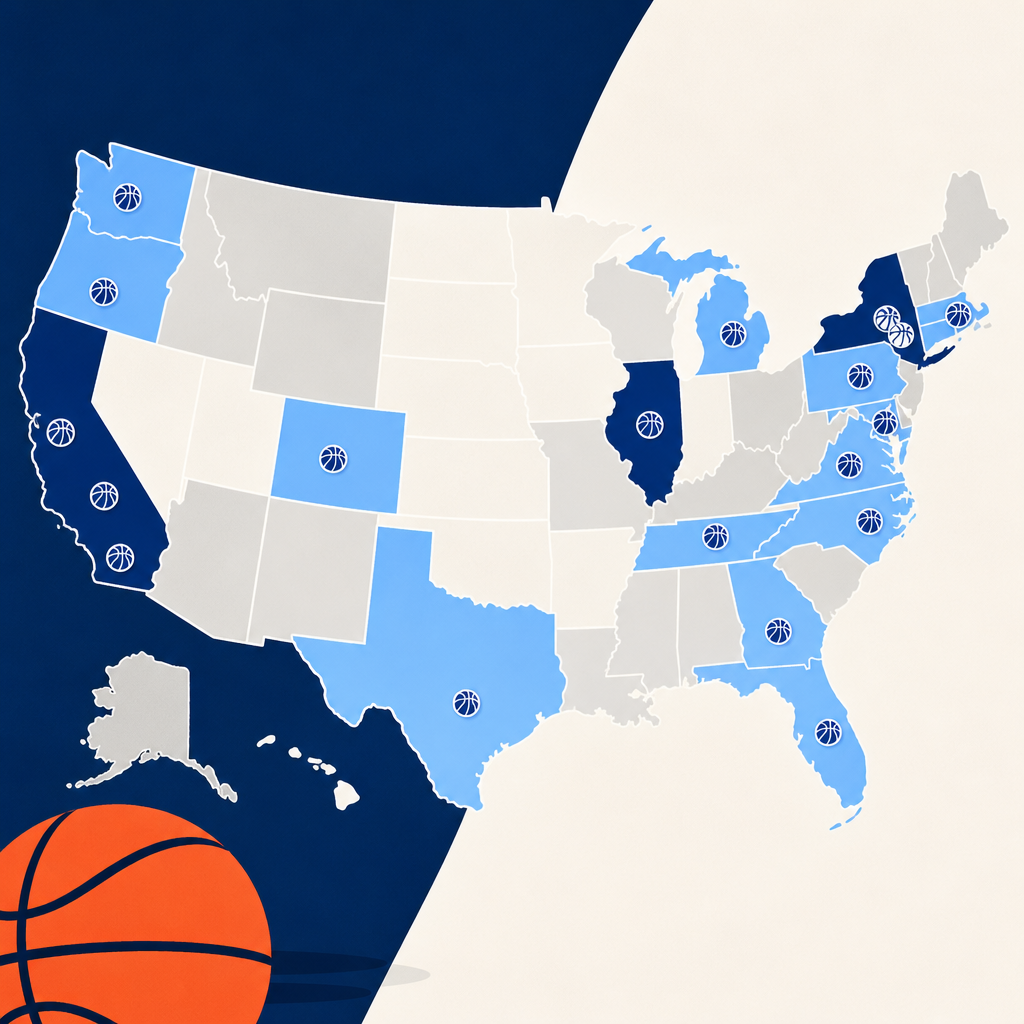
The NBA’s geographic footprint tells a larger story about league structure, media economics, travel logistics, and the uneven distribution of major professional sports across the United States. “NBA teams by state” sounds like a simple count, but it opens the door to bigger questions: Which states have multiple franchises, which states have none, why were teams placed where they are, and how does that map shape the way fans understand the league? For anyone learning NBA basics, this is one of the clearest ways to grasp how the league is organized and why some markets carry outsized influence.
In practical terms, an NBA franchise is a member club in the National Basketball Association, currently one of 30 teams split between the Eastern and Western Conferences and further divided into six divisions. A state, of course, is the political unit most U.S. fans use to locate a team, even though the league itself operates primarily by metropolitan markets rather than state borders. That distinction matters. The Golden State Warriors do not represent a single city name, the Washington Wizards play in the District of Columbia rather than a state, and several teams draw support from multi-state regions. When people ask how many NBA teams a state has, they are really asking how professional basketball markets are distributed across the country.
I have used this state-by-state framework often because it helps new fans connect league structure to real-world geography. It also clarifies why some rivalries feel local, why national TV schedules favor certain regions, and why expansion talk usually starts with population, corporate sponsorship, arena readiness, and travel efficiency. States with multiple teams usually have large media markets and dense population centers. States with no teams may still have strong basketball cultures, but they lack some combination of ownership groups, suitable arenas, local television value, or strategic fit within the league’s broader map.
This article serves as a hub for understanding league structure through geography. It will cover which states have the most NBA franchises, identify every state with no team, explain how conferences and divisions relate to location, and examine why market size is not the only factor in franchise placement. If you want a strong foundation in NBA basics, start here: the map explains more about the league than many standings pages ever will.
How NBA Teams Are Distributed Across States
The NBA has 30 franchises, but those teams are not spread evenly across the 50 states. In fact, most states have no NBA team at all, while a small number have two, three, or even four franchises. This concentration reflects the league’s long-term preference for major metropolitan markets with strong revenue potential. Teams are placed where ticket demand, regional media rights, corporate partnerships, and arena infrastructure can support a modern franchise.
As of today, California has the most NBA teams with four: the Los Angeles Lakers, Los Angeles Clippers, Golden State Warriors, and Sacramento Kings. Texas follows with three: the Dallas Mavericks, Houston Rockets, and San Antonio Spurs. Florida and New York each have two teams. Many other states have one, including Arizona, Colorado, Georgia, Illinois, Indiana, Louisiana, Massachusetts, Michigan, Minnesota, Oklahoma, Oregon, Pennsylvania, Tennessee, Utah, and Wisconsin. Canada also has one franchise, the Toronto Raptors, which matters when discussing overall league structure even though this article focuses on states.
| State | Number of NBA Teams | Teams |
|---|---|---|
| California | 4 | Lakers, Clippers, Warriors, Kings |
| Texas | 3 | Mavericks, Rockets, Spurs |
| Florida | 2 | Heat, Magic |
| New York | 2 | Knicks, Nets |
| Single-team states | 16 | AZ, CO, GA, IL, IN, LA, MA, MI, MN, OK, OR, PA, TN, UT, WI, plus DC not a state |
One important clarification: the Washington Wizards are not in a state, because Washington, D.C., is a federal district. If you are counting NBA franchises by U.S. state strictly, D.C. does not increase any state total. That detail comes up often in search queries and trivia discussions, and it is one of the easiest mistakes for newer fans to make.
Which States Have the Most NBA Franchises
California leads the country with four NBA franchises, and that dominance is not accidental. The state combines massive population, multiple top-tier media markets, deep basketball culture, and significant corporate wealth. Los Angeles alone supports two teams, the Lakers and Clippers, because its television market, arena demand, sponsorship base, and celebrity profile are unusually large. Northern California supports the Warriors in the Bay Area and the Kings in Sacramento, giving the state representation in separate media and political regions.
Texas ranks second with three teams, and its case shows that population growth can sustain multiple successful franchises without placing them in the same city. Houston, Dallas, and San Antonio are distinct markets with different regional identities. The Rockets serve a major energy and international business hub, the Mavericks play in one of the country’s largest metro areas, and the Spurs became a model small-market franchise through sustained success, strong ownership stability, and elite basketball operations under Gregg Popovich and R.C. Buford.
Florida and New York each have two teams, but their structures differ. New York’s Knicks and Nets are both tied to the New York City metropolitan area, even though the Nets originated in New Jersey before moving to Brooklyn in 2012. Florida’s teams split the state between the Miami Heat in South Florida and the Orlando Magic in Central Florida. That gives the league access to two separate television regions and fan bases rather than doubling down on one city.
These states matter disproportionately in league business. They host some of the NBA’s biggest arenas, highest franchise valuations, and most visible national brands. Forbes valuations regularly place clubs such as the Warriors, Lakers, Knicks, and Nets among the league’s most valuable properties, reflecting the same state-level concentration seen on the map. When fans ask which states have the most NBA teams, they are also asking where the league’s commercial center of gravity sits. The answer is clear: on the coasts and in the large Sun Belt markets.
States With One NBA Team and What That Means
Most NBA franchise states have exactly one team. That list includes Arizona, Colorado, Georgia, Illinois, Indiana, Louisiana, Massachusetts, Michigan, Minnesota, Oklahoma, Oregon, Pennsylvania, Tennessee, Utah, and Wisconsin, with Ohio notably absent because it has the Cleveland Cavaliers, bringing the single-team total higher when counted carefully. Missouri has no NBA team despite having major sports cities. New Jersey has none since the Nets moved to Brooklyn.
Single-team states often anchor an entire regional fan base. The Utah Jazz are the only NBA team in Utah, but their support extends into Idaho, Wyoming, and parts of Nevada. The Indiana Pacers represent not just Indianapolis but one of the country’s strongest basketball cultures at the high school and college levels. The Portland Trail Blazers effectively serve all of Oregon and much of the Pacific Northwest outside the Seattle area, especially since the SuperSonics relocated and became the Oklahoma City Thunder in 2008.
Having one team can create a cleaner identity than sharing a market. The Milwaukee Bucks are synonymous with Wisconsin basketball in a way that would be harder if the state had a second franchise. The Denver Nuggets hold a similar position in Colorado, where they compete for attention with the NFL’s Broncos and MLB’s Rockies but still function as the state’s only NBA flagbearer. In my experience, these one-team states often produce some of the most coherent local fan cultures because loyalties are less divided geographically.
That said, one-team states are not automatically small markets. Illinois has the Chicago Bulls, one of the league’s premier global brands because of the Michael Jordan era. Pennsylvania has the Philadelphia 76ers, a flagship Eastern Conference franchise in a major market. Massachusetts has the Boston Celtics, perhaps the league’s most historically decorated organization. So the category “one team” says more about state-level distribution than market importance.
Which States Have No NBA Team
A majority of U.S. states have no NBA franchise. That group includes Alabama, Alaska, Arkansas, Connecticut, Delaware, Hawaii, Idaho, Iowa, Kansas, Kentucky, Maine, Maryland, Mississippi, Missouri, Montana, Nebraska, Nevada, New Hampshire, New Jersey, New Mexico, North Carolina does have the Hornets, so it should not be included, while North Dakota, South Carolina, South Dakota, Vermont, Virginia, West Virginia, and Wyoming have none. The exact list becomes easier to understand when you remember the NBA favors metro markets over statewide representation.
Some no-team states surprise people. Kansas and Kentucky are obvious examples because both are central to American basketball culture. Yet elite college support does not guarantee NBA viability. Kentucky has no franchise despite Louisville’s basketball history, and Kansas has none despite Kansas City’s NBA past and college pedigree. Maryland and Virginia also have no team, even though both sit inside the broader Washington metropolitan area and may support the Wizards informally. Nevada lacks a team despite Las Vegas being one of the most discussed expansion candidates.
There are several reasons a state may have no NBA team. First is market size: the league needs a metro area large enough to drive ticket sales, premium seating, local sponsorships, and media deals. Second is arena quality: modern NBA venues need revenue-generating suites, club spaces, broadcast infrastructure, and practice facilities. Third is ownership: the NBA does not place a team somewhere simply because fans want one; it requires a capitalized ownership group and long-term political and business support. Fourth is geographic balance: too many teams clustered in one part of the country can complicate scheduling and dilute neighboring markets.
It is also important not to confuse “no NBA team” with “no NBA influence.” States without franchises often produce players, TV audiences, merchandise sales, and travel fans. Las Vegas hosts NBA Summer League and the NBA Cup championship rounds. Seattle, in Washington state, has no active team but remains one of the strongest expansion candidates because of its history with the SuperSonics, renovated arena, and established corporate base.
How Geography Shapes Conferences, Divisions, and Rivalries
State distribution helps explain the NBA’s league structure, but it does not determine it perfectly. The NBA splits 30 teams into the Eastern and Western Conferences, with three divisions in each conference. Divisions matter far less today than they once did for playoff qualification, yet they still organize scheduling logic and historical rivalries. Geography was a practical necessity when air travel was less efficient and remains relevant because reducing travel strain improves player recovery and limits scheduling distortion.
Still, the map is not mathematically tidy. The Minnesota Timberwolves spent years in the Northwest Division despite being geographically closer to several Eastern Conference teams than to Portland or Salt Lake City. The Memphis Grizzlies are in the Western Conference although Memphis sits farther east than some Eastern clubs. Oklahoma City inherited Seattle’s conference placement after relocation, showing that league structure often reflects historical continuity as much as pure geography.
Rivalries also grow out of proximity. Lakers versus Clippers is an intra-city battle. Knicks versus Nets is a fight for New York relevance. Texas teams share a natural triangle of competition, especially Spurs-Mavericks and Spurs-Rockets during the Tim Duncan era. California rivalries have intensified in different periods, from Lakers-Kings playoff battles in the early 2000s to Warriors-Clippers clashes during the 2010s. When multiple teams share a state, rivalry stakes increase because fans are arguing over local bragging rights, not just standings.
For new fans trying to understand league structure, this is the key point: the NBA is not just a list of 30 teams. It is a network of markets arranged to balance competition, commerce, and travel. The state map is a shortcut to understanding all three.
Expansion, Relocation, and the Future NBA Map
The current state-by-state layout is not permanent. NBA geography has changed repeatedly through relocation and expansion, and it will likely change again. Franchises have moved from Minneapolis to Los Angeles, Seattle to Oklahoma City, Syracuse to Philadelphia, and New Jersey to Brooklyn. Each move reflected a calculation about revenue, arena economics, ownership stability, and long-term growth rather than a simple desire to fill blank spots on the map.
Expansion discussions usually center on Seattle and Las Vegas. Seattle has proven demand, a historic brand in the SuperSonics, and Climate Pledge Arena ready for top-level basketball. Las Vegas offers tourism, event infrastructure, and strong ties to the league through Summer League. If those two cities join, Washington would regain a team and Nevada would move from the no-team list to the one-team list. That would also require the NBA to reconsider conference alignment, likely moving one current Western Conference team East.
Other cities occasionally appear in speculation, including Louisville, Kansas City, Mexico City, Nashville, and Vancouver. But serious expansion requires more than enthusiasm. The NBA evaluates media reach, local corporate partners, arena financing, practice infrastructure, and whether a new team would strengthen the league’s national footprint. Based on those criteria, not every basketball-loving state is equally viable.
The practical takeaway is simple: franchise counts by state are snapshots, not permanent truths. They reflect decades of business decisions layered over fan culture and geography. Watching those patterns helps fans understand where the league may head next.
The easiest way to understand NBA league structure is to start with the map. California has the most franchises, Texas is next, Florida and New York follow, many states have one team, and most states have none. Those counts are not random trivia. They reveal where the league’s biggest markets are, how conferences and divisions evolved, why rivalries form, and which regions are most likely to land future teams.
They also show a key truth about professional basketball: the NBA is organized around metropolitan opportunity, not equal statewide representation. That is why basketball-rich states such as Kentucky and Kansas have no franchise, while California supports four. Arena economics, ownership strength, television value, and travel considerations matter as much as fan passion. Once you see the league through that lens, team placement makes far more sense.
As a hub within NBA Basics, this topic connects naturally to deeper questions about conferences, divisions, expansion, relocation, scheduling, and market size. If you are building your understanding of the league, use this state-by-state view as your foundation, then continue into those related areas. Learn the map, and the rest of the NBA becomes easier to follow.
Frequently Asked Questions
Which states have the most NBA teams?
California has the most NBA franchises, with four teams: the Los Angeles Lakers, Los Angeles Clippers, Golden State Warriors, and Sacramento Kings. No other state matches that total. Texas comes next with three teams—the Dallas Mavericks, Houston Rockets, and San Antonio Spurs—while Florida and New York each have two. This distribution reflects more than population alone. The NBA has historically concentrated teams in large media markets, fast-growing metropolitan areas, and regions with strong corporate sponsorship potential. California stands out because it combines multiple major cities, enormous television reach, deep basketball culture, and decades of economic influence, making it uniquely capable of supporting several franchises at once.
It is also important to remember that “teams by state” can look straightforward on paper but represent very different market realities. For example, California’s four franchises are not spread evenly; two are located in the Los Angeles area, one represents the Bay Area, and one is in Sacramento. That means the state’s high total is really tied to a few especially powerful urban centers. In contrast, other large states may have only one team because their population is less concentrated or because there is not enough commercial demand across multiple metro areas to sustain another NBA franchise. So when readers ask which states have the most teams, the answer is simple, but the reason behind it is tied to geography, economics, fan density, and league history.
Which states do not have an NBA team?
Most U.S. states do not have an NBA franchise. The league has only 30 teams, so even with broad national reach, a majority of states are without one. States such as Alabama, Alaska, Arkansas, Connecticut, Delaware, Hawaii, Idaho, Iowa, Kansas, Kentucky, Louisiana once had a team only in certain eras? No—today Louisiana does have the New Orleans Pelicans, so it should not be included among teamless states. Current examples of states without an NBA team include Alabama, Alaska, Arkansas, Connecticut, Delaware, Hawaii, Idaho, Iowa, Kansas, Kentucky, Maine, Mississippi, Missouri, Montana, Nebraska, Nevada, New Hampshire, New Mexico, North Dakota, Oklahoma once had? No—Oklahoma has the Oklahoma City Thunder, so it also should not be included. Additional states without NBA teams include Rhode Island, South Carolina, South Dakota, Utah once had? No—Utah has the Utah Jazz, so it should not be listed either. The complete idea is that many states, especially smaller or more rural ones, do not have the population base or market size the league typically targets.
More cleanly, the states without current NBA teams include Alabama, Alaska, Arkansas, Connecticut, Delaware, Hawaii, Idaho, Iowa, Kansas, Kentucky, Maine, Mississippi, Missouri, Montana, Nebraska, Nevada, New Hampshire, New Mexico, North Dakota, Rhode Island, South Carolina, South Dakota, Vermont, West Virginia, Wisconsin, and Wyoming. Some of these states still have strong basketball followings through college programs, nearby NBA teams, or regional fan loyalties. Kentucky, for instance, has no NBA franchise but remains one of the most basketball-passionate states in the country because of its college tradition. Connecticut has no team of its own, yet many fans there follow the Celtics or Knicks. In other words, lacking an NBA franchise does not mean lacking NBA interest—it often just means the state sits outside the league’s preferred combination of media scale, arena economics, and metropolitan concentration.
Why are NBA teams concentrated in certain states instead of being spread evenly across the country?
The NBA is not designed to distribute teams evenly by state. It is designed to place franchises where they can succeed financially and competitively over the long term. That usually means large metropolitan areas with strong television markets, corporate sponsorship opportunities, modern arenas, affluent fan bases, and transportation infrastructure that supports team travel and league scheduling. States with multiple big cities naturally have an advantage. California and Texas, for example, do not just have large populations—they have several major metro areas capable of functioning as separate sports markets. That makes multiple franchises more viable there than in a sparsely populated state with only one mid-sized city.
League history matters too. Some franchises were founded decades ago when the basketball map looked very different, and others relocated to more promising markets over time. Teams have moved because of attendance struggles, ownership changes, arena disputes, or better revenue opportunities elsewhere. As a result, the modern NBA map is the product of expansion, relocation, economic strategy, and historical momentum rather than a deliberate effort to give every region equal representation. Travel logistics also play a role. The league benefits from placing teams in clusters where road trips are manageable and rivalries can develop naturally. That is one reason certain corridors and major urban regions have stronger NBA footprints than isolated states far from other franchise hubs.
Does having multiple NBA teams in one state create stronger rivalries or divide fan support?
Usually, it does both. When a state has multiple NBA franchises, fans often split along city, regional, and cultural lines, which can create intense rivalries and distinct identities. California is the clearest example. Lakers and Clippers fans share the same metropolitan area but often represent very different eras, expectations, and basketball identities. The Warriors have their own powerful following tied to the Bay Area, while the Kings carry Sacramento’s separate regional pride. These teams may all belong to the same state, but they do not operate as one unified fan base. Instead, they compete for attention, media coverage, sponsorships, and emotional loyalty.
At the same time, multiple franchises can strengthen basketball interest overall by keeping the sport highly visible year-round. More teams mean more local broadcasts, more storylines, more in-state matchups, and more reasons for fans to engage. In-state rivalries also help the league from a marketing perspective because they are easy to promote and already come with geographic meaning. Texas offers another strong example, where the Mavericks, Rockets, and Spurs each have distinct fan cultures and historical identities. So yes, multiple teams can divide support, but that division is often exactly what makes the NBA more compelling in those states. Rivalries deepen attachment, and attachment drives long-term interest.
Could more states get NBA teams in the future through expansion or relocation?
Yes, but only a small number of states are realistic candidates, and expansion is never based on geography alone. If the NBA adds franchises in the future, the leading contenders will most likely be metropolitan areas that can support an arena deal, attract ownership capital, deliver strong local and national media value, and fit the league’s broader strategic plans. Cities often mentioned in expansion discussions include Seattle and Las Vegas, which would affect Washington and Nevada, respectively. Seattle already has NBA history from the SuperSonics era, while Las Vegas has grown into a major sports destination with increasing infrastructure and corporate appeal. Those examples show how the league evaluates not just fan enthusiasm, but also business conditions and long-term growth potential.
Relocation is another possibility, though leagues generally prefer stable franchises over constant movement. A team might relocate if arena negotiations fail, local revenues lag, or ownership sees a better opportunity elsewhere. Even then, the league is cautious because moving a franchise affects existing fans, scheduling, branding, and competitive balance. That is why some states without teams may remain without one for the foreseeable future, even if they have passionate basketball audiences. The NBA’s map changes slowly. When it does change, the deciding factors are usually market strength, ownership stability, arena readiness, and strategic value—not simply whether a state currently has zero teams and “deserves” one. In short, more states could join the NBA footprint in the future, but only if the business case is overwhelming.