
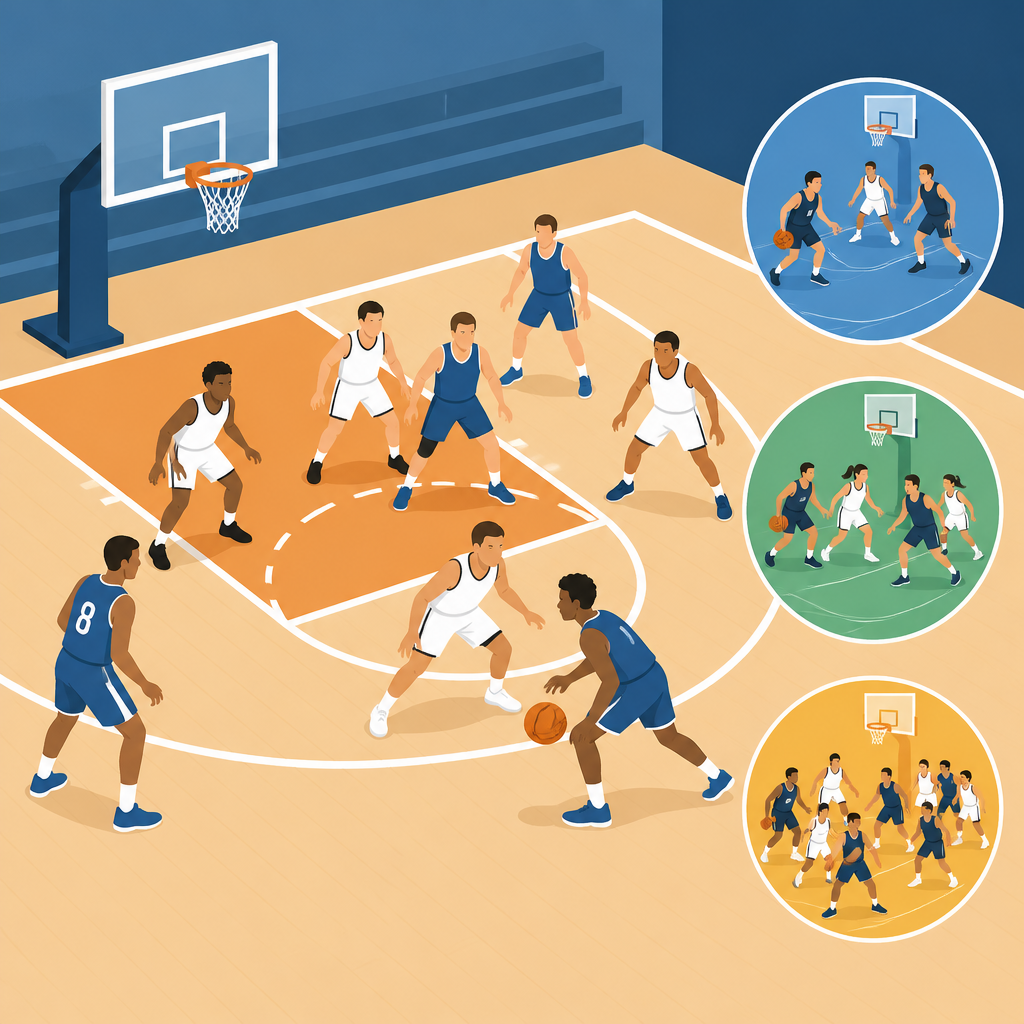
Basketball starts with a simple question that new fans, youth players, and parents ask right away: how many players are on the court in basketball? In standard basketball, each team has five players on the court at one time, so a regulation game usually has ten players playing live at once. That five-on-five structure defines the sport across the NBA, WNBA, FIBA international play, NCAA college basketball, and most high school leagues. Once you understand that foundation, the rest of the game becomes easier to follow, from positions and substitutions to fouls, spacing, and strategy.
This matters because “players on the court” is more than a counting question. It shapes how offenses create shots, how defenses rotate, and how coaches build lineups. When I explain basketball basics to beginners, I start here because confusion often comes from seeing benches full of athletes while only ten are actually participating in live action. Roster size, active players, starters, and substitutions are related concepts, but they are not the same thing. A team may dress 12 or more players for a game, yet only five from that team can be on the floor during play.
The standard five-player unit also gives basketball its familiar positions: point guard, shooting guard, small forward, power forward, and center. Modern basketball is more flexible than those labels suggest, but the structure still helps beginners understand responsibilities. Guards usually handle the ball and initiate offense, wings often score and defend multiple spots, and bigs protect the rim, rebound, and screen. At youth levels, coaches may simplify these roles, but five players still must share ballhandling, shooting, spacing, rebounding, and defense at all times.
This article serves as a practical hub for getting started with basketball basics. It explains regulation five-on-five, common alternative formats such as three-on-three and half-court pickup, and the rules that affect who can be on the court. It also covers substitutions, positions, youth adaptations, and frequent beginner questions. If you are learning the game, coaching new players, or helping a child join a team, this guide will give you the framework needed to understand how basketball is organized before moving into skills, rules, and tactics.
Five-on-Five Basketball: The Standard Format
The direct answer is straightforward: basketball is normally played with five players from each team on the court. That means ten players total during live play. This is the official format in the NBA, WNBA, FIBA competitions such as the Olympics and World Cup, NCAA men’s and women’s basketball, and National Federation of State High School Associations rules used by many U.S. high schools. If one team has too many or too few players on the court, officials stop play and enforce the rule through substitutions, technical fouls, or administrative corrections depending on the level and situation.
Why five? Historically, the game developed around five-player lineups because that number balances space and responsibility on a standard court measuring 94 by 50 feet in the NBA and WNBA, or 28 by 15 meters under FIBA rules. Five players create enough passing options to run organized offense without overcrowding the floor. In practical terms, a five-player unit can place a ballhandler at the top, two players on the wings, and two interior players, or spread all five around the perimeter in modern systems. Defensively, five players allow complete coverage of the basket, ball, passing lanes, and rebounding areas.
Beginners should also know that “on the court” does not mean “on offense only.” The same five players play both offense and defense unless there is a dead ball and a coach substitutes. That two-way demand is one reason conditioning, communication, and role clarity matter so much. In games I have coached and analyzed, many beginner mistakes happen not because players lack skill, but because they lose track of matchups in transition after a turnover or miss. Counting the five teammates and five opponents is one of the fastest ways to understand spacing and assignments.
Positions, Roles, and What Five Players Actually Do
Although basketball is increasingly positionless, the classic five positions remain useful teaching tools. The point guard usually organizes the offense, advances the ball against pressure, and calls actions. The shooting guard is often a perimeter scorer and secondary ballhandler. The small forward typically contributes on the wing as a slasher, defender, and versatile scorer. The power forward screens, rebounds, and operates inside or as a stretch shooter. The center protects the rim, contests shots, sets picks, and anchors interior defense. On many youth teams, one player may cover several of these tasks.
Those labels matter because five-on-five basketball requires coverage of every core job on every possession. Someone must bring the ball up safely, someone must space to create passing angles, someone must screen or cut to force defensive movement, and multiple players must rebound and recover on defense. If even one player stands in the wrong place, the court shrinks. That is why coaches teach alignment concepts like four-out one-in, five-out motion, horns, and pick-and-roll spacing. The number of players directly influences every one of those systems.
Here is a simple breakdown of the standard positions and beginner responsibilities:
| Position | Typical Area | Main Duties | Beginner Focus |
|---|---|---|---|
| Point Guard | Top perimeter | Ballhandling, passing, organizing offense | Protect the ball and read defenders |
| Shooting Guard | Wing | Scoring, spacing, secondary creation | Move without the ball and shoot in rhythm |
| Small Forward | Wing/corner | Versatile scoring and defense | Cut decisively and defend multiple players |
| Power Forward | Elbow/post | Screening, rebounding, interior play | Set legal screens and box out |
| Center | Paint | Rim protection, rebounding, finishing inside | Contest shots and secure rebounds |
In advanced basketball, these roles blur. Nikola Jokic functions as a center but initiates offense like a guard. A’ja Wilson scores inside, from midrange, and in transition while anchoring defense. Many teams switch defensively across several positions and use lineups with no traditional center. Still, five players must collectively cover the same responsibilities. For beginners, understanding jobs before labels is the clearest path.
Substitutions, Rosters, and Who Is Allowed on the Floor
One of the most common beginner misunderstandings is confusing roster size with the number of players on the court. A basketball team can have far more than five available players, but only five per team may participate at one time. In the NBA, teams generally carry up to 15 standard contract players plus two-way players, though not every player is active every night. In college and high school, roster sizes vary by program and league. Regardless of the bench size, the live lineup is always limited by the rules of the game format.
Substitutions usually happen during dead balls: after fouls, violations, timeouts, made baskets in certain situations, or other stoppages recognized by officials. A substitute reports to the scorer’s table and waits to be beckoned in. If a team accidentally puts six players on the court, officials can assess a technical foul or correct the lineup, depending on the rules code and when the error is discovered. This is rare at higher levels because scorekeepers, coaches, and officials track substitutions closely, but it happens often enough in youth games that coaches should teach substitution routines early.
Foul trouble, fatigue, injuries, and tactical matchups all influence who the five players are at any moment. A coach may use a smaller lineup for speed and shooting, or a bigger lineup for rebounding and rim protection. In close games, “closing lineups” matter more than starting lineups because they reflect the best combination for the moment. This is another reason the number of players on the court matters: every substitution changes spacing, defensive range, and decision-making. Learning to watch how a lineup functions is one of the first steps toward understanding basketball strategy.
Other Basketball Formats: Three-on-Three, Half-Court, and Youth Variations
While five-on-five is standard, it is not the only format. The fastest-growing official alternative is three-on-three, often written as 3×3, which is governed internationally by FIBA and played in the Olympics. In 3×3, each team has three players on the court with one substitute, and the game is played on a half court with one basket. The pace is faster, the space is tighter, and every player must handle, defend, and make decisions constantly. Shot clocks are shorter, possessions change quickly after made baskets, and versatility matters even more than in five-on-five.
Pickup basketball also introduces many beginners to formats such as one-on-one, two-on-two, three-on-three, and four-on-four. These games are usually played on a half court and use house rules that vary by gym or park. For example, players may “check” the ball at the top after a stoppage, call their own fouls, and play to 11 by ones and twos. These versions are excellent for skill development because each player gets more touches and has to guard in space. However, they do not fully teach transition defense, full-court spacing, or substitution patterns found in regulation five-on-five.
Youth basketball sometimes adapts formats for developmental reasons. Very young beginners may play four-on-four to increase touches and reduce crowding. Small-sided games are widely used in practice because they force decision-making, improve conditioning, and create more repetitions of passing, cutting, and help defense. USA Basketball and many coach education programs encourage age-appropriate modifications so players can learn concepts before they face the complexity of full five-on-five competition. These versions are valuable, but they are developmental tools or alternate competitions, not the standard answer to how many players are on a basketball court.
Getting Started: What Beginners Should Learn First
If you are new to basketball, start with four essentials. First, remember the basic count: five players per team, ten total on the court in standard games. Second, learn the purpose of spacing. Players should not cluster around the ball because that makes defenders’ jobs easier. Third, understand transition: when possession changes, all five players must react immediately. Fourth, know your role on the next play, whether it is bringing up the ball, filling a wing, setting a screen, boxing out, or finding your defensive assignment. These habits help beginners contribute quickly.
When teaching new players, I use a simple progression. We begin with names of positions, then move to floor spots, then to possession responsibilities. A point guard is not just “the shortest player”; that player must handle pressure and organize teammates. A center is not just “the tallest player”; that player must protect the rim without fouling and finish around the basket. Once beginners understand that five players create a connected system, drills make more sense. Shell defense, give-and-go passing, rebounding triangles, and transition lanes all become logical instead of random.
As you continue learning basketball basics, it helps to connect this topic with related areas: court dimensions, scoring rules, fouls and violations, positions, and beginner drills. Those subjects all depend on understanding how many players are on the court and what each one is responsible for. Watch a full game with that lens and count the patterns. Notice where the five offensive players stand before a set begins, how the five defenders shift on a drive, and how substitutions change the feel of the game. Then take that understanding into practice, pickup runs, or your next youth league session.
Common Questions and Final Takeaways
So, how many players are on the court in basketball? In the standard game, there are five players from each team on the court, for ten total. That is the format used in the NBA, WNBA, international competition, college basketball, and most high school leagues. Alternative versions exist, especially 3×3 and pickup formats, but they are variations rather than the default structure. This distinction is the key takeaway for anyone starting to learn the game, because it affects positions, spacing, substitutions, strategy, and even how you watch basketball intelligently.
Another frequent question is whether there are always five designated positions. The practical answer is yes for teaching purposes, but modern teams often use flexible roles instead of rigid labels. You may also wonder whether bench players count as being “in the game.” They do not. Only the five players legally on the floor count. If a player fouls out, gets injured, or is substituted, another player enters so the team can continue with five if possible. Rules can become more technical in extreme situations, but for beginners, that framework is accurate and dependable.
If you are getting started with basketball basics, master this concept first and build outward. Learn what each of the five players is trying to do, study how lineups fit together, and spend time watching both full games and small-sided play. That foundation will make every other basketball topic easier to understand, from offensive sets to defensive rotations. Use this page as your hub, then keep learning the connected basics that explain how the sport really works. The next step is simple: watch one game closely and identify all ten players’ roles on every possession.
Frequently Asked Questions
How many players are on the court in basketball during a standard game?
In standard basketball, each team has five players on the court at one time, which means there are usually ten players participating in live play altogether. That five-on-five format is the foundation of the sport and is used across the NBA, WNBA, FIBA international competition, NCAA college basketball, and most high school leagues. For new fans, this is the most important number to remember because it shapes everything from spacing and defensive matchups to substitutions and positions.
Each of those five players typically fills a role within the lineup, traditionally described as point guard, shooting guard, small forward, power forward, and center. Modern basketball is more flexible than ever, but the five-player structure still organizes how teams attack and defend. Even when benches are full of substitutes and coaches are rotating lineups, only five players per team can legally be on the court at any given moment in a standard game.
Does every level of basketball use the same five-on-five format?
Yes, most traditional organized basketball uses the same five-on-five setup. If you watch an NBA game, a WNBA game, an NCAA men’s or women’s game, a FIBA international matchup, or a typical high school contest, you will see five players from each team on the court at the same time. That consistency is one reason basketball is easy to follow across different levels: the court may look the same, the basic objective is the same, and the player count on the floor is the same.
There can be differences in rules between leagues, such as game length, foul limits, shot clock timing, or three-point line distance, but the number of players actively playing does not change in the standard version of the game. Youth leagues also generally teach basketball in this format once players reach full-team competition. So while many details vary from league to league, five players per side remains the standard structure that defines regulation basketball.
Why are there five players on each team in basketball?
Five players per team creates the balance that makes basketball work so well. With five offensive players and five defenders sharing the court, the game has enough room for passing, cutting, screening, help defense, rebounding, and transition play without becoming too crowded or too spread out. This number allows teams to combine individual skill with coordinated strategy, which is one of the reasons basketball is both fast-paced and tactically rich.
It also supports the traditional positional framework of the sport. Historically, teams were built around a ball-handler, perimeter scorers, wings, interior players, and rebounders. While today’s game is more positionless, the five-player design still gives coaches room to build lineups with size, shooting, speed, and defense in different combinations. In short, five-on-five is not arbitrary; it is the format that has long provided the best competitive balance for the full-court version of basketball.
Are there other basketball formats besides five-on-five?
Absolutely. While five-on-five is the standard form of basketball, there are several other popular formats. The most well-known is three-on-three, often written as 3×3, which has grown into a major international version of the game and is even played in the Olympics. In 3×3 basketball, each team puts three players on the court, and the game is usually played on a half court with faster possessions and different scoring dynamics than traditional full-court basketball.
There are also casual and developmental versions such as one-on-one, two-on-two, and four-on-four. Youth leagues sometimes use smaller-sided formats to help players get more touches, learn spacing, and develop decision-making skills before moving into full five-on-five competition. In pickup basketball, the number of players often depends on how many people are available and how much court space is being used. So if someone asks how many players are on the court in basketball, the correct answer for regulation play is ten total, but other formats do exist and are widely played in training, recreation, and international competition.
What happens if a team has too many or too few players on the court?
In regulation basketball, a team must have exactly five players on the court during live play unless unusual circumstances affect player availability. If a team accidentally has six players on the floor, that is typically a rules violation and can result in a technical foul or another penalty depending on the league and the situation. Officials and scorekeepers monitor substitutions closely to prevent this, especially during dead-ball situations when players are entering and exiting the game.
If a team has fewer than five players temporarily because of injury, foul trouble, disqualification, or an administrative issue during a substitution, play may be delayed until the situation is corrected if possible. In normal circumstances, teams are expected to maintain five active players at all times. This is one reason benches and substitutions matter so much over the course of a game. Coaches rely on reserves to replace tired players, cover injuries, and manage foul situations, but no matter how often lineups change, the standard rule remains the same: five players per team on the court, ten total in live action.