
Few subjects in basketball carry more weight than the history of the Celtics-Lakers rivalry, a matchup that defines NBA rivalries through championships, superstar legacies, and unforgettable games. In NBA history, no pairing better captures the league’s growth from a regional competition into a global entertainment force. When fans ask why Celtics vs Lakers matters more than any other rivalry, the answer is simple: these franchises have repeatedly met at the sport’s highest stakes, usually with Hall of Fame talent on both benches and on both sides of the ball. The result is a rivalry that is not just old, but structurally important to how the NBA built its identity.
The terms matter. A rivalry is more than repeated competition; it requires consequence, cultural contrast, and memory. The Boston Celtics represent continuity, defense, banners, and a franchise mythology rooted in team-first basketball. The Los Angeles Lakers represent glamour, stars, offensive flair, and reinvention across generations. Those identities are simplified versions of longer histories, but they explain why each Finals meeting felt larger than a series. I have covered enough historical game film and postseason trends to say this confidently: Celtics vs Lakers is the league’s clearest example of how teams can become symbols as much as opponents.
This hub article covers the legends and eras that shaped the rivalry, from Bill Russell and Jerry West to Magic Johnson, Larry Bird, Kobe Bryant, Paul Pierce, and LeBron James. It also highlights the greatest games, because this story lives in moments as much as in banners. If you are building a broader understanding of NBA history, this is the page that connects dynasty basketball, television growth, race and geography in sports culture, and the evolution of superstar leadership. No rivalry offers a better map of the NBA’s past, or a clearer lens for understanding how legends are made.
The 1960s: Bill Russell, Red Auerbach, and Boston’s Foundational Dominance
The rivalry first became historic in the 1960s, when the Celtics and Lakers met in the NBA Finals six times in that decade alone. Boston won every one of those series, and that fact shaped both franchises for generations. The Celtics, coached by Red Auerbach and anchored by Bill Russell, built a model around defense, rebounding, depth, and fast decision-making. Russell was not simply a great center; he changed what winning basketball looked like. His rim protection, outlet passing, and understanding of team defense made Boston function as a complete system rather than a collection of scorers.
The Lakers, first in Minneapolis and then Los Angeles, countered with elite individual talent, especially Jerry West and Elgin Baylor. West remains central to this rivalry because his greatness is inseparable from his losses to Boston. He was brilliant enough to become the only player to win Finals MVP from the losing team, doing so in 1969 after averaging 37.9 points per game in the series. Baylor brought scoring artistry and aerial creativity that influenced future wings, yet Boston repeatedly found ways to survive. These defeats created one of the rivalry’s enduring themes: the line between all-time greatness and championship validation.
The 1969 Finals distilled the era. The Lakers had West, Baylor, and Wilt Chamberlain, one of the most talented trios ever assembled. Boston was aging, with Russell serving as player-coach in his final season. Yet the Celtics won Game 7 in Los Angeles, 108-106, in a result that still sits among the biggest upsets in Finals history. The image of owner Jack Kent Cooke preparing celebratory balloons before the game, only to watch Boston spoil the ending, became part of league folklore. That single result reinforced Boston’s dynasty and hardened the Lakers’ sense of unfinished business.
The 1980s: Magic vs Bird Turned a Great Rivalry into the NBA’s Centerpiece
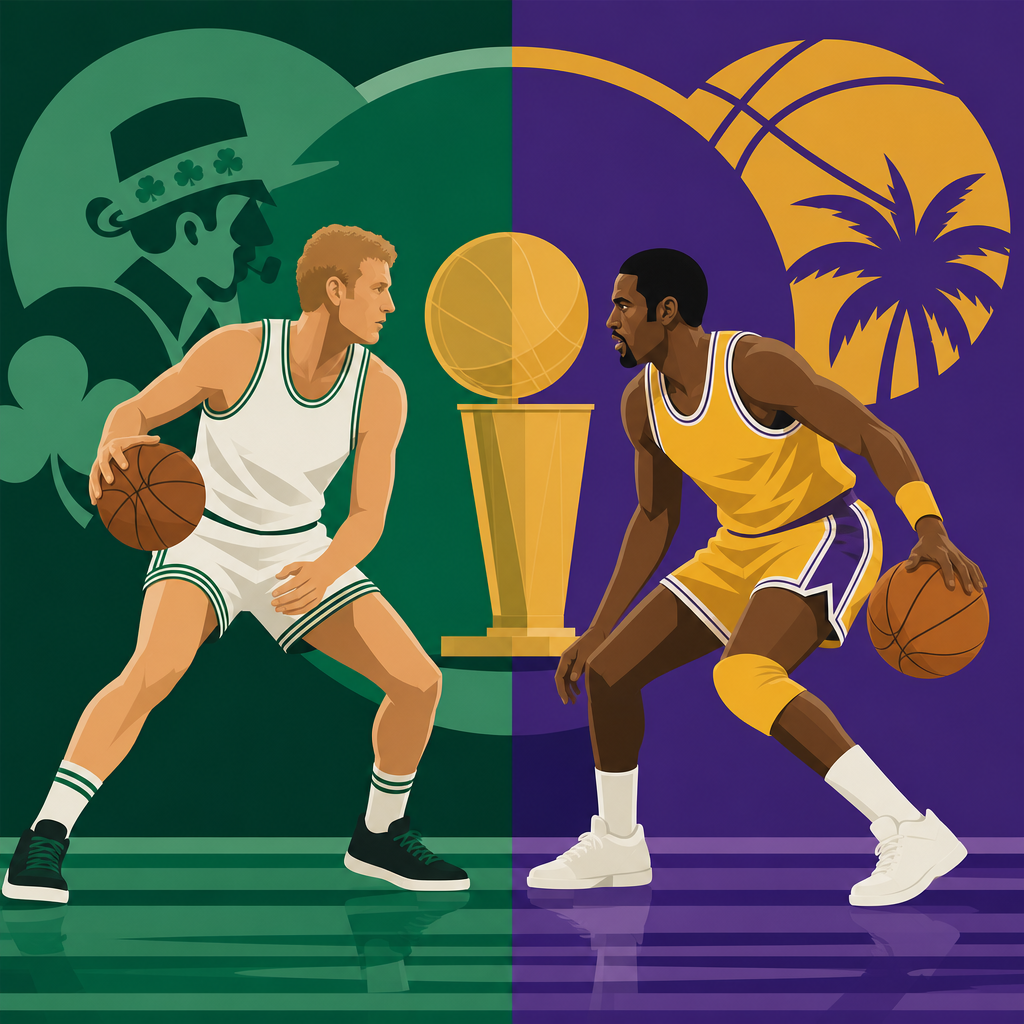
If the 1960s established Celtics vs Lakers as important, the 1980s made it the NBA’s defining television drama. The rivalry needed new stars, and the league received two transformational ones at exactly the right time. Magic Johnson and Larry Bird entered the NBA in 1979 after meeting in the NCAA championship game, carrying a preexisting competitive story into professional basketball. Their contrast was ideal for storytelling: Magic was joyful, improvisational, and synonymous with Showtime pace; Bird was ruthless, precise, and emblematic of half-court execution and psychological edge.
From 1980 through 1989, the Celtics won three championships and the Lakers won five, with three Finals meetings between them in 1984, 1985, and 1987. Those matchups elevated league interest, network ratings, and international awareness. The 1984 Finals gave the rivalry fresh emotional force. Boston won in seven games behind Bird, Robert Parish, Kevin McHale, and Dennis Johnson, but the series is remembered equally for its physicality. Game 4 at Boston Garden became known for Kevin McHale clotheslining Kurt Rambis on a fast break, a play that symbolized the harder edge of playoff basketball in that period.
The Lakers answered in 1985 by becoming the first Los Angeles team to defeat the Celtics in the Finals, a breakthrough with enormous historical significance. After the humiliation of the Memorial Day Massacre in Game 1, an eventual 148-114 Boston win, the Lakers recalibrated. Kareem Abdul-Jabbar responded with one of the finest age-38 Finals performances ever, averaging 25.7 points and winning Finals MVP. Pat Riley’s team proved it could beat Boston with discipline as well as pace, especially by controlling transition opportunities and getting efficient offense through Magic-Kareem actions.
The 1987 Finals completed the trilogy and delivered one of the signature plays in NBA history: Magic Johnson’s junior sky hook in Game 4 at Boston Garden. With the Lakers leading the series 2-1 and trailing late in the game, Magic drove into the lane and lofted a right-handed hook over Parish and McHale. The shot gave Los Angeles a 107-106 win and effectively broke Boston’s control of the matchup. When people discuss legends and eras, this is the kind of possession they mean. It was not merely a basket; it was an inheritance claim on the rivalry itself.
Legends and Eras: How Superstar Generations Kept the Rivalry Alive
One reason this subtopic works as a hub within NBA history is that Celtics vs Lakers links nearly every major era of league development. Russell and West belonged to the black-and-white television age, when the NBA was still building national relevance. Bird and Magic arrived as cable television expanded sports coverage and turned marquee players into year-round public figures. The 2000s revival with Kobe Bryant, Paul Pierce, Kevin Garnett, and Ray Allen emerged in the modern media environment, where debate television, internet fandom, and advanced analytics changed how great teams were discussed.
Each era also redefined what star leadership looked like. Russell’s leadership was defensive command and moral authority. West embodied relentless competitive pressure. Bird weaponized anticipation and shooting range before spacing became standard strategic language. Magic made passing a primary commercial attraction. Kareem offered durability and technical excellence over two decades. Kobe carried the Jordan-influenced ideal of individual scoring mastery and obsessive preparation. Pierce represented shot-making under pressure, while Garnett changed Boston’s emotional temperature with communication and defensive intensity.
These transitions matter because rivalries survive only if new generations can inherit them without feeling trapped by nostalgia. The Celtics and Lakers did that better than any NBA franchises. Even when they were not playing each other in June, each team measured itself against the other’s banner count, mythology, and star lineage. Front offices understood this. Boston’s 2007 trade for Garnett and Allen was partly about title contention, but it also restored the franchise’s historical self-image. The Lakers’ mid-2000s rebuild around Kobe and later acquisitions underlined the same truth: championship windows are judged differently when your franchise shares a rivalry this large.
The 2008 and 2010 Finals: A Modern Revival with Classic Stakes
For many younger fans, the defining Celtics vs Lakers chapter is the late-2000s revival. In 2008, Boston assembled a new Big Three in Pierce, Garnett, and Allen, adding defensive identity under coach Doc Rivers. The Lakers, led by Kobe Bryant and later strengthened by Pau Gasol after the 2008 trade, represented the West’s top skill and structure. Their Finals collision felt immediately historic because both brands already carried so much inherited meaning. Boston won the 2008 Finals in six games, closing with a 131-92 blowout in Game 6 that remains one of the most lopsided closeout wins in Finals history.
That series mattered for legacy. Pierce won Finals MVP and permanently changed his standing within franchise history. Garnett validated his move from Minnesota by becoming the emotional and defensive center of a title team. For Kobe, the loss intensified scrutiny, especially from those comparing his resume to both Magic and Michael Jordan. In practical basketball terms, Boston’s switching, help defense, and physical wing play disrupted Los Angeles’ rhythm. The Celtics were not just tougher; they were more connected possession to possession.
The rematch in 2010 was tighter, meaner, and in some ways even more memorable. Kendrick Perkins missed Game 7 for Boston with a knee injury, a significant loss against the Lakers’ front line. The Lakers won the title in a 83-79 Game 7 grinder at Staples Center despite Bryant shooting 6-for-24. This is why context matters more than box-score shorthand. Kobe compensated with 15 rebounds and late free throws, while Ron Artest added a decisive three-pointer and memorable postgame interview. Pau Gasol’s interior work and Los Angeles’ 23 offensive rebounds told the tactical story. It was ugly, tense, and perfectly appropriate for a rivalry that rarely rewards comfort.
Greatest Celtics vs Lakers Games
The best Celtics vs Lakers games combine star shot-making, tactical adjustment, and historical consequence. Several stand above the rest because they altered perception as much as results.
| Game | Why it matters | Defining moment |
|---|---|---|
| 1969 Finals Game 7 | Russell’s final title, major upset in Los Angeles | Boston wins 108-106 despite Lakers star power |
| 1984 Finals Game 4 | Reframed the series around physicality and resilience | McHale’s foul on Rambis ignites Boston’s edge |
| 1985 Finals Game 6 | Lakers finally beat Boston in the Finals | Kareem closes the door on years of frustration |
| 1987 Finals Game 4 | Magic’s signature road win in Boston Garden | Junior sky hook over Parish and McHale |
| 2008 Finals Game 4 | Largest comeback in Finals game history at the time | Boston rallies from 24 down in Los Angeles |
| 2010 Finals Game 7 | Modern era title decider between the rivals | Lakers survive an 83-79 defensive battle |
Among these, 2008 Finals Game 4 deserves special attention. The Lakers led by 24 points and seemed ready to level the series at 2-2. Instead, Boston produced a composed comeback built on defense, bench scoring, and Pierce’s control of pace. The Celtics won 97-91, taking a stranglehold on the series. In film review, what stands out is Boston’s refusal to chase points. They forced longer possessions, attacked matchup weaknesses, and let pressure turn on Los Angeles. Championship teams often reveal themselves through emotional steadiness, and that game is a textbook example.
Why Celtics vs Lakers Still Matters in Today’s NBA
The rivalry still matters because it remains the NBA’s clearest shorthand for legacy. Banner counts are discussed every season. Any major star who joins either franchise is immediately placed inside a historical chain that includes multiple top-15 players ever. That creates pressure, but it also creates relevance. LeBron James becoming a Laker in 2018 was not just a roster move; it was an entry into a legacy system shaped by Johnson, West, Baylor, Bryant, and Abdul-Jabbar. Boston’s current contenders are judged against Russell, Bird, and the 2008 group in the same way.
There is also a practical historical value in studying this rivalry. It helps explain how the NBA evolved stylistically, commercially, and culturally. You can trace defensive principles from Russell’s help rotations to Garnett’s communication. You can follow offensive evolution from West’s shot creation to Magic’s transition orchestration to Bryant’s triangle-era scoring. You can see how media narratives changed, from newspaper mythmaking to 24-hour television to digital fragmentation. For anyone exploring NBA history through legends and eras, Celtics vs Lakers is the most efficient single path because it touches nearly everything important.
The essential takeaway is straightforward: Celtics vs Lakers is the greatest rivalry in NBA history because it combines repeated Finals stakes, iconic players, and games that still define how basketball greatness is remembered. It is a rivalry of systems and personalities, of coast-to-coast identity, of old wounds and renewed ambition. If you want to understand the NBA at its highest level, start with Russell and West, move through Bird and Magic, then study Kobe, Pierce, and the modern revival. From there, follow the next chapter as it forms, because this rivalry never stays in the past for long.
Use this page as your hub for the broader legends and eras conversation within NBA history. Revisit the greatest games, compare the championship teams, and study how each generation inherited the pressure of the last. The more closely you examine Celtics vs Lakers, the more clearly the league’s bigger story comes into focus.
Frequently Asked Questions
Why is the Celtics vs Lakers rivalry considered the greatest in NBA history?
The Celtics-Lakers rivalry is widely viewed as the NBA’s greatest because it combines everything that makes sports history memorable: championships, iconic players, contrasting identities, and repeated meetings on the biggest stage. No other rivalry has shaped the league’s story quite like Boston and Los Angeles. These franchises have faced each other in the NBA Finals more than any other pairing, turning championship series into defining moments for entire generations of fans. From the Bill Russell and Jerry West era in the 1960s to the Magic Johnson and Larry Bird battles of the 1980s, and later the Kobe Bryant-led Lakers against the Paul Pierce-Kevin Garnett Celtics in the late 2000s, the rivalry has remained relevant across multiple basketball eras.
What makes it especially powerful is that it represents more than wins and losses. The Celtics have traditionally symbolized defense, discipline, tradition, and team-first basketball, while the Lakers have often represented star power, pace, style, and Hollywood visibility. Those differences gave each matchup a larger cultural meaning. The rivalry also helped the NBA grow from a struggling league into a global sports powerhouse, particularly during the 1980s, when Bird and Magic elevated professional basketball into must-watch television. In short, Celtics vs Lakers matters so much because it is not just a rivalry between two teams. It is a rivalry between dynasties, cities, philosophies, and legacies.
How many times have the Celtics and Lakers met in the NBA Finals, and why do those matchups matter so much?
The Celtics and Lakers have met in the NBA Finals 12 times, more than any two teams in league history, and that fact alone explains much of the rivalry’s legendary status. Their Finals meetings span decades, beginning in the late 1950s and continuing into the modern era. Boston dominated many of the early championship clashes, especially during the Bill Russell years, when the Celtics repeatedly denied the Lakers titles despite the greatness of stars like Elgin Baylor, Jerry West, and Wilt Chamberlain. Those repeated losses added emotional weight and historical tension to every future matchup.
These Finals matter so much because they were rarely ordinary championship series. They often featured Hall of Fame talent on both sides and had direct consequences for how players and teams are remembered. In the 1984 Finals, for example, Larry Bird and the Celtics defeated Magic Johnson and the Lakers in a bruising, emotional series that intensified one of basketball’s defining personal rivalries. The Lakers answered in 1985 by beating Boston in the Finals for the first time, a breakthrough that changed the narrative around Showtime. In 1987, Los Angeles won again behind Magic’s brilliance, including his famous “junior sky hook.” Decades later, the rivalry returned to center stage in 2008 and 2010, with Boston winning first and the Lakers getting revenge in a dramatic seven-game series. Every Finals meeting added another chapter to a story already rich with pressure, revenge, pride, and historical consequence.
Who are the most important players in Celtics vs Lakers rivalry history?
Several of the most important figures in NBA history built their legacies through this rivalry. Bill Russell is central to the story because his Celtics teams established early dominance and set the tone for Boston’s championship identity. On the Lakers side, Jerry West became one of the rivalry’s most tragic and respected figures, producing extraordinary performances even as Boston repeatedly denied him titles in the Finals. Elgin Baylor and Wilt Chamberlain also played major roles in keeping the Lakers in championship contention during that era.
The rivalry reached another level in the 1980s through Larry Bird and Magic Johnson, the two players most responsible for transforming Celtics-Lakers into a global basketball event. Bird brought toughness, shooting, confidence, and a blue-collar edge that perfectly fit Boston’s image. Magic brought flair, creativity, leadership, and showmanship that captured everything people associated with Showtime Los Angeles. Their personal competition, which began before the NBA and continued through multiple Finals, revived the league and made this rivalry essential to basketball culture.
In the modern era, Kobe Bryant became the Lakers’ defining rival figure against Boston, especially during the 2008 and 2010 Finals. For the Celtics, Paul Pierce, Kevin Garnett, and Ray Allen restored the franchise to championship contention and reintroduced the matchup to a new generation. Garnett’s intensity, Pierce’s scoring, and Boston’s defensive identity made their victories over Los Angeles feel deeply connected to the franchise’s old traditions. Across eras, these stars did more than win games. They gave the rivalry its personality, emotion, and historical depth.
What are some of the greatest Celtics vs Lakers games ever played?
There is no shortage of unforgettable games in this rivalry, but several stand above the rest because of their stakes, drama, and long-term impact. One of the most famous is Game 7 of the 1962 NBA Finals, when Boston defeated Los Angeles in a tense, one-possession finish. That game reinforced the Celtics’ dominance and deepened the Lakers’ frustration during the Russell-West era. Another major classic is Game 4 of the 1984 Finals, a physical and emotional overtime win by Boston that shifted the tone of the series and remains one of the defining games of the Bird-Magic rivalry.
Game 6 of the 1986 NBA Finals is not a Celtics-Lakers game because those teams did not meet that year, so when discussing this rivalry specifically, the real highlights come from 1985, 1987, 2008, and 2010. In Game 6 of the 1985 Finals, the Lakers closed out the Celtics in Boston Garden, a symbolic breakthrough after years of frustration. In Game 4 of the 1987 Finals, Magic Johnson hit the famous junior sky hook at the Garden, one of the signature shots in NBA history. In 2008, the Celtics’ 24-point comeback in Game 4 against the Lakers was stunning and helped propel Boston toward another title. Then came Game 7 of the 2010 Finals, an ugly, physical, pressure-filled battle that perfectly captured what this rivalry means. The Lakers rallied behind Kobe Bryant and a huge effort from Pau Gasol and Ron Artest to win the championship, making it one of the most emotionally significant games either franchise has ever played.
How did the Celtics-Lakers rivalry help grow the NBA into a global league?
The Celtics-Lakers rivalry played a massive role in turning the NBA from a league with uneven national appeal into a global sports product. While the rivalry mattered in earlier decades because of repeated Finals meetings, its biggest impact on league growth came in the 1980s. At that time, the NBA needed compelling stars, clear storylines, and big-market visibility. Boston and Los Angeles provided all three. Larry Bird and Magic Johnson were perfect opposing forces: different styles, different personalities, different regions, and different team identities. Their matchups gave television networks, sponsors, and fans an easy-to-understand narrative that transcended basketball strategy.
The rivalry also made the NBA feel larger than a domestic competition. Celtics-Lakers games carried event-level importance, and the personalities involved drew casual viewers into the sport. As those Finals became national showcases, the league’s image improved, ratings rose, and the NBA gained momentum that later benefited stars like Michael Jordan, Kobe Bryant, LeBron James, and beyond. Even in the 2008 and 2010 Finals, the revival of the rivalry reminded fans how powerful historical continuity can be. People were not just watching two teams chase a title. They were watching one of sports’ most important stories continue. That sense of tradition, combined with superstar appeal and championship drama, helped make the NBA more marketable, more memorable, and more globally recognizable.