

The best NBA coaching staffs in history shaped dynasties, rescued underperforming rosters, and turned talent into repeatable championship habits. A coaching staff is more than the head coach on the sideline. It includes lead assistants, player development coaches, defensive coordinators in all but name, video analysts, scouts, strength staff, and trusted veterans who translate strategy into daily practice standards. When fans discuss great teams, they usually start with stars, but every title run also depends on the brains organizing spacing, matchups, substitutions, scouting reports, recovery plans, and late-game counters. In my experience studying championship film and coaching trees, the teams that endure are rarely the ones with the most talent alone. They are the teams whose staffs create clarity under pressure.
That matters especially in NBA history because each era asks different questions. In the Russell years, staffs managed travel, short rotations, and a compressed league. In the Showtime and Bird-Magic era, they balanced star freedom with structured systems. In the Jordan years, staffs translated the triangle offense into a repeatable postseason advantage. In the modern game, staffs must integrate analytics, sports science, player tracking, and opponent-specific schemes while keeping stars engaged over an 82-game season and four playoff rounds. The greatest staffs did not simply ride great players. They built environments where elite players could scale their strengths without breaking team cohesion.
This hub page on NBA history, legends, and eras explains which coaching staffs belong in the top tier and why. It also serves as a roadmap for the wider topic. If you are exploring dynasties, all-time coaches, classic playoff teams, or how basketball strategy evolved from the 1960s through today, this is the place to begin. The core standards are simple: championship results, tactical innovation, player development, adaptability, and historical influence through coaching trees or leaguewide imitation. By those measures, a few staffs stand above the rest, not because they were flawless, but because they solved the hardest problems of their time and left the NBA looking different after they won.
What separates a great NBA coaching staff from a famous head coach
A famous head coach can dominate headlines, but the best NBA coaching staffs in history operated as high-functioning ecosystems. They prepared game plans, divided teaching responsibilities, challenged stars, and delivered adjustments between games and between timeouts. A strong staff also protects the head coach from blind spots. One assistant may specialize in weak-side help rules, another in after-timeout sets, another in player relationships. The staff’s quality shows up in details: cleaner substitutions, smarter foul management, better role definition, and a bench unit that survives non-star minutes.
Three tests separate the truly elite staffs. First, can they install an identity that works from October through June? Second, can they adapt when the playoffs expose a weakness? Third, do they improve players beyond expectation? The 1980s Lakers, 1990s Bulls, 2000s Spurs, and 2010s Warriors all passed those tests. Their staffs handled stars, developed role players, and changed tactics without losing institutional trust. That combination is rarer than one brilliant playbook. It is why some excellent regular-season coaches never break through in the postseason, while the greatest staffs keep finding solutions when every opponent has a week to study them.
Red Auerbach and the Celtics standard for organizational coaching
No discussion of coaching staffs can start anywhere but Boston. Red Auerbach established the original championship operating system with the Celtics, first as head coach and later as an executive power shaping continuity around the bench. His teams won nine championships in ten seasons as coach, then sustained the culture through handoffs that would break most franchises. The Celtics’ edge was not simply Bill Russell’s greatness, though Russell was the central force. It was a complete structure built around conditioning, fast-break decision making, role acceptance, and relentless scouting within the limits of the era.
Auerbach delegated effectively before delegation became management jargon. He trusted lieutenants, valued specialist input, and recognized that teaching defense required more than motivational speeches. Russell became a player-coach in 1966, and the staff still won two more titles. That transition matters historically because it proved the Celtics’ methods were institutional, not just personal. Their principles—defensive communication, outlet passing, lane running, and sacrifice from stars—became templates for later champions. When people ask what the first great NBA coaching infrastructure looked like, Boston provides the answer: a staff aligned around a clear style, reinforced daily, and sustained across leadership changes.
Pat Riley, Bill Bertka, and the Showtime Lakers machine
The Showtime Lakers are remembered for Magic Johnson’s passing, Kareem Abdul-Jabbar’s longevity, and the glamour of the Forum, but their staff deserves equal billing. Pat Riley, with assistant Bill Bertka and a strong support network, mastered one of the hardest coaching balances in league history: preserving creative freedom while enforcing championship discipline. The Lakers won five titles in the 1980s because they ran with precision, defended when necessary, and understood when to flow and when to call structure. Riley’s staff gave stars enough autonomy to weaponize instinct, but not so much that possessions dissolved into improvisation.
One overlooked strength was role optimization. Michael Cooper became the perimeter stopper every champion needs. James Worthy was deployed as a devastating transition finisher and half-court slasher rather than overburdened as a primary creator. Kareem’s minutes and touch were managed intelligently as he aged. The staff also handled enormous personalities and expectations. That is tactical work too. A system fails if players stop believing in it, and the Lakers’ coaches kept belief high while demanding pace, conditioning, and accountability. Their influence still appears in modern teams that push tempo yet maintain strict spacing and lane-fill rules in transition offense.
Phil Jackson’s Bulls and Lakers staffs turned the triangle into a dynasty tool
Phil Jackson is often treated as a singular guru, but his greatest teams depended on outstanding assistants and the intellectual architecture provided by Tex Winter. With the Bulls, Winter’s triangle offense gave Michael Jordan and Scottie Pippen a system that reduced predictability, created strong-side and weak-side reads, and punished traps without requiring a traditional ball-dominant point guard. Later, with the Lakers, the same framework was adapted around Shaquille O’Neal and Kobe Bryant, two stars with very different strengths and egos. That adaptation is exactly what elite staffs do: they preserve principles while changing applications.
The triangle’s real value in the postseason was not mystique. It was repeatability. Because the offense relied on spacing, cuts, post entries, and read-based reactions, it could survive pressure defense better than simpler sets. Jackson’s staffs also stressed emotional management. The Bulls needed to move from Jordan’s individual brilliance to collective poise. The Lakers needed to avoid tearing themselves apart under title pressure. Assistants handled film detail, practice structure, and player communication that made those larger goals practical. Six Chicago championships and five more with Los Angeles are not just evidence of star power. They are proof that a coherent staff can scale a philosophy across eras, rosters, and locker rooms.
Gregg Popovich and the Spurs built the modern gold standard
If one staff best represents complete organizational coaching, it is San Antonio under Gregg Popovich. The Spurs won five championships across three distinct basketball periods: the late-1990s twin-tower era, the mid-2000s defensive peak, and the 2014 ball-movement masterpiece. That range alone is extraordinary. Popovich’s assistants—including Mike Budenholzer, Brett Brown, Ettore Messina, Ime Udoka, and Becky Hammon later in the organizational arc—helped create perhaps the deepest coaching laboratory in NBA history. The Spurs produced not just wins, but methods copied around the league.
San Antonio’s core strengths were developmental rigor, tactical flexibility, and honest communication. The staff turned Manu Ginobili into a controlled chaos engine, Tony Parker into an elite paint attacker, and a succession of role players into dependable playoff contributors. They embraced international scouting before many rivals did, then integrated those players into a culture that valued quick decisions and defensive discipline. In 2014, after the painful 2013 Finals loss, the Spurs responded with one of the clearest examples of staff-led adaptation ever seen: faster ball movement, sharper spacing, and a devastating blend of drive, kick, swing, and extra pass sequences that overwhelmed Miami. That title run remains a clinic in collective coaching intelligence.
| Staff | Peak Era | Signature Strength | Championship Impact |
|---|---|---|---|
| Celtics under Auerbach | 1957–1969 | Defensive identity and continuity | Created the league’s first dynasty template |
| Showtime Lakers | 1980–1988 | Transition structure with star freedom | Defined 1980s fast-break championship basketball |
| Bulls and Lakers under Jackson | 1991–2010 | Triangle offense and emotional management | Scaled one philosophy across two dynasties |
| Spurs under Popovich | 1999–2014 | Adaptability, development, and global integration | Set the benchmark for modern organizational coaching |
| Warriors under Kerr | 2015–2022 | Motion offense plus switching versatility | Merged analytics-era spacing with championship defense |
Steve Kerr’s Warriors staff and the analytics-era championship model
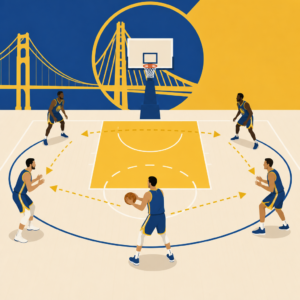
Steve Kerr inherited talent in Golden State, but talent alone does not explain a 73-win season, four championships in eight years, and a style copied across every level of basketball. Kerr’s staff, featuring assistants such as Alvin Gentry, Ron Adams, Mike Brown, and later Kenny Atkinson, fused motion principles, split cuts, pace-and-space logic, and switchable defense into a championship system. Ron Adams especially deserves mention for defensive architecture. Golden State’s title teams were not just beautiful on offense; they were organized, connected, and devastating at shrinking windows on the perimeter.
What made this staff historically important was synthesis. They did not invent spacing, off-ball movement, or small-ball lineups in isolation. They combined those ideas into a stable identity built around Stephen Curry’s gravity, Draymond Green’s playmaking, Klay Thompson’s movement shooting, and versatile defenders who could survive cross-matches. In the 2015 Finals, shifting Andre Iguodala into the starting lineup changed the series. In 2022, the staff again proved its value by rebuilding the defense around Green, Andrew Wiggins, and Gary Payton II while tailoring lineups to matchups. Great staffs are not trapped by their own genius. The Warriors kept updating the same core blueprint.
Other legendary staffs that deserve a place in the conversation
Several other championship staffs belong just below the inner circle and matter to any complete NBA history hub. Chuck Daly’s Detroit Pistons staff engineered the “Bad Boys” into a disciplined defense-first champion, not merely a tough team. Their coverages, physical help principles, and psychological edge were all coached. Rudy Tomjanovich’s Houston Rockets staff guided Hakeem Olajuwon through two title runs in the 1990s by surrounding him with disciplined spacing and timely double-team counters. Those teams are often underrated because they interrupted a larger Chicago narrative, but they were brilliantly prepared.
Erik Spoelstra’s Miami Heat staffs also deserve strong consideration, especially for adaptability. The 2012 and 2013 title teams balanced LeBron James, Dwyane Wade, and Chris Bosh while evolving into a pressure defense and pace-oriented attack. Later Heat staffs reached the Finals with less raw talent through elite preparation, zone variation, and player development. Larry Brown’s 2004 Pistons staff is another landmark. That championship was one of the clearest demonstrations that defensive cohesion, scouting precision, and role clarity can defeat superior star power. These staffs may not have the same sustained title counts as the Celtics, Bulls, Spurs, or Warriors, but their methods changed playoff thinking and deserve serious historical weight.
How great staffs shape eras, coaching trees, and the way fans remember legends
The best NBA coaching staffs in history do more than win rings. They shape eras by teaching the league what championship basketball looks like at a given moment. Auerbach’s Celtics normalized defense and sacrifice. Riley’s Lakers made tempo glamorous but disciplined. Jackson’s staffs proved stars could thrive inside a system without losing individuality. Popovich turned development, international scouting, and adaptive scheme design into front-office and coaching essentials. Kerr’s Warriors accelerated the league’s shift toward movement shooting, versatile defenders, and five-man decision making.
These staffs also influence how legends are remembered. Jordan without the Bulls’ structure is still an icon, but not necessarily a six-time champion. Duncan without San Antonio’s continuity might still be great, yet his longevity as the anchor of changing title teams reflects staff excellence. Curry’s legacy is intertwined with a system that maximized his movement and gravity rather than forcing him into conventional point guard habits. That is why coaching history belongs at the center of NBA history, not in the margins. If you want to understand legends and eras completely, follow the staffs behind the banners, then use this hub to explore the dynasties, coaches, systems, and stars that defined basketball’s biggest championship runs.
Frequently Asked Questions
What makes an NBA coaching staff historically great rather than just successful for a short period?
A historically great NBA coaching staff does much more than win a title in a favorable season. The difference is sustainability, adaptability, and influence across every layer of team performance. Short-term success can come from a hot playoff run, an unusually healthy roster, or a superstar playing at an unstoppable level. Historic staffs build systems that hold up over time, survive injuries, evolve with roster changes, and keep producing elite habits year after year.
That usually starts with clear organizational alignment. The head coach sets the philosophy, but the assistants help translate that vision into specific defensive coverages, offensive counters, practice plans, film sessions, and player development programs. Great staffs also know how to divide responsibilities efficiently. One assistant may focus on opponent scouting, another on player relationships, another on late-game execution, and another on big-picture scheme adjustments. When those pieces work together, the team becomes more consistent than its raw talent alone would suggest.
Historically great staffs also leave fingerprints on the league itself. They introduce tactical ideas that other teams copy, such as new spacing concepts, switching schemes, pace-and-space principles, triangle reads, split actions, or more sophisticated use of analytics and matchup data. Just as important, they create a culture where stars buy in, role players improve, and standards remain high even when expectations become overwhelming. The best staffs are remembered not only for trophies, but for building repeatable championship habits that outlast one season or one roster version.
Why is the full coaching staff so important when discussing championship teams?
Championship teams are almost never the result of one voice alone. The head coach may receive most of the attention, but the full coaching staff is what makes a winning vision executable on a daily basis. An NBA season is too long, too complex, and too demanding for one person to manage every tactical, developmental, and interpersonal detail. That is why the best title teams are usually supported by assistants who specialize in game planning, player development, defense, film study, communication, and practice design.
Lead assistants often act as strategic sounding boards. They challenge ideas, prepare scouting reports, and offer alternative counters when playoff series shift. Player development coaches help young players and bench contributors become trustworthy rotation pieces, which is essential during deep postseason runs. Video coordinators and analysts break down tendencies, helping coaches and players identify where an opponent is vulnerable and where their own team is slipping. Strength and conditioning staff keep players physically ready for the grind of an 82-game season and multiple playoff rounds, which can be the hidden difference between a conference finalist and a champion.
There is also a human element that often gets overlooked. Not every player responds to the same style of communication. Some need direct accountability, others need confidence-building, and stars often need coaches who can be honest without creating friction. A strong staff creates those communication bridges. On great championship teams, someone is always reinforcing standards, clarifying responsibilities, and keeping the group connected. That is why the full coaching staff deserves serious attention in any discussion about the best NBA teams in history.
Which legendary NBA coaching staffs are most often mentioned in conversations about all-time greatness?
Several coaching staffs come up repeatedly because they combined championships with clear strategic identity and long-term influence. Phil Jackson’s staffs with the Bulls and Lakers are central to that conversation, especially because they paired elite talent with a system built around structure, spacing, and psychological management. Tex Winter’s role in implementing and teaching the triangle offense is a major reason those staffs are remembered as complete basketball operations rather than star-driven title teams alone.
Red Auerbach’s Celtics ecosystem is another foundational example. Even beyond his own coaching years, the Celtics established one of the earliest models for organizational continuity, player buy-in, and tactical discipline. In later eras, staffs surrounding coaches like Pat Riley, Gregg Popovich, and Steve Kerr became defining examples of how a strong coaching brain trust can support dynasties. Popovich’s Spurs staffs were especially respected for player development, ball movement principles, defensive adaptability, and the ability to refresh the roster without losing identity. Many future head coaches came out of that environment, which is a sign of how deep and respected the staff culture was.
More recent examples include the Warriors under Steve Kerr, where assistants and developmental personnel helped blend motion offense, modern spacing, defensive versatility, and strong locker-room communication. Erik Spoelstra’s staffs in Miami also deserve mention for their ability to maximize personnel, defend creatively, and maintain elite standards through multiple team eras. When people discuss the best NBA coaching staffs in history, they usually point to groups that consistently turned talent into disciplined, scalable systems rather than relying on individual brilliance alone.
How do great coaching staffs turn talented rosters into championship habits?
Talent wins games, but habits win playoff series. Great coaching staffs turn raw ability into reliable championship behavior by making execution repeatable under pressure. That means drilling details until they become second nature: defensive rotations, transition balance, clock awareness, shot selection, communication on switches, box-outs, spacing discipline, and composure late in games. The goal is not simply to have a team that looks good when everything is working, but one that stays organized when the opponent takes away the first option.
This process happens in layers. First, the staff defines the identity of the team. Are they going to pressure the ball, protect the paint, switch aggressively, run in transition, or emphasize half-court precision? Once that identity is clear, assistants help break it into teachable pieces. Film sessions reinforce the concepts visually, practice work builds muscle memory, and player development sessions address individual weaknesses that could become postseason liabilities. Over time, players stop thinking through every action and start reacting correctly as a unit.
The best staffs also know that habits are cultural as much as tactical. Championship teams are usually built on accountability that applies to everyone, including stars. Coaches create standards for effort, preparation, and unselfishness, then reinforce them every day. Trusted veterans often help carry those messages into the locker room, but the coaching staff sets the tone. That is how underperforming rosters improve and talented teams avoid wasting their potential. Great staffs build environments where winning behaviors become normal, not occasional.
How should fans evaluate a coaching staff’s legacy when star players often get most of the credit?
The fairest way to evaluate a coaching staff’s legacy is to look beyond rings alone and study how the team functioned because of the staff’s influence. Star power matters enormously in the NBA, and no coaching group wins big without high-level talent. But the key question is whether the staff elevated that talent, organized it, developed it, and kept it effective across changing circumstances. If a team consistently defended at a high level, improved role players, made smart playoff adjustments, and sustained excellence through roster turnover, that says a lot about the staff.
Fans should also pay attention to what happens around the stars. Do bench players become reliable contributors? Do veterans revive their careers? Do young players improve fundamentals and decision-making? Does the team show clear identity on both ends of the floor? Is there evidence of strategic evolution from one playoff run to the next? Those are signs that the coaching staff is doing more than rolling the ball out to elite players.
Another useful measure is influence. If assistants from that staff become successful head coaches elsewhere, if the team’s schemes spread around the league, or if former players talk about how organized and demanding the environment was, that strengthens the staff’s historical standing. In the end, stars may headline championship stories, but coaching staffs shape the structure underneath them. The best ones do not replace talent; they maximize it, stabilize it, and turn it into something repeatable enough to define an era.