
The NBA Replay Center is the league’s centralized video review operation, built to help officials confirm or correct critical calls in real time without relying only on what three referees can see live from the floor. For fans trying to understand NBA officiating, replay review is one of the most important systems to learn because it sits at the intersection of rules, technology, game management, and competitive fairness. I have spent years following replay-trigger language in the NBA rulebook, Last Two Minute reports, and referee training materials, and one point is clear: the Replay Center does not exist to re-officiate every possession. It exists to resolve specific reviewable situations under strict procedural rules.
That distinction matters. Many viewers assume any obvious missed call can be fixed on video, but the NBA replay system is narrower than that. Officials can review whether a shot beat the buzzer, whether a foul occurred before time expired, who touched the ball last before it went out of bounds, whether a defender was inside the restricted area on a block-charge play, and several flagrant, hostile act, goaltending, clock, and boundary questions. They cannot simply pause the game because social media thinks a reach-in happened twenty seconds earlier. Understanding that limit explains much of the frustration and much of the value.
Officiating, as a broader NBA Rules topic, includes mechanics, crew communication, advantage-disadvantage judgment, foul criteria, violation enforcement, coach interaction, replay protocols, and postgame accountability. This article serves as the hub for that subtopic by explaining how the Replay Center works and how it connects to the larger officiating ecosystem. If you are also studying referee positioning, foul interpretation, coach’s challenges, Last Two Minute reports, or common controversial calls, this page gives you the framework to place those subjects in context. Replay is not separate from officiating; it is an extension of it, with its own chain of authority.
The modern NBA game moves too quickly for perfect live accuracy. Players cover ground at elite speed, shooters release in fractions of a second, and contact on drives can involve multiple bodies, rotating help defenders, and line-of-sight problems. Even experienced crews miss angles. The league’s answer has been a combination of better mechanics, centralized review, high-frame-rate broadcast feeds, and detailed replay triggers. When used properly, the Replay Center improves accuracy on high-leverage moments while preserving the rhythm of the game as much as possible. The key is knowing what can be reviewed, who makes the decision, and why some calls stand even when the arena crowd is certain they are wrong.
What the NBA Replay Center Is and How It Fits Into Officiating
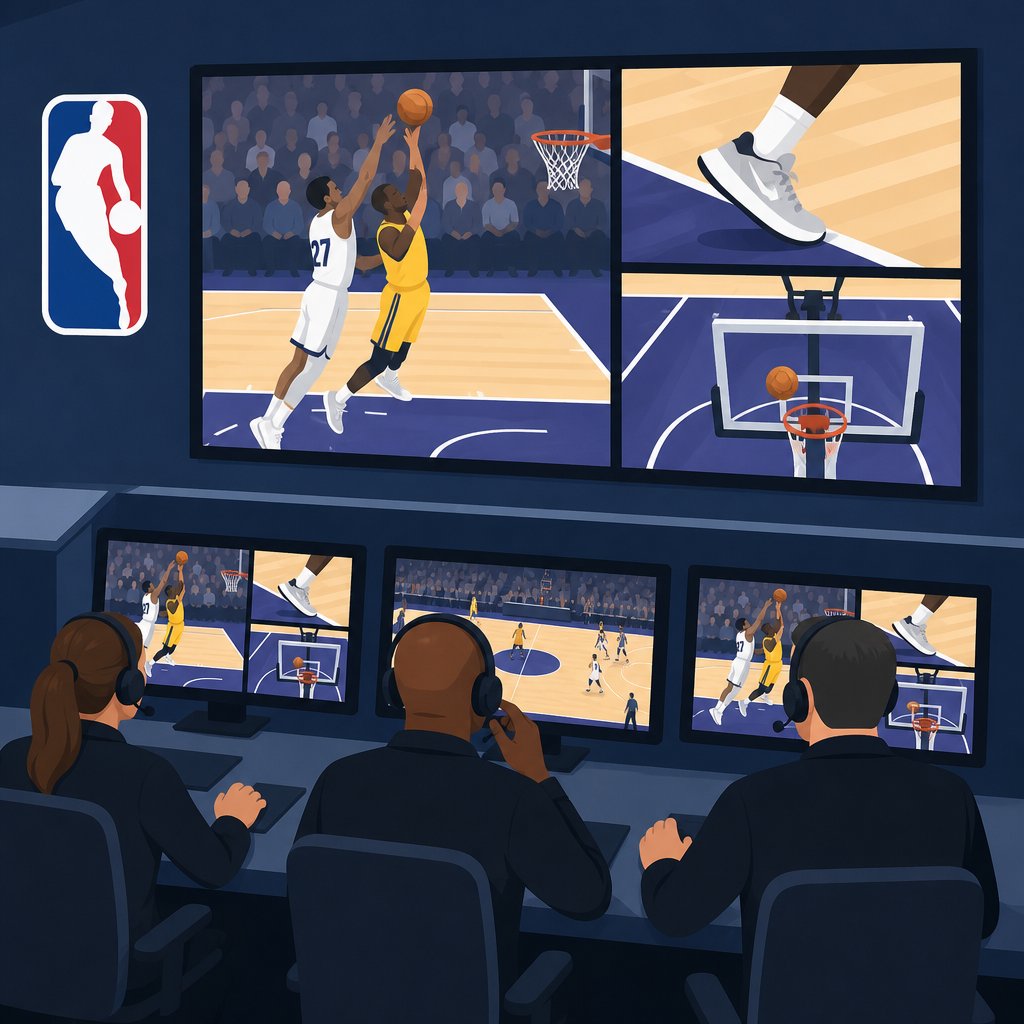
The Replay Center is the NBA’s remote review hub, staffed by trained officials who support the crew on the floor during games. It is often associated with Secaucus, New Jersey, where the league has long centralized replay operations, though the essential point is operational rather than geographic: a dedicated team has access to synchronized camera angles, timing feeds, and communications channels that let them analyze reviewable events faster than an arena crew could on its own. The on-court referees still officiate the game. The Replay Center supports, advises, and in defined cases helps determine the final ruling.
In practical terms, the system reduces two recurring problems. First, referees on the floor do not always have the best angle for end-line, sideline, or above-the-rim decisions. Second, the in-arena review process used to consume too much time when officials had to sort through feeds courtside. Centralization improves consistency because replay officials repeatedly apply the same standards across the league. It also improves speed because they are working with purpose-built equipment and direct access to all available broadcast and in-house sources.
Officiating crews communicate with the Replay Center through headsets and standardized review procedures. During a trigger event, the crew chief may initiate a review, a coach may use a challenge if the situation qualifies, or the Replay Center may alert the floor to certain reviewable matters, such as timing corrections. That communication is tightly structured. The crew is not debating the entire game. It is identifying the exact question under the rules, checking the authorized evidence, and applying the proper standard. This point is vital for any serious discussion of NBA officiating because review errors often come from asking the wrong question, not from lacking enough camera angles.
Which Calls Can Be Reviewed in Real Time
The NBA rulebook and replay trigger list define reviewable categories with precision. Common examples include made basket timing at the end of a period, whether a shooter released before the shot clock expired, out-of-bounds decisions, goaltending or basket interference in certain circumstances, clear-path fouls, flagrant foul upgrades or downgrades, hostile act determinations, restricted-area block-charge reviews, scorekeeping corrections, and game-clock or shot-clock adjustments. The system is powerful, but it is not open-ended. Review must fit an authorized category.
For fans, the easiest way to think about reviewable calls is by separating objective and interpretive questions. Objective questions usually involve lines, clocks, and touch sequences: Did the ball leave the hand before 0.0? Did the defender’s heel touch the restricted-area arc? Did the ball go off blue or white last? These are where replay adds the most value because video can often answer them clearly. Interpretive questions involve the judgment of contact and legality: Was there marginal contact on the drive, did the defender establish legal guarding position early enough, or was the hand contact incidental? Some of those judgments are reviewable only through a coach’s challenge or a specific trigger; many remain live-call territory.
That limitation is why people often misunderstand controversial possessions. A missed travel or three-second violation may not be reviewable. A missed off-ball hold may not be reviewable. A clear foul that occurred before the final out-of-bounds touch may still be irrelevant if the review is limited to who touched the ball last. In my experience, that is the single biggest gap between fan expectation and league procedure. Replay is not designed to fix every basketball wrong. It is designed to answer narrow questions the rulebook has marked for video review.
| Review situation | Typical question | Why replay helps |
|---|---|---|
| End-of-period shot | Was the ball released before the clock expired? | Frame-by-frame sync between hand release and game clock |
| Out of bounds | Who touched the ball last? | Multiple angles reveal fingertip contact and deflections |
| Restricted area block-charge | Was the defender inside the arc? | Baseline views and overheads clarify foot position |
| Flagrant foul review | Was the contact unnecessary or excessive? | Slow motion helps assess wind-up, impact, and follow-through |
| Clock correction | How much time should be restored or removed? | Broadcast and arena feeds provide precise timing cues |
How a Replay Review Actually Unfolds During a Game
A real-time NBA replay review follows a repeatable sequence. First, a review trigger occurs. That might be an automatic review at the end of a quarter, a coach’s challenge, a possible hostile act, or a late-game out-of-bounds question. Second, the crew identifies the ruling on the floor. This is essential because replay is not conducted in a vacuum; there must be a call or a no-call context to review against the rule. Third, officials and the Replay Center isolate the exact issue under review. Fourth, they examine available camera angles, often prioritizing the clearest angle rather than the most dramatic broadcast shot. Fifth, the crew chief announces the ruling and, when required, explains the outcome.
When this process works well, it is concise because everyone stays inside the defined scope. Suppose a defender contests a layup with heavy body contact, the ball goes out of bounds, and the ruling is off the attacker. If the review trigger is only the out-of-bounds call, officials can determine touch sequence but cannot use that review to create an entirely new common foul unless the rules permit a challenge on the foul itself. Fans may see obvious contact and wonder why the result stayed with the original review category. The answer is procedural discipline. The league would rather have a limited review system applied consistently than an improvisational one that changes game flow and authority possession by possession.
There is also a standard of evidence. Replay does not require philosophical certainty; it requires clear and conclusive visual evidence to overturn the call on the floor. If the available angles are obstructed or ambiguous, the ruling stands. This is common on block-charge plays where torso angle, foot placement, and secondary contact occur almost simultaneously. A fan watching one replay on television may think the answer is easy. Officials are trained to ask whether the evidence definitively defeats the original call. If not, the original ruling remains, even if another interpretation feels plausible.
Roles of the On-Court Crew, Crew Chief, and Replay Center Officials
NBA officiating is hierarchical during replay. The three-person on-court crew calls the live game, and the crew chief manages final communication. Replay Center officials provide technical review support, rule application assistance, and timing analysis. Depending on the situation, the replay official may effectively confirm what the video shows, but the floor crew remains central because it owns the original call context and game administration responsibilities such as free-throw alignment, possession direction, and player management after the review.
The crew chief’s role is broader than fans realize. During a review, the crew chief must control the discussion, prevent mission creep, verify the reviewable issue, and ensure the final result matches both the visual evidence and the applicable rule. Good crew chiefs are decisive and disciplined. They know when enough evidence has been seen and when a long search for certainty becomes counterproductive. I have watched many reviews where the quality of the process depended less on technology than on whether the crew framed the review properly from the start.
Replay officials, meanwhile, bring consistency. Because they work continuously with review tools and replay standards, they help reduce arena-to-arena variation. They also support clock administration, which is one of the least glamorous but most important parts of officiating. A two-tenths adjustment can affect whether a team has time for a catch-and-shoot, a tip, or no legal attempt at all. That is why precise synchronization matters. The best replay work is often invisible to casual fans because it ends with a corrected clock and a resumed game rather than a dramatic overturned foul.
Coach’s Challenges, Trigger Reviews, and Common Misunderstandings
The coach’s challenge changed NBA officiating by allowing teams a formal path to contest certain foul calls, out-of-bounds rulings, goaltending, basket interference, and other reviewable decisions. A challenge is not a general protest tool. It must target an eligible event and be used according to procedural rules, including timeout requirements in the applicable season framework. That matters strategically. Coaches tend to save challenges for high-leverage possessions, but holding one too long can waste an opportunity to erase a pivotal early mistake.
One common misunderstanding is that a successful challenge means everything connected to the play can be reofficiated. In reality, the review is tied to the challenged event and any outcomes the rules specifically allow officials to adjust. Another misunderstanding is that replay creates perfection. It does not. Video can sharpen some evidence while distorting other judgments, especially with slow motion. Contact that looks severe frame by frame may be ordinary at game speed. The NBA has spent years refining replay interpretation because speed context affects whether contact is incidental, marginal, unnecessary, or excessive.
This is where officiating knowledge becomes more valuable than outrage. The best analysts do not ask only whether a call looked wrong. They ask whether it was reviewable, what the ruling on the floor was, what standard applied, whether there was conclusive evidence, and whether the resulting administration matched the rulebook. Those are the questions that produce accurate explanations and better fan understanding. They also connect this replay hub to the wider NBA Rules landscape, from foul definitions to game-clock procedures and postgame reporting.
Why Replay Improves Accuracy but Cannot Eliminate Controversy
The Replay Center makes NBA officiating better, faster, and more consistent on critical reviewable plays, but it cannot remove disagreement from a sport built on speed, contact, and judgment. Some calls remain subjective. Some camera angles remain imperfect. Some procedures intentionally limit what can be fixed in order to preserve game flow and the authority of live officiating. Those limits are not flaws in themselves; they are policy choices about how basketball should be administered.
The practical takeaway is simple. To understand NBA officiating, learn the replay categories, the review sequence, and the standard for overturning a call. Then connect replay to related officiating topics such as foul criteria, referee mechanics, restricted-area rules, clear-path standards, and Last Two Minute reports. That broader context turns isolated controversies into understandable decisions. If you are building your knowledge of NBA Rules, use this Officiating hub as your starting point and keep exploring the connected articles that break down each review type in detail.
Frequently Asked Questions
What is the NBA Replay Center, and why was it created?
The NBA Replay Center is the league’s centralized video review hub, designed to support on-court officials when a play needs a closer look. Instead of forcing referees to rely only on their live angle, split-second judgment, and whatever they can see from floor level, the Replay Center gives them access to multiple broadcast and arena camera feeds in real time. That matters because NBA games move fast, and many of the most important calls involve tiny details such as whether a player released the ball before the shot clock expired, whether a foot was on the three-point line, or whether contact rose to the level of a flagrant foul.
The system was created to improve accuracy, consistency, and confidence in high-leverage decisions. In practical terms, it helps reduce avoidable errors on reviewable plays while still preserving the authority of the game officials. It also reflects a broader reality of modern sports: elite leagues now use technology not just for entertainment, but for officiating support and competitive integrity. For fans, the Replay Center is important because it shows that NBA officiating is not simply three referees making isolated calls; it is a structured process that blends rulebook standards, camera evidence, communication protocols, and timing rules to get critical situations right as efficiently as possible.
How does an NBA replay review actually work during a game?
When a reviewable event occurs, the officials first determine whether the play falls into a category that can legally be reviewed under NBA rules. That distinction is crucial, because replay is not a free-for-all. The league has specific triggers and boundaries for what can be examined. Once a review is initiated, the crew chief typically goes to the courtside monitor, while the Replay Center simultaneously evaluates the play using available angles and communicates with the officials. Depending on the type of play, the review may involve confirming the original ruling, changing part of the ruling, or clarifying a detail such as timing, possession, point value, or the severity of contact.
The process is built around communication. The on-court crew, the Replay Center, and the rule framework all work together. The referees are not simply watching TV clips in isolation; they are applying precise rule standards to what they see. For example, on an out-of-bounds review, they may examine not only who touched the ball last but also whether another reviewable element occurred immediately before the ball went out. On a potential buzzer-beater, they may study hand position, horn timing, and game clock synchronization. Once the evidence is reviewed, the referee announces the decision to the arena and broadcast audience. That announcement is a key part of the process because it explains what was reviewed and what the final ruling means for the game.
What kinds of calls can the NBA Replay Center review in real time?
The Replay Center can assist with a defined set of reviewable matters, generally focused on objective or high-impact situations. Common examples include whether a made shot was a two-pointer or three-pointer, whether the ball was released before the shot clock or game clock expired, whether a player was inbounds or out of bounds, and who last touched the ball before it went out. Officials can also review certain foul-related questions, such as whether contact meets the standard for a flagrant foul or whether a hostile act occurred. In end-of-period situations, replay often becomes especially important because tenths of a second and exact release timing can determine whether points count.
Just as important, replay has limits. Not every judgment call is reviewable, and fans often get frustrated when a play looks controversial but does not fit within the rulebook’s replay categories. The system is designed that way on purpose. The NBA wants to improve correctness on key, reviewable plays without turning every disputed moment into a lengthy stoppage. So while replay can resolve many factual questions with video evidence, it does not eliminate officiating discretion. Understanding that balance helps explain why some calls are reviewed immediately, some can be reviewed only under special conditions such as a coach’s challenge, and some are not reviewable at all even if the television broadcast shows multiple replays.
Does the NBA Replay Center make the final decision, or do the referees on the floor still control the call?
The referees on the floor remain the official decision-makers, even though the Replay Center plays a major support role. The Center is there to provide technical assistance, additional angles, rule application support, and real-time communication, but the game crew is still responsible for administering the final ruling. In many reviews, especially standard monitor reviews, the crew chief evaluates the video and announces the outcome. The Replay Center helps make sure the officials have the clearest possible evidence and that the review follows league protocol, but it does not replace the authority of the officiating crew.
That said, the relationship between the floor officials and the Replay Center is more collaborative than many fans realize. The centralized model allows the league to standardize review practices across all arenas and game situations. It helps avoid a scenario where one crew has limited access, inconsistent camera quality, or uneven procedural support. So while the referees are still in charge, they are not operating alone. The best way to think about it is that the Replay Center expands what the officials can reliably know in the moment. It strengthens decision-making without removing accountability from the crew assigned to the game.
Does replay review improve fairness, or does it slow the game down too much?
Replay review undeniably creates a trade-off between accuracy and flow, but its core purpose is to improve fairness in moments that can change outcomes. In a league where a single possession can determine seeding, playoff results, or player legacies, getting pivotal calls right matters. Reviews can correct obvious mistakes, confirm close rulings, and give players, coaches, and fans more confidence that decisive moments were judged with all available evidence. That is especially valuable late in games, when the margin for error is smallest and every possession is magnified.
At the same time, concerns about delays are legitimate. Long reviews can interrupt momentum, cool off players, and test fan patience in the arena and at home. The NBA tries to manage that tension by limiting replay to specific categories, refining procedures, and using the centralized Replay Center to speed up access to angles and communication. The goal is not to review everything, but to review the right things. In that sense, replay is best understood as a targeted correction tool rather than a complete rewrite of officiating. When it works well, it protects competitive integrity without overwhelming the rhythm of the game. For most fans and analysts who study how the rulebook is applied, that balance is exactly why the Replay Center has become such a central part of modern NBA officiating.