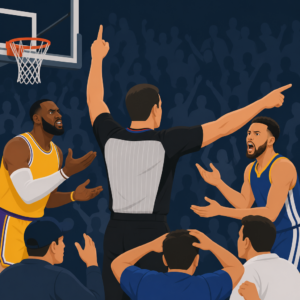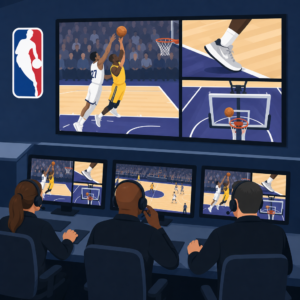

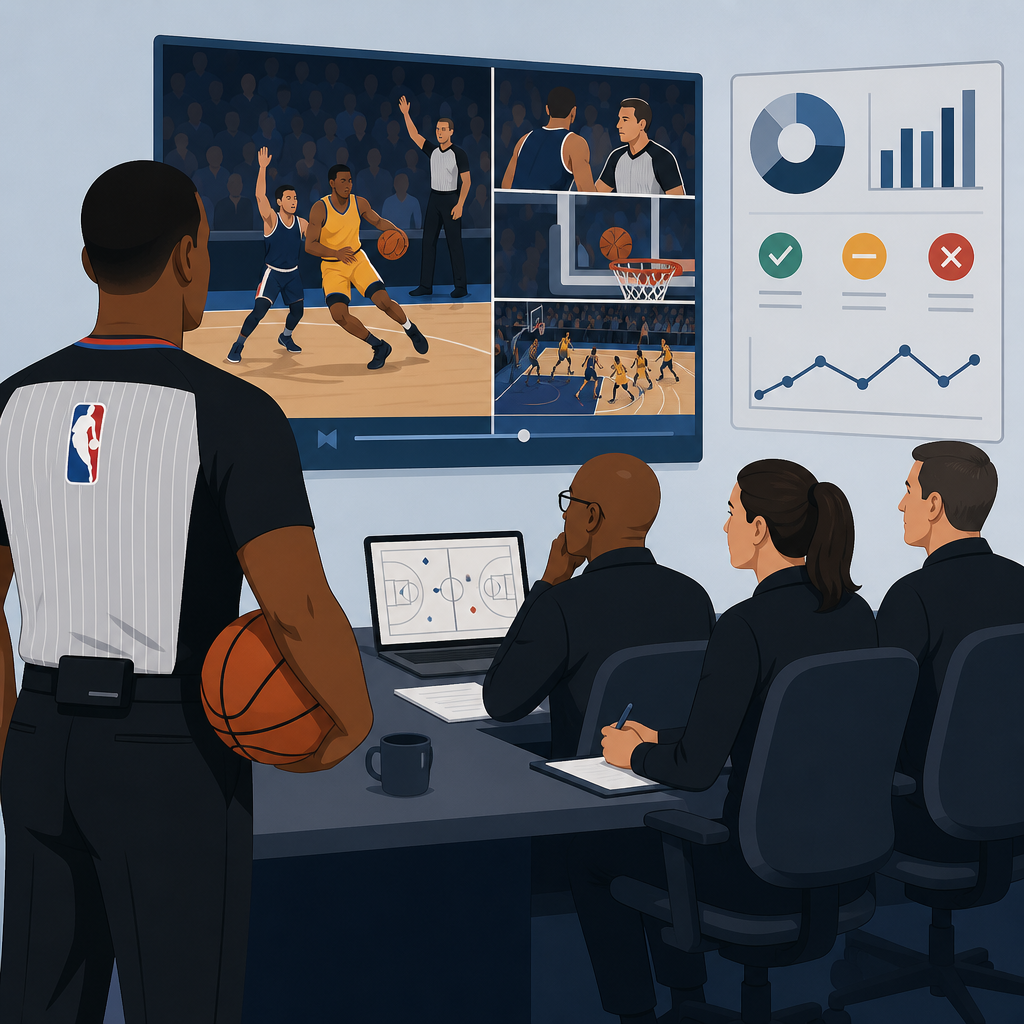
NBA referees are evaluated through a layered quality-control system that combines live observation, postgame video review, statistical tracking, formal grading, rules education, and advancement criteria tied to assignment opportunities. In simple terms, every game creates an evidence trail: calls made, calls missed, mechanics used, positioning choices, crew communication, and game-management decisions all become part of an official’s performance record. For anyone studying NBA rules, this matters because officiating is not just about whistle accuracy in the moment; it is a professional discipline built around consistency, accountability, and measurable improvement across an 82-game season and the playoffs.
When people ask how NBA officiating works, they usually mean one of three things. First, how are referees judged after a game? Second, who does the judging and what standards do they use? Third, how do those evaluations affect playoff assignments, promotions, and long-term careers? I have worked through film-based officiating review frameworks in basketball settings, and the biggest misconception I see is the idea that a referee’s quality is judged only by obvious missed calls. In reality, the league evaluates much more: whether the official saw the primary defender establish legal guarding position, whether secondary defenders arrived on time, whether the lead official maintained the correct angle, whether off-ball illegal contact was identified, and whether the crew applied points of emphasis consistently from opening tip to final possession.
Key terms help clarify the process. Officiating quality control refers to the systems used to measure and improve referee performance. Play-calling accuracy means whether a whistle or non-whistle matched the rulebook and approved interpretations. Game management covers composure, communication, preventive officiating, conflict de-escalation, and handling replay, coaches, and players. Mechanics are the standardized floor movements, signals, and coverage responsibilities used by the crew. Together, these categories shape how the NBA assesses officials and why officiating deserves its own hub within the broader NBA Rules landscape.
The NBA officiating evaluation framework
The NBA uses a centralized review model rather than leaving assessment to informal opinion. Every referee works inside a structure that includes the NBA rulebook, case interpretations, mechanics manuals, training directives, and game-by-game performance review. Officials are not graded on reputation alone. They are evaluated against the same standards whether the game is a nationally televised rivalry in March or a quieter midweek matchup in November.
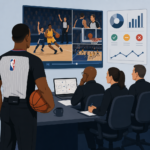
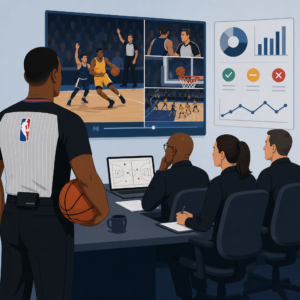
At the core of the framework is video. Every game can be broken down possession by possession, and review staff can isolate specific judgment plays, rotations, out-of-bounds rulings, timing issues, unsportsmanlike acts, and replay decisions. This allows the league to compare what happened on the floor with what should have been called under the rules. In practical terms, video reduces memory bias. A crew chief’s strong late-game sequence does not erase earlier misses, and a visible error in the final minute does not automatically define an otherwise solid night.
Another defining feature is that evaluation is multidimensional. Call accuracy matters most, but it is not the only variable. The NBA expects proper floor coverage, clear signals, whistle discipline, awareness of advantage-disadvantage principles, and collaboration among the three officials. An official who gets many rulings right but repeatedly works poor angles or fails to support partners can still grade below expectation because those habits create future risk.
What is reviewed after every game
Postgame review focuses on decision quality and process quality. Decision quality asks a direct question: was the ruling correct under the rules and officiating interpretations? Process quality asks whether the referee gave himself or herself the best chance to make the right call. A correct call made from a compromised angle may still trigger coaching in evaluation notes because poor positioning is not sustainable over a full season.
Reviewers examine common foul categories such as illegal use of hands, blocking and charging, verticality, freedom-of-movement restrictions, screens, rebounding contact, and post play. They also assess technical fouls, delay-of-game warnings, hostile act awareness, transition take fouls, shot-clock administration, and goaltending or basket-interference judgments. End-of-game situations receive special scrutiny because clock, score, challenge strategy, and replay protocol combine to magnify every ruling.
Non-calls are a major part of quality control. Fans often assume evaluation starts only when a whistle is blown, but experienced reviewers know elite officiating depends on passing correctly as much as calling correctly. If legal marginal contact occurs on a drive, the official must recognize that the defender maintained legal position and that no advantage demanding a whistle was created. Over-officiating can be as damaging as under-officiating because it disrupts rhythm and changes competitive balance.
The role of the referee operations department
The NBA’s referee operations leadership oversees standards, training, accountability, and assignment decisions. This function is not ceremonial. It connects game film, grading, education, and staffing into one continuous loop. In any high-level officiating program, the value of evaluation depends on whether the lessons from one game influence the next one. That is exactly why centralized operations matter.
Leaders in referee operations review trends across the league, not just isolated mistakes by individual officials. If data shows a recurring issue with transition block-charge plays, off-ball holds, or transition take fouls, the department can issue clarifying instructional material to all crews. That keeps officiating from drifting crew to crew. Consistency is the product the league is trying to deliver, and consistency requires league-wide interpretation management.
This department also supports development pipelines. Officials moving between the G League, WNBA experience, college backgrounds, or prior international work need alignment on NBA-specific standards. Even highly accomplished referees from other competitions must adapt to NBA pace, spacing, player size, and replay procedures. Evaluation therefore serves both accountability and onboarding.
Grading criteria: accuracy, positioning, and game management
Three buckets define most serious referee assessment: judgment accuracy, mechanics and positioning, and game management. Judgment accuracy is the clearest to explain. Either the defender was legal or not, the shooter was fouled or not, the ball was last touched by one player or another, or a timer-related ruling matched the rules and replay evidence or it did not. Accuracy is the backbone of credibility.
Mechanics and positioning are less visible to casual viewers but vital in professional review. Each official has primary coverage areas and rotation expectations. Trail, lead, and center positions are designed to create angles on the ball, paint, weak-side action, and rebounding matchups. When an official fails to close down to the end line, gets stacked behind players, or watches the ball at the expense of off-ball contact, the chance of error rises sharply. I have seen film where the wrong outcome began not with the whistle, but with a half-step late rotation that blocked the official’s sightline.
Game management covers everything that keeps a contest under control without becoming overbearing. Strong game management means listening without losing authority, addressing repeated contact before it escalates, handling coaches professionally, using replay efficiently, and maintaining poise in volatile moments. Officials who communicate clearly can prevent problems that no box score captures.
| Evaluation Area | What Reviewers Look For | Example |
|---|---|---|
| Call Accuracy | Correct whistles and correct non-whistles under the rulebook | Legal verticality judged correctly at the rim |
| Positioning | Proper angles, rotations, and coverage responsibility | Lead official rotates to open a clear look at secondary defender |
| Game Management | Communication, control, preventive officiating, professionalism | Crew de-escalates a bench reaction before it becomes a technical foul |
| Replay Administration | Correct trigger, efficient process, accurate final ruling | Out-of-bounds review completed quickly with proper reset |
How replay and late-game review affect evaluations
Instant replay changed officiating evaluation because it created a second standard beyond live judgment: procedural correctness. A referee can identify that a reviewable event occurred, communicate it properly to the scorer’s table, consult available angles, and deliver the right ruling with the right clock adjustment. That sequence is itself evaluated. A technically correct final answer does not excuse a poorly managed review that causes confusion or delay.
The Last Two Minute reporting process brought extra visibility to late-game rulings in close games. Although public reports cover only a narrow slice of a contest, they matter because they illustrate how the league classifies correct calls, incorrect calls, correct non-calls, and incorrect non-calls. Fans sometimes overread these reports, but they remain useful for understanding standards in crunch time. They also reinforce a critical point: non-calls are reviewed just as rigorously as whistles.
Replay can correct boundary plays, timing issues, goaltending questions, and certain hostile act scenarios, but it does not erase the need for strong live officiating. Most judgment decisions still rely on real-time positioning and recognition. The best crews use replay as a safeguard, not a crutch.
Training, feedback, and continuous improvement
Evaluation only improves performance if it produces actionable feedback. In the NBA environment, that feedback can include postgame notes, video clips, rules bulletins, preseason points of emphasis, and direct conversations with supervisors. The strongest feedback is specific. “Work wider on baseline drives to open your look through the defender’s torso” helps an official improve. “Be better on drives” does not.
Officials also study patterns over time. If an evaluator notices recurring misses on wrap-up fouls in transition or delayed whistles on post displacement, the official can target those situations in film sessions and live practice. In my experience, improvement usually comes from narrowing the problem. Referees do not get better by trying to fix everything at once; they get better by identifying repeatable situations and adjusting mechanics, focus points, or timing.
Fitness and mental sharpness are part of this process too. NBA officials cover significant ground each game, and fatigue can hurt angles, patience, and concentration. Training therefore extends beyond rules knowledge. It includes movement efficiency, communication under stress, and the discipline to reset mentally after a visible mistake. Professional officiating is performance work, not just rule memorization.
How evaluations shape assignments, promotions, and playoff selection
Performance review has direct career consequences. Regular-season assignments, marquee games, playoff rounds, and eventually the NBA Finals are tied to trust earned through sustained grading and professionalism. One excellent week will not override months of uneven work, and one poor game usually will not erase a strong season. The league is looking for dependable repeatability.
Playoff selection is the clearest example. Officials are chosen round by round, with stronger evaluative standing generally leading to deeper postseason assignments. Finals officials are typically those who combine high call accuracy with calm game management and proven performance under pressure. The standard is high because playoff basketball magnifies every possession and every interaction.
Promotion pipelines work similarly. Officials in developmental tracks need strong evaluations to move upward. Supervisors want evidence that an official can process NBA speed, enforce freedom-of-movement rules consistently, handle star players without bias, and maintain composure in replay-heavy endings. The evaluation file becomes a long-term record of readiness.
Common misconceptions about NBA referee accountability
The biggest misconception is that accountability means public punishment after every controversial call. That is not how effective officiating management works. Real accountability is systematic, private when appropriate, documented, and tied to future opportunity. Public outrage may spotlight a play, but internal review determines whether the official applied the rule correctly and whether broader improvement is needed.
Another misconception is that good officiating means invisibility. In some games, that is true. In others, the right crew must be highly active because players are testing physical limits, coaches are challenging boundaries, or end-game procedures demand precision. The goal is not silence for its own sake. The goal is accurate, consistent control that preserves fairness.
A third misconception is that superstar treatment makes objective evaluation impossible. High-profile players certainly create difficult optics because they handle the ball often and draw heavy contact, but modern video review and centralized grading reduce the influence of perception. The tape still asks the same question on every play: legal or illegal, correct or incorrect.
Why officiating quality control matters to NBA Rules coverage
Any serious NBA Rules hub needs a strong officiating foundation because rules do not exist in a vacuum. They become meaningful only when applied by officials in live, complex, high-speed environments. Understanding the evaluation process helps readers interpret why the league emphasizes freedom of movement one season, transition take fouls another, or replay efficiency in tight endings. It also explains why controversial plays are rarely just about one whistle; they usually involve positioning, coverage responsibility, crew support, and standardized interpretation.
For readers exploring related officiating topics, the natural next steps include block-charge principles, replay review rules, technical fouls, flagrant fouls, goaltending and basket interference, the coach’s challenge, and Last Two Minute reports. Those subjects all connect back to the same central idea: NBA officiating quality is managed through detailed review, not guesswork.
The key takeaway is simple. NBA referees are evaluated continuously through film, grading, supervision, and feedback designed to improve consistency and accuracy over time. That process affects game assignments, playoff advancement, and the credibility of rule enforcement across the league. If you want to understand NBA Rules more deeply, keep following the officiating branch of this hub and study how the rulebook translates from page to possession.
Frequently Asked Questions
How does the NBA actually evaluate referee performance after each game?
The NBA evaluates referee performance through a multi-step quality-control process that begins during the game and continues well after the final buzzer. Every contest generates a detailed performance record that includes calls made, calls missed, no-calls, positioning, mechanics, communication, and overall game management. Supervisors and evaluators review game film to examine whether officials correctly applied NBA rules and proper officiating standards in real time. This review is not limited to obvious fouls or controversial endings; it also looks at routine plays, off-ball action, timing, crew coordination, and whether referees were in the right place to see the play clearly.
Postgame analysis is especially important because video allows the league to slow down sequences, compare angles, and determine whether a decision matched the rulebook. In that sense, evaluation is both technical and practical. A referee might get the final ruling correct but still be reviewed on whether the mechanic, positioning, or communication process could have been better. Over time, these evaluations form a larger performance profile, helping the league identify consistency, strengths, recurring issues, and readiness for more demanding assignments. The result is a system designed to measure officiating quality not by one headline moment, but by a broad body of evidence collected game after game.
What kinds of things are referees graded on besides whether a call was right or wrong?
Correctness of calls is central, but it is only one part of how NBA referees are graded. Officials are also evaluated on mechanics, positioning, court coverage, timing, signaling, communication, teamwork, and game management. Positioning matters because even a highly knowledgeable referee can be put at a disadvantage if they are screened or out of angle on a play. Mechanics matter because clear signals, proper reporting, and smooth administration support accuracy and credibility. Evaluators want to see whether the official was prepared, composed, and disciplined in how they handled both routine possessions and emotionally charged situations.
Crew communication is another major factor. NBA officiating is built around a team structure, so evaluators look at how referees rotate, help one another on difficult plays, discuss information when necessary, and maintain consistent standards throughout the game. Game management is equally important. That includes how officials handle player complaints, bench decorum, delay situations, unsportsmanlike conduct, replay administration, and escalation risks. In close or tense games, officials are expected to apply the rules accurately while also maintaining control and flow. So while fans often focus only on a single whistle, the league’s grading process is much broader and measures whether an official consistently performs the full job at an NBA level.
Does the NBA use video review and statistical tracking to monitor officiating trends?
Yes, video review and statistical tracking are both essential tools in NBA referee evaluation. Video review provides the visual evidence needed to assess specific decisions and overall mechanics with precision. Evaluators can study whether the referee had an unobstructed look, whether contact met the threshold for a foul, whether verticality or legal guarding position was applied correctly, and whether off-ball action was properly monitored. Because many plays happen quickly and involve multiple players moving at once, film review helps create a more reliable record than memory alone.
Statistical tracking adds another layer by identifying patterns over time. Rather than looking at one game in isolation, the league can analyze how often an official is involved in certain call types, whether there are repeat issues in specific play categories, or whether their accuracy and judgment remain stable across different game environments. Statistics can highlight trends in foul calls, violations, replay-triggered situations, and perhaps broader tendencies tied to positioning zones or coverage responsibilities. This does not mean referees are judged by raw numbers alone; context always matters. But combined with film, statistical monitoring helps the NBA distinguish between a one-off mistake and a recurring weakness that may require targeted feedback, rules reinforcement, or developmental attention.
How do referee evaluations affect playoff assignments, promotions, and career advancement?
Referee evaluations have a direct impact on assignment opportunities and long-term advancement within the NBA officiating system. Strong performance records can lead to higher-profile regular-season games, postseason consideration, and increased trust from the league office. Because playoff basketball is more intense, more heavily scrutinized, and often more physically and emotionally demanding, the NBA relies on accumulated evaluation data to determine which officials have demonstrated the consistency, rule knowledge, composure, and game-management skill required for that environment. In other words, playoff assignments are earned through sustained quality, not reputation alone.
The same principle applies to broader career progression. Officials who grade well over time may be viewed as ready for more responsibility, while those with repeated deficiencies may need correction, monitoring, or developmental work before moving forward. Advancement is therefore tied to a documented body of evidence: accuracy on calls, sound mechanics, dependable teamwork, command under pressure, and the ability to apply NBA rules consistently. This performance-based structure is a major reason the evaluation process matters so much. It is not just a feedback exercise; it influences who gets the most important games and who continues rising within the profession.
Why is the NBA referee evaluation process important for people studying NBA rules and officiating standards?
The evaluation process matters because it shows how NBA rules are applied in real-world situations, not just how they are written in the rulebook. For students of officiating, coaches, media members, and serious fans, the grading system reveals that officiating quality is built on more than isolated whistle decisions. It connects rule interpretation to positioning, timing, angle, communication, and judgment. That makes the process valuable as a teaching framework. When a play is reviewed after the game, the discussion is often about what the official saw, what standard was applied, whether the crew shared information properly, and how the correct ruling should be reached under NBA mechanics and philosophy.
It is also important because it reinforces accountability and consistency. The existence of formal review, education, and grading demonstrates that officiating is treated as a professional discipline with measurable standards. Referees are expected to learn continuously, adapt to points of emphasis, and improve through feedback. For anyone studying NBA rules, that is a key takeaway: officiating is not simply instinctive decision-making in the moment. It is a structured craft supported by film analysis, formal evaluation, and ongoing education. Understanding that system gives people a more accurate picture of how officiating quality is maintained and why the NBA treats each game as part of a larger performance record.