
The NBA Play-In Tournament changed the league’s season format by inserting a high-stakes qualifying round between the regular season and the traditional 16-team playoff bracket. In simple terms, the play-in determines the final two postseason seeds in each conference, giving teams ranked seventh through tenth a chance to secure the No. 7 or No. 8 playoff spot. What began as a temporary competitive fix inside the 2020 bubble has become a permanent part of the NBA calendar, and understanding its history is now essential for anyone studying how the modern league structures its season.
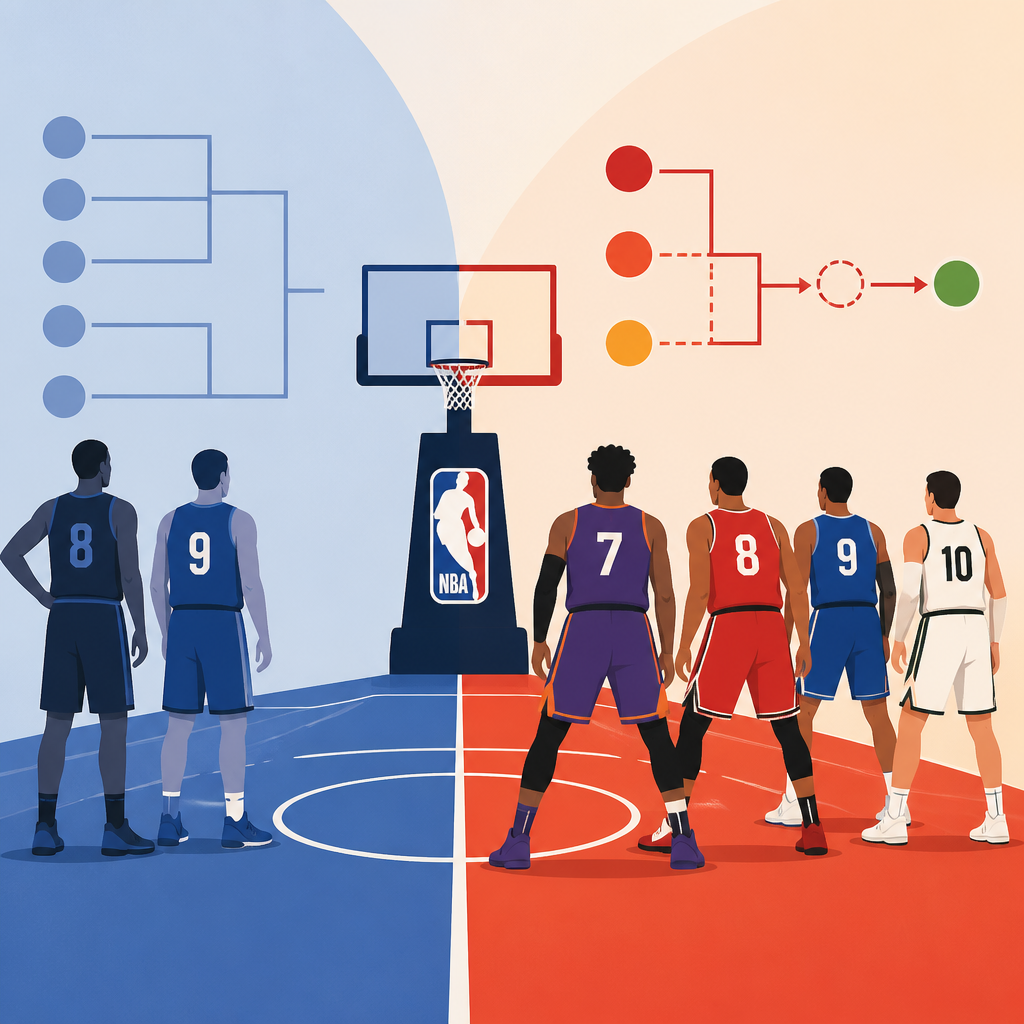
When I explain the play-in to new fans, I start with the practical question they are actually asking: how does it work? The answer is straightforward. In each conference, the seventh-place team hosts the eighth-place team, and the winner becomes the No. 7 seed. The ninth-place team hosts the tenth-place team, and the loser is eliminated. Then the loser of the 7-versus-8 game plays the winner of the 9-versus-10 game for the No. 8 seed. That design gives the seventh and eighth teams a double-chance advantage while still rewarding late-season pushes from ninth and tenth.
This matters because season format shapes incentives. Before the play-in, many teams near the bottom of the playoff race faced a familiar problem in March and April: once a club slipped a few games behind eighth place, urgency faded, resting became easier to justify, and fan interest dropped. The play-in widened the meaningful portion of the standings. More franchises now believe they have a realistic path to the postseason deeper into the schedule, which affects roster management, trade deadline decisions, television value, and even how coaches distribute minutes.
It also matters because the play-in sits inside a broader NBA rules conversation. Season format is not just about the 82-game regular season and the four-round playoffs. It includes tiebreakers, conference seeding, schedule balance, competitive integrity, rest strategy, and the league’s ongoing effort to discourage tanking without eliminating parity. The play-in touches all of those issues. It has supporters who see it as one of the NBA’s smartest structural updates, and critics who argue it can unfairly punish teams that earned a top-eight record over 82 games.
How the NBA Play-In Tournament Started
The origin of the NBA Play-In Tournament is tied directly to the league’s response to the COVID-19 interruption during the 2019-20 season. When the season resumed at Walt Disney World in Orlando, the NBA invited 22 teams instead of bringing back the full league. Because some teams had played different numbers of games before the shutdown, the league needed a fair mechanism to settle the last playoff spot in each conference if the race remained close after the seeding games.
The solution was narrower than today’s format. In 2020, if the ninth-place team finished within four games of the eighth-place team after the bubble seeding schedule, a play-in would be triggered. The ninth-place team had to beat the eighth-place team twice, while the eighth-place team needed one win to keep its spot. In the Western Conference, the Portland Trail Blazers finished eighth and the Memphis Grizzlies finished ninth within the required margin. Portland beat Memphis in the play-in game, and the experiment immediately showed the league something important: one additional elimination-style contest could create playoff-level attention without requiring a full bracket redesign.
From a league operations perspective, that 2020 version solved several problems at once. It preserved the value of regular-season performance by giving eighth place an advantage, created made-for-television urgency, and compensated for schedule irregularities caused by the suspension. In my experience covering season-format questions with fans and editors, this is the point where confusion usually starts: many people think the modern play-in existed all along. It did not. The bubble model was a one-off emergency adaptation, not the current seventh-through-tenth structure.
How the Format Changed in 2021 and Became Permanent
The real structural shift came in the 2020-21 season. The NBA and National Basketball Players Association agreed to a broader play-in format in which the teams finishing seventh through tenth in each conference would compete for the final two playoff seeds. This was a much more ambitious change than the bubble version because it no longer depended on a narrow games-back threshold. Instead, it formally extended postseason qualification beyond the top eight records in each conference.
Under the 2021 system, the seventh-place team hosted the eighth-place team for the No. 7 seed, while the ninth-place team hosted the tenth-place team in an elimination game. The loser of 7-versus-8 then played the winner of 9-versus-10 for the No. 8 seed. This format borrowed logic from page playoff systems used in other sports: better regular-season finishers receive a margin for error, while lower seeds face sudden death immediately. The design was intentional, not cosmetic. It increased excitement without treating seventh and tenth as equals.
Results in the first full play-in year justified the league’s confidence. National attention surged around matchups such as Lakers versus Warriors in May 2021, a game that felt like a conference finals event despite serving only to decide the No. 7 seed. The NBA Board of Governors later approved the play-in on a permanent basis, locking it into the league calendar rather than treating it as a pandemic-era temporary measure. Since then, fans, broadcasters, and front offices have planned around it as a standing feature of the season format.
The permanence of the rule changed team behavior. Front offices now build with tiers in mind: top-six safety, play-in security, and lottery risk. Coaches manage final-week lineups differently because jumping from seventh to sixth means avoiding the play-in entirely, while falling from sixth to seventh now carries real downside. That single boundary line between sixth and seventh has become one of the most consequential cutoffs in the league.
Why the NBA Added the Play-In Tournament
The NBA added the play-in for competitive, commercial, and strategic reasons. First, it keeps more teams in meaningful games later in the regular season. A franchise sitting in eleventh place in early April can still chase tenth, and a team in eighth has reason to push for seventh or sixth instead of settling. Second, it improves television inventory by creating win-or-go-home contests before the first round. Third, it helps discourage aggressive late-season losing because the path to postseason relevance stays open longer.
Those goals connect directly to season format. The NBA has spent years trying to solve the tension between rewarding regular-season excellence and preserving late-season drama. Flattening lottery odds addressed one part of the tanking issue, but not all of it. The play-in addressed another part by enlarging the competitive middle. In practical terms, fewer teams declare the season over in March when tenth place still matters. That does not eliminate rebuilding strategy, but it does change the cost-benefit calculation.
There is also a fan-experience reason. One common criticism of the old format was that the final weeks in one conference could become stale if seeds seven and eight were effectively decided. The play-in makes seeding races more layered. Now the battles for sixth, seventh, eighth, ninth, and tenth all carry specific consequences, and that keeps more local markets engaged. When I have worked on playoff-race explainers, this is the clearest measurable difference: there are simply more standings positions with immediate stakes.
| Format element | Before play-in | Current system |
|---|---|---|
| Automatic playoff qualifiers per conference | Top 8 teams | Top 6 teams |
| Conditional qualifiers | None | Teams 7 through 10 enter play-in |
| Value of finishing 6th | Playoff berth | Playoff berth and avoidance of play-in risk |
| Value of finishing 7th or 8th | Playoff berth | Two chances to qualify |
| Value of finishing 9th or 10th | Lottery position only | Postseason path remains alive |
How the Play-In Affects the NBA Season Format
The play-in has changed the meaning of the regular season without changing its length. The NBA still plays 82 games, but the interpretation of those games is different. In the old structure, the main seeding lines in each conference ran around third, sixth, and eighth. Now sixth is arguably the most important border because it separates guaranteed playoff participation from the uncertainty of the play-in. That has made late-season scoreboard watching more intense across a wider band of teams.
It also affects scheduling strategy and roster decisions. Teams that once might have rested veterans once a top-eight finish looked secure now think twice if they are not safely in the top six. Trade deadline buyers and sellers also operate under a wider competitive window. A club in twelfth place in January may still project a realistic run to tenth, which can justify retaining veterans or adding rotation depth instead of pivoting immediately to draft positioning. That is a concrete season-format consequence, not just a marketing talking point.
From a rules standpoint, the play-in remains separate from the official playoffs in statistical recordkeeping. The NBA treats play-in games differently from regular-season and playoff games, which matters when comparing player and team records. Seeding is also not fully locked until play-in results are complete. The seventh and eighth seeds are no longer earned solely by regular-season finish; they are finalized through the play-in bracket. That distinction is essential for accurate historical comparisons.
Another subtle change is strategic asymmetry. Finishing seventh or eighth still carries a real advantage because those teams need only one win in two opportunities, while ninth and tenth must survive elimination pressure immediately. Critics sometimes say the play-in makes the regular season meaningless, but that is not supported by the structure itself. The format explicitly rewards better records. The debate is really about degree: is that reward large enough? Reasonable observers disagree, but the regular-season edge is built into the design.
Criticism, Controversy, and Real-World Results
The strongest criticism of the NBA Play-In Tournament is fairness. Opponents argue that a team can finish seventh after 82 games, then lose two contests and miss the playoffs entirely despite outperforming the ninth and tenth teams over six months. That objection is legitimate. Over a long season, standings usually reflect quality better than one or two games do. Coaches and executives have voiced this concern, especially when the gap between seventh and tenth is several games or more.
At the same time, actual results show the format has not erased regular-season advantages. Seventh and eighth seeds have often still advanced because they host games and receive two opportunities. The lower seeds can break through, but they must do it under harder conditions. That balance is why the system has endured. It introduces volatility, yet not pure randomness. In plain terms, the play-in creates drama while still leaning toward the better team.
There are also basketball-quality concerns. Some analysts worry that a tenth-place team hovering well below .500 does not deserve a postseason chance. That can happen, particularly in a weaker conference year. The counterargument is that the play-in does not guarantee anything to tenth place; it offers access to an elimination path. The league has judged that possibility to be worth the entertainment and engagement benefits. Whether that tradeoff feels right often depends on whether you prioritize regular-season purity or broader competitive inclusion.
Looking at real examples helps. In 2022, the Minnesota Timberwolves and Los Angeles Clippers played a tense 7-versus-8 game that carried genuine playoff urgency. In 2023, the Miami Heat survived the East play-in, entered the bracket as the No. 8 seed, and then reached the NBA Finals. That run did not prove the play-in is perfect, but it did prove the event can feed directly into major postseason storylines rather than serving as disposable theater.
What the Play-In Means for Fans and the Future
For fans, the biggest benefit of the play-in is simple: more games matter. The standings are easier to care about deeper into the season because the cutoff points create more races at once. For teams, the biggest consequence is strategic pressure. The difference between sixth and seventh now influences coaching decisions, injury management, and trade deadline planning. For the league, the biggest win is a season format that creates urgency without shortening the schedule or expanding the full playoff field beyond sixteen teams.
The history of the NBA Play-In Tournament shows a rare thing in league governance: a temporary solution that exposed a permanent improvement. It started in 2020 as a bubble-specific adjustment, expanded in 2021 into the seventh-through-tenth model, and has since become one of the defining features of the modern NBA season format. It has changed how playoff races are framed, how teams evaluate their odds, and how fans consume the final weeks of the regular season.
The core facts are clear. The play-in did not replace the playoffs; it reshaped the path into them. It did not make the regular season irrelevant; it changed which standings lines matter most. And it did not emerge from abstract theory; it was built in response to a specific scheduling crisis, then kept because it worked. If you are building out your understanding of NBA rules and season format, start here, then follow the connected topics of seeding, tiebreakers, lottery odds, and playoff structure to see the full system in context.
Frequently Asked Questions
What is the NBA Play-In Tournament, and how does it work?
The NBA Play-In Tournament is a qualifying round that takes place after the regular season and before the start of the standard 16-team NBA Playoffs. Its purpose is to determine the final two postseason teams in each conference, specifically the No. 7 and No. 8 seeds. Instead of locking those spots automatically based only on regular-season standings, the play-in gives teams that finish seventh through tenth in the conference a chance to compete for those final playoff berths.
The format is designed to reward better regular-season performance while still creating opportunity. The team that finishes seventh hosts the team that finishes eighth, and the winner of that game earns the No. 7 seed outright. The ninth-place team then hosts the tenth-place team in an elimination game, meaning the loser is immediately done for the season. After that, the loser of the 7-vs-8 matchup plays the winner of the 9-vs-10 game, and the winner of that final contest claims the No. 8 seed. This structure gives the seventh- and eighth-place teams a built-in advantage because they only need one win to advance, while the ninth- and tenth-place teams must win twice to reach the playoffs.
That balance is what makes the system so important to understanding today’s NBA postseason. It adds pressure, television drama, and late-season incentive without completely erasing the value of the 82-game regular season. Teams near the edge of playoff contention now have more reason to keep competing deep into the schedule, while higher-seeded teams in that play-in range still benefit from finishing above the teams below them.
Why did the NBA create the Play-In Tournament in the first place?
The NBA introduced the play-in concept in response to unusual circumstances during the 2019-20 season, when the COVID-19 pandemic interrupted the regular season and forced the league to restart inside the Orlando bubble. Because not every team had played the same number of games and the season was shortened, the league needed a fair and flexible way to address close playoff races. The solution was a limited qualifying mechanism that would allow teams within striking distance of the eighth seed to still compete for a postseason spot.
In its original bubble version, the format was narrower than what fans see today. If the ninth-place team finished within a certain number of games of the eighth-place team, those two clubs would play a special series of sorts for the final playoff spot. The eighth-place team had the advantage of needing to win only once, while the ninth-place team had to beat the eighth-place team twice. That temporary setup was created as a competitive compromise, but it also revealed something bigger: the format generated urgency, attention, and meaningful basketball at the end of the regular season.
After seeing the competitive and commercial value, the NBA expanded the concept. The league recognized that more teams remained engaged longer, fewer franchises had reason to tank early, and fans got additional high-stakes games before the playoffs even began. What started as a one-time answer to a crisis quickly proved useful as a long-term scheduling and competition tool. In that sense, the play-in was born out of necessity but kept because it aligned with the NBA’s broader goals of maintaining relevance, preserving competition, and increasing excitement across the standings.
How has the NBA Play-In Tournament changed since it first began?
The biggest change is that the play-in evolved from a narrow emergency measure into a formal, permanent part of the NBA postseason structure. In 2020, the concept was limited to a bubble-specific scenario involving only the teams battling for the eighth seed, and it was triggered only if the standings were sufficiently close. It was not yet the broad, four-team-per-conference event that fans now recognize. That original version was carefully tailored to unusual conditions rather than intended as a permanent format.
The modern format expanded the field to include the teams that finish seventh, eighth, ninth, and tenth in each conference. That shift dramatically increased the play-in’s impact. Instead of affecting only one possible playoff spot under special circumstances, it now consistently determines both the No. 7 and No. 8 seeds every year. This change widened postseason access while preserving a measurable advantage for teams that finish higher in the standings. It also increased the number of meaningful late-season games, because teams outside the top six still have a clear path into the playoffs.
Another important change is the league’s commitment to permanence. After testing the broader version, the NBA and the National Basketball Players Association eventually agreed to keep the play-in as a standing feature. That decision transformed the end of the regular season. Races for the sixth seed, seventh seed, and tenth seed now matter in ways they did not before. A team once satisfied to coast into seventh now has strong motivation to avoid the play-in altogether by reaching sixth, while teams on the edge of tenth have reason to keep pushing. In short, the play-in changed from a temporary patch into a strategic pillar of the NBA calendar.
What impact has the Play-In Tournament had on the regular season and playoff race?
The play-in has significantly changed how teams approach the final weeks of the regular season. Before it existed, many late-season standings battles were simpler: either a team was securely in the top eight or it was effectively out. Now the pressure extends across a wider section of the standings. The top six seeds matter more because they guarantee direct entry into the playoffs, while the seventh through tenth positions remain alive with postseason implications. That creates a layered race rather than a simple cutoff line.
One of the biggest effects has been on competitive intensity. More teams remain mathematically relevant for longer, which reduces the number of meaningless games late in the season. Franchises that might once have pivoted early toward draft positioning now have a realistic incentive to chase tenth place and get into the play-in field. At the same time, teams sitting in seventh or eighth cannot relax, because they are no longer guaranteed playoff spots. That tension has made late-season scheduling more compelling for fans, broadcasters, and the league itself.
The play-in has also influenced roster management, strategy, and public expectations. Front offices must decide whether to buy, sell, or hold at the trade deadline based on a wider range of postseason possibilities. Coaches may treat end-of-season games with greater urgency because a move from sixth to seventh, or from tenth to eleventh, can completely alter a team’s fate. From a fan perspective, it has created a clearer sense that more games matter. Whether someone loves or dislikes the format, there is little question that it has made the regular season standings more dynamic and the path to the playoffs more dramatic.
Has the Play-In Tournament been controversial, and why do some people still debate it?
Yes, the play-in has been controversial from the moment it gained traction, largely because it changes a long-standing understanding of what regular-season success should guarantee. Critics argue that a team that performs well enough over 82 games to finish seventh or eighth should not have to prove itself again in a short, high-variance setting just to enter the playoffs. From that viewpoint, the format can feel unfair because one or two bad games can undermine months of stronger overall work. Concerns like that become especially loud when there is a large gap in the standings between the seventh-place team and the teams behind it.
Supporters, however, see the play-in as a smart compromise rather than a punishment. The system does not treat all four teams equally; instead, it gives meaningful advantages to the teams that finish seventh and eighth. Those clubs get two chances to win one game, while the ninth- and tenth-place teams must survive a much tougher path. Defenders also point out that the format discourages complacency, keeps more markets invested, and adds playoff-level intensity before the official first round begins. In an entertainment-driven league, that is a powerful argument.
The debate continues because both sides are reacting to real tradeoffs. The NBA has clearly decided that added competition, engagement, and drama outweigh the traditional simplicity of the old top-eight system. Still, every season renews the argument whenever a team with a better regular-season record is forced into a dangerous play-in scenario. That tension is part of the tournament’s identity now. It is popular, consequential, and still not universally embraced, which is often the sign of a format that has fundamentally changed the sport’s postseason conversation.