
The NBA possession arrow is one of the most misunderstood concepts in basketball because many fans use the term from college or high school rules, even though the NBA does not use an alternating possession arrow during normal play. In the NBA, jump ball situations are resolved through a center-court tip to start the game and then specific held-ball, out-of-bounds, and replay procedures governed by the official rulebook. Understanding how an NBA jump ball works matters because it affects late-game strategy, officiating decisions, replay outcomes, substitution choices, and how viewers interpret controversial moments. It also serves as a practical gateway into the broader structure of NBA game rules, including live-ball status, team control, violations, timing, and referee administration. I have explained this rule to new fans, youth coaches, and even experienced players moving between rule sets, and the same confusion comes up every season: people expect a possession arrow to decide ties or held balls, but that expectation belongs to other levels of basketball, not the NBA.
In simple terms, a possession arrow is an indicator used in some leagues to alternate possession after jump-ball situations. The NBA chooses a different approach. After the opening tip, most true jump-ball situations are settled with another actual jump ball between the two involved players at the nearest circle, not by awarding the ball according to an arrow. There are limited administrative procedures that assign possession after certain replay reviews or special circumstances, but fans should not confuse those with the alternating possession method used under NCAA or FIBA variants in some competitions. If you want to understand NBA game rules as a whole, this topic is foundational because it connects directly to when the ball becomes live, who can legally touch it, where players must stand, how violations are called, and what happens when officials cannot clearly determine a team’s right to the ball.
This article acts as a hub for NBA game rules by using the jump ball as the entry point. From there, the logic expands into held balls, loose-ball tie-ups, lane restrictions, clock operation, instant replay, and endgame administration. Once you grasp those links, many seemingly strange calls make sense. You also become better at reading coaching decisions, because bench staffs plan around foul counts, challenge use, and which players are best in a tip scenario. The result is a clearer view of how the NBA preserves competitive balance without relying on an alternating arrow.
Does the NBA Have a Possession Arrow?
No. The NBA does not use an alternating possession arrow in the way many fans mean it. That direct answer solves the main search question immediately. The opening tip begins the game, and later jump-ball situations are typically handled with another jump ball. If two opponents gain firm control of the ball at the same time and neither can gain advantage without undue roughness, officials call a held ball. In the NBA, that means the referee designates the two players involved and restarts play with a jump ball at the nearest circle. There is no table-side arrow flipping from one team to the other after each tie-up.
The confusion is understandable because college basketball popularized the arrow system for decades, and broadcasters sometimes casually say “possession arrow” when discussing who might get the ball after a review. In NBA language, however, possession is assigned by rule, not by an alternating marker. The distinction matters because a real jump ball introduces skill, timing, height, and lineup strategy. Teams with elite leapers or quick guards can turn a 50-50 restart into a designed advantage. An arrow removes that variable. The NBA has consistently preferred the contested restart because it preserves a live competitive act rather than an administrative shortcut.
For fans building a full understanding of NBA rules, this is also a reminder to separate vocabulary by league. Terms such as team control, restricted area, defensive three seconds, clear-path foul, and coach’s challenge all have NBA-specific definitions and consequences. Applying high school or NCAA assumptions to an NBA game often leads to misreading the call.
How an NBA Jump Ball Actually Works
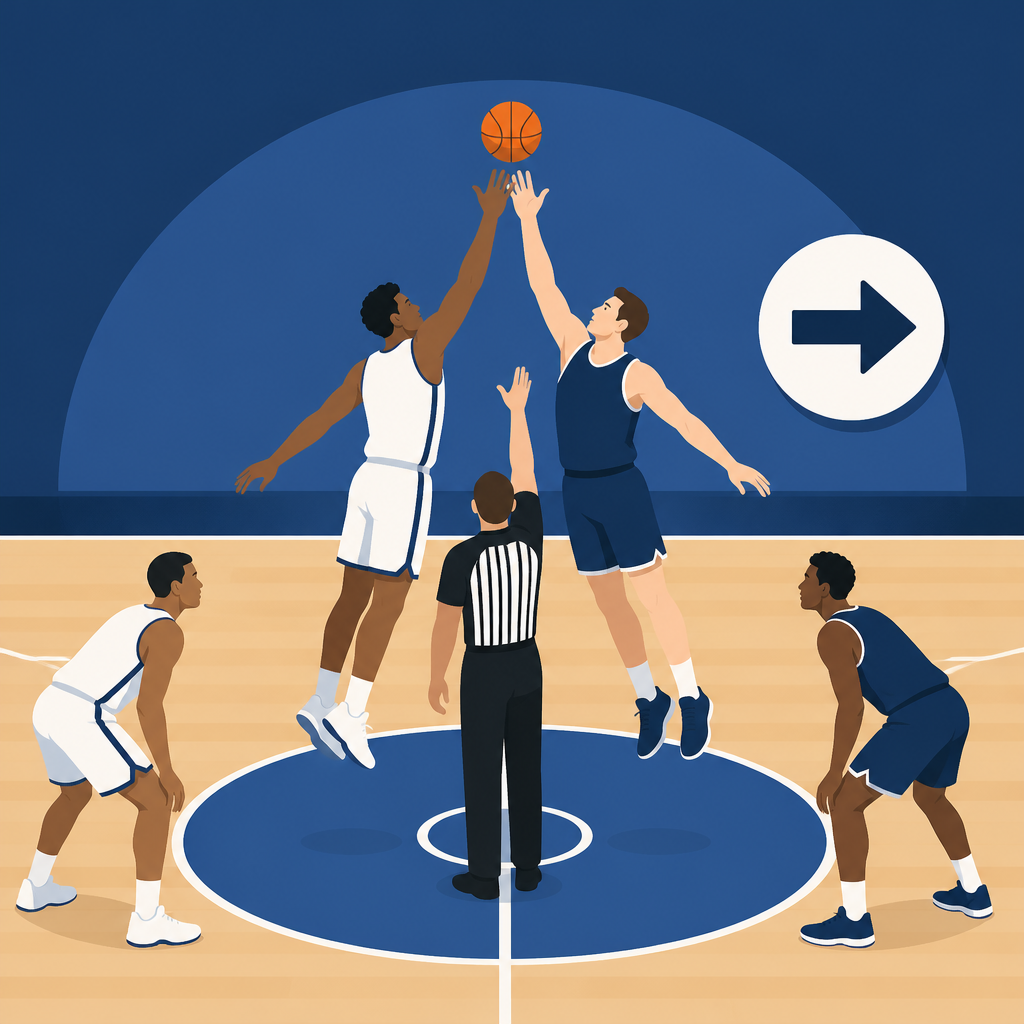
An NBA jump ball starts with the official entering the nearest jump circle and tossing the ball vertically between the two designated players. The toss must be straight enough to give both players an equal opportunity. The players cannot tap the ball before it reaches its apex, cannot catch it directly, and cannot leave the circle until the ball is legally tapped. Their teammates must remain outside the restraining circle markings until the tap occurs, and no player may secure position illegally by holding, displacing, or stepping across the line early.
At the start of the game, one player from each team participates at center court. On later held balls, the two involved players usually jump. If one of those players is injured or disqualified before the jump is administered, a substitute can be designated under the rulebook’s normal substitution procedures. The location matters too. A tie-up in the backcourt may lead to a jump at the nearest circle rather than returning everyone to center court. That detail affects spacing and play design because side circles create different angles for the first touch.
Coaches script these situations. A common late-game tactic is placing a strong tip specialist opposite a smaller ballhandler after a tie-up. The offense may align a shooter toward open space while a guard anticipates the direction of the tap. Defensively, teams often station their quickest player to attack the first deflection. In film sessions, staffs review which teammate a jumper naturally prefers with right-hand or left-hand taps. Those details can swing a possession in a one-score game.
Officials also watch for violations that casual fans miss. If a jumper taps the ball twice before it touches another player, that is illegal. If a non-jumper enters too soon, the official can whistle a violation and award possession accordingly. These mechanics show why the NBA sees jump balls as more than ceremonial. They are technical restarts with precise requirements.
When a Jump Ball Is Called During the Game
The most common in-game reason is a held ball. That occurs when opponents have one or both hands firmly on the ball and neither can pull it free without excessive force. Referees are trained not to wait too long, because delaying the whistle can create contact, elbows, or awkward falls. In practice, you often see a whistle within a second once dual control is clear. Another jump-ball trigger can arise when the officials are in doubt after the ball goes out of bounds and replay or consultation still cannot identify who touched it last under the applicable standard. In specific situations, the rules provide for a jump ball rather than a guessed award of possession.
Loose-ball scrums under the rim create many examples. A rebounder lands, a defender gets both hands on the ball, and neither player can move. Whistle, held ball, nearest circle jump. On the perimeter, a trap may pin the ballhandler near the sideline until a second defender ties the ball up. Again, no arrow, just another jump. I have seen younger fans expect the score table to point one way, then react with surprise when the referee walks players to the circle instead.
Not every simultaneous touch is a held ball. If one player clearly has control and another merely slaps a hand onto the ball, officials may allow play to continue. The key is joint control. Similarly, if the ball is loose and two players place hands on it while diving on the floor, officials judge whether either player ever established control before the tie-up. That judgment can influence whether a timeout request is legal, because a team generally needs player control to call timeout.
Jump Ball Rules Compared With Other Basketball Levels
The best way to understand the NBA rule is to compare it with the systems fans already know. High school and college games in the United States commonly use an alternating possession procedure after the opening tip. FIBA competitions also use alternating possession after the initial jump ball. The NBA and WNBA instead rely more heavily on actual jump balls. That difference changes strategy, roster value, and officiating rhythm.
| League | After opening tip | Held-ball resolution | Strategic effect |
|---|---|---|---|
| NBA | No alternating arrow | Usually an actual jump ball | Tip skill and matchup matter throughout game |
| NCAA | Alternating possession used | Ball awarded by arrow | Administrative possession replaces contested restart |
| NFHS high school | Alternating possession used | Ball awarded by arrow | Less emphasis on later jump-ball specialists |
| FIBA | Alternating possession used | Ball awarded by arrow | Cleaner administration, less live-tip variance |
Each model has tradeoffs. The arrow is faster and reduces repeated tosses, which can help game flow and lower the chance of poor toss mechanics affecting outcomes. The NBA model, however, rewards players for anticipation and contested skill. It also avoids giving teams a future possession simply because the arrow happens to favor them. From a rules philosophy perspective, the NBA tends to preserve live competitive outcomes when possible.
This comparison is useful across the entire NBA Rules topic because many rule debates start with a mistaken cross-league assumption. Fans often do the same thing with goaltending, continuation, timeout advancement, and basket interference. Learning the jump-ball distinction helps prevent similar errors elsewhere.
Replay, Out-of-Bounds Reviews, and Special Possession Awards
Where fans get tripped up is replay. In the final two minutes of the fourth quarter or overtime, officials can review certain out-of-bounds calls. During that process, they may determine more than just who touched the ball last. They can also identify fouls or violations that occurred immediately before the ball went out. If replay shows the ball was simultaneously touched or the evidence does not produce a clear last touch within the review standard, the rulebook can require a jump ball or otherwise restore possession based on the underlying event. That is not an alternating arrow. It is a replay-based ruling.
Another special category involves inadvertent whistles and suspended play. If an official accidentally blows the whistle while a team has clear control, that team is usually awarded the ball at the point nearest the interruption. If neither team had control, a jump ball may result. Similarly, if the game clock or shot clock malfunctions and no team can be fairly disadvantaged, officials use prescribed remedies that may include resuming from a designated spot with the appropriate team in possession. Again, fans sometimes call these “arrow” situations, but they are simply administrative restarts under NBA rules.
The practical lesson is straightforward: ask first whether there was player control, team control, or a held ball. Then ask whether replay altered the original assumption. Once you classify the event correctly, the restart usually becomes obvious.
Why Jump Ball Rules Matter for Strategy and Officiating
Jump-ball rules influence more than isolated tie-ups. They shape how defenders attack the ball, when offensive players protect it, and how coaches deploy personnel. A strong on-ball defender knows that tying up a ballhandler can be almost as valuable as a steal, especially against a lineup with weak jump-ball participants. Big men are coached to chin rebounds tightly because exposing the ball invites a tie-up. Guards are taught to pivot low and keep the ball away from a second defender for the same reason.
Officiating consistency matters too. If referees call held balls quickly, teams can play aggressively without excessive wrestling. If whistles come late, physicality escalates. The NBA’s officiating operations and Last Two Minute Reports have made fans more aware of procedural precision, even if those reports do not eliminate disagreement. In my experience, one of the clearest signs of strong game management is when a crew identifies a tie-up early, administers the jump efficiently, and resets the clock correctly without confusion at the scorer’s table.
For the broader game-rules hub, this topic links naturally to traveling, legal guarding position, loose-ball fouls, timeout rules, and replay review. Many controversial endgame possessions involve several of those rules at once. A star may gather the ball, pivot into help, get tied up, call timeout, and then trigger a review for clock time. If you understand jump-ball administration, the whole sequence becomes easier to decode.
Key Takeaways for Fans Learning NBA Game Rules
The clearest takeaway is this: the NBA does not use a standard alternating possession arrow. After the opening tip, held balls are generally resolved with another actual jump ball. That rule choice affects strategy, lineup usage, and officiating throughout the game. It also explains why announcers, coaches, and players react so strongly to tie-ups in late possessions. A jump ball creates uncertainty and opportunity in a way an administrative arrow never could.
As a hub for NBA game rules, this subject is especially useful because it connects basic concepts that appear everywhere else in the rulebook. To interpret any restart correctly, identify whether there was player control, team control, a loose ball, or simultaneous control. Then consider whether replay, an inadvertent whistle, or a timing issue changes the procedure. That framework will help you understand not only jump balls but also out-of-bounds rulings, timeout legality, and many endgame reviews.
If you follow the NBA closely, keep this rule in mind during every scramble rebound and sideline trap. Watching for who established control, when the whistle came, and where the next jump will occur will make the game far easier to read. Use this article as your starting point for the full NBA Rules series, and revisit the related game-rule topics whenever a strange possession leaves you wondering what just happened on the floor.
Frequently Asked Questions
Does the NBA use a possession arrow like college basketball?
No. The NBA does not use an alternating possession arrow during normal play, which is why the phrase “NBA possession arrow” is technically a misnomer. Many fans bring the term over from college or high school basketball, where a held ball after the opening tip is usually resolved by an alternating possession system. In the NBA, that is not how it works. Instead, the league relies on an actual jump ball procedure in specific situations, along with other rulebook mechanisms for out-of-bounds rulings, replay decisions, and dead-ball administration.
The confusion usually starts because people assume every level of basketball handles tie-up situations the same way. In reality, the NBA keeps the jump ball as a live, meaningful part of the game beyond the opening tip. That means players, coaches, and fans need to understand that there is no arrow determining which team automatically gets the ball after a held-ball situation. If a true jump ball is required, the officials bring the involved players to the center circle or the nearest circle and administer the toss according to NBA rules. So if you are watching an NBA game and wondering which way the arrow is pointing, the answer is simple: there is no possession arrow deciding regular in-game tie-ups.
What happens in an NBA jump ball situation after the opening tip?
After the game begins with the center-court tip, later jump ball situations are handled based on the specific circumstances. If two opponents gain possession of the ball at the same time and neither can establish clear control without undue roughness, the officials can call a held ball. In the NBA, that typically leads to a jump ball between the two players involved. The toss does not get awarded through an arrow; it is actually contested on the floor.
The location of the jump ball depends on the situation. The opening tip takes place at center court, but many in-game jump balls are administered at the nearest circle. The referee tosses the ball vertically, and the two players must follow jump ball rules regarding timing, movement, and legal tapping. They cannot catch the ball directly off the toss before it is tapped, and teammates must remain outside the restraining area until the ball is legally touched. From there, play continues live, just as it would after the opening tip. This matters because an NBA jump ball is not just a procedural formality. It creates a genuine possession battle that can swing momentum, field position, and even end-of-game strategy.
When does the NBA call a jump ball instead of simply awarding possession to one team?
The NBA calls a jump ball when the rules require a contested restart rather than an automatic award of possession. The most common example is a held-ball situation, where opposing players clamp down on the ball at the same time and neither player can gain clear control. Officials may also use a jump ball when there is doubt about which team last touched the ball and replay or on-court judgment does not allow the ball to be awarded through a standard out-of-bounds ruling. In certain special situations, such as offsetting violations or unclear possession after the ball becomes dead, the rulebook can direct officials to resume play with a jump ball as the fairest method.
That said, not every scramble or tie-up becomes a jump ball. If one player had clear possession and another player reaches in and causes a foul, the play may be ruled a personal foul instead. If the ball goes out of bounds and officials can determine who last touched it, possession will be awarded in the usual way. Replay can also eliminate the need for a jump ball by clarifying who touched the ball last or whether a violation occurred first. The key point is that the NBA does not use a possession arrow as a backup shortcut. The officials either identify the proper team for the inbound or, when the rules call for it, they administer an actual jump ball.
How is an NBA jump ball conducted, and what rules do players have to follow?
An NBA jump ball begins with the referee positioning the two designated players in the circle and tossing the ball straight up between them. Those players must remain in their legal jumping positions and may not move into the circle early or make illegal contact before the ball reaches its peak and is tapped. The purpose is to create an even opportunity for both players to tip the ball to a teammate. They are not allowed to catch the tossed ball directly unless it has been legally tapped, and they cannot tap it more times than the rules allow before another player touches it. Teammates outside the circle must also respect spacing restrictions until the ball is legally contacted.
Violations on a jump ball can include stepping into the circle too soon, leaving a designated position early, tapping the ball before it reaches the proper height, or grabbing instead of tapping the toss. If a violation occurs, officials can stop play and award possession according to the rulebook outcome for that infraction. In practical terms, the jump ball is a technical skill play, not a random toss-up. Timing, hand placement, anticipation, and teammate positioning all matter. That is why coaches still value players who can win tips and why late-game jump ball situations can be especially important. A cleanly won tap can create a fast-break chance, preserve a one-possession lead, or deny the opponent a critical final opportunity.
Why is understanding NBA jump ball rules important in late-game situations?
Late in close games, every possession carries more value, and misunderstanding jump ball rules can lead to confusion about what should happen next. Because there is no NBA possession arrow, teams cannot assume they are “due” for the next ball after a previous tie-up. If a held ball occurs with seconds left, the outcome may depend on which players are involved, where the jump ball is administered, and which team is better prepared to win the tip. That can directly affect whether a team gets a final shot, protects a slim lead, or forces overtime.
This also matters during replay reviews and disputed out-of-bounds decisions. Fans sometimes expect an alternating possession-style resolution when officials cannot immediately identify the correct team, but NBA procedures are different. The rulebook emphasizes either determining possession through evidence and judgment or restarting with a jump ball when appropriate. In tense end-of-game moments, that difference is huge. Coaches may substitute stronger leapers, players may intentionally tie up an opponent rather than foul, and defensive strategy can change based on who is likely to control the toss. In other words, understanding the NBA’s actual jump ball process is not just a rules trivia point. It helps explain real strategy, officiating decisions, and why one seemingly minor tie-up can change the outcome of an entire game.