
Winning one NBA championship is hard enough. Winning titles with multiple different franchises is rarer, and it marks a player as more than a star on a single great team. It shows adaptability, durability, and the ability to fit into different systems, coaching staffs, locker rooms, and eras. In the NBA records and milestones landscape, this achievement stands out because it connects individual excellence to team success across changing circumstances, making it a natural hub topic for anyone researching historic championship resumes.
When people search for NBA players who won championships with multiple different teams, they usually want more than a list of names. They want to know who did it, how many teams were involved, which players were central stars versus elite role players, and why the accomplishment matters historically. They also want context: how free agency changed the pattern, how player movement affected title chances, and which records still look untouchable. I have built player-research pages and championship record databases around exactly these questions, and the same issue always comes up: counting titles is easy, but interpreting them correctly takes precision.
Key terms matter here. A championship means an NBA Finals winner recognized by league records. Multiple different teams means a player earned rings with at least two separate franchises, not simply relocated versions of the same organization. Records and milestones refers to the broader statistical and historical framework around the feat, including most franchises won with, oldest player to do it, repeat success after changing teams, and the distinction between bus-driving primary stars and high-value veterans. That context is what turns a trivia answer into a meaningful basketball analysis.
This topic matters because it sits at the intersection of legacy debates, team-building strategy, and league history. It helps explain why players like LeBron James, Robert Horry, John Salley, Danny Green, and Kareem Abdul-Jabbar are discussed in different ways when championship credibility comes up. It also serves as a gateway into related NBA Players records and milestones articles, such as most rings ever, most Finals MVPs, most championships by franchise, oldest champions, and players with titles in both conferences. If you understand who won across multiple teams, you understand a lot about what actually travels in championship basketball.
What the record really measures
The core question is simple: which NBA players won championships with more than one franchise? The deeper answer is that the record measures portable winning value. A player who contributes to titles in different environments proves something important. He can adapt to new spacing schemes, defensive coverages, leadership structures, and playoff roles. In practical terms, this means a center who thrived in a low-post era might later anchor a transition-heavy team, or a wing defender might slot beside very different superstars and still close Finals games.
Not every multi-team champion carries the same historical weight. LeBron James won titles as the best player on the 2012 and 2013 Miami Heat, the 2016 Cleveland Cavaliers, and the 2020 Los Angeles Lakers. That is franchise-spanning championship leadership. Robert Horry, by contrast, won with the Houston Rockets, Los Angeles Lakers, and San Antonio Spurs, often as a role player, but one with unusual late-game value and defensive versatility. Both accomplishments matter, but they answer different questions. One asks whether a superstar can build a title identity in multiple places. The other asks whether a specialist can remain indispensable across dynasties.
That distinction is useful for readers exploring records and milestones because ring totals alone can flatten the conversation. John Salley won with the Detroit Pistons, Chicago Bulls, and Los Angeles Lakers. Danny Green won with the Spurs, Toronto Raptors, and Lakers. Those names belong in the record books because winning with three franchises is extraordinarily rare. At the same time, nobody would confuse their role with what Kareem Abdul-Jabbar meant to the 1971 Milwaukee Bucks and the Showtime Lakers, or what LeBron meant to every title team he led. Good historical writing keeps both truths in view.
The shortest list that matters most
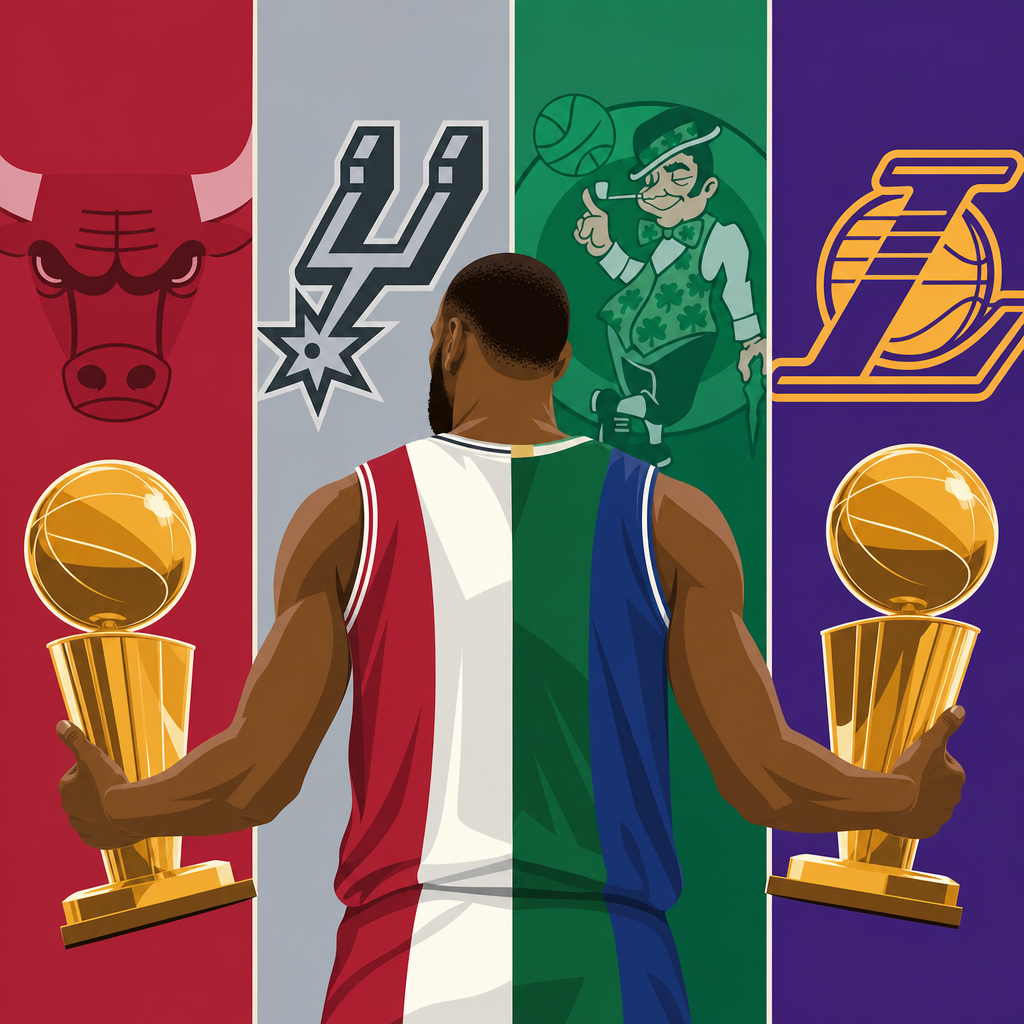
Only a small group of players have won NBA championships with three different franchises, and that is the cleanest milestone in this category. John Salley was the first to do it, winning with Detroit in 1989 and 1990, Chicago in 1996, and the Lakers in 2000. Robert Horry followed a different path: Houston in 1994 and 1995, the Lakers in 2000, 2001, and 2002, then San Antonio in 2005 and 2007. Danny Green joined that club with San Antonio in 2014, Toronto in 2019, and the Lakers in 2020. LeBron James made history with Miami, Cleveland, and the Lakers, while also becoming the first player to win Finals MVP with three different franchises.
Those are the benchmark cases because three franchises is the current standard for the most different teams on which a player has won NBA titles. No player has won championships with four NBA franchises. That absence tells you how difficult the feat is. To do it, a player would need longevity, timely movement, health, and the ability to earn a playoff rotation role repeatedly on elite teams. Even in an era with more player movement, the odds remain narrow because championship windows are short and roster continuity still matters in the postseason.
Several players have won with two franchises and belong in any complete hub on the subject. Kareem Abdul-Jabbar won with Milwaukee and the Lakers. Shaquille O’Neal won with the Lakers and Miami. Dennis Rodman won with Detroit and Chicago. Kawhi Leonard won with San Antonio and Toronto. Stephen Jackson won with San Antonio and the 2011 Dallas Mavericks. Ron Harper won with Chicago and the Lakers. C.J. McCollum does not qualify because he has no title, and Patrick McCaw, though often cited for his early rings, won with two franchises, Golden State and Toronto, not three. Precision matters because online lists often mix contenders, finalists, and champions.
| Player | Franchises | Championship Years | Milestone Note |
|---|---|---|---|
| John Salley | Pistons, Bulls, Lakers | 1989, 1990, 1996, 2000 | First player to win with three franchises |
| Robert Horry | Rockets, Lakers, Spurs | 1994, 1995, 2000, 2001, 2002, 2005, 2007 | Seven rings across three dynasties |
| Danny Green | Spurs, Raptors, Lakers | 2014, 2019, 2020 | Elite 3-and-D role on three champions |
| LeBron James | Heat, Cavaliers, Lakers | 2012, 2013, 2016, 2020 | Finals MVP with three franchises |
Superstars, supporting stars, and specialist champions
The best way to analyze this record is to separate players into tiers of responsibility. First are franchise-driving superstars. LeBron James is the clearest modern example, and Kareem Abdul-Jabbar belongs in that conversation historically. Shaquille O’Neal also qualifies, winning as the dominant force of the early-2000s Lakers and then as a major star on Miami’s 2006 title team. Kawhi Leonard is a nuanced case because he was a developing contributor on San Antonio’s 2014 team and the unquestioned lead star for Toronto in 2019. The common trait is that these players shaped the team around them.
Second are supporting stars who were not always the face of the champion but were crucial to the title equation. Dennis Rodman fit this profile perfectly. He was a defensive anchor and rebounding force for Detroit’s Bad Boys champions, then became an essential possession-winner for Chicago’s second three-peat teams. Ron Harper also fits. By the time he joined the Lakers, he was no longer the scorer he had been with Cleveland and the Clippers, but he remained a smart, adaptable guard who could defend and organize lineups next to stars. These are not incidental rings; they are examples of high-level role transformation.
Third are specialist champions, the players front offices and coaches trust because their skills survive playoff stress. Robert Horry is the gold standard. He defended multiple positions, spaced the floor, and delivered iconic late shots without needing high usage. Danny Green built a similar, if less dramatic, case through perimeter defense, transition awareness, and catch-and-shoot gravity. Steve Kerr won with Chicago and San Antonio as a reserve guard whose shooting gave star-led offenses breathing room. These careers prove a major lesson within NBA records and milestones: portability often comes from elite, narrow skills executed under pressure.
How era, rules, and movement changed the milestone
This record looks different depending on the era. Before modern free agency fully empowered stars, players had less control over destination and timing, which made multi-team title success harder to engineer. Kareem forced his way from Milwaukee to Los Angeles in a very different league structure from the one LeBron navigated. Role players also moved differently. In earlier decades, veterans were not cycling through contender ecosystems at the same rate seen after the salary-cap and luxury-tax era matured.
The collective bargaining environment changed the path but did not make the feat easy. Since the 2011 CBA, teams have had stronger financial incentives to manage depth carefully, and that increased the market for ring-chasing veterans and specialized shooters or defenders. Yet playoff basketball remains unforgiving. Many accomplished veterans join contenders and never win because matchups, injuries, and shooting variance decide everything in May and June. Gary Payton eventually won with Miami after near misses elsewhere, while Karl Malone reached the 2004 Finals with the Lakers but retired without a ring.
Style of play matters too. As the league shifted toward pace, space, and switchability, certain championship skills became even more portable. A wing who can defend up a position and hit open threes can help almost any contender. That is one reason Danny Green translated across systems. Conversely, some productive regular-season stars have games that are less modular in elite playoff settings, especially if they need the ball constantly, struggle defensively, or cannot survive targeted half-court schemes. Winning with multiple franchises usually signals that a player’s strengths scaled cleanly to postseason basketball.
Related records and milestones this hub connects
As a sub-pillar hub under NBA Players, this topic should connect readers to the broader records and milestones map. The most obvious related article is most NBA championships by a player, where Bill Russell’s eleven rings remain the unmatched standard. Another is players with the most Finals MVP awards, a list led by Michael Jordan and LeBron James among modern icons. A third is oldest players to win an NBA championship, where Robert Parish and Kareem create useful longevity context for this discussion.
Other valuable companion topics include players who won championships in both conferences, players with the most consecutive NBA Finals appearances, and players who won titles as teammates and later as opponents. You can also branch into franchise-based records: which organizations have the most titles, which franchises ended the longest droughts, and which teams produced the most Hall of Fame champions. For readers comparing legacies, articles on most All-NBA selections, most playoff points, and most career win shares provide balance, because championships alone never tell the full story.
The practical value of this hub is clarity. If a reader lands here asking whether anyone has won with four teams, the answer is no. If the question is who won with three teams, the short list is Salley, Horry, Green, and LeBron. If the question is which player was the top star on the most different championship franchises, LeBron has the strongest modern case. That direct-answer structure is exactly what a good records page should deliver before moving into the richer historical explanation.
NBA players who won championships with multiple different teams occupy a special place in league history because they proved their value could survive change. Some, like LeBron James, carried entire franchises to titles in different cities. Others, like Robert Horry and Danny Green, showed that elite playoff role skills can travel across dynasties. John Salley remains a milestone figure as the first player to win with three franchises, while legends such as Kareem Abdul-Jabbar, Shaquille O’Neal, Dennis Rodman, Kawhi Leonard, and Ron Harper deepen the two-team side of the record.
The biggest takeaway is that this milestone is not just about ring counting. It is about portability, timing, and fit. Winning in multiple organizations means adapting to new coaches, star teammates, schemes, and expectations while still contributing to the only outcome that matters in June. That makes this one of the most revealing records in the NBA Players universe and an ideal gateway into championship legacy research.
If you are building out your understanding of NBA records and milestones, use this hub as the starting point, then compare these names with related pages on most championships, Finals MVPs, oldest champions, and playoff longevity. The full picture of greatness gets sharper when you connect the rings to the role, the era, and the path each player took.
Frequently Asked Questions
Which NBA players have won championships with multiple different teams?
Several notable NBA players have won titles with more than one franchise, and that is exactly why the accomplishment carries so much weight in league history. LeBron James is one of the clearest modern examples, having won championships with the Miami Heat, Cleveland Cavaliers, and Los Angeles Lakers. Robert Horry is another legendary case, earning titles with the Houston Rockets, Los Angeles Lakers, and San Antonio Spurs. John Salley also won championships with three different organizations: the Detroit Pistons, Chicago Bulls, and Los Angeles Lakers. Danny Green joined a smaller but still impressive group by winning with the Spurs, Raptors, and Lakers.
Many other stars and key role players have also done it with two franchises. Kareem Abdul-Jabbar won with the Milwaukee Bucks and Los Angeles Lakers. Shaquille O’Neal won with the Lakers and Heat. Kawhi Leonard won with the Spurs and Raptors. Dennis Rodman won with the Pistons and Bulls. Horace Grant won with the Bulls and Lakers. Ron Harper won with the Bulls and Lakers. Steve Kerr won as a player with the Bulls and Spurs. These names span different eras, which helps show that winning with multiple teams is not just a modern player movement story. It has happened across decades, but it remains uncommon enough that every addition to the list attracts real attention from fans, historians, and analysts.
Why is winning NBA championships with multiple teams considered such a rare achievement?
It is rare because winning a championship in any era usually requires an ideal combination of talent, health, timing, roster balance, coaching, and front-office decision-making. Even all-time great players can spend their entire careers with one franchise and never win, or win only within one carefully built championship window. To repeat that success with a second or third organization means a player has survived roster turnover, changing roles, new teammates, different systems, and often entirely different stages of his career.
This is what makes the achievement especially meaningful in the larger NBA records and milestones conversation. A player who wins titles with multiple teams is not simply benefiting from one great dynasty or one perfect fit. He is proving he can contribute to championship basketball in different environments. Sometimes that means being the undisputed superstar, as with LeBron James. Other times it means thriving as a flexible defender, floor spacer, veteran leader, or playoff specialist, as players like Robert Horry and Danny Green did. In either case, the common thread is adaptability. Championships with multiple franchises signal that a player’s impact translated beyond one coach, one core, or one organizational identity, which is why the feat is viewed as both rare and historically significant.
Who has won NBA championships with the most different franchises?
A small group of players is commonly highlighted for winning titles with three different NBA franchises, which places them in especially exclusive company. Robert Horry won championships with the Houston Rockets, Los Angeles Lakers, and San Antonio Spurs. John Salley won with the Detroit Pistons, Chicago Bulls, and Los Angeles Lakers. Danny Green won with the San Antonio Spurs, Toronto Raptors, and Los Angeles Lakers. LeBron James also belongs in this category, having won with the Miami Heat, Cleveland Cavaliers, and Los Angeles Lakers.
That distinction matters because each additional franchise makes the achievement more difficult. Winning with two teams already requires a player to transition successfully from one championship context to another. Winning with three teams means doing that repeatedly, often across different competitive eras and against very different styles of play. In Horry’s case, it reinforced his reputation as one of the greatest role players and clutch performers in NBA history. In LeBron’s case, it strengthened his legacy as a transformational superstar who could lead different organizations to the top. Either way, winning titles with three franchises represents one of the clearest examples of portable championship value in the NBA.
Does winning championships with multiple teams help a player’s legacy more than winning all titles with one franchise?
It can, but the answer depends on how people define greatness. Winning all of your championships with one franchise often builds a powerful legacy around loyalty, continuity, and dynasty-level dominance. Players such as Michael Jordan, Tim Duncan, Kobe Bryant, and Stephen Curry are celebrated in part because they became inseparable from one organization’s championship identity. That kind of sustained success is enormously valuable and historically respected.
At the same time, winning with multiple teams adds a different kind of legacy strength. It suggests that a player’s value travels. He was not only great within one stable ecosystem but effective across different rosters, coaching staffs, and expectations. For stars, that can show leadership and the ability to reshape a franchise quickly. For role players, it can prove they possessed elite, repeatable skills that contenders everywhere needed. So while one path is not automatically better than the other, championships with multiple teams often add a layer of versatility and basketball portability that voters, historians, and fans find compelling. In debates about all-time impact, that flexibility can become a major point in a player’s favor.
Are players who win with multiple teams usually superstars, or can role players do it too?
Both superstars and role players can accomplish it, which is one reason the topic is so interesting. Superstars often do it by serving as the central force behind a title run. LeBron James is the clearest modern example, winning championships as the defining player on multiple franchises. Kawhi Leonard also fits this conversation, winning Finals MVP with two different teams and showing that elite two-way stars can carry championship aspirations into new environments.
But role players may be just as important to this discussion because they demonstrate another path to the feat. Robert Horry is the classic example: he was never the face of a franchise, but his defense, versatility, late-game shot-making, and understanding of playoff basketball made him valuable on multiple championship teams. Danny Green’s perimeter defense and three-point shooting translated across championship rosters. Steve Kerr, Horace Grant, and Ron Harper also showed how specific, high-level skills can travel from one contender to another. So the accomplishment is not limited to MVP-level players. It can belong to anyone whose game is adaptable enough, dependable enough, and valuable enough to help different organizations win at the highest level.