
NBA assist records tell the story of basketball’s smartest players, the guards and forwards who controlled tempo, created efficient shots, and made teammates better over thousands of possessions. In NBA terms, an assist is awarded when a pass directly leads to a made field goal, but the statistic has always been more than a box score credit. It reflects vision, timing, spacing awareness, decision-making, and trust between passer and finisher. When fans search for the all-time playmaking leaders or debate the greatest passers ever, they are really asking which players shaped offenses most consistently and most creatively across regular seasons, playoffs, and defining moments.
I have worked through assist data for player profiles, milestone pages, and game recaps, and one pattern always stands out: raw totals matter, yet context matters just as much. Pace, era, scorekeeping, offensive structure, and teammate quality all influence assist numbers. A point guard in a fast, transition-heavy system can pile up chances differently than a half-court orchestrator in a slower era. That is why any serious guide to NBA assist records has to do two jobs at once. It needs to identify the record holders clearly, and it needs to explain how those records were built, what they mean, and where they fit among the league’s broader records and milestones.
This hub article covers the full landscape. It looks at the career assist leaders, single-game and single-season benchmarks, playoff records, and the signature playmaking styles that separated Magic Johnson, John Stockton, Chris Paul, LeBron James, Jason Kidd, Steve Nash, and other elite creators from ordinary distributors. It also explains how to evaluate passing beyond traditional assist totals using assist percentage, turnover rate, on-ball creation load, and film study. If you want one page that anchors the Records and Milestones branch of an NBA Players content hub, this is it. The names at the top are familiar, but the reasons they remain there reveal what greatness as a passer actually looks like.
At the center of the historical assist conversation is John Stockton, the NBA’s all-time leader in career assists with 15,806, a total so far ahead of the field that it remains one of the league’s toughest records to threaten. Stockton’s record matters because it combines peak creation with extraordinary durability. He played 19 seasons, missed very few games, and ran Utah’s offense with relentless precision, especially in pick-and-roll actions with Karl Malone. Longevity alone does not produce that number. The player must also maintain elite decision-making, keep turnover counts under control, and generate efficient offense year after year against changing defenses and schemes.
Career assist leaders and why Stockton still defines the standard
The all-time assist leaderboard is the first place most readers start, and for good reason. Career totals reward both excellence and staying power, which is why the top group includes Stockton, Jason Kidd, Chris Paul, LeBron James, Steve Nash, Mark Jackson, Magic Johnson, and Oscar Robertson among the most discussed names. Stockton’s 15,806 assists place him well ahead of Kidd, who finished with 12,091, while Paul moved into second place late in his career by sustaining elite control well into his late thirties. LeBron’s climb into the upper tier is especially notable because he is not a traditional point guard by position, yet he has functioned as a primary offensive engine for most of his career.
When I compare these players, I focus on three filters. First is role: was the player the full-time initiator, a secondary creator, or a forward who bent defenses with size? Second is era: Magic and Stockton operated before the modern spread pick-and-roll explosion, while Paul and LeBron have worked in more space but also against more switch-heavy, analytics-driven schemes. Third is offensive translation: did the player’s passing produce playoff-level advantages when defenses were locked in? Stockton’s record remains the benchmark because he clears all three filters. He was the primary organizer, he sustained value across eras within his own career, and his passing scaled to high-leverage postseason basketball.
| Record category | Leader | Mark | Why it matters |
|---|---|---|---|
| Career assists | John Stockton | 15,806 | Largest long-term playmaking record in league history |
| Single-season assists | John Stockton | 1,164 in 1990-91 | Peak volume plus durability across 82 games |
| Single-game assists | Scott Skiles | 30 in 1990 | Highest one-night creation burst ever recorded |
| Career playoff assists | LeBron James | 2,067 | Shows postseason longevity and primary-ballhandler value |
| Playoff game assists | Magic Johnson | 24 | Iconic example of elite passing under playoff pressure |
Chris Paul deserves special attention in any updated assist hub because he built one of the most efficient passing résumés the sport has seen. His assist-to-turnover discipline, command of pace, and mastery of pocket passes and weak-side reads allowed him to age better than many high-usage guards. Jason Kidd reached historic totals differently, using rebounding, hit-ahead passing, and transition orchestration to create offense before defenses got set. Steve Nash’s totals are lower than Stockton’s or Kidd’s, but his impact on team efficiency in Phoenix was enormous; under Mike D’Antoni, his live-dribble passing helped define modern spread offense. Magic Johnson remains the most transformative big playmaker, pairing size with creativity in ways the league had rarely seen.
Single-season and single-game assist records
If career totals measure sustained greatness, single-season and single-game records show how high a player’s playmaking peak could rise. Stockton holds the single-season assist record with 1,164 in 1990-91, and he also owns several of the highest seasonal totals ever. That season captures the core of his case: elite health, elite consistency, and an offense that generated repeatable advantages. To clear 1,100 assists, a player must average well above 14 assists per game while appearing in nearly every contest. In today’s NBA, where stars rest more often and playmaking is distributed across multiple creators, that combination is much harder to reproduce.
The single-game assist record belongs to Scott Skiles, who posted 30 assists for the Orlando Magic against the Denver Nuggets on December 30, 1990. That record is often overlooked because Skiles is not usually placed in all-time greatest passer debates, yet the game remains a landmark in NBA history. Thirty assists in one night require more than a hot hand from teammates. The offense must produce a steady diet of makeable shots, the passer must read defenses instantly, and game flow must support repeated creation without the scorer taking over individually. It was a perfect storm of tempo, accuracy, and opportunity.
Other remarkable single-game performances help frame the record. Magic Johnson and John Stockton both had 24-assist games, while modern stars like Rajon Rondo, Chris Paul, and Russell Westbrook have delivered huge assist nights that reflect changing offensive environments. When evaluating these explosions, I look beyond the number itself. Was the player manipulating the weak-side tag defender? Were the assists mostly transition advances, or were they high-difficulty half-court reads? A 20-assist game built on dissecting a set defense often says more about passing genius than one fueled primarily by pace. That distinction matters when a records page also aims to identify the greatest passers ever rather than merely the biggest totals.
Playoff assist records and why postseason passing carries extra weight
Playoff assist records matter because postseason basketball removes easy advantages. Teams scout every action, take away first options, and force stars to make second and third reads under pressure. That is why LeBron James finishing as the career playoff assists leader is such a powerful indicator of all-time playmaking value. His postseason total, 2,067, reflects not only remarkable longevity but also the responsibility he carried as a primary creator deep into May and June. Defenses loaded up on him for two decades, and he still generated shots for shooters, rollers, cutters, and corner spacers at historic volume.
Magic Johnson’s playoff passing legacy remains equally important. He holds the record for assists in a single playoff game with 24, and his entire postseason profile captures what makes him one of the greatest passers ever. At 6-foot-9, he saw over traps, accelerated fast breaks instantly, and delivered passes with either hand from angles most guards never attempted. In playoff settings, that versatility became even more valuable because the Lakers could attack before defenses matched up or exploit double teams in the half court. His passing was not decorative. It was structurally devastating.
Stockton, Kidd, and Paul also deserve strong postseason discussion, though their playoff reputations vary. Stockton was precise and dependable, thriving in Utah’s disciplined system. Kidd’s transition pushes and cross-court deliveries fueled Finals teams in New Jersey. Paul, despite some frustrating team outcomes, repeatedly showed elite playoff orchestration with New Orleans, the Clippers, Houston, Phoenix, and Golden State. When judging postseason passing, I put special weight on turnover management, late-clock creation, and adaptability against switching. High assist counts are valuable, but the best playoff passers create quality looks when opponents know exactly what is coming and still cannot stop it.
The greatest passers ever: ranking style, difficulty, and influence
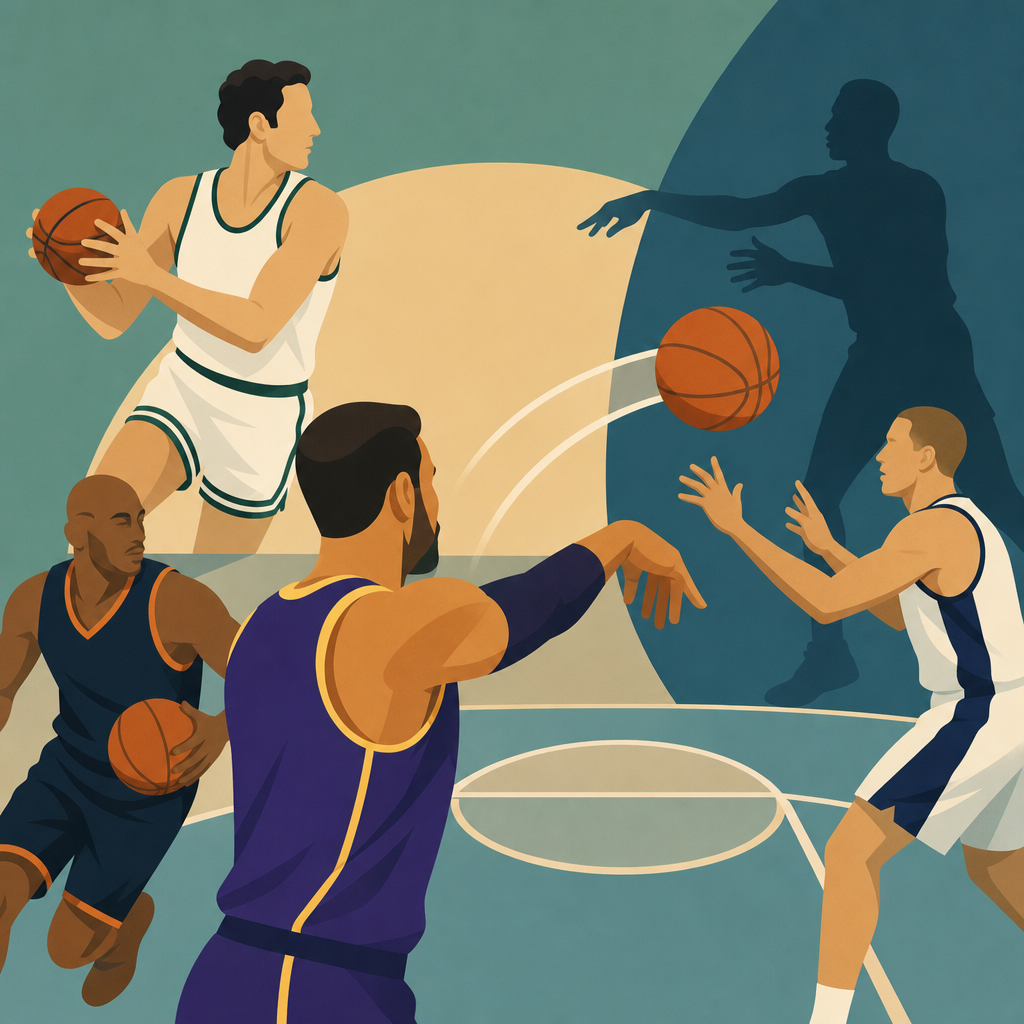
The phrase greatest passer ever is not identical to all-time assist leader. Passing greatness blends volume, creativity, accuracy, anticipation, and scalability. Magic Johnson is often the first name in that discussion because he expanded what playmaking from a lead ballhandler could look like. His no-look passes are famous, but the substance of his genius was simpler: he processed the floor earlier than everyone else. Larry Bird belongs in the same conversation from a forward position, using touch passes, outlet reads, and interior timing that punished every defensive mistake. Nikola Jokic, though from a center spot, has also forced historians to rethink positional boundaries in the passing debate.
Stockton represents the purest case for technical reliability. He rarely wasted dribbles, consistently hit rollers in stride, and turned a basic high pick-and-roll into one of the league’s most repeatable weapons. Nash brought a different kind of artistry, probing under the rim, keeping his dribble alive, and creating delayed angles that broke help schemes. Jason Kidd’s genius lay in seeing transition opportunities before they existed. LeBron weaponized power and vision together, throwing lasers to the opposite corner after collapsing entire defenses. Chris Paul mastered manipulation, snaking screens and moving big defenders inch by inch until a window opened.
Where does that leave all-time rankings? My own framework starts with Magic, Stockton, LeBron, Paul, Nash, Kidd, Bird, Robertson, and Jokic among the strongest candidates, with Isiah Thomas and Bob Cousy essential in historical context. The exact order will change depending on whether you prioritize invention, precision, or total output. What should not change is the core principle: the greatest passers consistently create advantages other players do not even see. Assists capture part of that value, but film completes the picture. The best passers bend help defenders, dictate rotations, and deliver the ball to a teammate’s shooting pocket before the defense realizes the opening exists.
How to evaluate assist records in context
Assist records are meaningful only when interpreted correctly. Official scorekeeping has always involved some judgment about whether a made basket resulted directly from the pass, and standards can vary slightly by era or arena. Pace also changes opportunity. Teams in faster environments simply produce more possessions, which means more potential assists. Usage rate matters too. A heliocentric star who controls every pick-and-roll will accumulate assists differently than a player in a read-and-react offense where creation duties are shared. For that reason, advanced metrics help refine the picture rather than replace traditional numbers.
Assist percentage estimates the share of teammate field goals a player assisted while on the floor, making it useful for comparing creators with different minutes or offensive roles. Turnover percentage adds needed balance by showing the cost of high-risk passing. Potential assists, tracked by modern optical data, reveal how many chances a passer generated even when teammates missed. Secondary assists and points created offer a broader view of orchestration. When I review record candidates, I combine those metrics with film. Numbers can tell you who produced volume. Film tells you whether the player generated easy reads or invented offense that should not have been available.
This is why records and milestones pages should link readers deeper into player profiles, playoff breakdowns, and era-specific studies. A hub article establishes the headline facts: Stockton owns the career and single-season assist mountains, Skiles has the single-game peak, LeBron leads playoff career assists, and Magic owns the playoff single-game record. From there, the richer question is how each player did it. That is where style, scheme, and context turn statistics into understanding. If you are building knowledge of NBA players, assists are one of the clearest windows into basketball intelligence. Learn the records, then study the reads behind them and compare eras with care.
NBA assist records offer more than a ranking of pass-first stars. They map how offense has evolved, from structured half-court execution to spread pick-and-roll systems and positionless creation. John Stockton remains the all-time career assist leader and the single-season standard bearer, Scott Skiles owns the unforgettable single-game mark, LeBron James leads in career playoff assists, and Magic Johnson still represents the highest form of imaginative postseason passing. Those milestones anchor the history, but they also invite a deeper appreciation of how different playmakers solved the same problem: creating the best possible shot before the defense could react.
The biggest takeaway is simple. Great passing is not just about flair, and it is not just about totals. It is about repeatable advantage creation, accuracy under pressure, and decision-making that lifts an entire offense. That is why Stockton, Magic, Paul, Nash, Kidd, Bird, Robertson, LeBron, and now Jokic all belong in serious discussions, even though they reached greatness through different methods. Some dominated with system precision, others with improvisation, and a few with positional uniqueness that changed how the sport thinks about playmaking.
Use this hub as your starting point for the NBA Players records and milestones subtopic, then keep going. Compare leaders across eras, study playoff passing, and explore individual player pages to see how each legend built his assist résumé one possession at a time.
Frequently Asked Questions
Who holds the NBA all-time assist record, and why is that mark so difficult to break?
John Stockton holds the NBA all-time assist record with 15,806 career assists, a total that remains one of the most untouchable statistical achievements in league history. What makes Stockton’s record so extraordinary is not just peak brilliance, but the combination of elite court vision, precision decision-making, durability, and consistency over an incredibly long period. He led the NBA in assists for nine straight seasons and built his total by showing up year after year, rarely missing games, and operating one of the league’s most efficient offenses with remarkable discipline.
The difficulty of breaking the record comes from how many variables have to align. A player must become a full-time primary creator early in his career, stay healthy for well over a decade, maintain top-tier passing production deep into his 30s, and play in an offensive system that consistently puts the ball in his hands. On top of that, modern basketball often spreads playmaking duties across multiple stars, wings, and bigs rather than concentrating creation with one traditional floor general. That means even elite passers today may produce tremendous value without piling up assist totals at Stockton’s historic pace.
Stockton also benefited from extraordinary chemistry with Karl Malone, one of the greatest finishers and screen-and-roll partners in NBA history. Their two-man game turned routine possessions into high-efficiency offense for years. So when people discuss the all-time assist record, they are really talking about a perfect storm of skill, longevity, role, health, and partnership. That is why Stockton’s total is not just impressive; it is often viewed as one of basketball’s true statistical monuments.
How is an assist defined in the NBA, and does the stat fully capture great playmaking?
In the NBA, an assist is generally awarded to a player whose pass directly leads to a made field goal by a teammate. That definition sounds simple, but in practice it involves scorer judgment and context. Some assists come from obvious setup passes that create wide-open layups or jumpers, while others are credited when the receiver still has to make a move, take a dribble, or finish through contact. Because of that, assist totals are useful and important, but they are not a perfect or complete measure of playmaking.
Great playmaking goes beyond the box score. A truly elite passer manipulates defenders before the pass ever happens, shifts weak-side help, creates advantages through pace changes, and delivers the ball on time and in the right spot. Sometimes the best pass is the “hockey assist,” the pass that leads to the next pass for an easy basket. Other times, a player bends a defense so dramatically with penetration or post touches that the entire possession opens up, even if no official assist is recorded. Spacing awareness, recognition of coverages, timing in pick-and-roll, and the ability to anticipate where teammates will be are all part of high-level playmaking.
That is why analysts often pair assists with other indicators such as assist percentage, turnover rate, usage, potential assists, time of possession, and film study. A player can average a lot of assists simply by dominating the ball, but the greatest passers combine volume with efficiency, creativity, and control. In other words, assists are one of the best starting points for identifying top playmakers, but the full art of passing is wider and richer than a single number can express.
Who are the greatest passers in NBA history besides John Stockton?
Several names belong in any serious discussion of the greatest passers ever, and each brought a different style to playmaking. Magic Johnson is usually near the top of the list because he transformed what people thought a lead creator could be. At 6-foot-9, he saw over defenses, pushed tempo in transition, and delivered imaginative passes that turned fast breaks into signature moments. His blend of flair and effectiveness made him one of the most influential playmakers the game has ever seen.
Jason Kidd also deserves major recognition for his rebounding-and-running style, defensive intelligence, and ability to ignite offense instantly. Steve Nash mastered pick-and-roll orchestration and used shooting gravity to create passing angles few defenders could anticipate. Chris Paul stands out for surgical control, low-turnover decision-making, and his ability to dictate every possession’s tempo. LeBron James belongs in the conversation as well because of his size, processing speed, skip passing, transition reads, and capacity to function as an offense unto himself across multiple eras and roster constructions.
Then there are innovators such as Larry Bird, whose anticipation and touch made difficult passes look easy, and Nikola Jokic, whose passing from the center position has redefined half-court creation for big men. Isiah Thomas, Rajon Rondo, Mark Jackson, Oscar Robertson, and Bob Cousy also hold important places in the history of NBA playmaking. The key point is that “greatest passer” is not always identical to “highest assist total.” Some players piled up immense numbers through longevity, while others changed the geometry of the sport with vision, creativity, and offensive command. The all-time leaders list matters, but so does the way a player generated those assists and elevated everyone around him.
What makes a player an elite playmaker, not just a high-assist guard?
An elite playmaker does much more than collect assist numbers. The difference starts with processing speed: the best creators read the floor one or two steps ahead, identifying help defenders, cutters, open shooters, and mismatches before they fully develop. They understand timing, which means knowing exactly when to deliver a pass so the receiver can score immediately rather than recover from a late or awkward catch. Placement matters too. A great pass does not just reach a teammate; it arrives in the shooting pocket, at the correct hand, or in stride toward the basket.
Control of tempo is another major separator. Elite playmakers know when to slow the game down, when to push in transition, and when to attack before a defense can get organized. They manipulate defenders with hesitation dribbles, eye direction, body positioning, and changes in pace. Importantly, they also value possessions. The greatest passers balance aggression with discipline, creating high-value shots without constantly forcing risky passes into traffic. That is why assist-to-turnover efficiency often tells an important part of the story.
Leadership and trust also play a huge role. The best playmakers learn where teammates prefer the ball, what shots they are comfortable taking, and how to keep everyone engaged over the course of a game and a season. They raise collective offensive confidence. In practical terms, that means role players often look more decisive and effective next to elite creators because the ball arrives on time and in rhythm. So while assist totals help identify playmakers, elite playmaking is really the complete package of vision, decision-making, manipulation, accuracy, and the ability to make an entire offense function at a higher level.
Why do assist records matter when evaluating NBA history and all-time player greatness?
Assist records matter because they capture one of basketball’s most valuable and difficult skills: creating efficient offense for others. Scoring often receives the most attention, but the ability to organize an attack, generate quality looks, and consistently improve teammates is central to winning basketball. All-time assist leaders typically served as the strategic engines of their teams, controlling the flow of possessions and turning talent into coherent offense. Their records help tell the story of how teams created advantages across different eras, from fast-break-heavy systems to modern spread pick-and-roll offenses.
These records also provide historical context. They allow fans to compare styles of play across generations and to appreciate how the role of the primary ball-handler has evolved. A player who racks up assists over many years has usually demonstrated durability, adaptability, and a deep understanding of changing defensive schemes. At the same time, assist records invite smarter conversations about context. Pace, system, teammate shooting, scorekeeping tendencies, and era all influence raw totals, which is why the best evaluations look at both the numbers and the film.
Most importantly, assist records highlight a form of greatness that is inherently collaborative. They remind us that basketball is not just about individual shot-making, but about creating structure, rhythm, and trust for an entire team. When fans search for the all-time playmaking leaders and the greatest passers ever, they are really asking which players most consistently bent the game to their will without always being the one to finish the possession. That is a powerful kind of basketball intelligence, and assist records are one of the clearest ways to trace it through NBA history.