
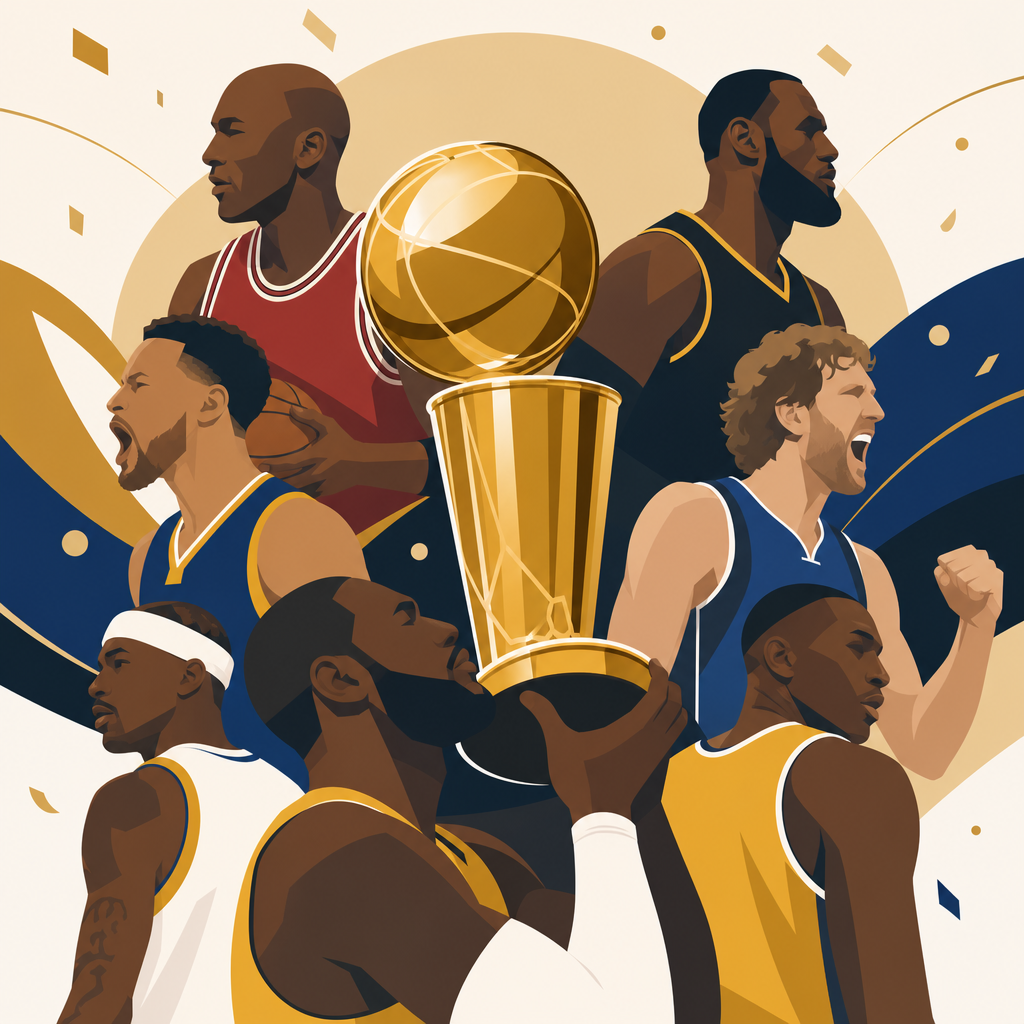
The NBA Finals MVP award is the clearest shorthand for postseason greatness, yet its history reveals far more than a list of stars holding trophies. Since 1969, the honor has identified the player judged most valuable in the championship series, usually from the winning team, and it has become one of basketball’s strongest legacy markers. When fans debate all-time rankings, Hall of Fame cases, or the defining moments of a dynasty, Finals MVPs sit near the center of the argument because the award captures performance under the league’s highest pressure.
In covering NBA playoffs history, I have found that Finals MVP discussions work best when they go beyond simple scoring averages. The award reflects matchup problems solved in real time, defensive schemes dismantled over four to seven games, and leadership shown when every possession is magnified. It also reflects the changing shape of the sport. Early winners often dominated from the post or midrange, while later recipients thrived through spacing, switching, high-volume three-point shooting, and pick-and-roll orchestration. Looking at every Finals MVP winner tells the broader story of Finals history itself.
The basics matter. The NBA Finals MVP is voted on by a small media panel at the end of the championship series. Jerry West remains the only player to win it from the losing team, doing so in the inaugural 1969 vote after a brilliant series against Boston. Since then, the award has overwhelmingly gone to the best player on the championship team, though there have been close calls, controversial ballots, and years when a defensive specialist or tactical disruptor nearly stole the spotlight. Those exceptions are part of why Finals MVP history remains so compelling.
This hub article covers every winner and, more importantly, what made each performance stand out. It is designed as a Finals history anchor page under the broader NBA Playoffs topic, so the emphasis is on patterns as much as names. Which winners overwhelmed defenses with scoring volume? Which controlled pace and decision-making? Which changed a series with rim protection, rebounding, perimeter containment, or shot creation in late-clock situations? Answering those questions creates a better understanding of why some championships feel inevitable and others hinge on one transcendent stretch from one player.
From Willis Reed’s emotional return in 1970 to Nikola Jokic’s methodical control in 2023 and Jaylen Brown’s two-way edge in 2024, the Finals MVP timeline maps the evolution of winning basketball. It also highlights the traits that hold up in any era: efficiency, adaptability, command of matchups, and reliability in the biggest moments. If you want one page that explains Finals history through the players who defined it, this is the place to start.
Every NBA Finals MVP winner, 1969 through 2024
| Year | Winner | Team | What stood out |
|---|---|---|---|
| 1969 | Jerry West | Lakers | Only losing-team winner; elite scoring and playmaking in seven games |
| 1970 | Willis Reed | Knicks | Emotional Game 7 return plus interior leadership |
| 1971 | Lew Alcindor | Bucks | Dominant post scoring during Milwaukee sweep |
| 1972 | Wilt Chamberlain | Lakers | Rebounding, rim protection, and control of tempo |
| 1973 | Willis Reed | Knicks | Second award driven by poise, defense, and team balance |
| 1974 | John Havlicek | Celtics | Two-way wing excellence and clutch scoring |
| 1975 | Rick Barry | Warriors | All-around offensive control in a stunning sweep |
| 1976 | Jo Jo White | Celtics | Transition pace, shot creation, and marathon-game composure |
| 1977 | Bill Walton | Trail Blazers | Passing center who anchored both ends |
| 1978 | Wes Unseld | Bullets | Defense, screens, outlet passing, and series steadiness |
| 1979 | Dennis Johnson | SuperSonics | Perimeter defense with timely offense |
| 1980 | Magic Johnson | Lakers | Historic rookie closeout playing center in Game 6 |
| 1981 | Cedric Maxwell | Celtics | Efficient inside scoring and physical play |
| 1982 | Magic Johnson | Lakers | Versatility and pace-setting playmaking |
| 1983 | Moses Malone | 76ers | Relentless rebounding and interior dominance |
| 1984 | Larry Bird | Celtics | Complete offensive game and rebounding edge |
| 1985 | Kareem Abdul-Jabbar | Lakers | Skyhook mastery at age 38 after early criticism |
| 1986 | Larry Bird | Celtics | High-level shotmaking and control of every phase |
| 1987 | Magic Johnson | Lakers | Late-game orchestration and the junior sky hook |
| 1988 | James Worthy | Lakers | Game 7 triple-double and transition finishing |
| 1989 | Joe Dumars | Pistons | Steady scoring and backcourt command |
| 1990 | Isiah Thomas | Pistons | Playmaking leadership and big-shot creation |
| 1991 | Michael Jordan | Bulls | Efficient scoring and total control of the series |
| 1992 | Michael Jordan | Bulls | Explosive offense highlighted by Game 1 shooting burst |
| 1993 | Michael Jordan | Bulls | 41.0 points per game and relentless attacking |
| 1994 | Hakeem Olajuwon | Rockets | Two-way center play against elite competition |
| 1995 | Hakeem Olajuwon | Rockets | Footwork, touch, and defensive command in a sweep |
| 1996 | Michael Jordan | Bulls | Return-to-the-top narrative with scoring and defense |
| 1997 | Michael Jordan | Bulls | Late-game precision and the Flu Game context |
| 1998 | Michael Jordan | Bulls | Series-clinching shot and complete offensive burden |
| 1999 | Tim Duncan | Spurs | Immediate dominance in a shortened season |
| 2000 | Shaquille O’Neal | Lakers | Unstoppable paint force and foul pressure |
| 2001 | Shaquille O’Neal | Lakers | Peak physical dominance with efficiency |
| 2002 | Shaquille O’Neal | Lakers | Third straight award through sheer interior control |
| 2003 | Tim Duncan | Spurs | Near quadruple-double closeout and defensive anchor role |
| 2004 | Chauncey Billups | Pistons | Pick-and-roll command and efficient shot profile |
| 2005 | Tim Duncan | Spurs | Half-court scoring and elite rim protection |
| 2006 | Dwyane Wade | Heat | Rim pressure and free-throw generation in comeback win |
| 2007 | Tony Parker | Spurs | Paint touches versus Cleveland’s defense |
| 2008 | Paul Pierce | Celtics | Physical wing scoring and defensive assignments |
| 2009 | Kobe Bryant | Lakers | Shot creation under pressure and playmaking growth |
| 2010 | Kobe Bryant | Lakers | Game 7 rebounding and late-series toughness |
| 2011 | Dirk Nowitzki | Mavericks | Clutch scoring and spacing a great defense |
| 2012 | LeBron James | Heat | Complete floor game and breakthrough composure |
| 2013 | LeBron James | Heat | Efficiency, versatility, and Game 7 shotmaking |
| 2014 | Kawhi Leonard | Spurs | Two-way surge after early adjustment period |
| 2015 | Andre Iguodala | Warriors | Lineup-shifting defense on LeBron and transition value |
| 2016 | LeBron James | Cavaliers | Historic 3-1 comeback with all-around dominance |
| 2017 | Kevin Durant | Warriors | Mismatch scoring and efficient isolation finishing |
| 2018 | Kevin Durant | Warriors | Shotmaking range and defensive flexibility |
| 2019 | Kawhi Leonard | Raptors | Half-court creation and calm leadership |
| 2020 | LeBron James | Lakers | Point-forward control in the bubble environment |
| 2021 | Giannis Antetokounmpo | Bucks | 50-point closeout and paint dominance |
| 2022 | Stephen Curry | Warriors | Off-ball gravity plus elite shotmaking against Boston |
| 2023 | Nikola Jokic | Nuggets | Tempo control, efficiency, and playmaking from center |
| 2024 | Jaylen Brown | Celtics | Two-way wing pressure, transition scoring, and matchup defense |
How the Finals MVP award evolved across eras
When you study Finals history in sequence, one fact becomes obvious: the standards for dominance changed with the game. In the 1970s, big men and physical interior play shaped most championship series. Alcindor, Chamberlain, Walton, and Unseld influenced possessions through rebounding position, outlet passing, post seals, and paint deterrence. Box scores mattered, but coaches and voters also valued control. A center who ended second chances, created deep catches, and forced opponents into difficult half-court shots could own a series without producing modern-style usage numbers.
The 1980s expanded the profile. Magic Johnson and Larry Bird made versatility impossible to ignore. Finals MVPs were no longer only scorers or rebounders; they became decision-makers who bent the series strategically. Kareem’s 1985 award is a classic example of substance over age narrative. After the Lakers lost Game 1 badly to Boston, many assumed the 38-year-old could not carry the matchup. Instead, he averaged 25.7 points and 9.0 rebounds, proving touch, timing, and half-court precision can break a Finals as surely as raw athletic force.
The 1990s elevated the wing creator as the central playoff archetype. Jordan won six Finals MVPs because he combined volume scoring with defensive commitment and endgame shot creation. Hakeem remained the counterexample, showing that an elite center could still anchor an entire championship attack and defense. By the 2000s, Shaq and Duncan briefly restored interior supremacy, but perimeter orchestration kept gaining value. Billups, Wade, Parker, Kobe, and Dirk each won in different ways, yet all solved the same Finals problem: how to create efficient offense when scouting removes easy actions.
In the last decade, the award has rewarded complete offensive ecosystems. LeBron, Durant, Curry, Jokic, and Brown each impacted lineups beyond conventional isolation scoring. Modern Finals MVP play often includes screening manipulation, help-defense reads, switching punishments, cross-match hunting, and transition efficiency. The language around the award has changed too. Analysts now discuss true shooting percentage, usage rate, assist-to-turnover profile, rim frequency, on-off impact, and shot quality allowed. The best winners still have signature moments, but the strongest cases are built on repeatable advantages created over an entire series.
The performances that most changed Finals history
Some winners did more than dominate their matchup; they redirected how the sport remembers a championship. Magic Johnson in 1980 is the template. With Kareem Abdul-Jabbar unavailable for Game 6, Magic started at center and delivered 42 points, 15 rebounds, and 7 assists in the clincher against Philadelphia. I still use that series when explaining why context matters more than raw averages. The rookie’s versatility answered the most important question of the moment: could he absorb the responsibility of every position and still control the pace? He could, and the performance instantly entered league mythology.
Jordan’s first three-peat cemented the idea that the Finals belong to the superstar who can generate good offense regardless of defensive attention. His 1993 series against Phoenix remains especially instructive. Averaging 41.0 points per game in the Finals is not just a scoring feat; it is proof of endurance, efficiency under tailored coverages, and relentless rim pressure before modern spacing widened the floor. Defenses loaded bodies early, yet Jordan still got to his spots. That series set a benchmark for offensive burden that later stars are still measured against.
Shaquille O’Neal’s 2000 through 2002 run is another defining block of Finals history. Opponents knew where the ball was going and still could not prevent deep catches, paint finishes, or foul trouble. During those three title series, he averaged at least 33 points and 15 rebounds twice, turning the restricted area into a strategic emergency. In practical terms, his dominance forced rosters to spend precious space on extra size, even when that size compromised spacing and speed everywhere else. Few Finals MVPs have dictated opponent team-building so directly.
Dwyane Wade in 2006, LeBron James in 2016, Giannis Antetokounmpo in 2021, and Stephen Curry in 2022 changed narratives as much as scoreboards. Wade’s downhill attacks rescued Miami from a 0-2 deficit and turned every help decision into a whistle or layup. LeBron’s 2016 case is larger than The Block; he led both teams in points, rebounds, assists, steals, and blocks during a comeback from 3-1 down against a 73-win team. Giannis closed Phoenix with 50 points while shooting 17-of-19 from the line, the cleanest answer possible to months of skepticism about late-game free throws. Curry’s 2022 award ended the only serious gap in his résumé by proving his off-ball gravity and self-created shooting could still define a Finals against an elite defense.
What actually makes a Finals MVP performance stand out
The award usually goes to the player who solves the series’ hardest problem most consistently. Sometimes that means scoring, but not always. Tim Duncan in 2003 stood out because New Jersey had no reliable answer for his length, bank-shot touch, and help defense. Andre Iguodala in 2015 won because Golden State’s smaller, faster lineup changed the structure of the matchup, and his defensive work on LeBron came with enough transition offense and connective passing to justify the vote. Jaylen Brown in 2024 fit the same principle. His rim pressure, strong-screen navigation, and ability to defend multiple perimeter actions gave Boston a dependable edge even when the offense shifted creators.
Three traits separate the most memorable winners. First is shot quality creation: can the player generate efficient attempts for himself or teammates when sets bog down? Jokic in 2023 was a masterclass here, using delay actions, handoffs, short rolls, and post touches to manufacture layups, open threes, and free throws without wasting motion. Second is matchup scalability: can the player remain dominant if the opponent switches, traps, drops, or zones? LeBron, Durant, and Bird repeatedly showed they could. Third is possession-ending value: defensive rebounds, steals, blocks, or sound positioning that finish stops and deny second chances.
Clutch moments matter, but they should confirm a series, not replace it. Kobe Bryant’s 2010 Finals is a good example. His Game 7 shooting line was rough, yet his rebounding, physicality, and willingness to keep applying pressure mattered in a low-efficiency rock fight against Boston. Voters and fans often remember the final image, but the best analysis looks at the full tactical burden. A great Finals MVP is the player opponents spend the entire series trying, and failing, to solve. Explore individual Finals recaps, team dynasties, and playoff matchup breakdowns across our NBA Playoffs hub to see how those patterns repeat through league history.
NBA Finals MVP history is ultimately the history of championship problem-solving. Every winner from Jerry West to Jaylen Brown represents a player who imposed a skill set the opposing finalist could not fully neutralize. Sometimes that force looked like Kareem’s skyhook, Jordan’s mid-post scoring, Shaq’s deep seals, Duncan’s backline control, Wade’s drives, LeBron’s total-game command, Curry’s movement shooting, or Jokic’s orchestration from the center position. The details changed by era, but the principle stayed constant: the award belongs to the player who most clearly bends the series.
That is why this list matters beyond trivia. Finals MVP winners mark the tactical turning points of NBA history. They show when the league prized size, when it shifted toward ball-handling wings, and when modern spacing elevated passing and shooting versatility. They also remind us that championships are rarely won by reputation alone. Maxwell, Unseld, Billups, Iguodala, and Brown were not the most famous players in their Finals, but their specific impact fit the series better than anyone else’s. Understanding those exceptions makes the legends easier to understand too.
If you are building a deeper view of Finals history, use this hub as your foundation. Revisit the winners by era, compare their statistical profiles, and study how each performance answered a different championship challenge. Then continue through the rest of our NBA Playoffs coverage for team-by-team Finals breakdowns, dynasty timelines, and series-specific analysis that adds context to every trophy and every vote.
Frequently Asked Questions
What is the NBA Finals MVP award, and why does it matter so much in basketball history?
The NBA Finals MVP award is given to the player judged most valuable during the championship series, not across the entire playoffs or regular season. It was first introduced in 1969, which makes it one of the most important modern markers of postseason excellence. Because it is tied directly to the final stage of the season, the award carries enormous historical weight. It signals that a player did not just perform well in general, but delivered when the stakes were highest, against the last team standing between them and a title.
Its importance goes far beyond a trophy presentation. Finals MVPs often become shorthand for defining a championship run, a dynasty, or an era. When people discuss Michael Jordan’s dominance, Magic Johnson’s brilliance, Shaquille O’Neal’s force, Tim Duncan’s consistency, Kobe Bryant’s evolution, LeBron James’ all-around command, or Stephen Curry’s place in history, Finals MVP awards are almost always part of the evidence. The honor helps frame legacy because it captures performance under maximum pressure, in games that are replayed, debated, and remembered for decades.
At the same time, the award also tells a larger story about how basketball greatness is interpreted. Some winners stood out through scoring explosions, others through defense, rebounding, playmaking, leadership, or the ability to control the tempo of a series. Looking at every NBA Finals MVP winner is useful because it reveals that there is no single formula for standing out. The history of the award reflects changing styles of play, evolving media narratives, and the ways superstars shape championship basketball.
Has the NBA Finals MVP always gone to a player on the championship-winning team?
No, and that is one of the most interesting facts in the award’s history. The only player to win Finals MVP from the losing team was Jerry West in 1969, the very first year the award was handed out. West was spectacular in that series for the Los Angeles Lakers, producing at such a high level that voters still chose him even though the Boston Celtics won the title. His performance was so compelling that it established early on that the award was supposed to honor the best individual showing in the series, not simply reward the best player on the winning side.
Since then, however, the Finals MVP has almost always functioned as an extension of the championship story, which means the winner nearly always comes from the title team. That pattern makes sense. Voters naturally connect value with winning, especially in a short series where every possession is heavily scrutinized. A great performance that does not end in a title can still be admired, but it usually does not outweigh the narrative and impact of the star who led the winning team across the finish line.
Jerry West’s win remains historically important because it reminds fans that the award is not supposed to be automatic. It also highlights how rare it is for a losing player to be seen as clearly superior to everyone else in the series. In practical terms, if a player wins Finals MVP today, it almost certainly means his team won the championship and that he became the defining figure of that series. West’s exception only makes that reality more memorable.
What usually makes a Finals MVP performance stand out from other great championship performances?
A Finals MVP performance usually stands out because it combines production, timing, and control. Big numbers matter, of course. Scoring, rebounding, assists, steals, blocks, and efficiency all help build a case. But what separates a Finals MVP from just another strong series is the way those numbers arrive in decisive moments. Voters tend to remember who took over a close game in the fourth quarter, who solved the opponent’s best defensive scheme, who shifted momentum after a loss, or who consistently answered every major challenge in the series.
Context matters just as much as statistics. A player who dominates against an elite defense, plays through injury, guards the opposing star, or changes the strategic shape of the Finals will often earn more admiration than someone whose box score looks impressive in a less demanding role. That is why the history of the award includes many different kinds of winners. Some were overwhelming scorers like Jordan or Durant. Others imposed themselves through versatility and control, like LeBron James. Some winners stood out because they anchored both ends of the floor, like Tim Duncan or Hakeem Olajuwon. Others elevated themselves through efficiency, leadership, or timely shot-making.
There is also a storytelling element. Finals MVPs are often remembered for what made their performance unmistakable. Maybe it was a string of 40-point games, a triple-double pace, dominant interior defense, a famous clutch shot, or a complete command of the series from opening tip to closeout. The award tends to go to the player whose impact feels impossible to ignore, the one whose fingerprints are all over the championship. In that sense, Finals MVP history is really a collection of performances that defined the biggest stage in the sport.
Which players have the most NBA Finals MVP awards, and what does that say about their legacy?
Michael Jordan holds the record with six NBA Finals MVP awards, and that fact is central to his case as the greatest player in league history. He won Finals MVP in each of his six championships with the Chicago Bulls, which reinforces the idea that whenever his team reached the top, he was the clearest driving force. That level of consistency on the biggest stage is almost unmatched in any sport. It is not just that Jordan won titles, but that he repeatedly produced the most memorable and decisive performances in the championship series.
LeBron James is next with four Finals MVP awards, achieved with three different franchises: the Miami Heat, Cleveland Cavaliers, and Los Angeles Lakers. That is a different kind of historical statement. Jordan’s record reflects peak dominance within a dynasty, while LeBron’s total reflects adaptability, longevity, and the ability to lead different rosters to championships under very different circumstances. Magic Johnson, Shaquille O’Neal, and Tim Duncan each won three, and all three used those performances to solidify legendary status. Their Finals MVP totals are not just trivia; they are evidence of sustained excellence when titles were on the line.
Having multiple Finals MVP awards usually signals more than star power. It suggests that a player was repeatedly the centerpiece of championship basketball rather than just a participant in it. That distinction matters in legacy debates. Hall of Fame credentials, all-time rankings, and dynasty narratives all become stronger when a player can point to repeated dominance in the Finals. Even a single Finals MVP can permanently elevate a player’s historical profile, but collecting several places a player in a very small and very elite group.
Are there any surprising or debated Finals MVP winners in NBA history?
Yes, several Finals MVP selections are still discussed because they reveal how difficult it can be to separate individual brilliance, team context, and narrative. One of the most debated examples is Andre Iguodala winning in 2015 over Stephen Curry. Iguodala was praised for his defense, versatility, and stabilizing role in Golden State’s championship, especially after moving into the starting lineup. Many fans and analysts, however, believed Curry’s scoring, playmaking, and offensive gravity made him the more valuable player in the series. That debate still comes up whenever people discuss how voters define “most valuable.”
Another famous example is Magic Johnson winning as a rookie in 1980. His versatility and unforgettable closeout performance became part of NBA mythology, but the discussion around that award often includes Kareem Abdul-Jabbar, who had been dominant throughout the series. The result is a reminder that Finals MVP voting is shaped not only by totals, but by signature moments and the emotional force of a performance that captures national attention.
There are also selections that surprised people because a player emerged from a deep, balanced team rather than entering the series as the obvious superstar favorite. Joe Dumars in 1989, Chauncey Billups in 2004, Tony Parker in 2007, and Kawhi Leonard in 2014 are all examples of players whose Finals MVP wins highlighted how team structure and matchup dynamics can shape the award. In each case, the winner became the symbol of a championship even if the team’s success rested on a broader foundation.
These debated or unexpected winners are part of what makes Finals MVP history so compelling. The award is not just a record of who won titles. It is also a record of how a particular series was interpreted in real time. Looking back at those choices helps explain how basketball values scoring versus defense, consistency versus peak moments, and superstar reputation versus series-specific impact. That tension is exactly why the award remains such a powerful lens for understanding NBA greatness.