

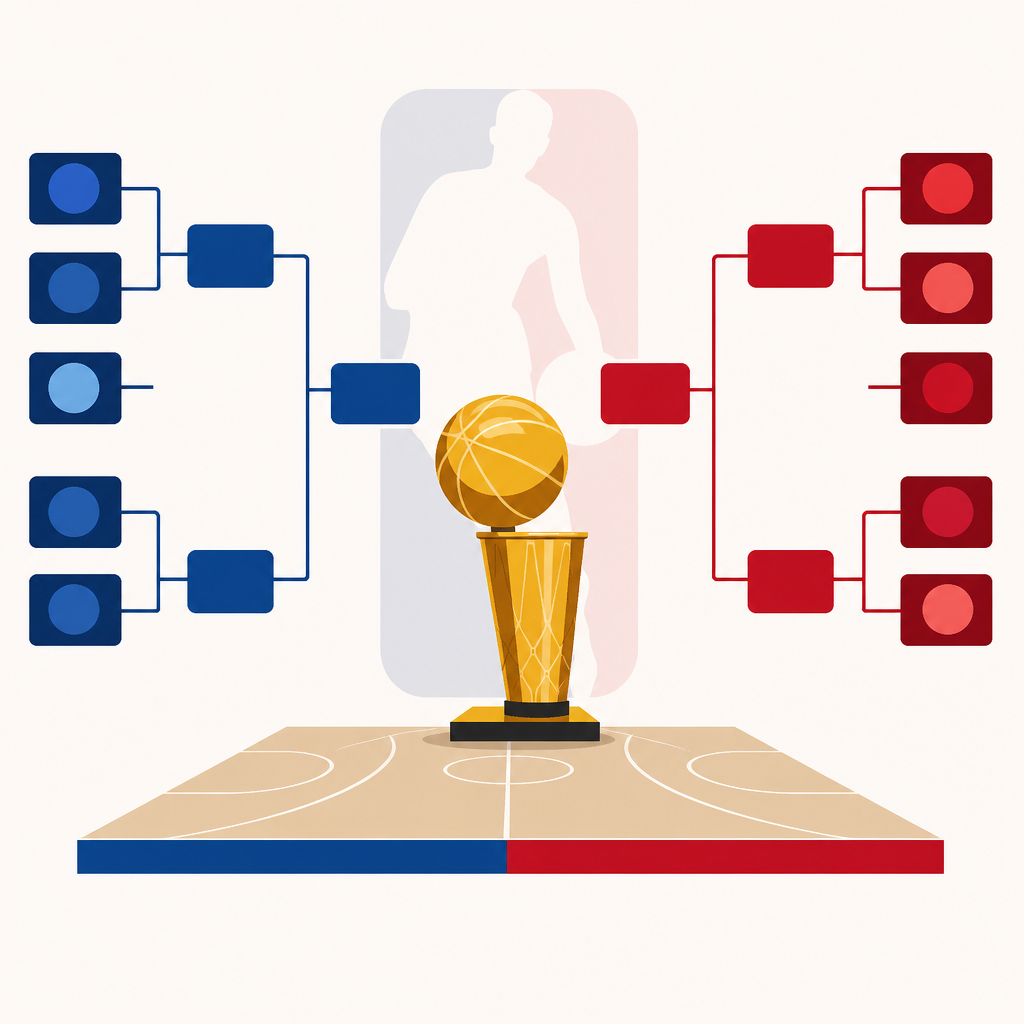
The NBA playoff bracket is the roadmap for the league’s postseason, showing who qualified, how each matchup is seeded, which team has home-court advantage, and what path leads to the NBA Finals. If you want to follow the postseason without guessing what the numbers, lines, and series records mean, you need to understand the bracket, the play-in tournament that feeds it, and the format that turns a regular season into four rounds of elimination basketball. I have covered and tracked playoff races for years, and the same questions come up every spring: How do teams make the bracket, why do some teams start at home, what does 1 vs. 8 really mean, and how can one upset change the entire championship picture? This guide answers those questions directly and sets up the broader NBA Playoffs topic by explaining the full playoff format in plain terms, with the context serious fans expect.
In the NBA, the postseason begins after the regular season standings are final. The league is split into the Eastern Conference and Western Conference, and each conference sends eight teams into the main playoff bracket. Seeds 1 through 6 qualify automatically based on regular-season record within their conference. Seeds 7 through 10 go into the play-in tournament, a short qualifying stage that determines the final two bracket spots in each conference. Once the field is set, the official bracket follows a fixed structure: 1 plays 8, 2 plays 7, 3 plays 6, and 4 plays 5 in the first round. Winners advance through the conference semifinals, then the conference finals, and finally the two conference champions meet in the NBA Finals. Every round is a best-of-seven series, so the first team to win four games advances. That simple structure is what fans see on television graphics, league apps, sportsbooks, team sites, and playoff coverage across the web.
Understanding the NBA playoff bracket matters because it explains more than who is playing whom. It tells you how the regular season still shapes the postseason, why tiebreakers can be critical in April, and how a favorable path can influence title odds. A No. 1 seed is not just a label; it usually reflects elite performance over 82 games and guarantees home-court advantage through at least the conference playoffs. A No. 5 seed facing a No. 4 seed is often a close matchup, while a No. 8 seed usually enters with a harder route and less margin for error. The bracket also helps casual fans become informed viewers quickly. When you know where teams sit, which side of the bracket they occupy, and how future opponents are determined, each result has immediate meaning. That is why the playoff bracket is the hub for understanding playoff format, schedule flow, upset potential, and championship probability.
How the NBA Playoff Bracket Is Structured
The NBA playoff bracket has two separate sides, one for each conference. The Eastern Conference bracket produces an East champion, and the Western Conference bracket produces a West champion. Those winners do not cross over before the Finals. This is important because many first-time viewers assume the bracket is reseeded league-wide after each round. It is not. The conference structure stays intact until the NBA Finals, where the conference champions meet regardless of regular-season conference seed. In practical terms, a top team’s route is defined by its own conference field, not by the entire league.
Once the play-in tournament is complete, each conference bracket is locked into the standard pairings: No. 1 vs. No. 8, No. 2 vs. No. 7, No. 3 vs. No. 6, and No. 4 vs. No. 5. The winner of 1 vs. 8 plays the winner of 4 vs. 5 in the conference semifinals. The winner of 2 vs. 7 plays the winner of 3 vs. 6. That fixed path is why fans pay close attention to bracket position late in the regular season. Finishing third instead of fourth can move a team to the opposite half of the bracket and completely change the likely second-round opponent.
The bracket does not reseed after each round. If the No. 8 seed upsets the No. 1 seed, that No. 8 seed simply advances along the existing path. It does not get moved to face the highest remaining seed by design. This difference matters because some leagues and tournaments reseed to reward better records more aggressively. The NBA does not. As a result, one upset can open a favorable lane for another team on the same side of the bracket. Analysts often call this “the bracket breaking right,” because a dangerous top seed gets removed before a potential meeting.
How Teams Qualify: Standings, Seeds, and the Play-In Tournament
To read the bracket correctly, you need to know how teams get there. Seeds 1 through 6 in each conference qualify automatically based on regular-season win-loss record. The NBA uses standard tiebreakers when teams finish with the same record. For division winners, head-to-head record, conference record, and record against playoff teams can all matter depending on the tie situation. Division titles no longer guarantee a top-four seed, which is a major modern change compared with older NBA formats. Today, the standings are more straightforward: win games, earn a better seed, and improve your path.
The play-in tournament fills the No. 7 and No. 8 seeds in each conference. The No. 7 team hosts the No. 8 team, and the winner becomes the official No. 7 seed. The No. 9 team hosts the No. 10 team in an elimination game, and the loser is done. Then the loser of 7 vs. 8 hosts the winner of 9 vs. 10 for the final playoff spot, and that winner becomes the No. 8 seed. This format rewards teams that finish seventh or eighth because they get two chances to secure a berth, while teams ninth and tenth must win twice.
| Stage | Matchup | Result |
|---|---|---|
| Automatic qualification | Seeds 1-6 in each conference | Advance directly to the playoff bracket |
| Play-In Game 1 | No. 7 hosts No. 8 | Winner becomes No. 7 seed |
| Play-In Game 2 | No. 9 hosts No. 10 | Loser eliminated |
| Play-In Game 3 | Loser of 7-8 hosts winner of 9-10 | Winner becomes No. 8 seed |
From a bracket-reading perspective, the play-in explains why the seventh and eighth lines are sometimes blank until the regular season ends and qualifying games are played. It also explains why a team listed seventh in the standings is not automatically the No. 7 playoff seed. The standings tell you who enters the play-in; the play-in determines who claims the final bracket slots. In recent seasons, the format has added urgency at both the top and middle of the standings. Teams pushing for sixth try to avoid the play-in entirely, while teams near tenth still have a path to the postseason.
How to Read Matchups, Home-Court Advantage, and Series Format
Each line of the NBA playoff bracket shows two teams, their seed numbers, and the progress of a best-of-seven series. The lower seed number indicates the better regular-season finish within that conference, so a No. 2 seed is stronger in bracket position than a No. 7 seed. The better seed gets home-court advantage, meaning it hosts Games 1, 2, 5, and 7 if those games are needed. The other team hosts Games 3, 4, and 6. This is commonly called the 2-2-1-1-1 format, and it applies in every playoff round, including the NBA Finals.
Home-court advantage is significant, but not absolute. Over time, home teams have won more often than road teams in the playoffs, especially in decisive games, because travel, crowd pressure, and routine matter. Still, many series turn on whether the lower seed can “steal” one of the first two games on the road. When that happens, the pressure shifts quickly. A bracket does not always display that strategic context, but informed fans read it that way. If the underdog wins Game 1 away from home, the series outlook changes immediately even though the seed numbers stay the same.
Bracket graphics also display series status such as 2-1 or 3-3. That record tells you wins in the series, not regular-season meetings. The first team to four wins advances, and there are no aggregate points or goal-difference style calculations. A one-point win counts the same as a twenty-point win. This is why matchup details matter more than final margins. Veteran observers know that a physical, defensive series can look close on paper even if one team has clearer control through shot quality, turnover rate, and rebounding dominance.
What Happens in Each Round of the NBA Playoffs
The first round features sixteen teams, eight in each conference, and reduces the field to eight. This round is where seeding advantage is supposed to show most clearly, but it is also where matchup-specific surprises happen. A No. 5 seed with elite shot creation may be favored by many analysts over a No. 4 seed despite lacking home-court advantage. A No. 6 seed with a healthy star returning can be more dangerous than its record suggests. Reading the bracket well means combining seeding logic with roster reality.
The conference semifinals narrow each conference from four teams to two. At this stage, the bracket path becomes more meaningful because opponents are often stronger and scouting advantages are smaller. Coaching adjustments, half-court execution, and depth usually matter more than early-round athletic mismatches. When fans say the “real playoffs” start in the second round, they usually mean the quality of competition becomes more concentrated, not that the first round is unimportant.
The conference finals decide the East and West champions. By then, fatigue, injuries, travel wear, and bench reliability can heavily influence outcomes. The bracket still looks simple, but the basketball is not. Teams must solve opponents over as many as seven games, and weaknesses that were hidden in round one are often exposed here. The winners advance to the NBA Finals, where the conference split disappears and the title is on the line.
Why Seeding Matters More Than Many Fans Realize
Seeding shapes opponent quality, home-court advantage, rest dynamics, and the probability of surviving multiple rounds. Historically, higher seeds advance more often, especially No. 1 and No. 2 seeds. That is not accidental. Better seeds usually combine stronger net ratings, healthier rosters, and more consistent performance across the full regular season. In most years, title contenders aim for a top-three seed because it lowers first-round risk and improves the odds of starting multiple series at home.
There are exceptions, and they matter. A lower seed can be underrated because of missed games by a star player, a major in-season trade, or a late defensive turnaround. I have seen brackets where the listed underdog was clearly the more feared team entering the series. That is why smart fans use the bracket as a framework, not a prediction engine. The seed tells you earned position. It does not tell you everything about current form.
Still, the bracket rewards regular-season excellence in concrete ways. A top seed avoids another top seed early, hosts more games, and usually gets more recovery time if it closes series quickly. That cumulative advantage is one reason coaches and front offices care deeply about finishing position even when players publicly downplay it. The bracket turns regular-season work into postseason leverage.
Common Questions and Mistakes When Following the Bracket
The most common mistake is assuming the NBA reseeds after each round. It does not, so always follow the preset path. Another mistake is confusing conference seeding with league-wide ranking. A No. 1 seed in one conference is not automatically better than a No. 2 seed in the other; they only meet in the Finals if both advance. Fans also misread play-in labels, especially when a seventh-place team loses and drops to the No. 8 seed.
Another frequent question is whether divisions matter. Today, divisions matter far less than they once did for the playoff bracket. They can affect some tiebreak procedures, but they do not guarantee premium seeding. The real drivers are win-loss record and conference placement. Fans should also know that the bracket can look static while the context changes daily. Injuries, suspensions, foul trouble trends, and coaching adjustments can swing a series long before the line on the graphic updates.
To follow the postseason effectively, use the official NBA standings, team injury reports, and box score trends together. Read the bracket for structure, then use game data for meaning. That approach helps you understand not just where teams sit, but why a series is moving in one direction.
The NBA playoff bracket is the clearest way to understand the entire postseason. It shows how teams qualify, how the play-in tournament fills the field, why seed numbers matter, and how each best-of-seven series advances toward the NBA Finals. Once you know the fixed conference paths, the lack of reseeding, and the importance of home-court advantage, the bracket stops looking like a simple chart and starts functioning as a map of competitive pressure, opportunity, and risk.
For fans, that knowledge makes every late-season standings shift and every playoff result more meaningful. You can see why teams push for sixth to avoid the play-in, why fourth and fifth are often volatile matchups, and why a single upset can transform a conference race. You also become better at evaluating postseason narratives. Instead of reacting only to headlines, you can place each result inside the broader playoff format and recognize how structure shapes outcome.
If you follow the NBA Playoffs closely, start with the bracket and return to it after every game. Track the seeds, note the home-court pattern, and watch how the path narrows round by round. That habit will make every series easier to read and every future article in this playoff format hub more useful.
Frequently Asked Questions
What does the NBA playoff bracket actually show?
The NBA playoff bracket is a visual map of the postseason. It shows which teams qualified from the Eastern Conference and Western Conference, how they are seeded from top to bottom, who plays whom in each round, and how each winner advances toward the NBA Finals. When you look at the bracket, you are essentially seeing the entire path a team must survive to become champion.
Each side of the bracket is divided by conference. In a standard format, the No. 1 seed faces the No. 8 seed, the No. 2 seed faces the No. 7 seed, the No. 3 seed faces the No. 6 seed, and the No. 4 seed faces the No. 5 seed in the first round. The lines connecting those matchups show where the winners move next. If a team wins its first-round series, it advances to the second round, then the conference finals, and finally, if it wins the conference, to the NBA Finals.
The bracket also helps you understand context at a glance. The seed number next to each team tells you where that team finished in the standings relative to others in its conference. The arrangement of the bracket indicates potential future opponents. Once you know how to read it, you can quickly follow current series, anticipate possible matchups, and understand why every result changes the postseason picture.
What do the seed numbers mean, and why do they matter so much?
The seed number represents a team’s rank entering the playoffs within its conference. A lower number means a stronger regular-season finish, so the No. 1 seed had the best record in that conference among playoff teams, the No. 2 seed had the next best, and so on. These numbers are not just labels. They directly shape the bracket and can significantly influence a team’s playoff path.
Seeding matters because it determines first-round opponents and home-court advantage. Higher seeds are rewarded for better regular-season performance by drawing lower-seeded opponents early, at least in theory. For example, a No. 1 seed opens against the No. 8 seed, while the No. 4 and No. 5 seeds usually face a much more evenly matched series. That structure is meant to reward the teams that performed best over 82 games.
Seed numbers also matter when you are projecting future rounds. Because the bracket is fixed, a team can often see its likely route in advance. A No. 1 seed knows it would face the winner of the No. 4 versus No. 5 matchup in the second round. That is one reason fans track late-season standings so closely: moving up or down even one spot can completely change a team’s opponent, schedule dynamics, and overall championship odds.
How does home-court advantage work in the NBA playoff bracket?
Home-court advantage goes to the team with the better seed in each conference playoff series, which usually reflects the better regular-season record. In practical terms, that means the higher-seeded team hosts more games if the series goes the distance. In a best-of-seven series, the higher seed hosts Games 1, 2, 5, and 7, while the lower seed hosts Games 3, 4, and 6. This is commonly described as a 2-2-1-1-1 format.
When you read the bracket, home-court advantage is not always spelled out in large print, but it is built into the seeding. If you see a No. 2 seed against a No. 7 seed, the No. 2 seed has home-court advantage in that matchup. If both teams advance and the No. 2 seed later plays the No. 3 seed, the No. 2 seed still keeps that advantage because it is the higher seed. In the NBA Finals, home-court advantage goes to the team with the better regular-season record, regardless of conference.
This matters because playoff series are often shaped by where games are played. Teams tend to perform better at home due to familiar surroundings, crowd energy, travel reduction, and routine. So when you are following the bracket, the seed is doing more than indicating quality. It is also telling you who gets the scheduling edge and the potential benefit of hosting a deciding Game 7.
How does the play-in tournament connect to the playoff bracket?
The play-in tournament determines the final two playoff spots in each conference before the traditional 16-team bracket is fully locked in. Teams that finish seventh through tenth in the regular-season standings do not all go directly into the main bracket. Instead, they enter a short qualifying stage that decides who becomes the No. 7 seed and No. 8 seed in each conference.
Here is how it works. The No. 7 team plays the No. 8 team, and the winner earns the No. 7 seed in the playoff bracket. The No. 9 team plays the No. 10 team, and the loser is eliminated. Then the loser of the 7-versus-8 game faces the winner of the 9-versus-10 game for the No. 8 seed. Once those two spots are decided, the bracket is complete, and the first round officially takes shape with the No. 1 seed facing the No. 8 seed and the No. 2 seed facing the No. 7 seed.
This setup is important because it adds drama and keeps more teams relevant late in the regular season. It also means the bracket may not be fully settled the moment the regular season ends. If you are trying to follow the postseason closely, it helps to know that the top six teams in each conference clinch direct playoff entry, while seeds seven through ten are fighting through the play-in to claim the final bracket positions.
How many rounds are in the NBA playoffs, and how do teams advance through the bracket?
The NBA playoffs feature four rounds total: the first round, the conference semifinals, the conference finals, and the NBA Finals. Every round is played as a best-of-seven series, meaning the first team to win four games advances. The bracket tracks that progression step by step, showing exactly where each series winner goes next.
In the first round, eight teams from each conference are paired based on seeding. The four winners in each conference move to the second round, also called the conference semifinals. From there, the two remaining teams in each conference meet in the conference finals. The winner of the Eastern Conference finals becomes East champion, and the winner of the Western Conference finals becomes West champion. Those two teams then meet in the NBA Finals to decide the league champion.
When following the bracket, you will often see series records listed beside a matchup, such as 2-1 or 3-3. That tells you the current status of the best-of-seven series. Once one team reaches four wins, that side of the bracket advances and the other team is eliminated. There is no double elimination and no reseeding after each round in the standard NBA playoff structure, so the path remains fixed. That makes the bracket especially useful because you can follow not only what has happened, but also what every team must do next to keep its season alive.