

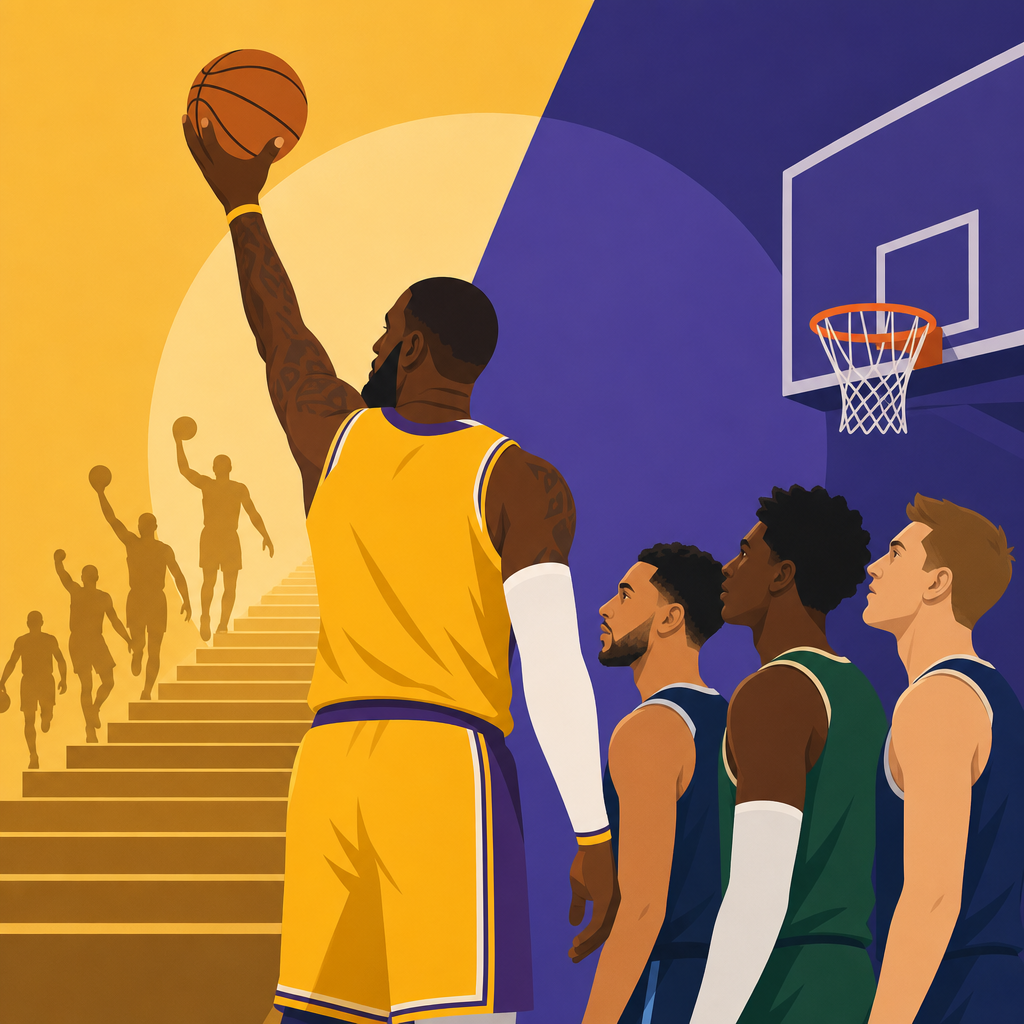
The NBA all-time scoring record is the league’s most visible measure of sustained greatness because it rewards elite talent, health, adaptability, and longevity across eras. When LeBron James passed Kareem Abdul-Jabbar in February 2023, he did more than claim a famous number. He closed one chapter of basketball history and opened a new debate about what it takes to reach the top, why the record stood for nearly four decades, and which current stars have any realistic path to challenge it. For fans exploring NBA players, records and milestones, this subject functions as a hub because career scoring connects directly to peak performance, aging curves, playoff workloads, rule changes, and the evolution of offense.
In plain terms, the NBA all-time scoring record tracks regular-season points only. Playoff points are counted separately, even though postseason scoring often shapes a player’s reputation more than regular-season totals. That distinction matters. James has led in combined regular-season and playoff points for years, but the regular-season record remained attached to Abdul-Jabbar until the night it officially changed hands. The record also reflects different historical environments. Abdul-Jabbar built his total in a lower-possession era without the three-point shot for the first part of his career. James accumulated points in a more efficient offensive era, but against deeper athletic pools, heavier media scrutiny, and longer careers shaped by sports science and year-round evaluation.
I have worked through scoring databases, possession estimates, and aging curves for years, and one lesson repeats every time: the all-time scoring leader is rarely just the best scorer. He is usually the best scorer who also avoids catastrophic injuries, maintains star-level usage into his late thirties, and evolves as the league changes around him. That is why Wilt Chamberlain, Michael Jordan, and Kevin Durant have all had stretches of superior scoring dominance by average, yet none reached the top cumulative mark. The record is a durability test disguised as a scoring stat.
This hub article explains how the record was broken, why Abdul-Jabbar’s total lasted so long, and who could realistically threaten James next. It also places the milestone inside the broader records-and-milestones conversation by addressing pace, efficiency, era adjustment, and the growing gap between highlight narratives and arithmetic reality. If you want a clear framework for evaluating future challengers, start with games played, points per game, role stability, and health before you start dreaming about legacy. Those four variables decide almost everything.
How Kareem Abdul-Jabbar Set a Record That Looked Untouchable
Abdul-Jabbar retired in 1989 with 38,387 regular-season points, a total built through 20 seasons of extraordinary consistency. He entered the NBA in 1969 as an immediate offensive centerpiece, won Rookie of the Year, and then spent two decades scoring in every imaginable context: as a Milwaukee focal point, as the lead star on title teams, and later as an aging but still reliable weapon for the Los Angeles Lakers. His signature skyhook was central to the record’s longevity. It was efficient, nearly unblockable, and less dependent on explosive athleticism than slash-heavy styles, which allowed his scoring to age gracefully.
The mechanics of the record are often misunderstood. Abdul-Jabbar was not piling up 40-point seasons late in his career. He built the total through relentless yearly accumulation. He scored at least 1,000 points in 19 consecutive seasons and played 74 or more games in 17 seasons. That combination is what made the mark feel unreachable. Many superstars can produce three or four historically great years. Very few can produce fifteen to twenty elite or near-elite seasons without a devastating interruption.
Context strengthens his case. The NBA introduced the three-point line in 1979, ten years into Abdul-Jabbar’s career, and he was never a volume three-point shooter. His scoring came mostly from post touches, transition seals, free throws, and half-court execution. He also played in eras with tighter spacing than today, where big men often operated amid congested lanes. Despite that, he finished with six MVP awards, 19 All-Star selections, and the kind of year-to-year durability that modern load management discussions make even more impressive in retrospect.
By the time Abdul-Jabbar retired, the record looked secure because the profile needed to break it seemed almost impossible to reproduce. A challenger needed superstar skill, early entry into the league, exceptional health, a long prime, and enough team success to remain relevant without carrying unsustainable offensive loads every season. For decades, no one checked all those boxes at once.
How LeBron James Broke the NBA All-Time Scoring Record
James broke the record on February 7, 2023, against the Oklahoma City Thunder in Los Angeles, scoring his 38,388th regular-season point on a fadeaway jumper late in the third quarter. The moment felt ceremonial, but the path to it was anything but simple. James entered the league in 2003 directly from high school, giving him a critical timing advantage. He became a high-usage star immediately, averaged more than 20 points per game as a rookie, and then never stopped scoring at an elite rate.
What separates James from past challengers is range in every sense. Early in his career, he was a downhill force who overwhelmed defenses with speed and strength. In Miami, he became more efficient from the post and midrange. In Cleveland and Los Angeles, he refined pacing, manipulation, and shot selection, turning basketball IQ into point production. He was never dependent on one move the way some specialists are. That adaptability protected his scoring as his athletic profile changed.
Durability drove the final result. Before the compressed 2020s portion of his career, James had an extraordinary record of availability, including eight straight Finals appearances from 2011 through 2018 that added immense postseason mileage without significantly reducing his regular-season output. He crossed 30,000 points younger than any player in league history and continued producing despite accumulating one of the heaviest minute loads ever seen. Sports science, recovery investment, and modern training methods helped, but they only matter if the athlete remains disciplined enough to use them relentlessly. James did.
His scoring record is also a reminder that style stereotypes can mislead analysis. For years, critics described him as pass-first, as if that limited his scoring ceiling. In reality, playmaking increased his scoring longevity because it reduced predictability. Defenses had to honor every passing window, which created cleaner driving lanes and more efficient late-career opportunities. A scorer who can also orchestrate offense ages better than one who relies only on shot difficulty.
What the Record Really Measures
The all-time scoring record measures accumulation, but accumulation has parts. First is scoring average. Second is games played. Third is role continuity, meaning whether a player remains central enough to keep usage high across roster changes and coaching systems. Fourth is era fit. A player can score brilliantly and still lose ground if injuries, lockouts, shortened seasons, or role changes interrupt the yearly total.
That is why records and milestones should be analyzed through both total production and rate production. Chamberlain averaged 30.1 points per game for his career, Jordan averaged 30.1, and Durant has spent most of his career among the most efficient high-volume scorers ever. Yet all faced barriers to the cumulative record: shorter careers, retirements, major injuries, or seasons with reduced availability. James, by contrast, paired superstar scoring with elite durability for most of two decades. That combination wins this race almost every time.
Rule changes matter too. Hand-check interpretations, defensive three seconds, offensive spacing, and the explosion of three-point volume have all made efficient scoring easier in some respects for perimeter stars. But modern players also face denser travel demands, more specialized defensive scouting, and organizational caution around rest. In practice, better offensive conditions do not automatically produce better record chances. A player still needs 70-plus games repeatedly over fifteen or more seasons.
| Player | Primary Case for Challenging | Main Obstacle | Realistic Outlook |
|---|---|---|---|
| Luka Doncic | Early career scoring volume, heliocentric role | Long-term conditioning and durability | Best early pace if health stabilizes |
| Kevin Durant | All-time scoring talent and efficiency | Missed too many games in key seasons | Unlikely without extraordinary late-career health |
| Jayson Tatum | Durable wing, early star usage, stable contender role | Needs elite scoring longevity into late thirties | Quietly plausible |
| Giannis Antetokounmpo | High point totals and constant rim pressure | Physical style may shorten accumulation window | Possible but difficult |
| Devin Booker | Young scoring guard with polished three-level game | Career pace below true record trajectory | Outside shot |
Why Most Great Scorers Never Get Close
The biggest misconception about the NBA all-time scoring record is that any generational scorer has a path if he is talented enough. History says otherwise. Bryant finished with 33,643 points despite unmatched shot-making ambition and twenty seasons with one franchise. Karl Malone reached 36,928 through elite durability and power-based consistency, yet still fell well short of Abdul-Jabbar. Dirk Nowitzki, Shaquille O’Neal, and Carmelo Anthony all had Hall of Fame scoring résumés but lost ground through injuries, role changes, or natural declines in late-career usage.
Modern examples reinforce the point. Stephen Curry changed the geometry of basketball and is the greatest shooter ever, but early ankle issues and lower-scoring team contexts cost him cumulative runway. James Harden stacked huge totals during his Houston years, yet his late-career role shifted from nonstop shot creation to shared orchestration. Durant may be the purest scorer of his generation, but the Achilles tear and other absences dramatically altered his chase. Records at this scale punish interruptions more than they reward brilliance.
Another factor is organizational context. To climb the scoring list, a player must remain important enough for coaches and front offices to tolerate very high usage over many years. Winning helps. James, Abdul-Jabbar, and Malone stayed on competitive teams deep into their careers, which preserved their minutes and touches. A star stuck on rebuilding rosters can lose both games and efficiency, while a star on stacked rosters may sacrifice volume for balance. The record demands a rare sweet spot between team success and personal offensive responsibility.
Who Could Challenge LeBron James Next
If the question is who can challenge James next, the honest answer is that no active player should be considered a favorite. The number is simply too high, and the health requirement is too strict. Still, some players deserve discussion because this hub page should separate fantasy from credible projection.
Doncic has the cleanest early mathematical case because he entered the league young, scored heavily from the start, and controls enormous offensive volume. If he averages around 29 to 31 points for another decade while consistently playing near 70 games, he stays in the conversation. The issue is that record chases are destroyed by small annual deficits. A few seasons in the low sixties for games played, one major injury, or a role evolution toward lower usage can remove him from pace quickly.
Tatum is not the first name fans mention, but he is a serious candidate profile because he scores a lot, entered stardom early, and has generally been available. Durable wings often age better than smaller guards or relentlessly physical interior scorers. If he maintains upper-tier usage on competitive teams into his mid-thirties, he could climb faster than people expect. He may never have a 35-point-per-game season, but steady 26-to-30-point seasons with strong availability are exactly how these chases stay alive.
Antetokounmpo has enough production to matter, yet his style creates concern. He scores through force, transition pressure, and constant paint attacks, which means the body absorbs punishment. Players with that profile can still age well, but their path usually requires a later-career skill shift toward easier jump-shot volume and reduced collision frequency. Booker is younger than many realize and has a polished scoring package, though his current pace suggests he would need exceptional longevity rather than merely excellent longevity. As for Durant, the talent is obvious, but cumulative records rarely forgive lost seasons.
How to Evaluate Future NBA Records and Milestones
For readers using this page as a hub for records and milestones, the right habit is to separate narrative milestones from structural ones. A single-game high, a youngest-to-reach mark, or a playoff scoring run can change legacies overnight. Career accumulation records work differently. They are built slowly, and the cleanest forecasting method is simple: multiply expected points per game by realistic games played, then repeat the exercise across projected seasons while accounting for age decline. When I model record chases, durability assumptions matter more than optimistic peak estimates.
That framework also applies beyond scoring. Rebounds, assists, three-pointers, and games played all reward a similar mix of skill and longevity, though each category has its own era effects. The lesson from James and Abdul-Jabbar is not just that they scored a lot. It is that they stayed great long enough for the arithmetic to overpower everyone else. That is the core idea behind nearly every major NBA milestone worth tracking.
LeBron James broke the NBA all-time scoring record because he combined immediate stardom, elite adaptability, and historic durability over two decades. Kareem Abdul-Jabbar held it for so long because he built a model of consistency that very few players in any era could match. The next challenger will need more than highlights, awards, or short-term dominance. He will need fifteen-plus years of elite scoring, strong health, and a role that never truly shrinks. For anyone following NBA players and the wider world of records and milestones, that is the real standard. Use this page as your starting point, then track every candidate with the numbers that actually decide the chase.
Frequently Asked Questions
How did LeBron James break the NBA all-time scoring record, and why was it such a historic moment?
LeBron James broke the NBA all-time scoring record on February 7, 2023, when he passed Kareem Abdul-Jabbar’s long-standing total in a game against the Oklahoma City Thunder. The basket that moved him to the top was instantly iconic, but the significance of the moment went far beyond a single shot or a single night. This was the end of one of the most enduring marks in sports, a record that had stood since 1984 and had come to symbolize a level of excellence few believed would ever be matched.
What made the achievement so historic was the way LeBron got there. He did not build his case through one overwhelming scoring style alone. Instead, he accumulated points through almost every version of offensive greatness the modern NBA allows. Early in his career, he was a devastating downhill attacker who lived at the rim. As he aged, he added a more reliable post game, improved outside shooting, elite playmaking reads, and a veteran understanding of tempo and spacing. That evolution allowed him to remain one of the league’s best scorers across multiple eras, rule changes, roster styles, and defensive schemes.
The record also resonated because it connected generations. Kareem’s total represented durability, efficiency, consistency, and a career that spanned very different periods of NBA history. LeBron passing him created a rare moment where fans could compare two all-time greats without reducing the conversation to simple era arguments. It underscored that lasting greatness is not just about peak dominance. It is about staying productive, healthy, and essential for two decades or more.
In practical terms, LeBron’s climb showed how difficult the record really is. It requires superstar scoring from a very young age, immediate NBA readiness, elite conditioning, and the ability to avoid major lost seasons. That is why the moment was celebrated not merely as a statistical milestone, but as proof of one of the most complete and sustained careers the sport has ever seen.
Why did Kareem Abdul-Jabbar’s scoring record last for nearly 40 years?
Kareem Abdul-Jabbar’s record lasted so long because it sat at the intersection of talent, longevity, and rarity. He was not just a prolific scorer. He was an exceptionally efficient one, with a signature shot in the skyhook that opponents understood but still struggled to stop. More importantly, he remained productive for an extraordinarily long time, playing 20 seasons and continuing to contribute at a high level well beyond the age when most stars decline sharply.
The record also survived because chasing it is far more demanding than people assume. A player cannot simply have a few huge scoring seasons. To even enter the conversation, he usually needs to average well over 25 points per game for many years, debut young, avoid serious injuries, and maintain star-level usage into his late 30s. That combination is incredibly rare. Many all-time great scorers have had the peak scoring ability, but not the health. Others have had the durability, but not the offensive volume. Some have lost seasons to injuries, shortened primes, or entered the league later than modern prospects do.
Another reason the record endured is that the NBA has changed in ways that can both help and hurt long-term scoring pursuits. Modern pace and three-point volume can inflate scoring totals, but today’s game also places enormous physical demands on perimeter creators. Ball-handling stars absorb contact, create off the dribble constantly, and often carry major playmaking burdens along with their scoring roles. That can wear down players over time. Even in higher-scoring eras, sustained availability remains the hardest part of the equation.
There is also a psychological factor. Kareem’s total became so large that it discouraged realistic challengers. Once a record starts to look unreachable, every missed season, every late-career decline, and every strategic choice to rest becomes magnified. By the time LeBron truly emerged as a threat, it was clear he needed an almost unprecedented combination of discipline, health, and adaptability to get there. That is exactly why Kareem’s mark remained one of the most respected benchmarks in basketball history for nearly four decades.
What qualities does a player need to realistically challenge the NBA all-time scoring record?
To realistically challenge the NBA all-time scoring record, a player needs much more than scoring talent. The first requirement is an early start. Players who enter the NBA as teenagers or at 19 years old immediately gain a major advantage because they have more seasons to accumulate points. Starting young matters because the margin for error is so small. A lost year in a player’s early or middle prime can remove him from serious contention almost instantly.
The second requirement is elite durability. This may be the single most important trait after talent. A record chaser must avoid catastrophic injuries, but he also has to consistently play enough games year after year. Small recurring injuries, load management, and normal aging all chip away at the total. A player can be an amazing scorer and still have no realistic path if he misses too many games over the course of a decade.
Third, the player has to be a true top-tier scorer, not just a star. That means producing high point totals efficiently and doing it against playoff-level defensive attention during the regular season. Twenty-point scorers do not usually threaten this record. The real candidates are players capable of 28, 30, or more points per game over multiple prime seasons while also staying central to their team’s offense.
Fourth, adaptability is critical. Defenses change, athleticism declines, and team roles evolve. A player who depends on only one physical advantage usually fades too quickly. To survive long enough to chase the record, he must diversify his scoring. That could mean developing a stronger jumper, a more polished post game, better footwork, or smarter shot selection. LeBron is a perfect example of this. He remained dangerous as his game changed, and that preserved his scoring pace deep into his career.
Finally, there is the matter of motivation and circumstance. A player needs to stay relevant long enough that teams continue building around him or at least giving him a featured offensive role. That requires not only individual excellence but also professionalism, conditioning, and the willingness to keep refining his game. In other words, the all-time scoring race is not won by scoring alone. It is won by the rare player who combines greatness, health, consistency, and reinvention over an extremely long career.
Which current NBA stars have the most realistic chance to challenge LeBron James’s scoring total next?
Any discussion of future challengers has to begin with a reality check: most current stars are not on a realistic record-breaking pace, even if they are brilliant scorers. The all-time record demands such a massive total that only a very small group deserves serious mention. In broad terms, the best candidates are players who entered the league young, have already built large early-career point totals, and project to remain elite scorers for a very long time.
Luka Dončić is often mentioned because he became a high-volume scorer almost immediately and has the offensive skill set to age well. He does not rely exclusively on explosive athleticism, which could help him remain productive deep into his 30s. If he stays healthy and maintains elite scoring volume for another decade or more, he fits the profile better than most. The challenge for Luka is durability over the long haul and whether his body can withstand the constant burden of being a primary scorer and creator every season.
Jayson Tatum is another name worth watching because he started young, scores consistently, and has shown strong year-to-year availability. He may not always dominate scoring headlines the way some others do, but his combination of age, role stability, and two-way value could support a very long prime. For a player like Tatum, the question is whether he can sustain the ultra-high scoring averages needed to stay on an all-time record pace rather than merely finishing with an excellent career total.
Kevin Durant would have been one of the most natural threats based on pure scoring ability, and in terms of talent he remains one of the greatest scorers ever. However, missed time from injuries has made the math significantly harder. The same general issue applies to several modern superstars: they may have the skill, but the lost games create too much ground to make up. That is why players such as Giannis Antetokounmpo, Devin Booker, Anthony Edwards, and others may appear in speculative conversations, but each would need a near-perfect run of health and longevity to truly enter the race.
The biggest takeaway is that realistic challengers must be judged by pace, age, health history, and projected longevity at the same time. It is not enough to be a great scorer today. A player must have a believable path to scoring at a superstar level for 15 to 20 years. That is why the list of serious candidates is always much shorter than the list of the league’s best offensive players.
Is the NBA all-time scoring record likely to be broken again soon, or could LeBron James hold it for a long time?
LeBron James could very realistically hold the record for a long time, even in an era of inflated scoring numbers. At first glance, modern offense might suggest the record will fall more quickly because teams shoot