
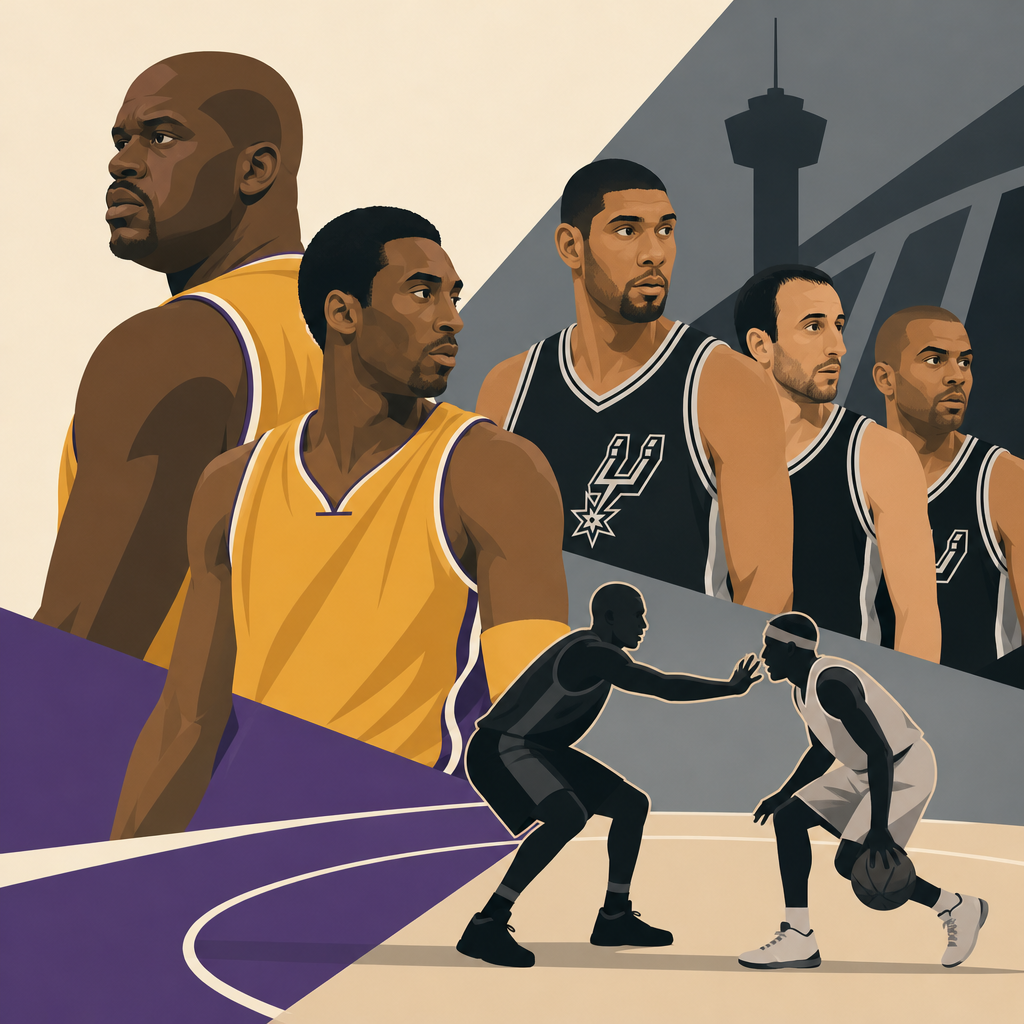
The NBA in the 2000s was defined by power, precision, and a dramatic shift in how championship basketball was played. In one decade, the league moved from the high-scoring, star-driven style of the late 1990s to an era shaped by half-court execution, elite rim protection, disciplined schemes, and franchise stability. If you want to understand league history, this period matters because it connects Michael Jordan’s final championship years to the pace-and-space revolution that followed. The decade gave fans dynasties, bitter rivalries, rule changes, global expansion, and some of the most debated MVP and Finals legacies in basketball.
At the center of the story were several defining forces. The Los Angeles Lakers, led by Shaquille O’Neal and Kobe Bryant, opened the decade with a three-peat and set the standard for star talent. The San Antonio Spurs answered with a quieter but equally formidable model built around Tim Duncan, Gregg Popovich, and a culture of defensive consistency. Around them, teams such as the Detroit Pistons, Miami Heat, Boston Celtics, and Phoenix Suns each represented a different interpretation of what winning basketball could look like. Yet one common thread tied the era together: defense was not a supporting detail. It was the foundation.
In league history, “defense” in the 2000s means more than low scores. It refers to the strategic emphasis on rim deterrence, help rotations, physical perimeter pressure, defensive rebounding, and playoff game control. This was also the decade when rule adjustments, especially illegal defense changes and hand-check enforcement, reshaped spacing and perimeter play. I have always viewed the 2000s as the NBA’s most transitional decade. It preserved old-school physicality while laying the groundwork for modern offensive creativity. To study this era is to see how championships are really built: not only through stars, but through systems, roster balance, and adaptation across an 82-game season and four playoff rounds.
Shaq and Kobe built the decade’s first dynasty
No team better captured the early 2000s than the Lakers. From 2000 through 2002, Los Angeles won three straight championships behind the overwhelming interior force of Shaquille O’Neal and the relentless perimeter brilliance of Kobe Bryant. Shaq was the league’s most physically dominant player, routinely collapsing defenses, drawing hard doubles, and forcing entire game plans to revolve around foul management. Kobe, still young but rapidly evolving, gave the Lakers a closer on the wing who could create shots late in games and attack from angles few defenders could contain.
Phil Jackson’s triangle offense gave structure to that talent. The system emphasized spacing, post entries, weak-side reads, and reactions rather than rigid play calls on every trip. In practical terms, it allowed the Lakers to feed Shaq without becoming predictable, while also giving Kobe room to operate when defenses loaded the paint. Their playoff runs proved how hard it was to survive a team that could punish opponents both inside and outside. The 2001 postseason remains one of the strongest title runs ever, with Los Angeles going 15-1 and dominating elite Western Conference opponents.
The partnership was never simple. Personality clashes, media scrutiny, and competing leadership styles created tension that eventually split the roster apart. But from a league history standpoint, that tension also reflected the NBA’s fascination with superstar hierarchy. Could one team sustain two all-time greats in their prime? For three championships, the answer was yes. Their rivalry within the roster became part of the mythology, yet it should not obscure the basketball reality: the Lakers won because they paired generational talent with size, rebounding, postseason shot-making, and enough defensive commitment to control playoff series.
The Spurs Machine turned consistency into a dynasty
If the Lakers were dramatic, the Spurs were methodical. San Antonio won championships in 2003, 2005, and 2007 during the decade, and every title followed a recognizable formula: elite defense, low error rates, controlled tempo, and Tim Duncan’s complete command of both ends of the floor. Duncan was the centerpiece, but “the Spurs Machine” is the right phrase because San Antonio functioned as a system before that became a leaguewide ideal. The franchise identified roles clearly, developed players patiently, and trusted continuity.
Gregg Popovich deserves central credit in any serious account of 2000s league history. He built a culture where possession value mattered. Transition defense, tagging rollers, closing out under control, and limiting live-ball turnovers were treated as nonnegotiable habits. The Spurs were rarely flashy, but they were devastatingly sound. Duncan anchored everything with elite rim protection, outlet passing, post scoring, and immaculate timing as a help defender. By the middle of the decade, Tony Parker’s speed and Manu Ginobili’s improvisation expanded the offense without weakening that identity.
What made San Antonio historically important was repeatability. Other teams had great seasons; the Spurs had an operating system. They could win ugly, win on the road, win in slow possessions, and adjust over a long series. In an era obsessed with stars, they showed that infrastructure could be just as decisive. Front-office discipline, international scouting, and role-player optimization all became part of the franchise’s edge. Their influence can be traced directly into modern NBA team-building.
Defense became the defining language of winning basketball
The 2000s are often remembered as a defensive era because scores were lower, but the deeper truth is that defenses became smarter. Teams packed the paint, shrank driving lanes, and relied on connected rotations. Big men such as Duncan, Ben Wallace, Kevin Garnett, and Dwight Howard changed shot selection before attempts even happened. Wing defenders fought over screens, funneled ball handlers toward help, and accepted physical possessions as standard playoff conditions. Coaches emphasized shell drills, weak-side stunts, and rebounding responsibilities in ways casual fans did not always see.
The 2004 Detroit Pistons are the cleanest example. They won the title without a conventional top-five scorer, defeating a star-loaded Lakers team through collective defense, transition prevention, and ruthless attention to detail. Ben Wallace protected the rim and controlled the glass, Rasheed Wallace added length and communication, Tayshaun Prince erased space on the perimeter, and Chauncey Billups managed tempo. Detroit’s title was not a fluke. It was proof that an elite defensive identity could beat superior name recognition when the rotations were sharp and the matchups were targeted correctly.
That lesson repeated throughout the decade. Miami’s 2006 title team leaned on interior pressure and late-game shot creation, Boston’s 2008 group built a historic turnaround around Kevin Garnett’s back-line command, and Orlando reached the 2009 Finals with Dwight Howard covering mistakes at the rim. Defense was never one-size-fits-all, but it consistently determined who lasted into June.
| Team | Championship Years in the 2000s | Defining Strength | Core Figures |
|---|---|---|---|
| Los Angeles Lakers | 2000, 2001, 2002, 2009 | Interior dominance and star shot creation | Shaquille O’Neal, Kobe Bryant, Phil Jackson |
| San Antonio Spurs | 2003, 2005, 2007 | Half-court execution and elite team defense | Tim Duncan, Tony Parker, Manu Ginobili, Gregg Popovich |
| Detroit Pistons | 2004 | Collective defense and balance | Chauncey Billups, Ben Wallace, Rasheed Wallace |
| Miami Heat | 2006 | Paint pressure and superstar closers | Dwyane Wade, Shaquille O’Neal, Pat Riley |
| Boston Celtics | 2008 | Defensive communication and veteran structure | Kevin Garnett, Paul Pierce, Ray Allen, Doc Rivers |
Rule changes and style shifts reshaped the league
To understand why the 2000s looked the way they did, you have to account for the rulebook. The NBA’s changes to illegal defense rules in 2001 allowed more zone principles and stronger help positioning, which made isolation basketball less automatic. Defenders could shade and load up more intelligently, and coaching staffs quickly found ways to clog driving lanes. Then, in 2004, the league increased emphasis on hand-check restrictions on the perimeter. That decision opened opportunities for quicker guards and wings, helping players like Steve Nash and later Chris Paul attack with more freedom.
These changes did not instantly create modern basketball, but they accelerated the transition. Early in the decade, offenses still leaned heavily on post-ups and midrange creation. By the later years, pace and space ideas were becoming more visible, especially through Mike D’Antoni’s Phoenix Suns. With Nash directing, Amar’e Stoudemire diving, and shooters spreading the floor, Phoenix pushed tempo and tested defensive coverages in ways that felt ahead of their time. They did not win a title, but their influence was enormous. Many concepts that define current offenses gained wider acceptance because the Suns proved they could scale in the regular season and threaten elite teams.
The era’s style was therefore not static. It was a debate between control and speed, brute force and spacing, post gravity and pick-and-roll pressure. That tension is why the decade remains so useful as a league history hub. It shows the NBA evolving in real time rather than flipping suddenly from one style to another.
Superstars, rivalries, and turning-point teams defined league history
Every strong league-history period needs landmark figures, and the 2000s had many. Allen Iverson’s 2001 MVP season and Finals run embodied volume scoring under enormous defensive pressure. LeBron James entered in 2003 and, by the end of the decade, had become the league’s central force, carrying Cleveland deep into the postseason and winning back-to-back MVP awards in 2009 and 2010’s lead-in season. Dwyane Wade delivered one of the great Finals performances in 2006. Kevin Garnett transformed Boston’s identity overnight in 2008. Dirk Nowitzki stretched the definition of a franchise scorer by winning the 2007 MVP as a seven-footer whose face-up game changed matchup logic.
The rivalries mattered just as much as the stars. Lakers versus Spurs was the decade’s essential Western Conference chess match. Pistons versus Pacers reflected the East’s bruising edge before the Malice at the Palace altered both franchises. Celtics versus Lakers restored the league’s most famous Finals matchup in 2008 and 2010’s adjacent cycle, reconnecting modern fans to a historic narrative. Even teams that fell short, like the Suns, Kings, Mavericks, and Cavaliers, helped define the decade by forcing contenders to answer different strategic questions.
From a hub perspective, these teams are important because they open pathways into every major league-history conversation: dynasties, officiating, pace changes, labor issues, international growth, draft development, and the rise of analytics-informed roster construction. The 2000s were not one story. They were several powerful stories colliding.
Why the 2000s remain central to NBA history
The decade still shapes how basketball is discussed because it offered competing models of success. One model said overwhelming star talent wins titles if the fit is good enough. Another said continuity, scheme discipline, and defense can outlast volatility. A third argued that innovation, especially in pace and spacing, eventually bends the league toward new possibilities even before championships catch up. All three models were present at once in the 2000s, which is why the era remains such a rich center of NBA history.
It was also the decade when the league became more globally interconnected. International players were no longer novelties; they were central to contenders. Ginobili came from Argentina, Parker from France, Nowitzki from Germany, Pau Gasol from Spain, and Yao Ming from China. Front offices expanded scouting networks, and the talent pipeline changed permanently. At the same time, the draft became more heavily scrutinized as teams weighed high school prospects, college production, and long-term upside in a league where one elite two-way player could transform an entire franchise.
For readers exploring league history, the clearest takeaway is that the 2000s explain both the end of one NBA age and the blueprint for the next. Shaq and Kobe showed what peak star dominance looked like. The Spurs showed how an organization sustains greatness. Defensive teams proved discipline wins in June. Rule changes and innovators like the Suns pointed toward the modern game. If you want to understand how today’s NBA was built, start with this decade, then follow each team, rivalry, and tactical shift deeper into the history of the league.
Frequently Asked Questions
What defined the NBA in the 2000s, and why is the decade so important in league history?
The NBA in the 2000s was defined by a major stylistic shift toward defensive structure, half-court execution, and long-term franchise stability. Compared with the more open, star-centered scoring environments that many fans associate with earlier eras, this decade placed a premium on controlling tempo, protecting the rim, limiting easy transition points, and winning through disciplined possession-by-possession basketball. Teams that succeeded were usually the ones that defended without mistakes, rebounded consistently, and executed in late-game situations with precision rather than speed.
This period matters because it serves as a bridge between eras. It followed the Chicago Bulls dynasty and Michael Jordan’s final championship run, but it also set the stage for the modern game that came later. The league in the 2000s still revolved around dominant big men, post entries, and physical perimeter defense, yet it also introduced strategic developments that would influence the next generation, including spacing concepts, international player integration, advanced team defense, and the importance of organizational continuity. In other words, the decade connected the old NBA and the modern NBA.
It was also a decade shaped by repeat contenders rather than constant chaos. The Los Angeles Lakers, San Antonio Spurs, Detroit Pistons, and later the Boston Celtics established identities built on system basketball. Even when these teams featured superstars, they won because those stars fit inside clear structures. That combination of elite individual talent and carefully engineered team play is what gives the 2000s its distinct identity. For fans and historians, this is one of the most tactically significant decades the league has ever had.
How dominant were Shaq and Kobe, and what made the Lakers’ early-2000s run so difficult to stop?
Shaquille O’Neal and Kobe Bryant formed one of the most overwhelming championship duos in NBA history, especially during the Lakers’ three straight titles from 2000 through 2002. Shaq was the central force. At his peak, he was nearly impossible to defend one-on-one because of his size, power, footwork, and touch around the basket. Teams often had to send immediate double-teams, which created opportunities for shooters and slashers around him. He did not just score efficiently; he bent entire defensive schemes out of shape.
Kobe complemented Shaq in a completely different way. He was a perimeter shot creator who could attack off the dribble, score in isolation, operate in the mid-range, and defend at a high level when locked in. That contrast made the Lakers uniquely hard to game-plan against. If a team packed the paint to slow Shaq, Kobe could punish single coverage on the perimeter. If defenses stayed home on Kobe and the wings, Shaq could dominate inside. The Lakers had the ability to pressure opponents from both the interior and the perimeter, which is one reason their ceiling was so high.
Another key factor was playoff adaptability. Under Phil Jackson, the Lakers were not just talented; they were structured. The triangle offense gave them spacing, passing options, and a framework that reduced predictability in half-court situations. Add role players who understood their jobs, plus the sheer star power of O’Neal and Bryant, and the result was a team that could survive different playoff styles. They could win ugly, control the glass, defend physically, and still generate enough top-end offense to beat elite competition.
What makes their run especially memorable is that it was never purely about aesthetics. These Lakers were not simply an offensive highlight machine. They were forceful, physical, and often at their best when games got slower and more demanding. That is a perfect reflection of the decade itself. Their dynasty showed that in the 2000s, championships were usually earned through a mix of star brilliance, interior dominance, and the ability to execute under pressure.
Why were the San Antonio Spurs called a machine, and what made them so consistently successful?
The Spurs earned that reputation because they were one of the most efficient, stable, and disciplined organizations in professional sports. Their success did not depend on emotional swings, media attention, or short-term roster gambles. Instead, San Antonio built a culture around fundamentals, continuity, smart drafting, unselfish play, and defensive reliability. Year after year, they looked prepared, connected, and clear about their identity. That level of consistency is why they are often described as machine-like.
At the center of it all was Tim Duncan, whose greatness defined the franchise. Duncan was not always the loudest superstar, but he was one of the most dependable and complete players of his era. He anchored the defense, scored efficiently in the post, rebounded at an elite level, and made winning plays without forcing the game. Around him, the Spurs developed a roster that fit beautifully. Tony Parker brought speed and dribble penetration, Manu Ginobili added creativity and fearless playmaking, and key role players consistently executed within Gregg Popovich’s system.
Popovich’s coaching was just as important as the talent. The Spurs were masters of preparation and adjustment. Defensively, they rotated on time, protected the paint, and rarely gave away easy shots. Offensively, they could grind through post touches and mid-range opportunities early in the decade, then evolve into a more fluid, international-influenced passing attack later on. That ability to adapt without losing their core identity is one of the strongest arguments for San Antonio’s place among the greatest dynasties in league history.
The Spurs also represented something larger about the 2000s: winning through patience and institutional strength. They were not built around drama or constant reinvention. They were built around trust, player development, and repeatable habits. In a decade known for defense and execution, no team embodied those values more completely than San Antonio. Their championships in 1999, 2003, 2005, and 2007 made them the defining standard of sustained excellence in that era.
Why did defense become so central in the NBA during the 2000s?
Defense became central in the 2000s because the structure of the league rewarded physicality, discipline, and half-court control. Offensive spacing was tighter than it is today, teams attempted fewer three-pointers, and many offenses relied heavily on post play, isolations, and mid-range creation. That made it easier for well-drilled defenses to load the paint, help aggressively, and force difficult shots late in the clock. In playoff basketball especially, every possession became a test of patience and execution.
Another major factor was the value of rim protection and interior size. Dominant big men and elite defensive anchors had enormous influence in this era because stopping the paint was still the foundation of almost every championship defense. Teams like the Spurs and Pistons showed how devastating it could be to combine strong individual defenders with connected team concepts. Contesting drives, rotating early, boxing out, and limiting second chances were not just helpful details; they were essential to survival.
The decade also rewarded teams that could defend without losing structure. Help defense, communication, and shot discipline were often more important than raw scoring talent. This is one reason the 2004 Detroit Pistons remain such an iconic champion. They did not rely on one unstoppable offensive superstar. Instead, they overwhelmed teams with pressure, intelligence, toughness, and cohesion. Their title run reinforced the larger truth of the era: if a team defended at an elite level and avoided mistakes, it could beat more glamorous opponents.
At the same time, the defensive emphasis of the 2000s helped push the league toward future change. As scoring became harder and possessions more congested, coaches and front offices increasingly searched for ways to create better spacing and more efficient shots. That search helped open the door for later tactical shifts, including more three-point shooting, faster pace, and expanded offensive freedom on the perimeter. So while the 2000s were remembered for defense-first basketball, they also helped create the strategic pressure that transformed the game in the years that followed.
Which teams and championship runs best represent the 2000s NBA style?
Several teams define the decade, but the most representative are the early-2000s Lakers, the San Antonio Spurs, the 2004 Detroit Pistons, and the 2008 Boston Celtics. Each of them reflects a different version of what winning basketball looked like in the 2000s, and together they tell the story of the era. The Lakers showed how overwhelming superstar talent could still dominate when paired with interior force and playoff composure. The Spurs represented system excellence, defensive consistency, and organizational stability. The Pistons proved that a collective identity could overcome more celebrated stars. The Celtics demonstrated how elite defense and veteran buy-in could produce immediate championship results.
The 2004 Pistons deserve special attention because they are often treated as the purest symbol of the decade’s defensive character. They defeated the heavily favored Lakers through pressure, communication, and total team discipline. Ben Wallace anchored the defense, Chauncey Billups controlled the game, and the entire team embraced its roles. They did not win by overwhelming opponents with individual shot-making. They won by making life miserable on every possession, which perfectly captures the spirit of the era.
The 2008 Celtics are also important because they showed how defense could be modernized without losing toughness. Kevin Garn