
NBA flagrant foul suspension rules shape how the league separates hard basketball plays from actions that endanger opponents, damage competitive fairness, or trigger retaliation. In NBA terminology, a flagrant foul is not just a common personal foul with extra drama. It is an unnecessary foul, and in more serious cases an unnecessary and excessive foul, assessed after live action review or postgame league office examination. The distinction matters because the penalty can include free throws, possession, ejection, fines, and suspension. For fans, coaches, writers, bettors, and youth officials studying professional standards, understanding how the NBA disciplines players after review is essential to interpreting game outcomes and league consistency.
This fouls explained hub sits inside the broader NBA rules landscape because flagrant fouls connect several rulebook areas at once: personal fouls, technical fouls, replay review, hostile act criteria, playoff discipline, and cumulative points that can lead to automatic suspension. In practice, the process is more layered than many broadcasts suggest. I have worked through game film and rule interpretations often enough to know that what looks obvious in real time may be judged differently after slow motion, multiple camera angles, and consideration of windup, follow-through, point of contact, and whether the defender made a legitimate play on the ball. The NBA wants a framework that protects players without criminalizing normal physicality, and that balancing act explains why reviews can be lengthy and why similar plays sometimes receive different outcomes.
At the center of the system are two categories. A Flagrant Foul Penalty 1 is called when contact is unnecessary. A Flagrant Foul Penalty 2 is called when contact is unnecessary and excessive. That second category usually triggers immediate ejection. Beyond the single game, the league office can upgrade or downgrade rulings, assign fines, and issue suspensions based on severity, prior acts, and the playoff point system. This article explains the complete discipline pathway, gives plain-language examples, and serves as a hub for understanding related foul concepts across the NBA rulesbook.
What Counts as a Flagrant Foul in the NBA
A flagrant foul begins with the rulebook definition, but the practical application depends on several review factors. Officials examine whether the player made a legitimate basketball play, whether there was a windup before contact, whether the follow-through increased force, whether the contact struck a vulnerable area such as the head, neck, or groin, and whether the overall act created unusual risk. That is why an arm wrapping around a driver on a take foul may remain a common foul, while a late rotating defender who swings downward and catches the shooter across the face may receive a Flagrant 1 or Flagrant 2.
The league also uses the hostile act framework during replay. A hostile act is not limited to punches. It can include unnecessary contact, aggressive strikes, or escalations away from the ball. In reviews I have seen repeatedly, officials are trained to separate outcome from intent. A player can insist there was no bad intent, yet still be penalized because the act was reckless and dangerous. Conversely, visible frustration alone does not guarantee a flagrant call if the contact itself was marginal and not excessive.
Common examples help. Under-cutting a jump shooter by failing to provide landing space is usually judged under separate shooter protection principles, but if the play includes forceful body contact or reckless undercutting it can rise to flagrant territory. A transition foul where a defender grabs from behind with both arms might be a take foul, but if the defender winds up and knocks the player to the floor, review for a flagrant becomes likely. Elbows are another frequent source of review. A natural pivot with incidental contact may stay common, while a swung elbow making hard head contact often draws a flagrant assessment.
How Replay Review Determines Discipline
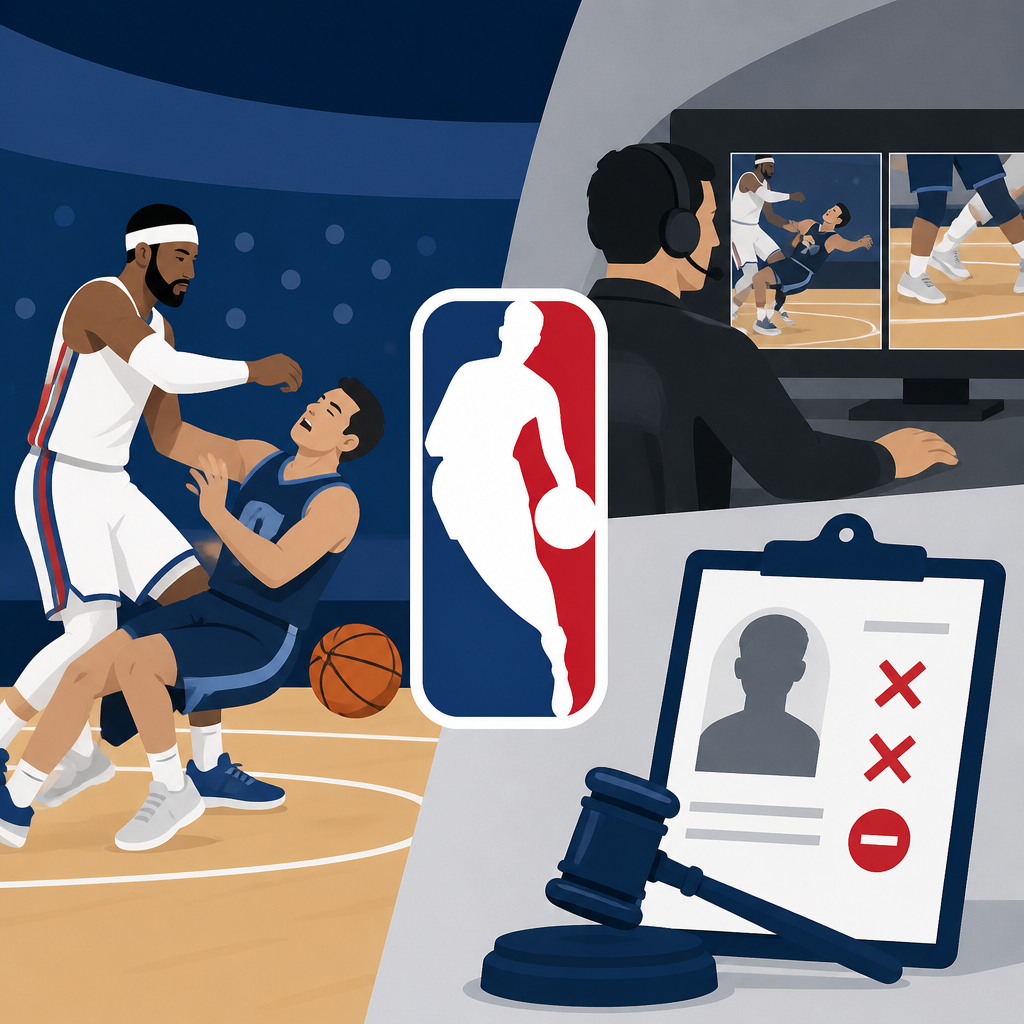
Replay review is the hinge between an ordinary foul call and major discipline. On the floor, referees can stop play to review potential hostile acts or possible flagrant fouls. They use the replay center and multiple camera angles to determine whether the initial call should stand, be upgraded, or in some situations be rescinded. The review does not only ask, “Was there contact?” It asks whether the contact meets the threshold for unnecessary or unnecessary and excessive force. That distinction is why reviews often focus on slow-motion evidence of windup and follow-through.
During review, referees generally evaluate five practical questions: Did the player make a play on the ball? Where did the contact land? How much force was used? Was there an avoidable extra motion after initial contact? Did the opponent face unusual danger because he was airborne, defenseless, or struck in a vulnerable area? Those questions are not always announced publicly in that exact language, but they track how officials explain outcomes and how the league later summarizes decisions.
Postgame review matters too. The NBA can reclassify incidents after examining full video and referee reports. If a play was missed entirely, the league may still issue a fine or suspension. If a Flagrant 2 ejection appears too harsh, the office can downgrade it for point accumulation purposes, though the in-game ejection itself cannot be undone competitively. This after-review authority is important because some benches clear slowly, some camera angles reveal instigators late, and some dangerous acts happen away from the ball where officials initially lack a clean look.
Flagrant 1, Flagrant 2, Ejection, and Automatic Consequences
The immediate penalties differ sharply. A Flagrant Foul Penalty 1 results in two free throws for the offended team and retained possession. A Flagrant Foul Penalty 2 carries the same free throws and possession, but the offending player is also ejected. That ejection is automatic once officials classify the act as unnecessary and excessive. The rule is meant to remove players whose conduct has crossed from physical competition into dangerous behavior.
Not every ejection creates a suspension. This is where many fans get confused. A player thrown out for a Flagrant 2 is not automatically suspended for the next game. The league office reviews the act and decides whether further discipline is warranted. The next-game penalty depends on severity, prior history, whether there was intent or recklessness, and in the postseason, the cumulative flagrant points system.
Fines are common even without suspension. The NBA often imposes monetary penalties for escalating altercations, failing to leave a scene, making hostile gestures, or initiating unnecessary confrontation after the whistle. Suspensions become more likely when the conduct involves strikes to the head, forceful shoves of airborne players, repeated offenders, or incidents likely to provoke fights. When I evaluate whether a suspension is coming, the clearest signals are vulnerable-point contact, non-basketball motion, and whether the player had time to avoid or lessen the hit.
| Ruling | Definition | In-Game Penalty | Postgame Risk |
|---|---|---|---|
| Common foul | Illegal contact without flagrant threshold | Personal foul; standard free-throw rules apply | Usually none unless upgraded later |
| Flagrant 1 | Unnecessary contact | Two free throws and possession | Fine possible; points added in playoffs |
| Flagrant 2 | Unnecessary and excessive contact | Two free throws, possession, automatic ejection | Fine or suspension possible; points added in playoffs |
| Hostile act review | Potential unsportsmanlike or dangerous action | Can lead to technicals, flagrants, ejections | League may issue further discipline |
The Playoff Points System and When Suspensions Become Automatic
The postseason uses the most defined cumulative suspension structure. Players receive one point for a Flagrant 1 and two points for a Flagrant 2. Once a player reaches four points in the playoffs, he is automatically suspended for one game. After that first automatic suspension, every additional two points trigger another automatic one-game suspension. This system exists because playoff intensity rises, series create grudges, and the league wants a predictable deterrent against repeated dangerous play.
That cumulative model means a player can be suspended without committing a single wildly violent act. Two Flagrant 2 fouls across a postseason would reach four points immediately. So would four Flagrant 1 fouls. More commonly, players edge toward the threshold through a mix of reckless closeouts, hard transition fouls, and retaliatory contact. The office can also rescind or reduce assessed points after review, which makes official announcements important after controversial games.
A well-known example came in the 2016 Finals, when Draymond Green’s cumulative flagrant points led to a suspension for Game 5. That case showed how regular review, series context, and prior playoff acts combine under the point system. Whether fans agreed with every call was almost secondary; the process itself was clear. Once the point threshold was met, the suspension followed. For coaches and players, the lesson is straightforward: in the playoffs, every reviewed act carries both immediate and compounding risk.
How the League Office Decides on Suspensions After Review
When the game ends, discipline moves from the court to the league office. Basketball operations reviews video, referee reports, prior discipline history, and sometimes contextual factors such as whether a player left the bench area or escalated an altercation. The standard is not purely punitive. The league is trying to preserve safety, competitive integrity, and deterrence. In effect, the office asks whether the in-game penalty fully addressed the conduct or whether extra punishment is needed to reflect risk and prevent recurrence.
Several factors consistently increase suspension odds. Contact to the head or neck is heavily scrutinized because the NBA has spent years emphasizing player safety. Shoving an airborne player is another major red flag because it creates uncontrollable landing risk. Leaving the bench during an on-court altercation can trigger automatic consequences under long-standing anti-escalation policy. Repeat history matters as well. A player with prior hostile-act fines or suspensions is more likely to receive stronger discipline for a borderline act than a player with a clean record.
There are also mitigating factors. If the player clearly attempted a basketball play, immediately showed concern, and the force was high but not excessive, the office may stop at a fine. If the contact looked severe in slow motion but had limited actual force and no windup, a suspension may be avoided. The league does not formally decide cases by injury outcome alone. A dangerous act can earn suspension even if the opponent is unharmed, and accidental bad luck does not automatically transform a legal or common foul into a suspendable offense.
Related Foul Concepts Every NBA Rules Reader Should Know
To understand flagrant foul suspension rules fully, it helps to place them among other foul categories. A personal foul is standard illegal contact. A shooting foul grants free throws when the offensive player is in the act of shooting. An offensive foul penalizes the ballhandler or screener for illegal contact, often with no free throws unless the team is in the bonus. A technical foul addresses unsportsmanlike conduct, delay, taunting, or administrative violations rather than illegal physical contact. A take foul addresses transition-stopping contact designed to prevent a fast break. These categories overlap in game flow but carry distinct penalties.
For a fouls explained hub, the key takeaway is that “hard foul” is not a rules category. Broadcast language can blur that distinction, but the NBA rulebook does not grade emotion; it grades action. A wrap-up, body check, or swipe can be common, clear-path related, take-foul related, or flagrant depending on timing, force, and context. That is why serious NBA rules analysis always starts with the exact mechanism of contact instead of a player’s reputation alone.
If you want to read the game more accurately, track four things in real time: whether the defender played the ball, whether the opponent was airborne, where the contact landed, and whether there was extra motion after initial impact. Those four clues predict review outcomes better than crowd reaction. They also make every related article in an NBA Rules and Fouls Explained series easier to follow, from personal fouls and technicals to replay standards and ejection procedures.
NBA flagrant foul suspension rules are best understood as a layered discipline system, not a single whistle. Officials first classify contact during the game, using replay to determine whether a foul was merely illegal, unnecessary, or unnecessary and excessive. That classification drives immediate penalties such as free throws, possession, and possible ejection. Afterward, the league office reviews the incident again to decide whether fines, point assessments, rescissions, or suspensions are appropriate. In the playoffs, cumulative flagrant points add a further automatic consequence that can change a series.
The central benefit of knowing these rules is clarity. You can separate a tough basketball play from a suspendable act, understand why some ejections end with no further penalty, and see why other incidents draw league action a day later. You also gain a better framework for every topic under the fouls explained umbrella, because flagrants sit at the intersection of player safety, officiating judgment, and league discipline. That makes this subject one of the most important hubs within any serious guide to NBA rules.
Use this article as your reference point when reviewing controversial calls, then continue through related NBA Rules topics such as personal fouls, technical fouls, replay review, take fouls, and ejections. The more precisely you understand the foul categories, the more accurately you will read the game.
Frequently Asked Questions
What is the difference between a Flagrant 1 and a Flagrant 2 foul in the NBA?
In NBA rules, the key distinction is severity. A Flagrant 1 is called when officials determine the contact was unnecessary, while a Flagrant 2 is assessed when the contact is both unnecessary and excessive. That difference is crucial because it affects the immediate in-game penalty and can strongly influence whether the player faces additional discipline after review. A Flagrant 1 usually results in free throws for the offended team and possession of the ball, but the player who committed the foul remains in the game. A Flagrant 2 carries those same penalty consequences and also triggers an automatic ejection.
When the league evaluates whether a foul rises to either level, it looks at factors such as wind-up, follow-through, point of contact, force, vulnerability of the opposing player, and whether the play resembled a legitimate basketball action. A hard foul by itself does not automatically become flagrant, and not every dangerous-looking sequence leads to a suspension. The NBA’s process is designed to separate physical but legal competition from conduct that creates unnecessary risk. That is why replay review and postgame examination matter so much in close cases.
Can a player be suspended after the game even if officials did not eject him during live play?
Yes. The NBA can suspend a player after the fact, even if the player was not ejected during the game or even if the foul was initially ruled less severe on the floor. The league office routinely reviews incidents to determine whether the in-game ruling fully reflected the nature of the conduct. If a play is judged to have involved dangerous, excessive, retaliatory, or clearly non-basketball contact, the league can upgrade the discipline after review and issue fines or suspensions.
This is one of the most important parts of NBA discipline. Officials must make quick decisions in real time, sometimes with replay assistance, but the league office has the benefit of multiple camera angles, slower frame-by-frame review, and broader context. That context can include whether the player made a genuine play on the ball, whether the opponent was airborne or otherwise defenseless, whether the action had the potential to cause injury, and whether the contact could provoke escalation between teams. In practice, that means a player is never fully insulated from discipline simply because he stayed in the game that night.
How does the NBA decide whether a flagrant foul should lead to a suspension?
The NBA does not rely on a single automatic formula in every case. Instead, it weighs the totality of the circumstances. League reviewers consider the type of contact, the amount of force, whether the act was unnecessary or excessive, whether the player made a legitimate basketball play, and whether the opponent was especially vulnerable at the moment of contact. Plays involving blows to the head, undercutting airborne players, retaliatory strikes, or actions far removed from normal basketball movement are more likely to bring additional punishment.
The league also pays attention to broader disciplinary context. A player’s history matters, especially if there is a pattern of dangerous conduct, repeated technical or flagrant behavior, or prior incidents that raised player safety concerns. The NBA’s goal is not only to punish one play in isolation but also to protect players and preserve competitive fairness over the course of a season. If the league believes a player’s actions created unacceptable danger or undermined sportsmanship, a suspension becomes more likely. In especially serious cases, the punishment may extend beyond one game depending on the conduct and the surrounding circumstances.
Do repeat flagrant fouls increase the chances of suspension during the season or playoffs?
Yes. Repeat offenders face a greater risk of stronger discipline because the NBA tracks flagrant foul points over the course of the regular season and postseason. In general, players assessed Flagrant 1 and Flagrant 2 fouls receive different point values, and once certain thresholds are reached, automatic suspensions can be triggered. This system is designed to discourage repeated dangerous play and to make sure patterns of reckless conduct carry meaningful consequences beyond the penalty in a single game.
The playoff structure is especially important because tensions rise and every possession matters more. The league treats postseason discipline seriously, and accumulated flagrant points can lead to suspensions at moments that materially affect a series. On top of the point system, the NBA still retains discretion to suspend a player for a single act that is severe enough on its own. So there are effectively two paths to suspension: one based on accumulation and one based on the seriousness of a particular incident. That combination allows the league to respond to both repeat behavior and isolated extreme actions.
Why does the NBA review flagrant fouls so closely instead of treating them like ordinary personal fouls?
Because flagrant fouls are about more than just illegal contact. They sit at the intersection of player safety, competitive integrity, and game control. An ordinary personal foul may stop an opponent unfairly, but a flagrant foul raises the possibility that the contact was dangerous, excessive, or likely to inflame emotions on the floor. If the league failed to review these incidents carefully, it would risk encouraging conduct that could injure players or provoke retaliation. Close review helps establish a consistent line between tough playoff-style physicality and actions the NBA considers unacceptable.
That is also why the consequences can go beyond free throws and possession. The league wants players, coaches, and teams to understand that certain behavior has real costs, including ejections, fines, and suspensions. Detailed postgame review reinforces accountability and helps maintain trust that the rules are being enforced consistently, even when a call in the moment is difficult. In short, the NBA reviews flagrant fouls closely because the stakes are higher than a routine whistle: the league is protecting players, preserving order, and safeguarding the fairness of competition.