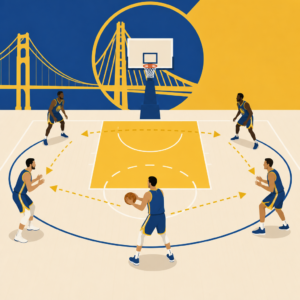

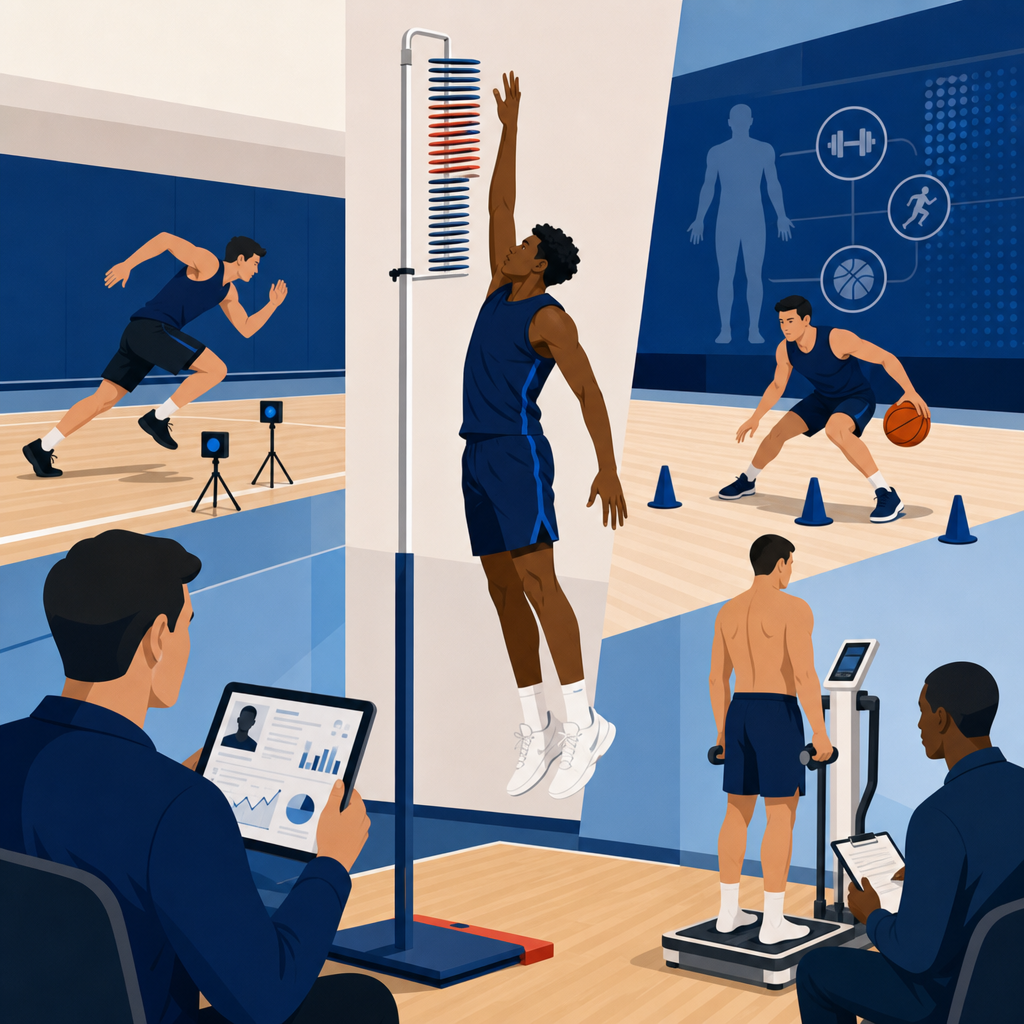
The NBA Draft Combine is the league’s centralized evaluation event where front offices measure prospects, test movement and athletic traits, review medical information, conduct interviews, and compare players in a controlled setting before the draft. For fans, it can look like a list of wingspans, vertical leaps, and sprint times. Inside team offices, it is a structured decision-making tool that helps scouts, executives, analytics staffs, and medical departments reduce uncertainty. It does not decide the draft by itself, but it changes conversations, sharpens projections, and often determines which questions still need answers before teams invest guaranteed money and roster spots.
When people ask what teams measure at the combine, they usually mean height, weight, hand size, standing reach, lane agility, shuttle run, three-quarter-court sprint, max vertical, and body fat estimates. Those numbers matter, but the combine is broader than a testing station. Teams also evaluate biomechanics, conditioning, reaction to coaching, competitiveness in scrimmages, shooting consistency in drills, and the professionalism a prospect shows in interviews. Medical examinations are especially influential because they can move a player up or down a board faster than a good jump test. In my experience following draft rooms and talking with evaluators, teams rarely ask whether one drill alone predicts NBA success. They ask whether the total profile supports a role, a development plan, and a risk assessment.
This matters because draft projections are probability exercises, not certainties. A lottery pick is not just a talented player; he is an expensive decision with opportunity cost. If a team misses on that pick, it can lose years of roster-building flexibility. The combine gives clubs standardized data points that help compare players from different leagues, tempos, and systems. It also helps explain why a productive college guard may project lower than expected, or why an unpolished wing with elite length and movement gets pushed up boards. To understand the combine is to understand how teams translate amateur production into professional projection.
What the NBA Draft Combine is designed to do
The combine exists to standardize information. College, G League, overtime programs, and international leagues all create different contexts. Pace varies, spacing varies, coaching varies, and competition quality varies. The combine gives teams a neutral setting where every invited player is measured under the same procedures and observed by the same group of decision-makers. That reduces noise. A front office can compare a 6-foot-2 lead guard from the SEC with a 6-foot-5 combo guard from France using the same anthropometric and athletic baseline rather than relying only on team-listed heights and uneven game samples.
Just as important, the combine helps teams test assumptions formed during the season. If scouts believe a wing plays bigger than his listed size, the measurements can confirm it. If analysts think a prospect struggles to create separation because of average burst, the sprint and agility testing can support or challenge that view. If coaches wonder whether a big man can survive in modern defensive schemes, movement patterns in drills and scrimmages provide more context. The event is not a replacement for full-season scouting, film study, or background work. It is a checkpoint that either validates earlier conclusions or forces a reevaluation.
Teams also use the combine to align departments. Traditional scouts may love a player’s competitiveness. Analytics models may flag weak steal rates or poor free throw indicators. Medical staffs may have concerns about feet, knees, or prior surgeries. The combine brings those conversations together in one place. That is why a player can “win” the combine in media coverage yet remain in the same draft tier internally. Public reaction often focuses on highlights and top-line numbers. Team reaction is driven by whether new information changes the expected value of selecting that player.
Physical measurements: the baseline for positional projection
Measurements are the first headline because they directly affect positional translation. Teams record height with and without shoes, weight, wingspan, standing reach, and hand dimensions. Those numbers matter because NBA roles are built around size thresholds. A guard with a plus wingspan may defend up a position. A center with limited standing reach may need exceptional timing to protect the rim. A wing who measured smaller than expected can lose some of the lineup flexibility teams had imagined. These are not cosmetic details. They affect matchups, finishing angles, passing windows, and defensive coverage options.
Wingspan and standing reach often matter more than casual fans realize. Wingspan helps explain deflections, recovery contests, and finishing extension. Standing reach can be even more important for rebounding and rim protection because it tells teams how high a player starts before he even jumps. For example, two forwards may both stand 6-foot-8, but if one has a significantly better standing reach, he may project better as a weak-side shot blocker and interior finisher. Hand size also gets attention, especially for ball security, one-hand passing, and finishing through contact, though teams generally treat it as supportive data rather than a single determinant.
Weight and frame are equally important. A prospect may have ideal length but still need years in an NBA strength program before holding up physically. Teams project not only the current body but the body’s capacity to add functional mass without losing mobility. That is one reason teenage prospects are judged differently from older players. Executives want to know whether a thin forward can become switchable rather than targetable, or whether a light center can absorb contact in drop coverage and on the glass. Measurement day gives teams the raw materials for those developmental forecasts.
Athletic testing: translating movement into NBA roles
Athletic testing aims to isolate explosive power, speed, and change of direction. The standard drills include the standing vertical jump, max vertical leap, lane agility drill, shuttle run, and three-quarter-court sprint. These are not perfect predictors of NBA performance, but they help teams describe a player’s movement profile in objective terms. A guard with an elite sprint time may pressure the rim and push pace. A wing with strong agility numbers may have a better chance to defend quick creators. A big with poor lateral testing may need a more conservative defensive scheme. The real value comes when the test results match or contradict what appears on film.
Vertical numbers are often misunderstood. A huge max vertical is impressive, but teams care more about how that explosiveness shows up functionally: second jumps, finishing in traffic, playing through contact, and contesting without fouling. Likewise, lane agility is useful, but it does not automatically mean a prospect can navigate screens or execute team defense. Basketball movement is reactive and decision-based. In combine meetings, coaches usually ask a more practical question: does this athlete have the movement tools required for the role we envision? That framing is why a merely good athlete with elite instincts can still out-project a testing star with inconsistent feel.
| Measurement or Test | What Teams Learn | Why It Matters for Projections |
|---|---|---|
| Height, wingspan, standing reach | True positional size and length | Shapes defensive versatility, finishing range, and lineup fit |
| Weight and frame | Current strength and growth capacity | Indicates readiness for physical NBA play and long-term body development |
| Standing and max vertical | Explosive power | Supports finishing, rebounding, rim contests, and vertical spacing |
| Lane agility and shuttle run | Change of direction and body control | Informs switchability, recovery ability, and perimeter survival |
| Three-quarter-court sprint | Straight-line speed | Helps project transition play, closeouts, and pace impact |
| Shooting drills | Mechanics, touch, and repeatability | Clarifies floor spacing potential and development priorities |
| Scrimmages and interviews | Decision-making, competitiveness, professionalism | Tests whether tools convert into dependable NBA habits |
Context is essential. Guards generally benefit more from burst and deceleration markers because separation creation is central to their role. Wings are often judged on broad movement versatility: can they open their hips, cover ground, and stay balanced through contact? Bigs are evaluated differently again. Teams care about vertical pop and mobility, but they also watch how efficiently a center moves, changes ends, and bends into defensive stances. This is why combine testing should always be tied to archetype. The same score can mean different things depending on whether the prospect is a point guard, a jumbo wing, or a rim-running five.
Shooting drills, scrimmages, and basketball skill context
The combine’s basketball portions matter because numbers without skill context can mislead. Shooting drills reveal footwork, release consistency, balance, and touch under repetition. Teams chart makes, but they also evaluate mechanics in detail: dip, elbow alignment, base width, shot preparation, and how cleanly a player transitions from movement into release. A prospect who shot poorly in college may help himself if evaluators see repeatable mechanics and soft touch that suggest future improvement. Conversely, a player with strong percentages can raise concerns if his form looks slow, rigid, or difficult to scale against NBA closeouts.
Scrimmages are especially valuable for fringe first-rounders, second-round candidates, and players whose tape comes with role uncertainty. In that setting, executives can watch who competes, who makes quick reads, who defends without the ball, and who adapts to unfamiliar teammates. Usage changes expose hidden strengths and weaknesses. A college scorer may struggle when he cannot dominate touches. A low-usage connector may suddenly look more dynamic when given on-ball reps. I have long thought scrimmages are most useful for identifying processing speed. NBA rotation players make fast, simple decisions repeatedly. The combine can reveal who sees the game early and who is still reacting late.
Still, teams are careful not to overreact to a small sample. One hot shooting day does not erase months of film, and one bad scrimmage does not make a player untalented. What teams want is supporting evidence. If the film says a wing is a smart team defender and the scrimmage confirms excellent rotations and communication, confidence rises. If the film says a guard is a shaky decision-maker and the scrimmage produces rushed reads and loose handle under pressure, concerns deepen. The combine works best when skill evaluation is layered on top of measurement and testing, not separated from it.
Medical reviews and interviews: often the most important part
Medical examinations can have more influence on draft order than any vertical jump. Teams review injury history, imaging, asymmetries, prior surgeries, and movement concerns that could affect durability or performance. The NBA season is long, dense, and physically punishing. A player with recurring foot issues, knee instability, or structural red flags may carry a lower projection even if his talent screams lottery. Front offices think in terms of availability curves and long-term asset protection. If the medical staff believes a prospect has elevated risk, that player may slide despite broad public enthusiasm.
Interviews matter because teams are drafting a worker as much as a player. Clubs want to know how a prospect learns, responds to criticism, handles adversity, studies film, and fits organizational culture. They ask about role acceptance, defensive principles, teammate relationships, and daily habits. Good interviews do not guarantee success, but they can clarify whether a player has the self-awareness and discipline needed for development. A prospect who can explain reads, coverages, and past mistakes in precise terms usually reassures coaches that he can absorb NBA teaching quickly.
This is also where background research becomes concrete. Teams cross-check what they heard all season from college staffs, trainers, agents, and opponents. If the interview confirms maturity and accountability, confidence grows. If answers feel rehearsed, evasive, or detached from the player’s actual tape, decision-makers notice immediately. In modern drafting, the gap between prospects is often smaller than public rankings suggest. When talent grades are close, medical confidence and interview quality can be the tie-breakers.
Why combine results change projections, and why they sometimes do not
Combine results change projections when they answer a major uncertainty tied to NBA role. If a scorer was considered too small for his listed position and then measures with exceptional length, teams may expand his defensive projection. If a forward looked stiff on film but tests better than expected and moves cleanly in drills, clubs may revisit his switchability. If a center posts poor movement numbers and struggles in live play, concerns about playoff viability can intensify. In each case, the combine moves the player because it affects translation, not because it creates excitement for its own sake.
But many results do not move the board very much. Elite college production, strong age-to-skill indicators, and years of proven feel usually outweigh one weekend of testing. Teams know the history here. Outstanding combine athletes have flamed out because they lacked decision-making, touch, or competitive consistency. Meanwhile, average testers with excellent processing and skill have become valuable starters. Think of how players such as Draymond Green, Jalen Brunson, and Malcolm Brogdon built NBA value through anticipation, strength, balance, and decision quality more than headline testing numbers. The league repeatedly rewards functional basketball ability over abstract athleticism.
For anyone following the NBA Draft, the right way to read combine news is to ask three questions. What specific concern did this result address? Does it fit the film? And does it materially change the player’s likely NBA role? That framework keeps projections grounded. The combine is meaningful because it sharpens probability, reveals hidden risk, and gives teams standardized evidence before the draft. Use it that way, and you will understand boards more clearly, spot overreactions faster, and evaluate prospects with the same disciplined lens NBA teams use every June.
Frequently Asked Questions
What is the NBA Draft Combine, and what is its main purpose?
The NBA Draft Combine is the league’s centralized pre-draft evaluation event, designed to give teams a consistent, controlled environment to assess prospects before draft night. Instead of relying only on college film, international scouting trips, pro day workouts, or secondhand reports, front offices get a shared set of measurements, testing data, medical evaluations, interviews, and on-court observations. That standardization matters because it helps teams compare players across different levels of competition, roles, and playing styles.
At a basic level, the combine measures physical dimensions such as height, weight, wingspan, standing reach, and hand size. It also evaluates movement and athletic traits through drills that can include lane agility, sprint testing, shuttle work, and vertical jump measurements. Beyond that, teams pay close attention to medical information, body composition, functional movement, and how a player responds in interviews. Some years also include scrimmages, which give teams a live setting to watch prospects make decisions, compete, communicate, and adapt.
The main purpose is not to produce a single definitive ranking. It is to reduce uncertainty. Teams want to know whether a prospect’s listed size is accurate, whether athletic flashes on film show up in testing, whether there are medical concerns that could affect long-term value, and whether the player has the maturity and basketball intelligence to handle an NBA environment. In that sense, the combine is best understood as a decision-making tool. It does not determine a player’s future on its own, but it gives teams more reliable information as they build projections and weigh risk against upside.
What specific measurements and tests do NBA teams focus on at the combine?
Teams start with the physical profile because size remains one of the easiest traits to verify and one of the hardest to teach. Height without shoes, weight, wingspan, and standing reach are especially important because they help define how a prospect may fit positionally. A long wingspan can improve defensive versatility, rebounding range, finishing angles, and shot disruption. Standing reach can be especially useful for projecting interior defense and finishing at the rim. Hand size can matter for ball control, catching in traffic, and shot comfort, even if it is only one piece of the overall picture.
Athletic testing gives teams another layer of context. Vertical jump results can indicate lower-body explosiveness, which matters for rim finishing, shot blocking, and rebounding pop. Sprint and shuttle times can help illustrate straight-line speed, acceleration, deceleration, and change-of-direction ability. Lane agility drills are often used to get a rough sense of mobility, balance, and body control. Teams do not treat these numbers as perfect replicas of basketball movement, but they do view them as useful markers, especially when paired with film.
Movement screening and medical review are often just as important as the more publicized drills. Teams want to understand flexibility, joint stability, asymmetries, prior injuries, and anything that could affect durability or developmental timelines. A player with intriguing upside may be evaluated very differently if medical information introduces long-term risk. Interviews also rank near the top of the list. Front offices want to hear how players process the game, discuss their role, respond to adversity, and present themselves professionally. For many organizations, the combine is less about finding one magic number and more about building a complete profile from measurable traits, movement quality, health status, and mental approach.
Why do combine results matter so much for NBA draft projections?
Combine results matter because draft projections are built on incomplete information. Prospects come from very different systems and competition levels, and their roles often shape how they are perceived. One player may have been asked to create everything on offense, while another may have been boxed into a limited role that hid some of his real skill. The combine helps teams create cleaner comparisons. If a player measures bigger than expected, moves better than expected, or shows more explosiveness than the film suggested, that can affect how teams think about his NBA position, defensive ceiling, or developmental runway.
These results also matter because projections are really about probability. A front office is asking how likely it is that a player can survive defensively, scale offensively, stay healthy, and eventually outperform his draft slot. Physical dimensions and athletic traits can meaningfully change those calculations. For example, a guard with surprising length may be viewed as more switchable. A forward whose mobility tests well may project more cleanly into pace-and-space schemes. A center with a strong standing reach and good vertical numbers may look more viable as a rim protector even if his college block totals were modest.
At the same time, smart teams are careful not to overreact. Great testing can raise interest, but it does not automatically override years of game film. Poor testing can create questions, but it does not erase production, feel, skill, or toughness. What matters most is how the results fit the broader scouting picture. The combine influences projections because it sharpens or challenges prior assumptions. When the numbers align with the tape, confidence grows. When they conflict, teams dig deeper to decide whether they found hidden upside, exposed a limitation, or simply captured a result that may not translate fully to real NBA basketball.
How do teams use interviews and medical evaluations at the combine?
Interviews and medical evaluations are often among the most influential parts of the combine because they address areas that box scores and highlights cannot. In interviews, teams are trying to understand the person behind the prospect. They want to learn how a player sees the game, how coachable he is, how seriously he takes preparation, and how he handles pressure, criticism, and role changes. Executives and scouts may ask about specific possessions from film, team concepts, defensive coverages, shot selection, or career goals. The purpose is not just to test memory. It is to evaluate processing speed, accountability, self-awareness, and communication.
Those conversations can shape how teams think about development. A player with clear strengths but raw decision-making may feel more draftable if he shows strong work habits and high basketball intelligence. A talented prospect may raise concerns if he struggles to explain his role, deflects responsibility, or gives teams little confidence that he will embrace coaching. In a league where many draft picks need years of development, mental makeup matters. Teams are not only drafting tools. They are drafting someone who must absorb coaching, adapt to systems, and navigate the demands of a professional environment.
Medical evaluations are equally significant because availability is a core part of player value. Team doctors and performance staffs review injury history, conduct exams, and assess whether there are structural or chronic concerns that could affect durability. Even a highly talented prospect may drop if multiple teams view the medical outlook as risky. Conversely, a player whose health was questioned during the season may calm concerns if the combine process provides reassuring information. For front offices, medical data helps determine not only whether a player can stay on the floor, but also how quickly he can develop, how much physical growth is realistic, and what kind of long-term investment makes sense. In many cases, these behind-the-scenes findings have more impact on draft boards than the public testing numbers fans tend to focus on.
Can a strong or weak combine performance significantly change where a player gets drafted?
Yes, but usually not in the simplistic way people imagine. The combine rarely turns a completely unknown player into a top pick on testing alone, and it rarely destroys the stock of a proven elite talent just because one drill went poorly. What it can do is move players within tiers, strengthen or weaken existing beliefs, and create momentum in a range where teams are already sorting through close evaluations. For prospects in the middle of the first round, late first, or second round, a good combine can be especially valuable because small differences in confidence level can affect whether a team is willing to invest guaranteed money or use a premium selection.
A strong combine performance can help in several ways. Accurate or favorable measurements may confirm that a prospect can defend a bigger position or survive physically in the NBA. Better-than-expected movement testing can support the case that a player has untapped defensive or transition upside. Solid interviews can reassure teams that the player understands his strengths, accepts coaching, and is prepared for the professional jump. Good scrimmage play, when available, can also matter because it lets teams see competitiveness, pace, shot selection, and adaptability in a setting closer to NBA talent than some prospects experienced during their previous season.
A weak combine can have an effect too, especially when it confirms existing concerns. If a player measures smaller than expected, lacks burst, performs poorly in movement testing, or raises medical red flags, teams may lower his projection or narrow the types of lineups and schemes they believe he can fit. Still, context is everything. The most disciplined organizations do not chase combine winners or panic over combine losers without checking those impressions against full-season film, role context, age, skill level, production, and long-term developmental indicators. In practical terms, the combine matters most when it helps teams make better distinctions between similarly graded prospects. It is a powerful part of the draft process, but its real value comes from informing the projection, not replacing it.