
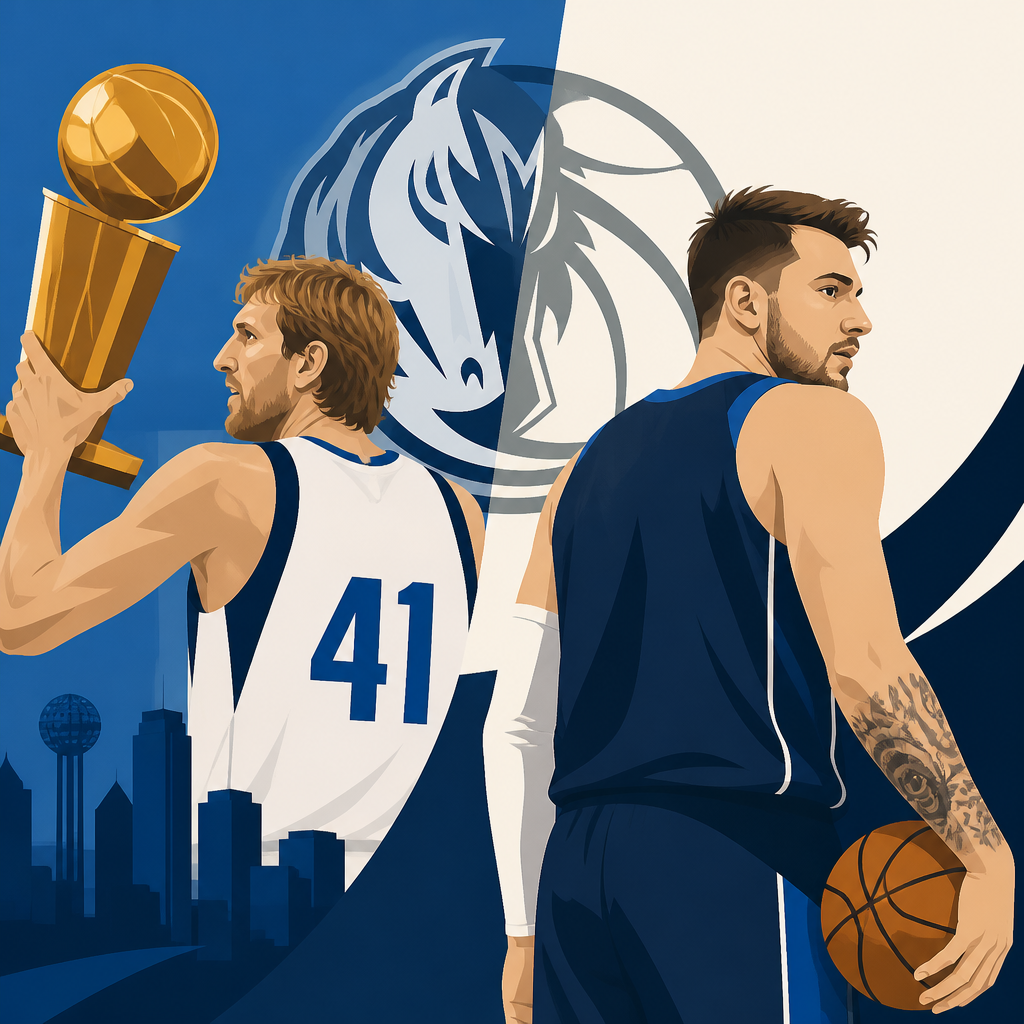
The Dallas Mavericks occupy a distinctive place in NBA history because their story bridges two sharply defined eras: the patient, internationally flavored rise built around Dirk Nowitzki and the fast-moving, heliocentric offense driven by Luka Doncic. For readers exploring team histories, the Mavericks offer one of the clearest examples of how a franchise can reinvent itself without losing identity. They have been contenders, rebuilders, innovators, and cautionary tales, sometimes within the same decade. That mix makes Dallas a valuable hub topic for understanding how NBA teams evolve across ownership changes, coaching philosophies, roster construction cycles, and shifting league economics.
Founded in 1980, the Mavericks entered a crowded basketball landscape but quickly became relevant through smart drafting, energetic ownership groups, and a willingness to embrace European talent before much of the league fully understood its value. Team history, in this context, means more than a list of playoff appearances. It includes front-office decisions, salary cap bets, cultural turning points, and the stars who set the tone for everything that followed. When people ask what defines Dallas, the answer usually starts with two names. Dirk established the franchise as a serious championship operation. Luka has made it one of the NBA’s most watched and most debated teams.
This history matters because the Mavericks often mirrored bigger league trends before others did. They leaned into spacing and skill with Dirk long before every offense hunted stretch bigs. They internationalized their talent pipeline earlier than many rivals. More recently, they built around a primary creator in a way that reflects modern star-centric basketball, where one elite decision-maker can control every possession. I have covered and analyzed Dallas through both phases, and the through line is unmistakable: when the franchise succeeds, it aligns roster construction, coaching, and pace of play around a singular player’s strengths rather than forcing stars into generic systems.
For fans researching NBA team histories, Dallas also works as a practical hub because nearly every major franchise question appears somewhere in its timeline. How much should a team prioritize continuity after a title? Can an owner’s public personality help and hurt at the same time? What is the right way to rebuild around a transcendent young star? Why do some Finals runs become permanent identity markers while others fade? The Mavericks give direct answers. Their 2011 championship remains one of the most respected title runs in league history, while the years between Dirk’s decline and Luka’s ascendance show how hard succession planning really is.
Expansion roots, early promise, and the search for a true franchise identity
The Mavericks joined the NBA as an expansion team in 1980 and became competitive faster than many new franchises. Under coach Dick Motta and with players such as Rolando Blackman, Mark Aguirre, Derek Harper, Sam Perkins, and later Roy Tarpley, Dallas reached the playoffs in the 1980s and even pushed the Los Angeles Lakers to seven games in the 1988 Western Conference Finals. That mattered because it gave the franchise early credibility. Dallas was not simply filling dates on the schedule; it was building a basketball audience in a football-dominant market and proving that the team could draft and develop serious talent.
Still, the first Mavericks era stopped short of championship level. Talent was real, but the organization lacked the durable superstar engine that the best franchises usually have. The 1990s exposed that gap brutally. Dallas cycled through losing seasons, front-office instability, and failed roster experiments. The low point was not just the record; it was the absence of direction. In team history terms, this period is essential because it explains why later Dallas leadership became so aggressive. Franchises that have lived through irrelevance rarely forget it, and the Mavericks’ later appetite for bold moves came directly from those years.
The turnaround began with the drafting and acquisition sequence that formed the “Big Three” of Dirk Nowitzki, Steve Nash, and Michael Finley. Don Nelson’s influence was enormous. He embraced skill over convention, trusted unconventional lineups, and saw possibilities in European players that many executives still undervalued. Dirk, acquired in a 1998 draft-night deal with Milwaukee after being selected ninth overall, was initially viewed as a project. Within a few years, he became the organizational axis. The Mavericks’ modern identity starts there: offensive creativity, international scouting confidence, and a willingness to build around a uniquely skilled star rather than a traditional interior bruiser.
Dirk Nowitzki changed everything for the Dallas Mavericks
Dirk Nowitzki did more than become the best player in franchise history. He changed what teams believed a seven-footer could be. At 7 feet tall, with elite shooting touch, one-legged fadeaway mastery, and unusually clean footwork, he forced defenses into impossible choices. Big defenders struggled to close space on the perimeter. Smaller defenders could not contest his release point or survive in the post. Before the league’s full stretch-big revolution, Dallas was already exploiting the geometry that Dirk created. That made the Mavericks one of the NBA’s most influential offensive teams of the 2000s.
Dirk’s impact on Dallas culture was just as important. He stayed through disappointments, conditioning demands, coaching changes, and roster resets. His loyalty created long-term stability, but it never felt passive. Inside the league, he earned respect for constant refinement. Every offseason seemed to bring a new counter: tighter handle, better balance, quicker face-up attack, improved passing reads out of doubles. That development arc matters when telling Mavericks history because the franchise was not built only on transactions. It was built on a superstar who elevated standards and accepted organizational pressure without making the drama bigger than the basketball.
Results followed. Dallas became a perennial 50-win team, reached the 2003 Western Conference Finals, and advanced to the 2006 NBA Finals. That 2006 run should not be overshadowed by what happened five years later. Beating San Antonio and Phoenix showed Dallas could survive multiple styles and hostile environments. But the Finals loss to Miami, after leading the series 2-0, became a scar. Then came the 2007 season, when the Mavericks won 67 games and Dirk earned MVP honors, only for Dallas to lose in the first round to Golden State. Fairly or not, those failures shaped the narrative around Dirk for years.
The 2011 championship run remains the franchise standard
The 2011 title run is the central chapter of Dallas Mavericks history because it combined star brilliance, elite role definition, and perfect timing. Dallas did not enter the playoffs as an overwhelming favorite. The roster was older and, in some national coverage, treated as vulnerable. Yet that veteran profile became a strength. Rick Carlisle coached with calm precision, the offense trusted spacing and shotmaking, and the defense executed detailed coverages possession after possession. This was not a lucky run. It was a disciplined championship built on matchup intelligence and emotional resilience.
Dallas beat Portland in the first round, swept the defending champion Lakers in the second, defeated the young Thunder in the Western Conference Finals, and then overcame Miami’s newly formed superteam in six games. Each series answered a different question. Could Dallas handle shot creation under pressure? Yes, through Dirk, Jason Terry, and J.J. Barea. Could it defend size and stars? Yes, with Tyson Chandler’s rim protection, Shawn Marion’s versatility, and collective rotations. Could it keep poise after losses? Absolutely. The Finals, especially, turned on execution late in games and the Mavericks’ refusal to panic when Miami’s athleticism spiked the pressure.
| 2011 Playoff Round | Opponent | Series Result | Why It Mattered |
|---|---|---|---|
| First Round | Portland Trail Blazers | Dallas won 4-2 | Overcame a blown lead in Game 4 and showed mental toughness |
| Semifinals | Los Angeles Lakers | Dallas won 4-0 | Swept the two-time champions and announced real title credibility |
| Conference Finals | Oklahoma City Thunder | Dallas won 4-1 | Handled rising athletic stars with experience and half-court control |
| NBA Finals | Miami Heat | Dallas won 4-2 | Defeated a superteam and secured the franchise’s first championship |
Dirk’s individual performance remains iconic, but the deeper lesson of 2011 is roster balance. Chandler gave the team a defensive spine. Jason Kidd organized possessions and defended bigger players intelligently. Terry supplied bench scoring with starter-level shotmaking. Barea changed pace in ways defenses hated. Marion filled every gap. Peja Stojakovic added spacing. Carlisle maximized all of it. When people ask why this championship is still celebrated so intensely, the answer is simple: it validated Dirk, rewarded patient team-building, and delivered one of the strongest postseason paths any champion has taken this century.
After the title: difficult choices, aging rosters, and the long bridge years
The Mavericks did not defend their title in the conventional way, and that decision remains one of the most debated in franchise history. Rather than keeping the championship core intact at almost any cost, Dallas prioritized future flexibility. Tyson Chandler departed. The front office repeatedly chased major free agents, trying to pair Dirk with another star while preserving cap room. In theory, the logic had merit under the collective bargaining system. In practice, missed pursuits and short-term signings created roster churn. The team stayed competitive at times, but it no longer had the two-way identity that defined the 2011 group.
These post-title seasons are important because they show how narrow championship windows can be. Dallas still had Dirk, still had respected coaching, and still had owner Mark Cuban’s willingness to spend. Yet continuity matters in the NBA, especially on defense. From 2012 through the late 2010s, the Mavericks produced capable offenses but often lacked the athleticism, rim pressure, or perimeter resistance needed to survive multiple playoff rounds. There were worthwhile moments, including a 49-win season in 2014 and a playoff push built around veteran contributors, but the franchise was clearly moving toward transition.
Dirk’s late-career years also cemented his symbolic role. Even as his mobility declined, his professionalism stayed central to the organization. Younger players learned habits from him, and fans continued to connect the team to his humility and consistency. That matters historically because not every franchise legend ages alongside the team with grace. Dirk did, and that softened the difficult reality that Dallas needed a successor. The key challenge was finding a new primary engine without falling into the prolonged mediocrity that traps many teams after a beloved star exits his prime.
Luka Doncic and the beginning of a new Mavericks era
The arrival of Luka Doncic solved the successor problem faster than anyone could reasonably expect. Acquired in a 2018 draft-night trade after being selected third overall by Atlanta, Doncic entered the league with one of the strongest pre-NBA résumés in modern history. He had already been a EuroLeague champion, EuroLeague MVP, and the best player on a Real Madrid team facing grown professionals. That background mattered. Luka was not adjusting from potential to possibility; he was translating proven high-level creation into the NBA. Dallas recognized that faster than many observers did.
From his rookie season onward, Luka gave the Mavericks a complete offensive identity. He controls pace, manipulates pick-and-roll coverages, punishes switches in the post, and creates efficient threes and rim attempts through timing rather than pure speed. In modern terms, Dallas built around a heliocentric creator, meaning the offense flows overwhelmingly through one player’s decisions. That model can produce elite regular-season efficiency, and it has. The challenge is building enough defense, secondary creation, and off-ball shooting around the star so playoff opponents cannot wear down the system over a seven-game series.
Dallas has tested multiple versions of that formula. Kristaps Porzingis represented the first major co-star bet, offering theoretical rim protection and floor spacing, but health and fit issues limited the partnership. Jalen Brunson’s development gave Dallas another playmaker, though his eventual departure to New York hurt. The trade for Kyrie Irving added one of the league’s most gifted shot creators and improved late-game scoring optionality. The 2024 Finals run, powered by Luka, Kyrie, improved rim protection, and cleaner role definition, suggested the franchise may have found a more sustainable roster framework than some earlier iterations.
What defines Mavericks team history today
Several themes now define the Dallas Mavericks within the broader NBA Teams conversation. First, stars shape eras more than logos do. Dallas before Dirk, Dallas with Dirk, and Dallas with Luka are meaningfully different basketball identities. Second, innovation matters when it is matched with personnel conviction. The Mavericks succeeded most when they saw value earlier than the market, whether in international scouting, stretch shooting, or creator-centered offense. Third, culture is real, but only when talent supports it. Stability from Cuban, Nelson, Carlisle, and then newer leadership structures mattered, yet the decisive factor was always elite on-court engine talent.
For readers using this page as a team histories hub, the Mavericks also connect naturally to deeper topics: the franchise’s expansion origins, the Nelson-Nash-Finley-Dirk transformation, the 2006 Finals collapse, the 2007 upset, the anatomy of the 2011 championship, post-title cap strategy, Dirk’s retirement legacy, and Luka’s evolving co-star ecosystem. Each subtopic reveals something larger about NBA history. Dallas is not merely a single championship team or a one-player franchise. It is a case study in adaptation, regret, vision, and renewal. Few teams better illustrate how fast the league changes and how enduring true superstar impact can be.
The clearest takeaway is that the Dallas Mavericks built one lasting legacy and are actively trying to build another. Dirk Nowitzki’s 2011 run gave the franchise its defining triumph and one of basketball’s most respected championship stories. Luka Doncic’s era has already restored relevance, national attention, and contender-level expectations. Between those poles lies the full team history: expansion ambition, early playoff promise, superstar development, painful setbacks, smart innovations, and the constant pressure to align roster decisions with a generational talent’s timeline.
If you are mapping NBA team histories, Dallas deserves close study because its past explains its present so well. The Mavericks show how a franchise can recover from lean years, maximize an unconventional superstar, misjudge a title window, and still find its way back through elite scouting and bold trades. Use this hub as your starting point, then explore each Mavericks era in detail to understand how championship identity is built, challenged, and renewed.
Frequently Asked Questions
Why is the Dallas Mavericks’ 2011 championship run considered one of the most remarkable title runs in NBA history?
The Mavericks’ 2011 championship is remembered so vividly because it combined timing, resilience, and star-level brilliance in a way that felt both unlikely and deeply earned. Dallas did not enter that postseason as the league’s most hyped team, and in many ways the roster reflected an older-school contender built on experience, chemistry, and matchup intelligence rather than overwhelming athletic dominance. Dirk Nowitzki was the centerpiece, but this was not a one-man miracle. The Mavericks won with elite shot-making, disciplined half-court execution, strong defensive game planning, and a veteran supporting cast that understood exactly how to adjust from series to series.
What made the run historic was the quality of the opponents. Dallas defeated a Portland team that was tougher than its record suggested, then swept the two-time defending champion Los Angeles Lakers, which immediately signaled that this was not a fluke run. After that, the Mavericks beat the rising Oklahoma City Thunder, a team led by Kevin Durant, Russell Westbrook, and James Harden, before taking down the Miami Heat in the Finals. That Heat team, with LeBron James, Dwyane Wade, and Chris Bosh, had become the defining villain and headline act of the season. Beating them gave the title a mythic quality.
Dirk’s individual performance elevated the run even further. He was already recognized as one of the greatest offensive players in league history, but 2011 transformed his legacy from all-time great scorer to unquestioned champion. He played through illness, delivered relentlessly in clutch moments, and showcased a style that was almost impossible to defend: high-release jumpers, one-legged fadeaways, and patient footwork that punished every type of defender. In historical terms, the 2011 title stands out because it validated long-term team building, rewarded perseverance after years of playoff disappointment, and gave the Mavericks a championship that remains one of the NBA’s clearest examples of a veteran group peaking at exactly the right moment.
How did Dirk Nowitzki change the identity of the Mavericks and the NBA as a whole?
Dirk Nowitzki changed the Mavericks by giving the franchise a stable, world-class identity for more than two decades. Before his rise, Dallas had moments of relevance, but it did not have the sustained credibility of the league’s signature organizations. Dirk gave the Mavericks consistency, legitimacy, and a style that stood apart from many of their rivals. He was a seven-footer with guard-like touch, a devastating outside shot, and a calm, understated leadership style. That combination made Dallas both unconventional and extremely difficult to prepare for. As the franchise built around him, the Mavericks became a perennial playoff team and a model of how international talent could be at the center of an NBA contender.
His impact on the broader NBA was just as significant. Dirk helped normalize the idea that a franchise player could come from outside the traditional American basketball pipeline and still become the face of a contender. While international stars existed before him, he became one of the clearest proof points that global scouting was no longer optional for serious organizations. He also expanded the definition of what a big man could be. Long before floor-spacing became the league’s default offensive philosophy, Dirk was punishing defenses with perimeter shooting, mid-post scoring, and movement that forced centers away from the basket. He did not merely fit into the evolution of the modern NBA; he helped accelerate it.
Just as important was the cultural effect he had on the Mavericks. Dirk’s loyalty, professionalism, and willingness to carry both praise and blame made him the ideal franchise cornerstone. He was not loud, but he was deeply respected, and that set a tone for the organization. Even when Dallas made imperfect roster decisions or struggled to sustain championship-level momentum after 2011, Dirk remained the connective tissue between ambition and identity. His era taught fans to expect relevance, smart offense, and international influence, all of which continue to shape how the Mavericks are viewed in the Luka Doncic era.
What defines the transition from the Dirk era to the Luka Doncic era for the Mavericks?
The transition from Dirk Nowitzki to Luka Doncic is one of the more fascinating generational handoffs in modern NBA history because it preserved the Mavericks’ star-driven identity while dramatically changing the style of play. Dirk’s teams often relied on balance, spacing, veteran composure, and carefully structured half-court offense built around his scoring gravity. Luka’s teams, by contrast, have leaned more heavily into a heliocentric model, where one elite playmaker controls the tempo, decision-making, and shot creation for nearly every possession. In both eras, the offense runs through a singular offensive genius, but the mechanics and rhythm are very different.
There is also a symbolic dimension to this transition. Dirk represented the patient rise of an international superstar who developed over years into an MVP and champion. Luka arrived with extraordinary hype, immediate production, and a style that already looked tailored for the modern NBA. That made the handoff feel less like a rebuild from scratch and more like a reinvention of the same core idea: Dallas as a franchise defined by an elite, internationally rooted offensive engine. Few teams have moved from one generational offensive talent to another so cleanly, especially with both stars carrying such distinctive global appeal.
At the same time, the differences matter. Dirk’s prime coincided with an NBA that still featured more traditional positional roles and less extreme pace-and-space architecture. Luka’s era exists in a league built around spread pick-and-roll, switch hunting, efficiency math, and constant playoff matchup targeting. That means Dallas has had to rethink roster building, defensive schemes, and supporting-cast priorities. The continuity lies in the franchise’s willingness to trust a unique superstar. The change lies in how the Mavericks must build around that superstar to compete in a faster, more perimeter-oriented, and more analytically optimized league.
How has Luka Doncic reshaped the Mavericks’ present and future?
Luka Doncic has reshaped the Mavericks by raising both their ceiling and their urgency. From the moment he emerged as an All-NBA-level force, Dallas was no longer operating on a distant rebuilding timeline. The franchise immediately had a centerpiece capable of carrying an elite offense, controlling playoff games, and drawing the kind of attention reserved for the league’s most important stars. Luka’s game is built on pace manipulation, elite vision, strength, touch, and an unusual ability to create efficient offense without relying on overwhelming speed. He can score at all three levels, punish mismatches, and generate quality looks for teammates on nearly every trip down the floor.
That level of offensive control changes everything about team construction. When a player is this ball-dominant and this productive, the front office has to prioritize fit with unusual precision. The Mavericks need shooting, secondary playmaking, screen-setting, perimeter defense, and enough size and versatility to survive postseason adjustments. Luka makes many lineups functional simply by existing, but that can mask deeper roster flaws during the regular season. In the playoffs, those flaws become much harder to hide. As a result, the franchise’s future is tied not just to Luka’s greatness, but to whether Dallas can consistently surround him with the right two-way talent.
He has also transformed the franchise commercially and culturally. Luka gives Dallas relevance across generations of fans and across international markets, much as Dirk once did in a different way. He creates nightly highlights, national attention, and long-term hope, but he also raises expectations. The standard is no longer simply making the postseason; it is contending in a conference full of elite competition. That is why the Luka era feels both exciting and demanding. He has already made the Mavericks matter at the highest level of NBA conversation. The next challenge is turning that relevance into sustained championship pressure.
What has allowed the Mavericks to reinvent themselves without completely losing their identity?
The Mavericks have managed to reinvent themselves because their identity has never been tied to just one system, one front-office trend, or one short competitive window. Instead, their identity has been built around a few durable themes: trusting singular offensive talent, embracing international influence, valuing basketball intelligence, and staying willing to adapt. That flexibility has allowed Dallas to move from the Dirk era to the Luka era without feeling like an entirely different franchise. The details changed, but the underlying philosophy remained recognizable.
Another reason is organizational memory. Dirk’s presence established a cultural baseline centered on professionalism, star accountability, and offensive sophistication. Even after his prime, that legacy continued to shape expectations around the team. When Luka became the next foundational star, he entered an environment where the franchise already understood the responsibilities and opportunities that come with building around a unique international talent. That continuity matters more than it might seem. It affects how the team communicates its vision, how fans understand the franchise, and how the Mavericks position themselves in the league’s broader story.
Of course, reinvention has not always been smooth. The Mavericks have had stretches where roster decisions backfired, where they hovered between contention and transition, and where their long-term planning looked uncertain. That is part of their story too. They have been contenders, rebuilders, innovators, and cautionary examples at different moments, sometimes in very short order. But that complexity is exactly what makes the franchise so compelling. The Mavericks’ identity is not about static tradition; it is about evolving around extraordinary talent