
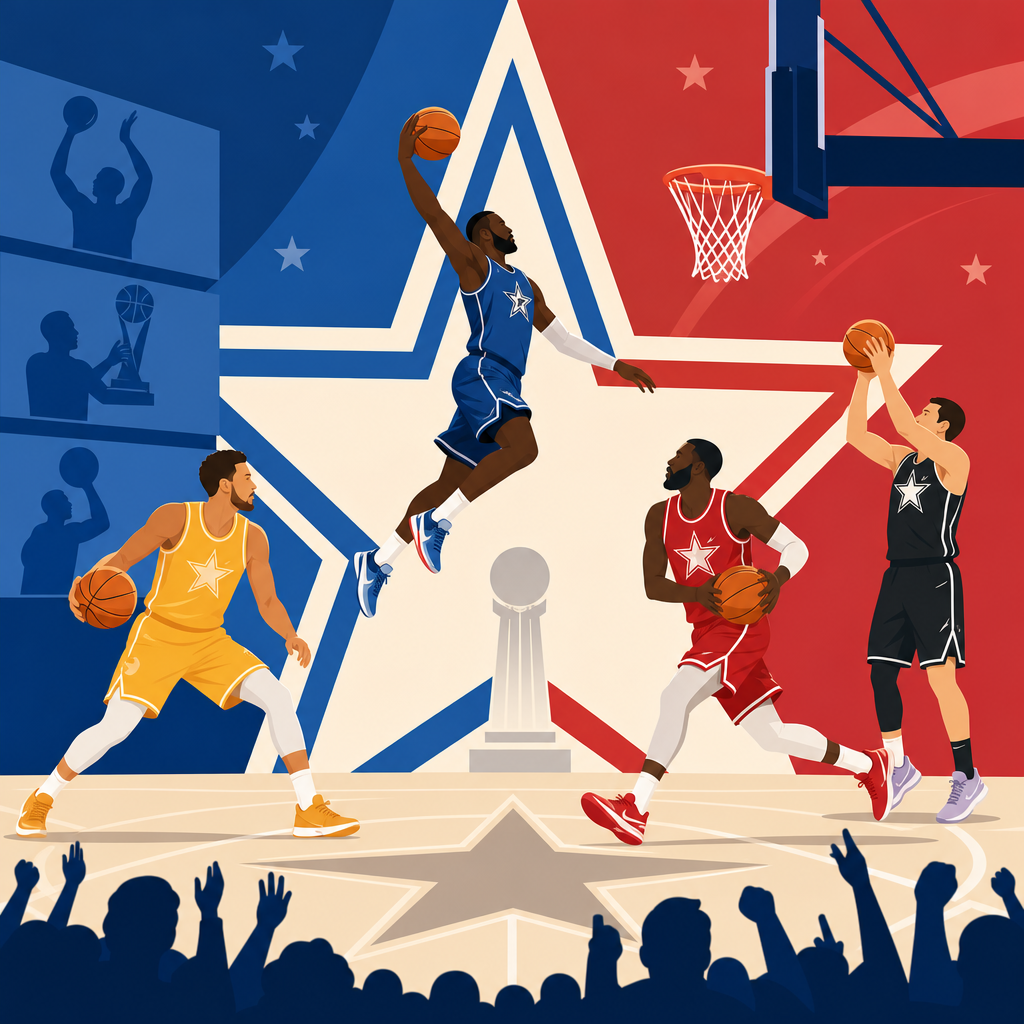
The NBA All-Star Game history mirrors the league itself: flashy, competitive, commercial, experimental, and constantly reshaped by what fans, players, and television partners want from basketball’s biggest exhibition night. In simple terms, the All-Star Game is the NBA’s annual showcase featuring selected star players, while All-Star Weekend includes the Skills Challenge, Three-Point Contest, Slam Dunk Contest, Rising Stars events, and related community programs. As someone who has followed league history through box scores, archival broadcasts, CBA shifts, and rules changes, I can say few events reveal the NBA’s priorities more clearly than this one. It is where player popularity, league marketing, media economics, and competitive integrity all collide. Understanding why the All-Star format keeps changing helps explain broader NBA history, from the rise of television and global branding to load management debates and the modern struggle to keep exhibitions meaningful without turning them into regular-season games.
The All-Star Game matters because it has never been just a single contest. It has served as a barometer for which stars define an era, how the league sells itself, and what fans expect from elite talent in a made-for-entertainment setting. George Mikan gave the early event legitimacy in the 1950s. Julius Erving, Larry Bird, Magic Johnson, Michael Jordan, Kobe Bryant, LeBron James, Stephen Curry, and many others used the stage to cement cultural status beyond ordinary standings. The event has also reflected practical pressures. When defense disappeared, the NBA adjusted rules. When conference imbalance made lineups uneven, the league tried captain drafts. When fourth quarters became unwatchable, it adopted the target-score ending. If you want one hub page to understand league history through a recurring annual event, the NBA All-Star Game is ideal because every major basketball era leaves a visible mark on its format, intensity, and signature moments.
How the NBA All-Star Game began and what it was designed to do
The first NBA All-Star Game took place on March 2, 1951, in Boston Garden. The league was still fighting for relevance, attendance, and media attention, and the concept borrowed from baseball’s successful all-star model. NBA publicity director Haskell Cohen is widely credited with pushing the idea after college basketball’s point-shaving scandal damaged fan confidence in the sport more broadly. Boston Celtics owner Walter Brown backed the plan and reportedly guaranteed against financial loss. That decision mattered. The inaugural game drew a strong crowd and proved professional basketball could package its biggest names into a national attraction.
From the start, the game served two purposes. First, it rewarded star players selected by media, coaches, and later fans under evolving voting systems. Second, it gave the NBA a concentrated marketing event in the middle of the season, when storylines can sag. Early editions were more competitive than many modern viewers assume. Players took pride in peer recognition, and the talent pool was smaller, which meant the best players shared more direct rivalry. The East versus West structure, eventually formalized around conference identity, gave fans an easy frame. Even in its earliest years, the All-Star Game was part celebration, part branding exercise, and part proof that the NBA belonged on the major American sports calendar.
The best moments in NBA All-Star Game history
Several moments stand above the rest because they capture both basketball excellence and the wider story of the league. In 1964, the players threatened to strike before the game unless owners recognized their concerns on pensions and working conditions. They relented only after receiving assurances, making that All-Star Game a turning point in labor history. It showed that the event’s visibility gave players unusual leverage. In 1988, Michael Jordan and Dominique Wilkins turned All-Star Weekend in Chicago into a defining dunk contest duel, and Jordan’s presence elevated the game itself into a global showcase for star power. In 1992, Magic Johnson, recently retired after announcing he was HIV-positive, returned to win MVP in Orlando. His fourth-quarter shot-making remains one of the most emotional moments in league history.
The 2001 game in Washington, D.C., deserves more attention than it usually gets. The East erased a 21-point fourth-quarter deficit behind Allen Iverson and Stephon Marbury, creating one of the rare genuinely intense All-Star finishes of the era. In 2003, Michael Jordan’s final All-Star appearance nearly ended with a classic game-winner before Kobe Bryant tied the game with free throws. In 2009, Phoenix hosted one of the most offense-heavy modern examples, illustrating how pace-and-space values were creeping into the exhibition before they fully transformed regular NBA play. Then came 2020 in Chicago, perhaps the clearest proof that format changes can restore stakes. The target-score ending produced a defense-first final quarter, Kyle Lowry taking charges, LeBron and Giannis lineups trading half-court possessions, and Anthony Davis sealing a game that felt dramatically different from the free-flowing first three quarters.
Memorable moments are not limited to the final score. Kobe Bryant’s four All-Star MVP awards tied Bob Pettit for the record before the trophy itself was renamed in Kobe’s honor in 2020. Shaquille O’Neal and Kobe sharing MVP in 2009 carried symbolism given their history. Wilt Chamberlain’s dominance, Oscar Robertson’s all-around command, and Bob Cousy’s early playmaking all helped establish the event’s mythology. More recently, Stephen Curry’s deep shooting in Cleveland in 2022, when he made 16 three-pointers and scored 50, perfectly expressed the modern NBA’s geometry. The best All-Star moments work because they do two jobs at once: they entertain in isolation and they summarize the style, celebrity, and tensions of their basketball era.
Why the format keeps changing
The simplest answer is that the NBA All-Star Game changes because the league is trying to solve a recurring problem: how do you keep elite players healthy and willing to perform while still giving fans a contest worth watching? Every major format change comes from that tension. The original conference setup was stable for decades because it was easy to understand and fit league structure. But as player empowerment grew, sports science advanced, and regular-season workloads came under greater scrutiny, stars became less willing to risk injury in a pure exhibition. At the same time, television audiences and social media culture increased pressure for highlights and dramatic endings.
When traditional East versus West games became too predictable or sluggish, the NBA introduced captain-led drafts in 2018. The idea was practical, not cosmetic. Drafted rosters reduced conference imbalance and created fresh combinations that fans would not usually see. It also generated extra programming value through televised draft content and debate over selections. The next major shift came in 2020 with the untimed fourth quarter and target-score ending, often called the Elam Ending after Nick Elam’s concept. That change addressed a specific issue: dead final minutes caused by loose defense and clock-draining possessions. By removing the game clock in the fourth quarter and setting a target based on the leading team’s total plus 24 points, the NBA created urgency on every possession.
Changes have also been driven by external factors. Television partners want competitive windows that retain viewers. Sponsors want stars visible and engaged. Players want recognition without unnecessary injury risk. Fans want effort, but not at the cost of a regular-season absence in March. The league’s recent experiments, including shifts in scoring incentives, draft procedures, and game presentation, all reflect those competing demands. The format keeps changing because there is no permanent solution. Exhibition basketball at this level is always negotiating between authenticity and preservation.
Major NBA All-Star Game format eras at a glance
Looking across league history, the event falls into distinct eras shaped by rules, media, and player behavior. This overview shows why no single version lasted forever.
| Era | Main Format | Why It Worked | Why It Changed |
|---|---|---|---|
| 1951 to late 1970s | Traditional all-star exhibition with stronger rivalry feel | Smaller league, high player pride, novelty value | League growth and changing incentives softened intensity |
| 1980s to early 2000s | East vs. West as a major television event | Superstar eras of Magic, Bird, Jordan, Shaq, Kobe | Defense steadily declined and scores inflated |
| Mid-2000s to 2017 | High-scoring conference game with entertainment focus | Highlight-driven appeal and global reach | Fans and media criticized lack of competitiveness |
| 2018 to 2019 | Captain draft without conference lineups on court | Fresh matchups and selection drama | Needed a better ending structure |
| 2020 onward | Draft concepts plus target-score fourth quarter and periodic tweaks | Better late-game intensity and clearer stakes | Effort still fluctuates, so the league continues experimenting |
How stars, fans, and media reshaped All-Star Weekend
The All-Star Game cannot be separated from All-Star Weekend, because the surrounding events often determine whether the whole package feels successful. In some years, the Slam Dunk Contest became the headline attraction. Think of 1984 and 1985 with the ABA-influenced creativity still fresh, 1988 with Jordan versus Wilkins, 2000 with Vince Carter’s performance in Oakland, or 2016 with Zach LaVine versus Aaron Gordon. Those contests raised the profile of the main game even when the game itself was not especially competitive. The Three-Point Contest did the same in later years, especially once Bird’s swagger, Craig Hodges’s specialist excellence, and eventually Curry’s transformational shooting gave it historical weight.
Fan voting also changed the event’s meaning. It democratized selection and increased engagement, but it introduced popularity bias. Yao Ming repeatedly demonstrated the global power of voting constituencies, while more recent campaigns on social media have shown that internet culture can shape ballot outcomes in ways not always aligned with on-court value. The NBA has repeatedly adjusted voting formulas, including weighted systems involving fans, players, and media, to balance visibility with merit. That process reveals a constant truth about league history: the NBA is both a competition and a show, and the All-Star apparatus sits exactly at that intersection.
Media expansion magnified every issue. National television turned stars into brands. Cable and then digital platforms turned All-Star Saturday and Sunday into content ecosystems. Today, clips from warmups, tunnel arrivals, and player interactions can matter almost as much as the box score. That shift explains why the league is comfortable revising ceremonial details. If format changes create more discussion, they serve a commercial purpose even before tipoff. Still, attention alone is not enough. The NBA learned that viewers can ignore a game that feels unserious, which is why competitive incentives remain central to every redesign.
What the All-Star Game reveals about broader NBA league history
As a hub within NBA history, the All-Star Game connects to nearly every major league theme. It reflects expansion, because conference depth changed as franchises were added. It reflects labor history, because the 1964 players’ action highlighted growing union strength. It reflects globalization, because international stars such as Dirk Nowitzki, Yao Ming, Giannis Antetokounmpo, Luka Doncic, and Nikola Jokic helped transform the event from an American showcase into a worldwide one. It reflects rules evolution, because the style of the game moved with the league’s emphasis on pace, spacing, and three-point volume. And it reflects celebrity economics, because sneaker culture, endorsement deals, and social media visibility all peak in All-Star settings.
It also reveals the league’s recurring governance style. The NBA often tests ideas in entertainment spaces before normalizing them elsewhere or discarding them if they fail. The target-score ending, for example, generated serious discussion about endgame pacing in basketball more generally. Uniform changes, broadcast presentation, and player-introduction theatrics often debut or intensify during All-Star Weekend before influencing regular-season packaging. In that sense, the event functions as the league’s laboratory. It is not separate from NBA history; it is one of the clearest places to watch history being negotiated in public.
Will the NBA ever find a perfect All-Star format?
Probably not, because the underlying conflict never disappears. Players are too valuable to their teams to treat an exhibition like a playoff game, yet fans understandably expect more than a glorified shootaround. The most realistic goal is not perfection but productive tension: enough structure to create urgency, enough flexibility to protect players, and enough star-driven storytelling to justify the stage. The best versions of the All-Star Game have always done that. They honored talent, produced a few unforgettable sequences, and left viewers feeling they had seen something unique rather than disposable.
The key takeaway from NBA All-Star Game history is that change is not a sign of failure alone. It is evidence that the league understands the event’s importance and refuses to let it become static. From Boston in 1951 to modern captain drafts and target scores, each version reflects what the NBA most needed at that moment: legitimacy, spectacle, television value, competitive juice, or global reach. If you are exploring NBA history, use the All-Star Game as a guidepost. Follow its stars, formats, and controversies, and you will understand how the league has evolved across generations. For deeper study, continue through the broader NBA History hub and connect this annual showcase to expansion eras, labor battles, rules changes, and the rise of basketball as a global sport.
Frequently Asked Questions
What is the NBA All-Star Game, and how has it changed over time?
The NBA All-Star Game is the league’s annual midseason showcase, bringing together many of its biggest stars for a high-profile exhibition designed to celebrate talent, entertain fans, and spotlight the sport on a global stage. The first game was played in 1951, and from the beginning it served a dual purpose: it was both a celebration of elite players and a major promotional event for the NBA itself. Over the decades, the event grew from a relatively straightforward East vs. West matchup into the centerpiece of a much larger All-Star Weekend that now includes the Slam Dunk Contest, Three-Point Contest, Skills Challenge, Rising Stars events, celebrity tie-ins, music, community outreach, and heavy television production.
The game’s structure has changed repeatedly because the NBA has never treated it as a fixed tradition. For many years, the familiar format was the Eastern Conference against the Western Conference. Later, in response to concerns that the game had become too predictable or lacked intensity, the league experimented with captain-based team drafts, target-score endings, and other adjustments aimed at making the event more competitive and more watchable. These shifts reflect a larger truth about All-Star history: the game evolves with the league. As styles of play, fan expectations, player branding, and media priorities change, so does the format. In that sense, the All-Star Game is not just a basketball event; it is a snapshot of what the NBA thinks its audience wants at any given moment.
Why does the NBA keep changing the All-Star Game format?
The NBA keeps changing the All-Star Game format because it is trying to balance three things that do not always fit neatly together: entertainment, competitiveness, and television appeal. Fans want highlight plays, star power, and memorable moments, but they also want the game to feel like it matters at least a little. Players, meanwhile, are understandably cautious about injury risk during an exhibition in the middle of a long season. Broadcasters and sponsors want a product that feels fresh, creates storylines, and keeps viewers engaged from start to finish. Whenever one of those elements seems out of balance, the league looks for a new structure.
That is why the format has shifted from traditional conference-based teams to player-drafted teams and from a standard game clock ending to the target-score approach inspired by the Elam Ending. These changes are not random. They are attempts to solve specific problems, especially the criticism that modern All-Star Games can become too loose, too high-scoring, and too low-intensity. The NBA knows that fans compare each year’s game not only to past All-Star classics but also to the broader entertainment landscape. If the event feels stale, the league risks losing cultural relevance for one of its marquee weekends. Constant experimentation is the NBA’s way of protecting the value of the event while acknowledging that the audience, the players, and the media environment keep changing.
What are some of the best and most memorable moments in NBA All-Star Game history?
The best moments in NBA All-Star Game history usually combine star power, drama, and a sense that something bigger than a normal exhibition is happening. One of the most famous examples is Michael Jordan’s performance in the 1988 All-Star Game in Chicago, where he thrilled the hometown crowd and helped cement the idea that the event could function as a stage for basketball mythology. Another major moment came in 1992, when Magic Johnson returned to the All-Star Game after announcing he was HIV-positive. His appearance, capped by a brilliant performance and an emotional MVP win, turned the game into something far more meaningful than entertainment. It became a moment of visibility, resilience, and league-wide unity.
There are also unforgettable performances tied to generational handoffs. Kobe Bryant’s many All-Star appearances helped define the event for an entire era, and the 2011 game in Los Angeles felt like a showcase of his bond with the city and his standing in the sport. More recently, the 2020 All-Star Game in Chicago stands out as one of the clearest examples of a format change actually improving the product. The target-score ending created real late-game intensity, strong defense, and genuine competitiveness, producing the kind of finish fans had been missing for years. Other beloved moments include dazzling scoring explosions, iconic alley-oops, creative passing displays, and the simple thrill of seeing players who are usually rivals become teammates for one night. That mix of spectacle and legacy is what has kept the All-Star Game culturally important even when the format itself keeps shifting.
How is All-Star Weekend different from the All-Star Game itself?
The All-Star Game is only one part of All-Star Weekend, which has grown into a multi-day celebration of basketball and NBA culture. The game itself is the headline event, featuring selected star players in the main Sunday night showcase. But All-Star Weekend includes much more than that. Depending on the year, fans also get the Rising Stars event featuring standout young players, the Skills Challenge, the Three-Point Contest, the Slam Dunk Contest, celebrity events, practice sessions, fan festivals, media appearances, and community service programs organized in the host city. In other words, the All-Star Game is the centerpiece, but All-Star Weekend is the full production.
This distinction matters because many of the most popular and enduring traditions tied to All-Star festivities happen outside the game itself. For some fans, the dunk contest has delivered more iconic memories than the game, especially during peak years featuring stars such as Michael Jordan, Dominique Wilkins, Vince Carter, Zach LaVine, and Aaron Gordon. For others, the Three-Point Contest is a purer test of elite skill and has become increasingly important in the modern era of perimeter-heavy basketball. The weekend also serves business and branding purposes: it gives the NBA, sponsors, broadcasters, and players a major platform for promotion and fan engagement. So while the article may focus on All-Star Game history, understanding the broader weekend is essential because the game’s place in NBA culture makes the most sense when viewed as part of this larger annual showcase.
Has the NBA All-Star Game become less competitive, and can format changes really fix that?
Many fans and analysts believe the NBA All-Star Game has become less competitive at different points in its history, especially in recent decades when scoring totals have climbed and defensive intensity has often dropped. That perception is not entirely wrong. The modern game places a greater emphasis on pace, spacing, and player health, and stars are far more aware of the physical demands of an 82-game season plus the playoffs. Since the All-Star Game does not affect standings, players have limited incentive to take major risks. The result can be stretches of the game that feel more like an open gym showcase than a true contest, filled with deep threes, breakaway dunks, and very little resistance.
Still, format changes can help, even if they cannot completely solve the problem. The most successful recent example was the target-score format introduced in 2020, which gave the fourth quarter a real sense of urgency and produced a much more serious closing stretch. That showed the issue is not that players are incapable of competing in the All-Star setting; it is that the structure must give them a reason to lock in. However, no format can guarantee maximum effort every year. The league can tweak incentives, draft procedures, scoring rules, and presentation, but the final product still depends on player buy-in. So the honest answer is that format changes can improve competitiveness around the margins and sometimes dramatically in key moments, but they work best when players embrace the spirit of the event. That ongoing tension is exactly why the NBA keeps experimenting and why the history of the All-Star Game is so closely tied to constant reinvention.